
If you’re visiting this site now, there’s a good chance that you seen the new FX series Shōgun, based on the novel by James Clavell. You’ve then also seen some of the watercraft that appears and may be wondering how accurately they are depicted. I’ve only seen the first couple episodes, and I haven’t had a chance to study them too closely yet. And, honestly, I was too engrossed in the story line, characters, and imagery to spend a lot of time studying the accuracy of the boats too closely yet. But, at first glance, things looked very good.

Screenshot from FX’s Shōgun Viewer’s Guide
By the way, I got the above image from FX’s Shōgun Viewers Guide, which you can link to here.
The Ship of the Old Series
To be honest, I’m liking the new series better than the 1980s series. But, that’s just me. I know the original series better follows the novel, but I wasn’t as into Japanese watercraft and history and culture as I am today, and I don’t recall all that much of the old series, particularly the Japanese boats that appeared in it. There’s only one that I recall, but again I don’t remember much about it, except that something about it seemed odd to me.
Over the years, I’ve tried to find pictures of it on the Internet, but haven’t been successful at finding more than glimpses of it from various close-up scenes. What I have seen shows a boat with some kind of raised bridge deck at the stern, which seems uncharacteristic of traditional Japanese boats, plus it had a lot more rigging than I would have ever expected to see on such a boat.
Some more digging around today led me to finally find the following image on an Ex-Twitter post.
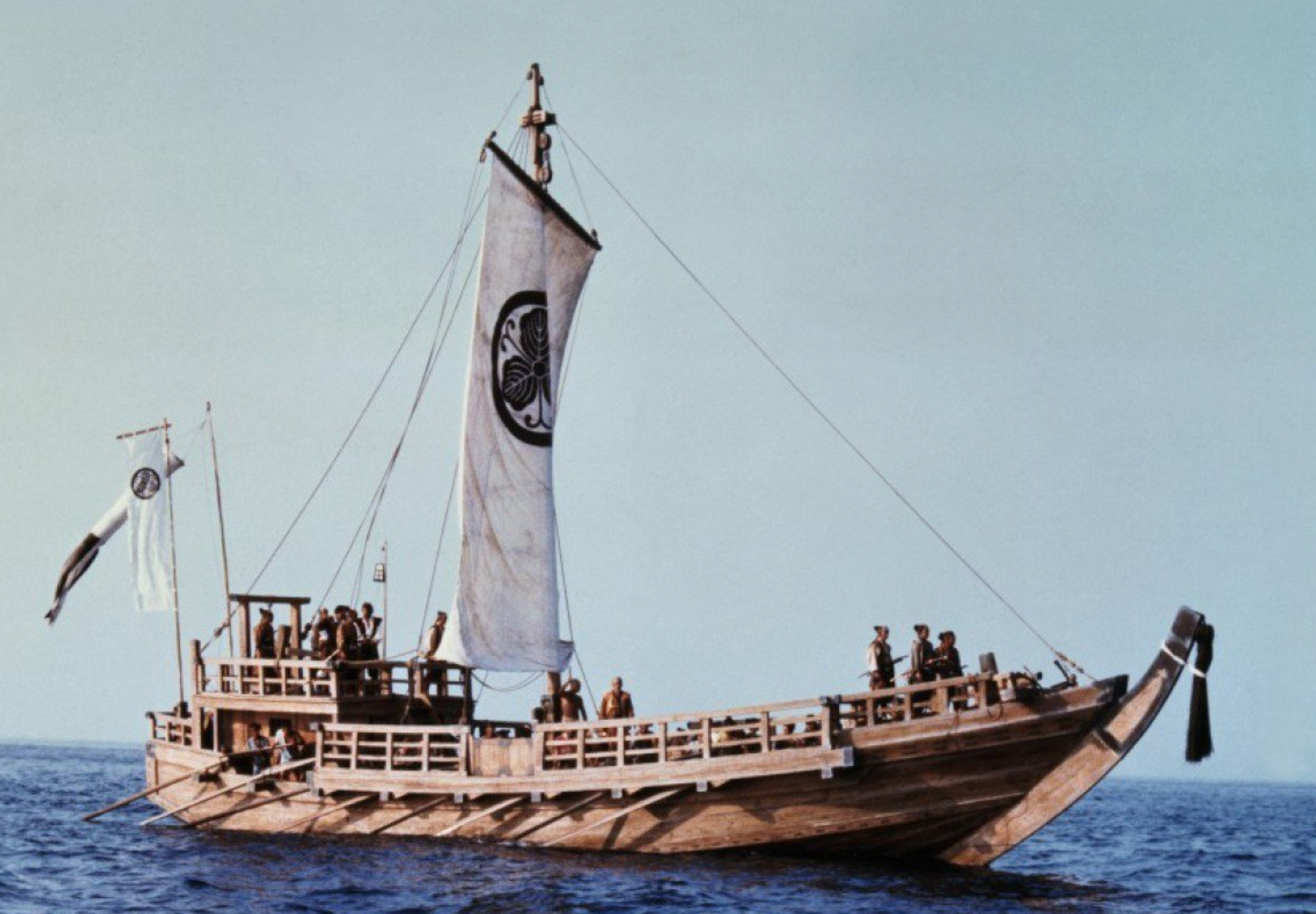 The overall shape does look like a proper Japanese coastal transport, called a Bezaisen. I’ve built similar models based on kits, but those were later period vessels from the 18th and 19th centuries. The later ones didn’t have need for the sculling oars, but the earlier ones were known to still employ them, like the ship in the above photo. I’m not sure about that raised bridge at the stern, but I can’t say it’s wrong.
The one thing that doesn’t look right at all is the rigging. The single sail is okay, but the mast looks too scrawny, and the rigging at the mast head is much too complicated. The Japanese didn’t use lifts, the lines leading up to the mast head from the ends of the yards, until the Meiji era. I don’t recall seeing tackle blocks like those on the main halliard in the photo. The sail isn’t sheeted in modern fashion, not in traditional Japanese style. There are other rigging issues, but I won’t go into them all. To me, it looks like it was rigged in a modernized way to make handling the sail easier for the filming crew, which makes sense since most people wouldn’t ever notice the issues I’ve brought up.
Anyway, the rest of the ship looks very good to me: The stem, the sagari bow tassel, the copper coverings on the beam ends, the design of the rails, the placement of the sculling oars, the gallows at the stern that supports the rudder. All looks very good.
The Ship of the New Series
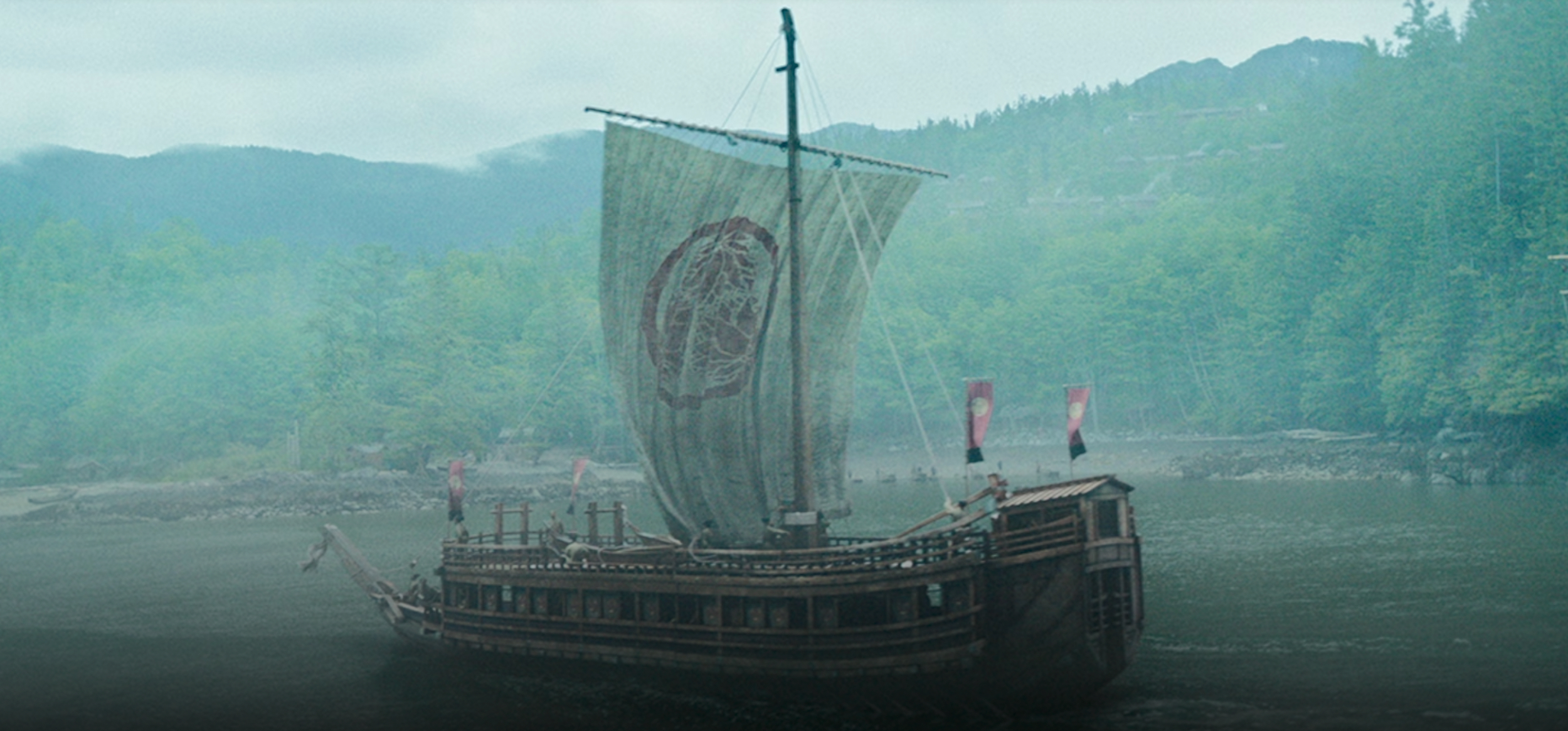
While the ship of the old series looks good, and represents a typical coastal trade ship that would probably be readily available, and an asset that one might expect to see in both TV shows, the ship in the new Shōgun series is a sekibune, the medium sized warship used by the Feudal navies of Japan. As I said, the representation of this type of ship looks very good. The structure and design looks good, though it feels more like something maybe from a later period. That’s just my feeling though, and I don’t have anything to base that on.
What I can tell is that it looks like someone did their research. The rigging looks good, the sail looks right, and the sheeting of the sail looks right. The long tiller and it’s use, the use of the sculling oars, all look good. I really don’t see anything wrong here, with the possible exception being that the sail is billing one way, and the banners after look they’re pointing the opposite way.
Also, I’ve never seen a sekibune with boats on the top deck. I don’t that it wouldn’t have been done, only that I’ve never seen that depiction. Actually, I’ve never seen any traditional Japanese ship depicted with more than one boat on deck and this one has two. But, it could have happened.
On a side note, I read on the FX Shōgun Viewers Guide that the actual sekibune were fast and maneuverable. Some of the smaller ones were indeed called Hayabune, or fast boats. But, fast and maneuverable are relative terms. They might have been fast and maneuverable in comparison with the large Atakebune, which were like the battleships of the navy.
However,I don’t think they were fast in comparison with a galleon under sail with a good wind. They did have a large number of oars, so they could move even with no wind. But, as for being maneuverable, just keep in mind that with sculling oars, you can’t row backwards. I don’t even know if there’s a way to reverse mount the oars, so that you could row in the other direction. That’s a question I should pose to my Wasen Study Group friends. To turn quickly, you’d probably have one side row hard, and the other side drag their oars in the water, all while trying to hold the tiller hard over.
Screenshot from FX’s Shōgun Viewer’s Guide
Anyway, the particular sekibune in the show is a kind of a “showy” ship to be sending to a small fishing village. I suppose it is used here to stress the importance of its mission, its high ranking passenger, and for TV audiences, just how much power Toranaga yields. Something that the ship in the 1980 series doesn’t really show. And, I’m not sure just how large Tokugawa Ieyasu’s navy would have been, but I would guess there were several vessels of this size, plus hundreds of smaller boats.
Smaller Boats of the New Series
Regarding the smaller boats, the new series shows us a number of them pretty early in the first episode, as they tow in the sea-battered Dutch galleon. My friend Douglas Brooks was a consultant for the series, and we’d discussed the type of small boat employed by the daimyos. They are basically the same as the “chaser” type of whaleboats called sekobune (not to be confused with the sekibune mentioned above). This type was commonly used for ferrying people and supplies, and used as tow boats for larger vessels.
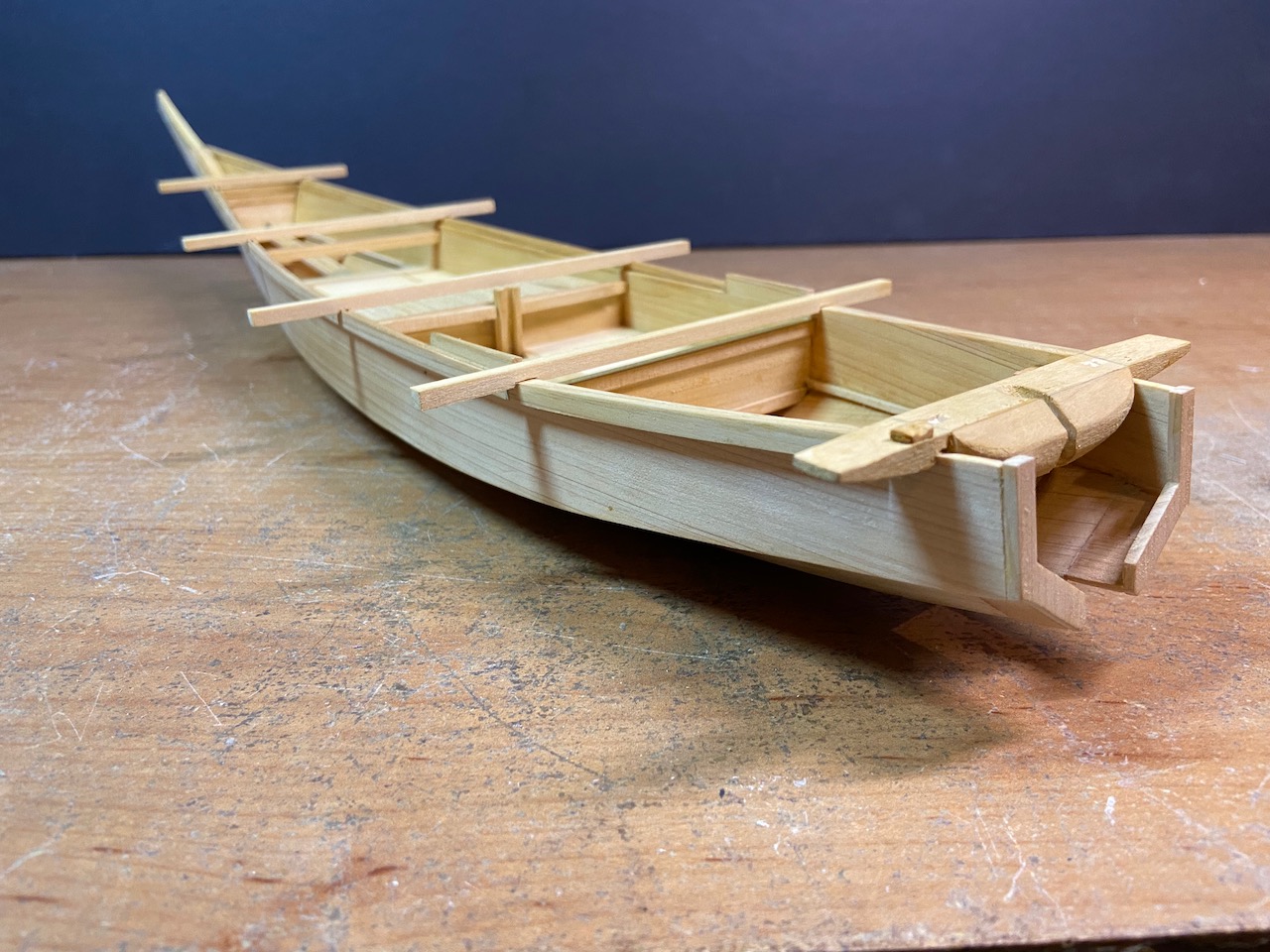
My model of the whaleboat-style boat Senzanmaru, which was used by Awa clan in the Edo period.
In fact, had the large sekibune seen in the film been traveling on a river, there would have certainly been half a dozen or more of these small boats towing it. On the ocean, I’m not sure. In good weather, probably. But, in the scene with the large waves, which looked quite over the top to me, the small boats would have certainly beached themselves at the first signs of bad weather.
Speaking of that scene, that single large mast is a weakness in a storm, and these were often cut down to save a battered ship. But, they were also designed to be lowered. I’m not sure of the accuracy of this scene. Certainly, many coastal transports were lost due to stormy seas, and I don’t know how often they would simply lower the mast just ahead of a bad storm – I don’t know how easy it was to do that. Also, without a sail, relying only on the rowers, I don’t know how well such a ship would fare. But, it does have me thinking about it.
Anyway, Douglas Brooks built one of the small boats used in filming, provided drawings for other boats, consulted on the boats, and taught the extras how to use a Japanese sculling oar. But the production crews built most of the boats from plywood, had another company build a couple of the boats using Douglas’s drawings (I don’t understand why they just didn’t have him build them), and took some existing dragon boats and modified them, making them look like boats with the back halves oddly chopped off.
If you haven’t seen the TV series yet, check out the first episode and see what you think. Post any comments or questions below.
In the meantime, watching the new series has got me thinking more about wasen models again, so I immediately pulled out one of my projects and began working on it again. Check back for more details. Ω
 Wasen Mokei 和船模型