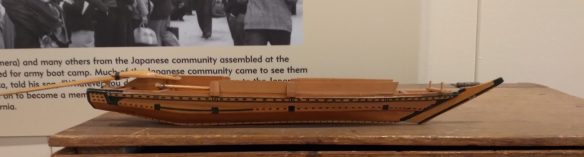
Wasen Model in Monterey, CA

Earlier this Summer, I was in contact with a gentleman who is a former Historian/Curator for the old Monterey Maritime Museum. Apparently, part of that collection included some Chinese junk models as well as some Japanese wasen models. He didn’t have much information on the Japanese models, but commented that all the models were built back in the 1920s.

While the collection of Junk models has apparently been moved to the Pacific Grove Museum of Natural History, one Japanese boat model now resides at the Monterey JACL (Japanese American Citizens League) Heritage Center & Museum, where he now works as the Curator.

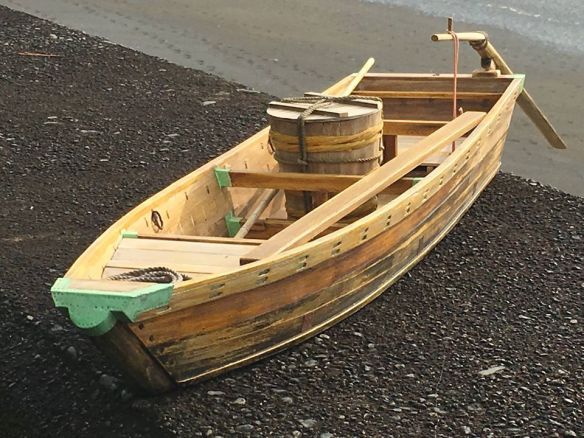
Wasen Model at the Monterey JACL Heritage Center / Museum

There is very little information on the model, except that it, along with the Junk models, is part of the Greatwood Collection. These were models commissioned by American oil company executive Royce Greatwood, working in the Far East in the 1920s. I’m sure there’s more to the story, but that’s all I know.

Continue reading

Wasen Model Table at the SF Asian Art Museum, October 17th

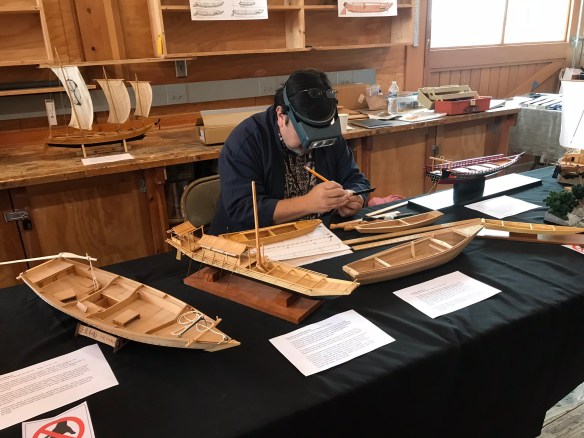
Sunday, October 17th, 2021, is Japan Day at San Francisco’s Asian Art Museum. A friend of mine is working with the museum on this and asked me to participate by displaying my wasen models. So, I will be setting up a table to display some models and, hopefully, have some room to do a little work on them – something like I did at the Wooden Boat Festival in Port Towsend a couple years ago.

Me, at the 3-day Port Townsend Wooden Boat Festival.

I’m hoping to have enough room to set up a few models in a nice, formal display with accompanying information. Since it’s at the Asian Art Museum, I’ll probably try to chose models that I can tie to artwork as much as possible. In general, I expect to make this a bit of a cross between the Port Towsend event above, and the Japantown display below.

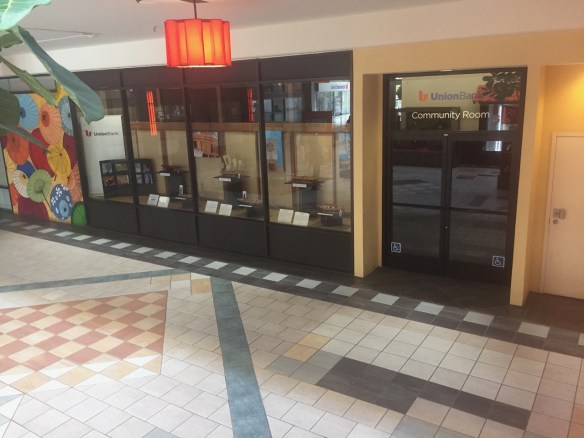
One several (seven?) wasen model displays I’ve had at the Japan Center’s East Mall in San Franciso.

By the way, I haven’t been able to set up the Japantown display in over a year due to Covid related bank policies. Wouldn’t have gotten much in the way of visitors anyway. However, with this October event, and with so much having reopened, I’m reaching out to Union Bank, who operates this community room and its display window.

I’m hoping I can have something set up there maybe in September, leading up to the Japan Day event. We’ll see what I find out when I hear back from the bank contact. Of course, I’ll keep you posted.

As for the Asian Art Museum, my Japanese Boats Display is supposed to be set up from approximately 11am to 5pm on Sunday, October 17th, on the first floor of the museum. I won’t be alone there. Two other ‘stations’ are scheduled to be set up there as well, including a Origami Irises display and a Toro Nagashi Paper Lanterns display (floating lanterns).

Make sure to mark your calendars, so you can stop by and visit me if you’re in the area!

Ω

Tenma-Zukuri Chabune Display at the Nakagawa Bansho Museum (中川船番所博物館)

I ran across some images from a Japanese museum in Tokyo’s Koto ward in early May, and I feel like some of my work has been completely validated. This little museum is called the Nakagawa Funabansho Museum (中川船番所博物館), and I know absolutely nothing about this museum. I don’t even know if I’ve heard about it before, though I recognize the Nakagawa, or Naka river, or middle river in Japanese, which flows down from Saitama prefecture through Tōkyō.

A large display in the museum is a full-sized diorama of a small, fully loaded canal boat that looks like it’s pulling away from the dock. What surprised me was that I recognized this specific type of boat as one that I studied and created a set of drawings.
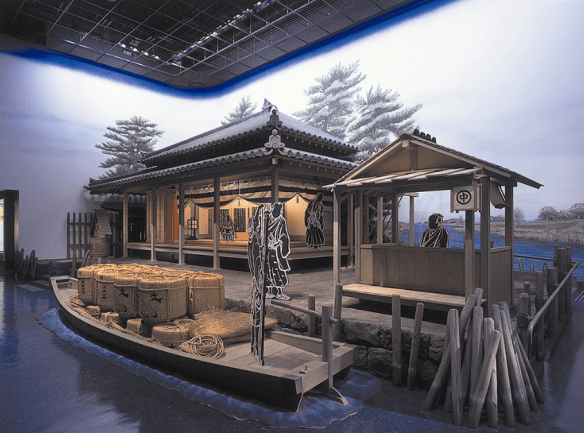
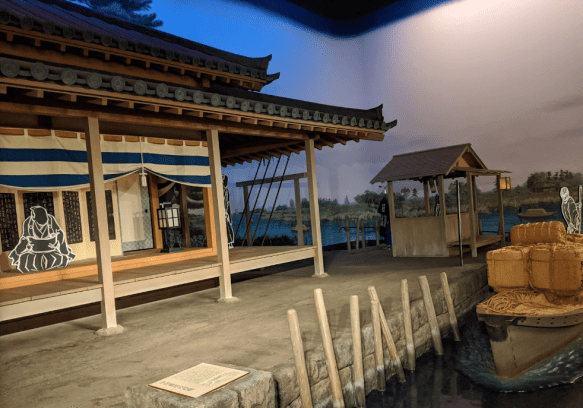
This is a tenma-zukuri chabune, a small general purpose boat from the canals of old Edo. I’ve seen very little about this boat, outside of a woodblock print in the Funakagami, an illustrated identification guide to river boats that was used to aid the government’s tax assessors.

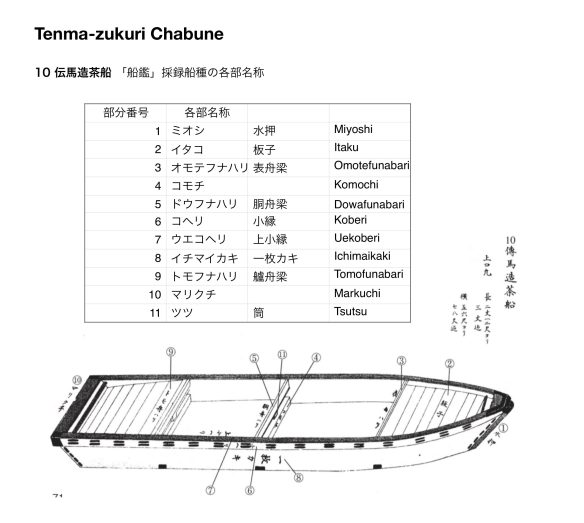
Page from the Funakagami, with my annotations on the names of parts.

Using this illustration, plus some information provided in the book, I came up with a set of drawings that I created in Adobe Illustrator.
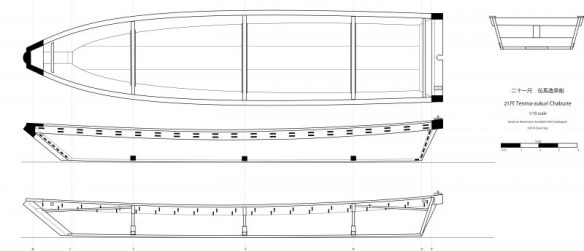
My own drawings based on the Funakagami illustration and provided dimensions.

There are some variations from the museum display, but all the details mostly seem to match. I will consider some modifications that I might make to the drawings, but I’m very confident with them, especially now that I’ve seen this museum display.

The drawings have been used to make at least two models: My 1/20-scale model and one by Japanese modeler Kouichi Ohata, who built a beautiful 1/10-scale model. Kouichi-san’s model actually came before mine, and he provided some great feedback that helped me improve the drawings from their original version.
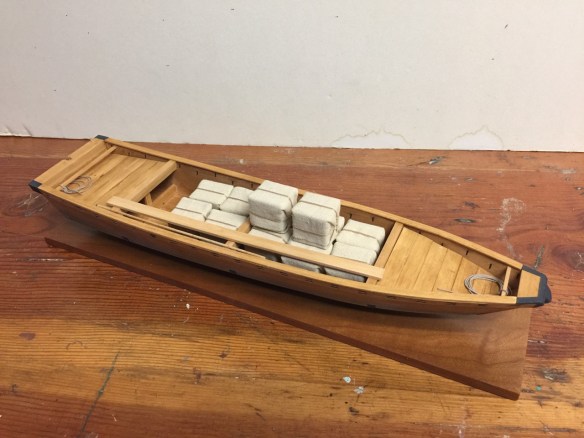
My 1/20-scale tenma-zukuri chabune
1/10-scale tenma-zukuri chabune by Kouichi Ohata

This is the first time I’ve researched a particular boat type and created a set of drawings based mostly on the interpretation of a woodblock print. While I knew I had the basic dimensions right, I never really new for sure if my interpretation of all the details was correct.

Seeing this museum display is not proof that I got everyhing correct, but at least it shows me that whoever was involved with the creation of this museum display agrees with my interpretation of this boat. That means a lot to me, given how separated and independent my study of wasen has to be.

So, I look forward to visiting this display at some point after Covid concerns have lightened up. In the meantime, perhaps I should pick another subject to try to illustrate and model. Ω