Unknown's avatar

About catopower

Ship modeling since 1993.

Wasen Projects Status – March 25, 2021

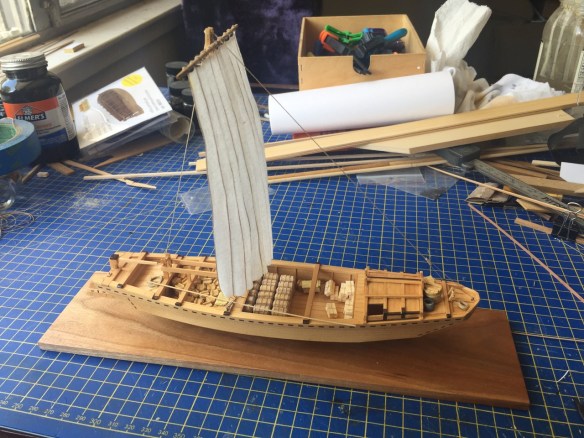
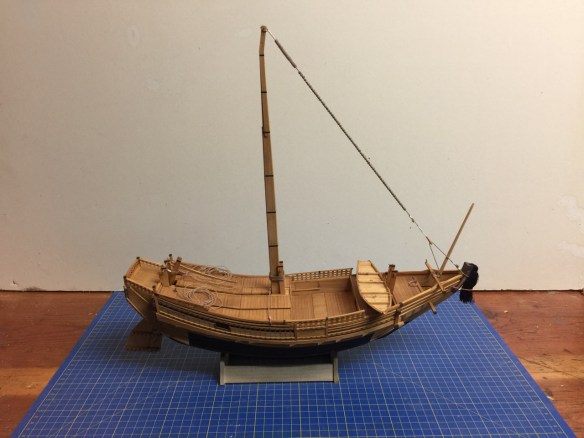
After taking a five-week break from wasen modeling, I’m back at it now, getting close to finishing up some more details on the Tonegawa takasebune, and soon the Kitamaebune, which still needs sails.
The break came about after I was asked to do a Zoom presentation as part of a series of lunchtime talks called the MESS lectures, for Maritime Education for Students of the Sea, a series organized by the San Francsico Maritime Research Center. The talk is not until the end of May – Thursday, May 27th, at 11am, to be precise. But, more on that later.

So, I kind of needed a break from my Japanese projects. Plus, for the talk, I think I need to keep some of the these models in various stages of completion, to serve as illustrations of the wasen model building process. So, I’ll probably leave the Senzanmaru and Nitaribune models where they are until after the talk.

Since it would be good to show the earliest stages of construction too, I’ll probably just get started on a couple other projects. Just not sure what the subjects will be yet. It’s all about what I think will be most interesting to illustrate or demonstrate. Again, more on that later.

For now, I ‘m going to try to focus on the takasebune. I started adding cargo into its hold, so I really need to continue with it until it seems reasonably loaded down. I had made a couple different kinds of cargo and am now finishing up the third type, which are covered buckets, or oke (oh-kay). Each one is simply a short piece of dowel, with a lid constructed of 5 small pieces, then the body of the bucket is wrapped with two threads to represent hoops of bamboo.

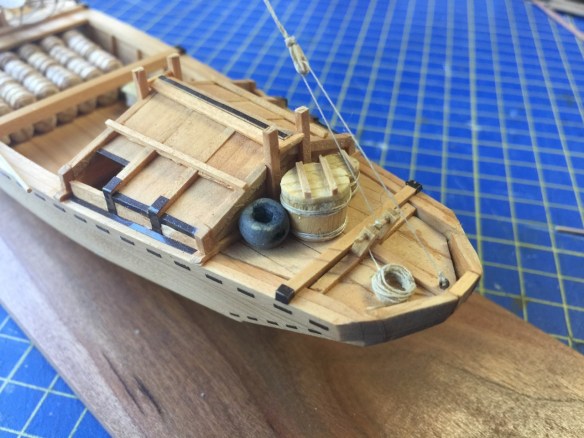
Aside from the cargo, I still have some “copper” trim to finish up, as well as the addition of parrals and brace lines to the yard. I don’t know the Japanese terms for these off-hand. My only regret is making the sale so square to the hull. I’ll probably brace the yard at a slight angle, so it’s not so straight. Thinking about it now, I would like to make a model that shows the yard holding the sail in a position that makes it act like a lug sail, a fore-and-aft sail for sailing closer to the wind.

In the near future, I’ll post more details about the steps in the construction of the Tonegawa takasebune model.

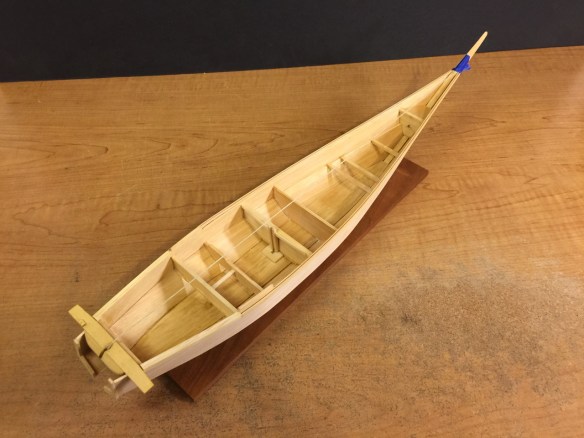
1/20-scale Senzanmaru Model – A First Update

Work is coming along on this model of the Edo period whaleboat-style craft Senzanmaru. Unfortunately, at this stage, a lot of work can be done with little apparent change in the model.

In the photos below, you can see how I taped a string at the bow and stern to service as a center reference line, so I can check to make sure everything is straight and even. I don’t know why I picked a tan line instead of a black one. I think the spool of tan line just happened to be handier.

As I mentioned, progress is being made, but it’s basically all in the details now. You may have already noticed the ōtoko, the heavy beam at the stern. This serves as the rudder mount and hinge, and has a rogui (hinge pin and resting pad) on the left or port side for mounting a sculling oar. This boat was set up for up to five sculling oars, with the rogui mounted on the ends of two beam that I have yet to add.

Continue reading

Act Fast! Douglas Brooks Online Workshop – Saturday, February 20

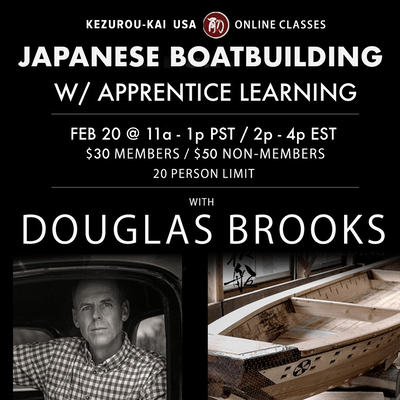
Sorry for the short notice, but there is an online workshop this Saturday, Feruary 20th, from 11am to 1pm PST. That’s 2pm to 4pm Eastern. The Zoom-based workshop is being hosted by Kezurou-Kai USA and there is a fee of $50 for non-members and $30 for members. Douglas will be discussing the building of Japanese boats under the traditional Japanese apprentice learning system.

For those who haven’t had a chance to attend one of his talks, this is a great opportunity. I have been fortunate to have attended his talks both in-person and online, and I’m always learning new things. But, the story of his apprenticeships is fascinating and entertaining and I’m sure you will feel that way too.

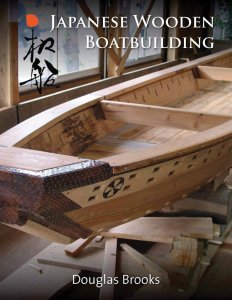
Whether or not he plugs his book, Japanese Wooden Boatbuilding, I strongly recommend it for anyone who is interested in building a real Japanese wooden boat, a model of one, or just looking for a fascinating read.

If you can, make sure to buy it direct from his website, as more of the proceeds to directly to him and help fund the next Japanese boatbuilding project. Also, it’s the only way to get a signed copy.

In any case, you should take the opportunity to attend his talk this Saturday. The workshop is limited to 20 attendees, and I understand it is just about half full as of this posting. Read about the details and sign up on the Kezuro-kai website here: https://www.kezuroukai.us/classes/japanese-boat-building-feb-20

Ω

Drawing Wasen Tomo no Kai’s “Kawasemi”

Just a few days ago, I mention in a blog post that I’d managed to acquire drawings of an Edo Nitaribune, a cargo boat used on the canals and rivers of old Edo. I also mentioned that it turns out that these drawings are a perfect match for a boat built by the late Mr. Kazuyoshi Fujiwara, a Japanese boatbuilder with whom Douglas Brooks studied under in his third apprenticeship.

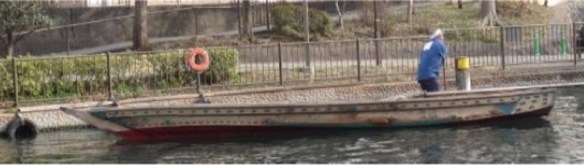
Mr. Fujiwara built at least a couple boats that are now used by a group called Wasen Tomo no Kai, or Friends of the Traditional Japanese Boat. This is a group of volunteers that operate and maintain several wasen, giving rides to visitors in Tōkyō’s Kōtō ward.

Today, I spent some time working with the drawings to create an illustration to help me work out the details of my Nitaribune model. Now, I’m using the term Nitaribune and the name “Kawasemi” pretty interchangeably. But, just bear in mind that Kawasemi is just the name given to the boat used by Wasen Tomo no Kai. The name is just Japanese for  Kingfisher. The group pretty much names all their boats after birds.

Anyway, using the drawings I have, plus some photos I dug up on the Japanese pages of Wasen Tomo no Kai’s website (the English language pages don’t have as much info), I was able to do a pretty fair reconstruction of Kawasemi.

Continue reading

Starting a 1/20-scale Senzanmaru Model

A couple weeks ago, in a spurt of initiative, I finally began work on a 1/20-scale model fo the Edo period boat Senzanmaru.

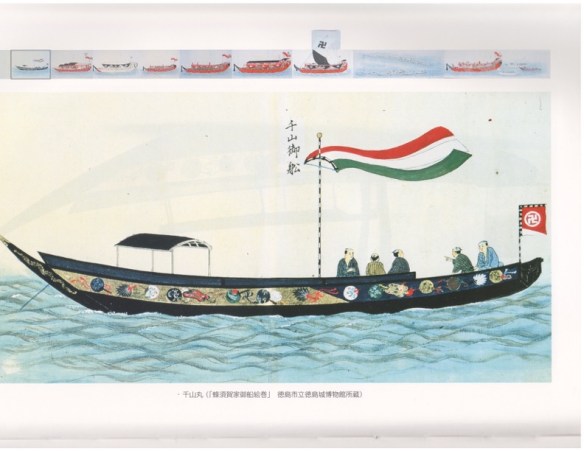
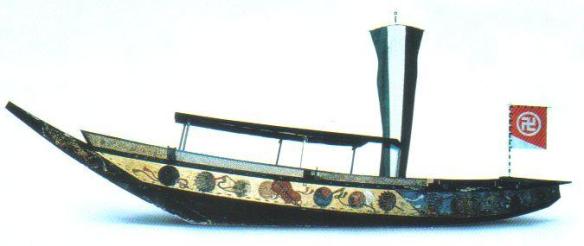
Senzanmaru is a whaleboat-style craft that was used by the Hachisuka clan of the former Awa province, now called Tokushima province. The boat measured just under 34 feet long and was propelled by up to 5 sculling oars. In addition, the boat has a mast step, though many boats have such a feature that goes unused.

I don’t know all the details of the boat and how it was used, but it is highly ornamented with elaborate designs painted on her hull and a relieve carving of a dragon on either side of her stem. While boats similar in size and type were used in large numbers to tow large gozabune, highly ornamental military-style vessels that served as yachts and transports for high-ranking samurai, the highly ornamented design of Senzanmaru suggests that this boat was also used to carry high ranking members of the clan. Perhaps it was more for transferring these individuals between ships or from ship to shore, or for carrying important dispatches, etc.

Continue reading

Wasen Projects for 2021

At the start of 2020, I wrote about an “Explosion of Wasen Model Projects” and I listed several projects, some have been long-time desired projects that were coming to life, and a few were new projects entirely. Here’s a rundown of those projects, followed be a look at what’s happening in 2021.


Himi Tenmasen – This was a project commissioned by boatbuilder Douglas Brooks. Though not a simple model, It was a quick project, as I had plenty of access to all the details of construction of the actual boat. This was something of a “full-time” build, which I started in mid-April of 2020 and finished by the end of the following month, about 5 weeks later.


Continue reading

Oshima Port Festival’s Racing Boat Custom Model – Kaidenma (櫂伝馬)

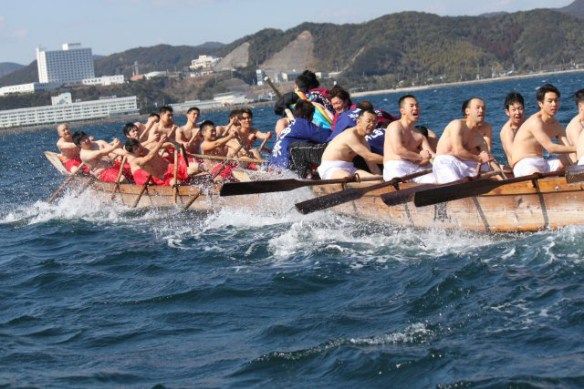
Kushimoto in Wakayama prefecture has the distinction of being the southernmost point of Japan’s main island of Honshū. The town is also the location of the Oshima Minato Matsuri, a traditional port festival held in early February every year. I don’t really know that much about the festival, except that it includes many Shinto rituals, lion dances (shishimai), and an ocean boat race using oar-powered boats called kaidenma.

The following photos, I took from the Kushimoto town website’s Minato Matsuri page, which you can visit here: https://www.town.kushimoto.wakayama.jp/kanko/event/minatomaturi.html

Continue reading

My Second Honryou (ホンリョウ) Model

Last year, I built a model of a simple Niigata riverboat based on the one built by Douglas Brooks and Nina Noah with Japanese boatbuilder Mr. Nakaichi Nakagawa in the Fall of 2019. That model was a 1/10-scale version of the 25-foot boat.

The actual Niigata Honryousen in the workshop. Photo courtesy of Douglas Brooks.

That model was actually a commission, though I priced it really cheap to help support the project. At the same time, I figured I’d build a second one for myself. Both models were effectively at the same stage when I shipped the one off to its new owner. The other one I kept for my wasen model displays, and so that I’d have something to show at home.

The first Honryou-sen model.

Continue reading

The Tonegawa Takasebune (高瀬船) – a Model in 1/72 Scale, Part 2

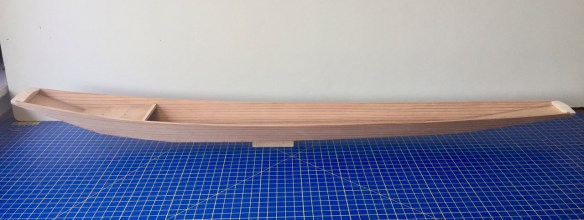
The 60-shaku Tonegawa Takasebune is a 1/72-scale scratch build, based on a drawing in the book of the same name. This, as I mentioned before, is the same scale as the Woody Joe Kitamaebune I’m building and my completed Woody Joe Higakikaisen kit. As mentioned last time, the model is based on a 2-view drawing of a 60-shaku (about 60 foot) I found in the book “利根川高瀬船” or Tonegawa Takasebune.

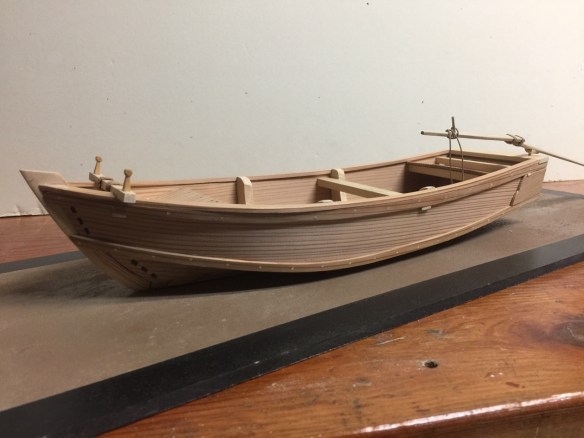
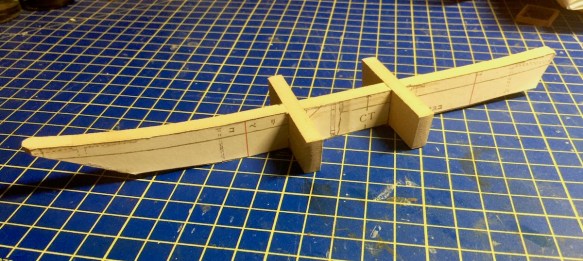
I began by scaling the actual drawing to 1/72-scale using cutting it up to create a pattern for an internal former. The use of a former is my standard method for building these essentially frameless wooden boats. The former is made from 1/4” MDF or Medium Density Fiberboard, which I buy by the 1/4-sheet at the hardware store. I start with the backbone, which is the easiest part to fashion, then add some cross section pieces, which will help me attach the hull planks at the proper angle.

Unfortunately, once I started the model, I didn’t really take a break to take photos or do any writing until I’d gotten the hull put together. But, below, you can see a template I made, which is essentially a tracing of the top view from the original drawing. This gives me the shape of the bottom of the boat. I’ve also gone back and re-created some steps so I could take a few photos to illustrate, at least. Continue reading

Zoom Session with Douglas Brooks: Building a Boat the Japanese Way, January 20th

The North West Maritime Center in Port Townsend, WA, will be featuring an interview with boat builder Douglas Brooks in a Zoom-based session on Wednesday, January 20th, at 6pm PST. The interview will be followed by a Q&A session, with the whole session running 90 minutes.


Jan 20, 6-7:30 PM (PST): Douglas Brooks: Building a Boat the Japanese Way

A look into the inside world of Japanese boatbuilding and the apprentice system: learning silently, no written plans, secrets, and the differences between Eastern and Western techniques.


Boats built by the Winter-term 2018 class taught at Middlebury College by Douglas Brook on Building the Japanese Boat.

The interview is part of their Wooden Boat Festival’s ‘Ask and Expert’ Winter Series, which presents a total of eight sessions with various boatbuilding experts. These sessions take place between January 6th and April 7th. The cost to join any one session is only $5.99, or $30 for the entire series.

Tickets can be purchased here: https://www.eventbrite.com/e/ask-an-expert-series-tickets-131265746381

Ω