Building a Tenma-Zukuri Chabune (伝間造茶船) – Part 2

In my last post, I discussed the building of a tenma-zukuri chabune from the Funakagami, and I stated that I was working on my model, but didn’t actually talk about building the model. The fact is that I wasn’t sure about what scale to build it at, given that a 1/10-scale model would end up being a little over two feet long, and I’m running low on space to display or store my models. So, I started a 1/20-scale model to see how I’d feel about the smaller scale.

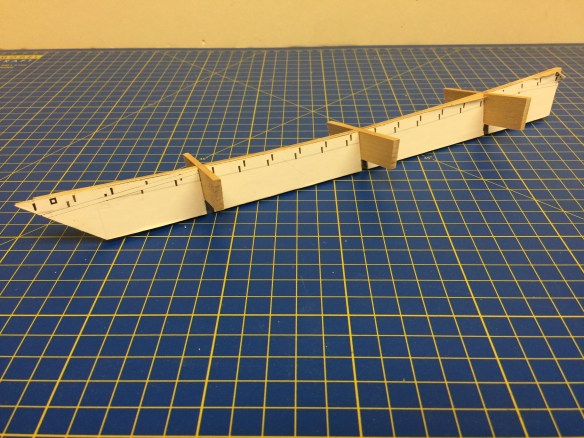
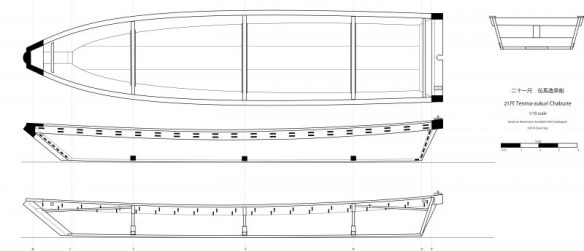
I began by making a temporary internal frame. This would allow me to build the shiki, or bottom, and add the miyoshi, or stem, and the todate, or transom, at the proper angles. The same goes for the tana, or hull planks.

The longitudinal member of the framework is shaped directly from a copy of my plan drawing. The cross pieces are located at positions of the funabari, or beams, and are shaped according to my drawings.

Continue reading

Hozu River Diorama

Something I’ve been working on over the past many months, somewhat off and on, is a mini diorama. I think I was inspired by Woody Joe’s release of the first of their 53 Stations of the Tōkaidō series, the Nihonbashi Bridge. That model depicts the famous Edo period bridge that was the eastern end of the Tōkaidō and Nakasendō roads that connected Edo to Kyōto, and is made to be a diorama with a pair of flowering cherry trees and a pair of small boats on the river.

Seeing this, I thought about the Japanese river boats I was familiar with. Having completed a boat from the Hozu river, its simple designed seemed a natural choice for a small diorama. The idea was also fed by the numerous available pictures of the large sightseeing boats that take tourists down the scenic river route.

Never having made a diorama of any type, I did my research and planning, did several experiments with materials and paints, and came up with what I thought was fairly decent for a first effort.
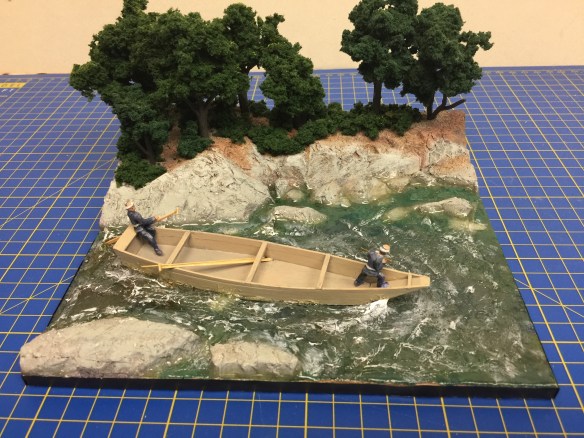
The diorama depicts a pair of Edo period boatmen traveling through a portion of the rapids on the Hozu river on a 24-foot riverboat, sometimes called an Ayubune, named for a popular kind of fish that they would catch from these boats.
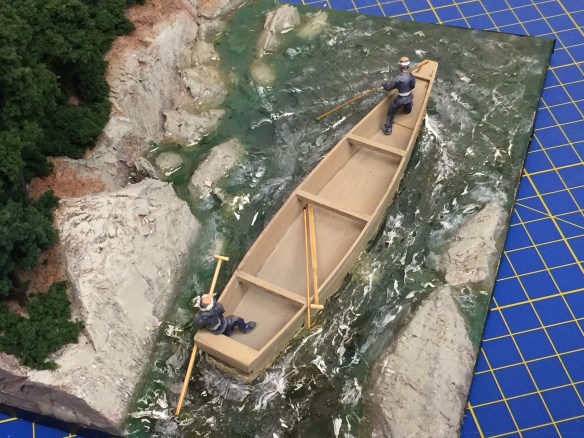
The initial challenge was getting the water to look right. The rocks turned out to be very easy to make using inexpensive sheets of insulating foam. The stoney texture was simple the result of cutting the foam with a knife.

The making of the boat was the easiest part of the whole display. I just scaled down the drawings I had and cut the parts and put it together. It’s a very simple boat design. And, at this scale, the details of a larger model would not really be visible, so I was able to omit them.
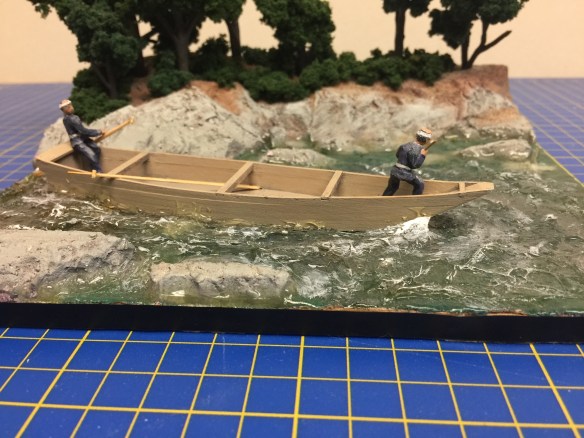
The two figures turned out to be the greatest challenge. I’ve fashioned individual figures before, but it’s not a skill I possess yet. Right now, it takes a lot of work for me to get something that passes as humanoid. Then, to try to make it look like they’re wearing Japanese traditional garb took another step. Painting helped make this work, and I’ve done a lot of miniature painting in my younger days, so that I think made a big difference.
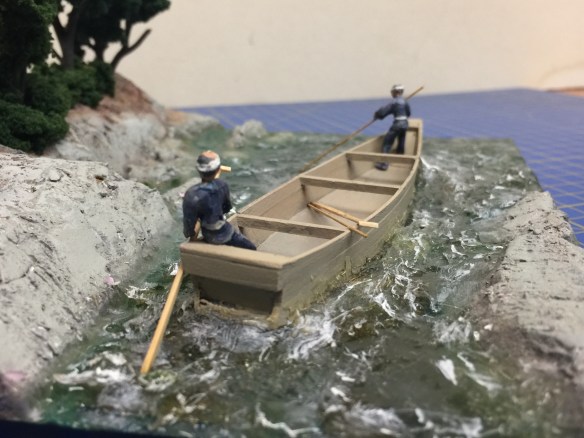
The diorama isn’t perfect. For one thing, the type of tree seen here is, I believe, all wrong. Most trees on the river banks are smaller and straighter, but I just used whatever I could find that would work, settling on the myriad of tree making kits available to the model railroad hobbyist.

The water was also problematic as the stuff I used for making the choppy waves, again a product made for model railroad enthusiasts, results in a horrific amount of shrinkage. The diorama is okay for now, but I can’t help but wonder what it will look like in another five years.

It’s nice to have this display done, and I’d like to do a more serene “cherry blossom viewing on the river” diorama in the future. For this, I purchased some trees made by Woody Joe, which should look more correct. However, I’d love to work on the skill of making model trees from scratch. But, another time, maybe. Ω

Rice Glue?

Someone on the ship modeler’s forum Model Ship World recently posted a link to an article about making rice glue. This is an interesting idea as it is completely natural and reversible, plus it is apparently ph balanced as well, meaning that it won’t chemically attack the glued materials over time.

http://islandblacksmith.ca/2015/10/making-sokui-rice-paste-glue/

I don’t have any plans to switch to it instead of the off-the-shelf commercially available glues, but it does get me to thinking about building something with it. What could be more Japanese than a wasen model built with Japanese woods held together with rice glue?

My Latest Tool Addition – Cameo 3 Vinyl Cutter

A new vinyl cutter is allowing me to move forward on my Gozabune model.

catopower's avatarShip Modeler

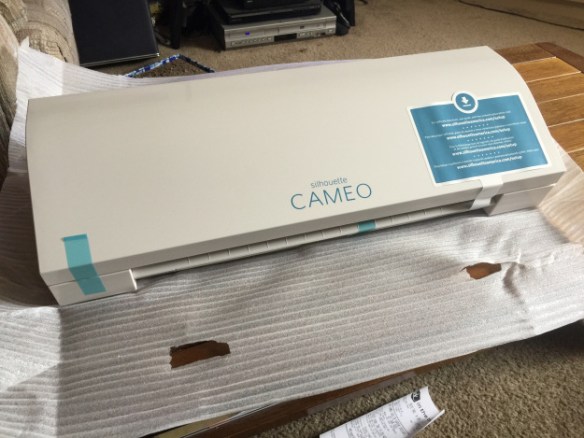
Last week, I received a new addition to my ship modeling tools. This one is a little more specialized that many that I have. It’s a Silhouette Cameo 3 vinyl cutting machine.

The unit is software controlled, and connects to a computer, in my case, a Mac. The software is a free download from the maker’s website and it’s actually a bit more sophisticated than I expected. Upgraded versions of the software, called Silhouette Studio, provide more specialized features, including the ability to import files from other programs, such as Adobe Illustrator and others.

These desktop vinyl cutters are basically the size of a computer printer and are essentially glorified plotters (if you remember those), with a blade mounted instead of a pen. It is capable of cutting vinyl, paper, cardboard, and various other similar materials.

View original post 338 more words

Building a Tenma-Zukuri Chabune (伝間造茶船) – Part 1

I completed what I believe is a good final draft of the Tenma-zukuri Chabune from the Funakagami, and I’m now working on my model. However, it appears that I am already late to my own game. Model builder Kouichi Ohata has already completed his model in 1/10 scale, and he’s done a beautiful job with the boat as well as with all the added details!

Kouichi Ohata’s model

With the help of fellow modeler Kouichi Ohata and my mentor Douglas Brooks, I’ve gone through several revisions of the plans – seven major ones, so far.

Tenma-zukuri chabune, from the Funakagami.

The biggest difficult has been in analyzing the single wood-block print of this type. Compared to other boats in the Funakagami, this one has a very flat bottom, showing no real rise at the stern, which may be possible, but it’s really throwing people, as it seems very unusual for a Japanese style boat. Continue reading

In Search of Biwakobune (琵琶湖船)

As you may recall, I’ve been reading about the Marukobune of Lake Biwa. In the book, there are some small drawings of various boat used in and around the lake. Besides the Marukobune, which was a cargo and passenger transport, there were fishing boats and rice field boats, the latter often being used for various tasks.

Marukobune on Lake Biwa

I was intrigued by the many small wasen types, so I’ve been on a hunt for better drawings. The ones in the book are nice, but they were scanned and printed at a fairly low resolution, as they appear pretty small in the book. They also have no scale.

Continue reading

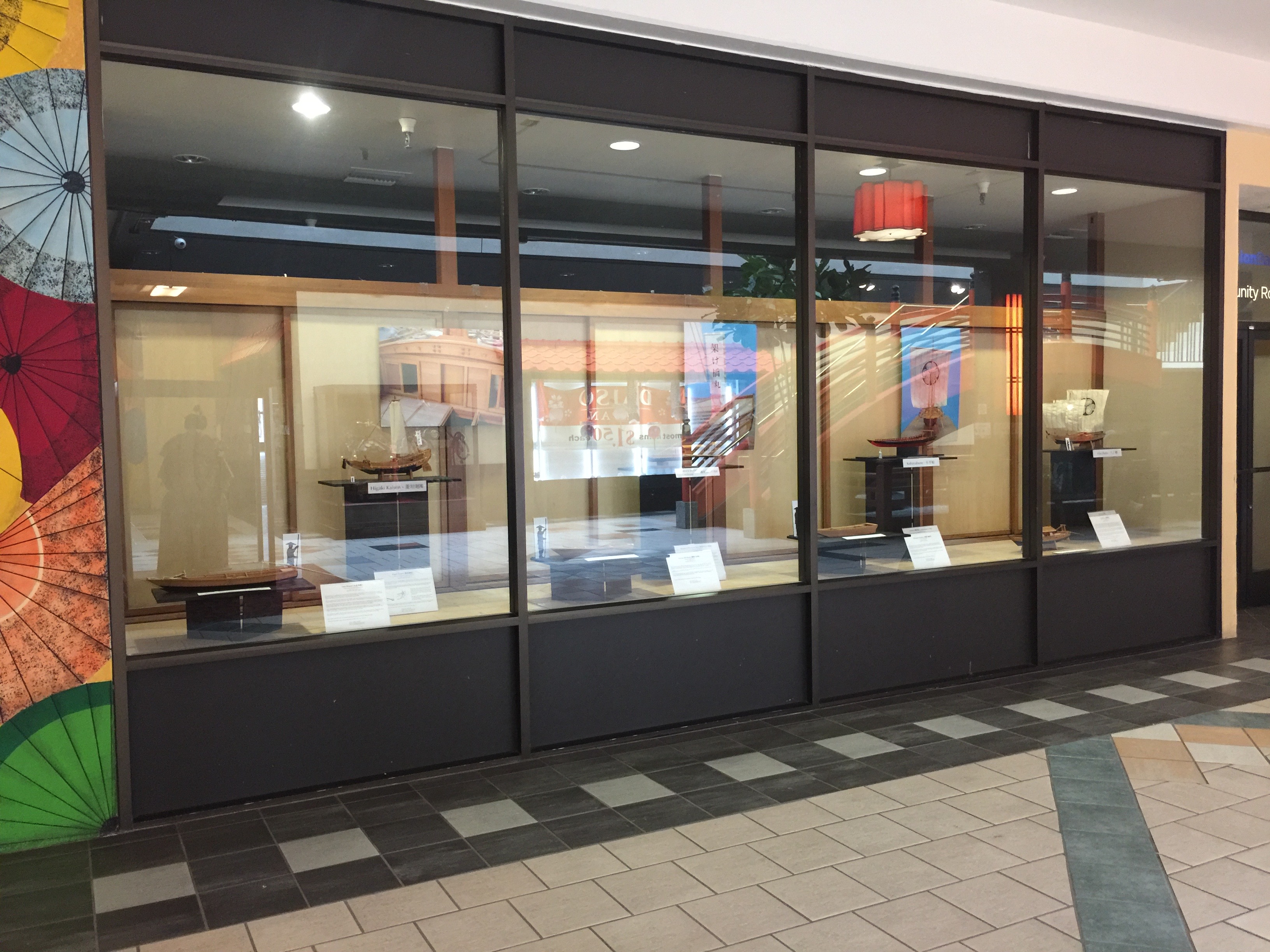
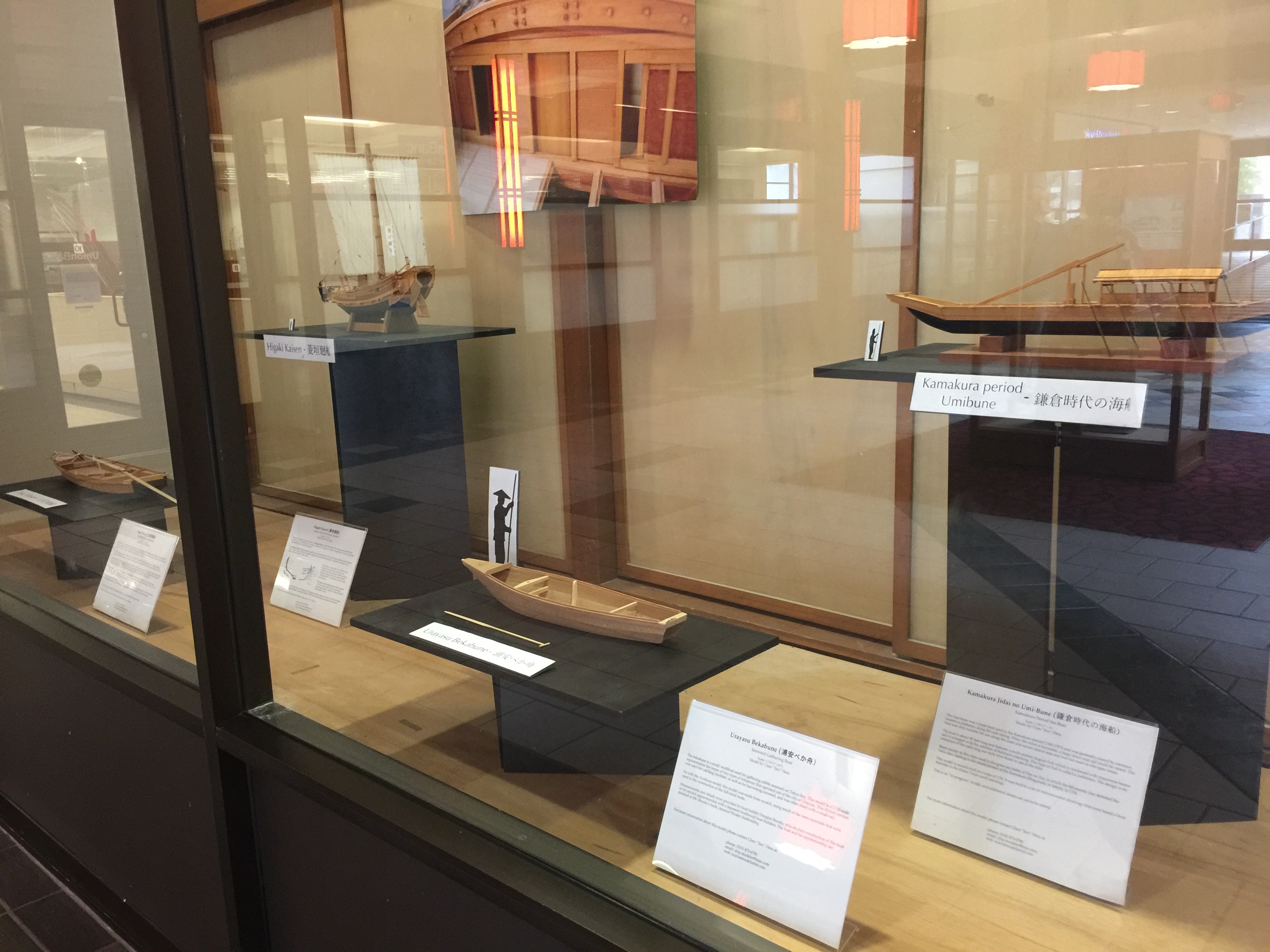
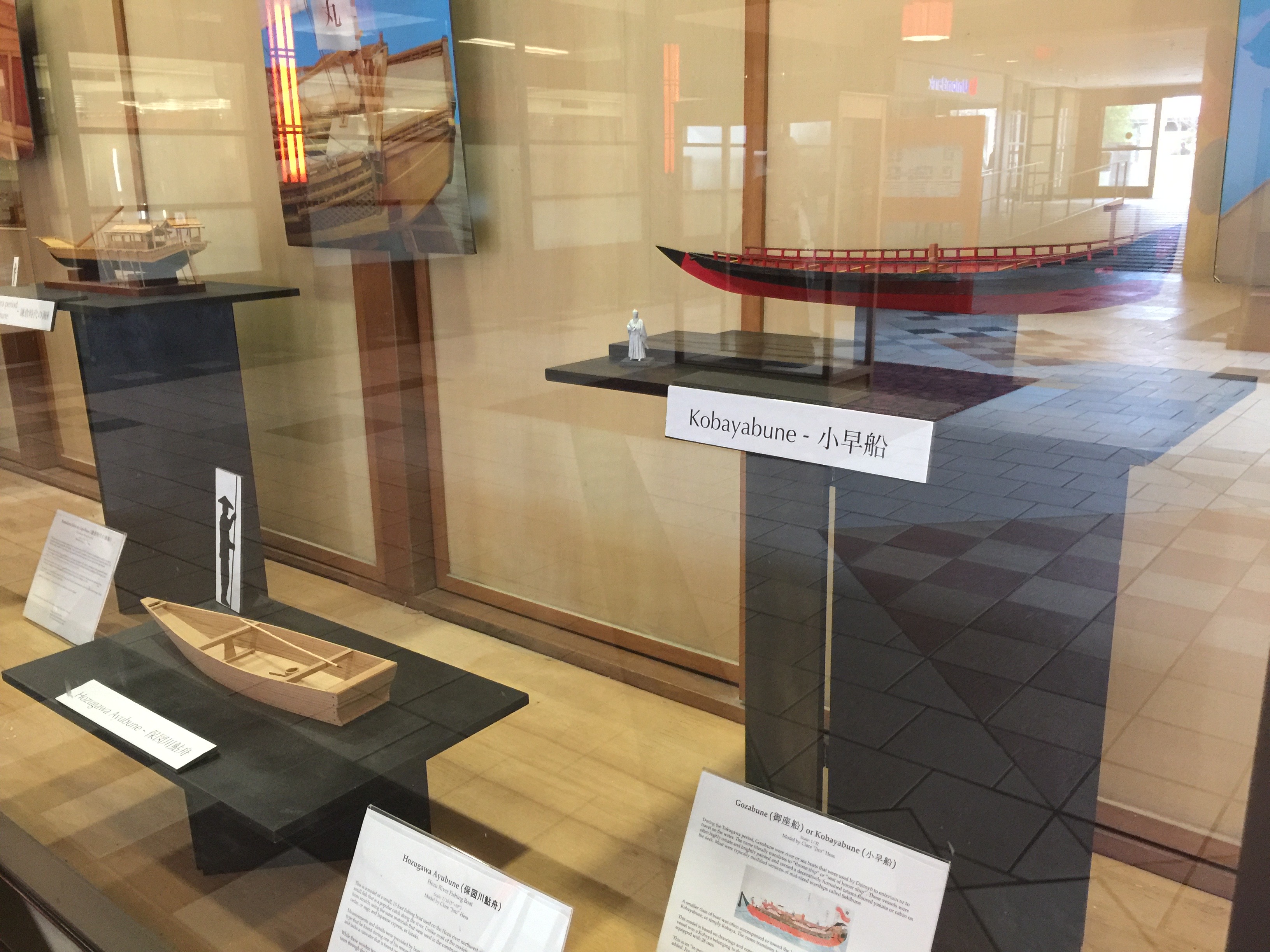
8th Japanese Boat Models Display, February 2019

My next display of models of Japanese traditional boats will run through the month of February in the display window of the Union Bank community room inside the Japan Center’s East Mall. It’s hard to believe, but this will be my eighth such display.

I made two more tall stands this week, giving me a total of seven stands, which is enough to put all the models I brought last time up on stands, getting them up off the floor of the display window. However, I’d like to put my Kobaya model on display too, even though it’s not yet complete – I did the same thing with my Kamakura period Umi-bune last time, which is done now.

The Kobayabune, though not complete, is my latest addition to the Japanese boats display.

The display includes the following models:

  • Higaki Kaisen – 1/72-scale Woody Joe kit of a coastal transport.
  • Hacchoro – 1/24-scale Woody Joe kit of a Yaizu bonito fishing boat.
  • Yakatabune – 1/24-scale Woody Joe kit of an Edo period pleasure boat.
  • Tosa Wasen – 1/10-scale Thermal Studio kit of a Tosa fishing boat.
  • Kamakura period Umibune – a 1/50 scale model of a trade boat, c. 1300AD
  • Hozugawa Ayubune – 1/10-scale model of a fishing boat from the Hozu river.
  • Urayasu Bekabune – 1/10-scale model of a Tōkyō Bay seaweed gathering boat.
  • Kobaya – 1/32-scale model of a boat belonging to the Shōgun’s government.

It is now set up and will be available for viewing through the morning of 2/28/19.

Tenma-Zukuri Chabune (伝間造茶船)- Plans Reconstruction Update

Work on the drawings of the Tenma-zukuri chabune continues. Over the past months, I’ve been making changes to my drawings of this wasen that I found in the the Funakagami. With the help of fellow modeler Kouichi Ohata and my mentor Douglas Brooks, I’ve gone through several revisions of the plans – seven major ones, so far.

Tenma-zukuri chabune, from the Funakagami.

The biggest difficult has been in analyzing the single wood-block print of this type. Compared to other boats in the Funakagami, this one has a very flat bottom, showing no real rise at the stern, which may be possible, but it’s really throwing people, as it seems very unusual for a Japanese style boat.

Also, if you look at the near side of the boat, particularly the bottom, it doesn’t appear to show any inward curvature. This threw me initially, as this is, again, pretty unusual. It’s not impossible, as the hozugawa boat I built doesn’t have any inward curvature at the stern either. But, looking more closely, at the far side, you can clearly detect inward curvature at the stern. The lack of curvature had bothered some people, so I’m glad I could spot some in the image to justify it on my drawings.

Continue reading

1/10-scale Figures – A Brief Update

Last week, I wrote a post about a pair of articulated 1/10-scale figures I bought made by Bandai of Japan called Body-Kun. The figures are a bit short, but a little long in the legs, so I hope to modify them slightly to make them a little closer to correct height by adding a little filler in their midsections. Ideally, I’d add some filler into the arms too, and make the heads a little larger. But, reasonably, I can only do so much.

In any case, I’m pretty sure I can do something with them, so I went ahead and ordered another pair off of Ebay for just over $30. However, I noticed that there was apparently another version, which had replacement arms and legs, to allow the figure to naturally sit seiza, or “Japanese-style”, and to allow him to have his arms folded across his chest or just his hands folded in front of him.

The biggest differences I realized only after getting the figures was that they’re a little skinnier than the other figure and, more importantly, they’re barefooted, which is exactly what I need for Japanese figures of this period. I can always rig zoris, Japanese-style sandals, waraji, straw sandals that are tied around the foot, etc.

Original figure on the left, the new one I received on the right. I think I chipped the chin of the new figure, which is why it looks a little odd. Should be repairable without too much trouble.

Continue reading

1/10-scale Figures… Almost

For the past many months, I’ve been feeling the need to add figures to my models. The models, by themselves, are nice. But to really give the feel of how the boats were used requires additional details, and figures have the added benefit of creating a sense of scale.

I’m not very good at making figures yet, but I’m working on it. In the meantime, I’m trying to use commercially available figures. This isn’t all that difficult in scales like 1/32 (Kobaya), 1/48 (my Kamakura period sea boat is 1/50 – close enough), 1/72 (Higaki Kaisen). But, many of my small boat models are in 1/10 scale. Finding a figure in the right size for a 1/10-scale model is pretty difficult, but I finally settled on something that looks like it might work.

A while ago, I saw some ads for a pair of fully articulated figures, one male, one female. The figures are produced by Bandai, a Japanese toy company that makes action figures. The figures are part of a line called S.H. Figuarts, with the male figure called Body-Kun, and the female figure called Body-Chan.

Continue reading