Japanese Boat Model in Western Art

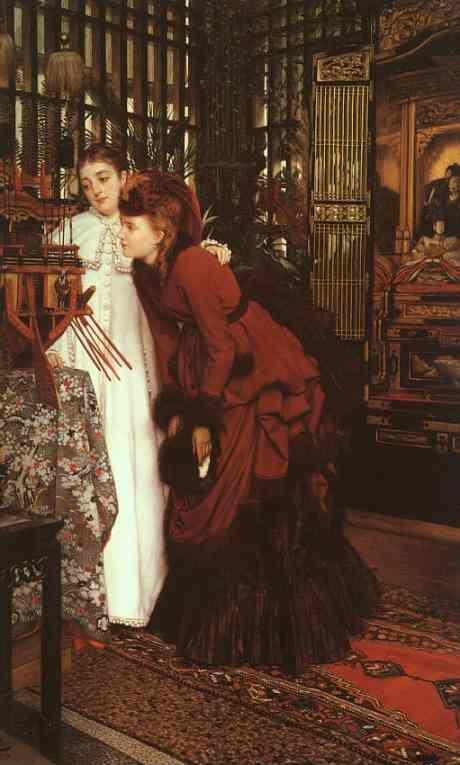
A fellow ship modeler sent me a photo he took at a Tissot exhibit at the Legion of Honor in San Francisco recently. Jacques Joseph Tissot was a French painter who is famous for his  biblical paintings as well as his paintings of fashionably dressed women of everyday life in France and England. Fortunately, his works are all in the public domain, so I can comfortable share it here.

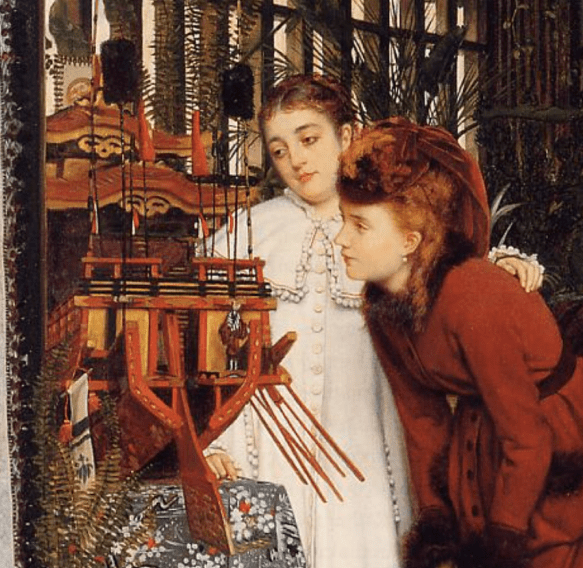
One painting in particular is called Young Women Looking at Japanese Objects, which he painted in 1869, shortly after the opening of Japan to trade. It depicts two young ladies looking at a large model of a gozabune, a kind of royal yacht used by the Japanese Daimyo in their local travel.

It’s not a very good view of the model, but a closer look shows some detail, which is nice to see. There even appears to be a small figure standing in the opening at the stern.

Of interest to me is the fact that this is a painting of model as it appeared in 1869. It is not unlike other models I’ve seen, probably about 1/20 scale. I specifically note that the rudder and oars are all painted red, and the ceremonial banners and there are several ceremonial banners and poles flying at the stern.

There appears to be a banner flying forward and above the tall deck houses, but it is partially obscured, and I don’t have enough knowledge to identify the crest displayed on it.

I can’t help but wonder what ever became of the model…

2020 New Year’s Explosion of Wasen Model Projects

I’m constantly studying and reviewing information about various types of wasen, or traditional Japanese boats, that I could possibly model. Sometimes it takes a long time, searching for information in books and on the Internet, until I have enough knowledge, drawings, and photos to get started on something.

I spend time researching and studying subjects based on what information I can find. Often, following a lead that takes me to some other website, or maybe suggests the availability of a book that might be useful. In all cases, I travel up an information stream that eventually just dries up. Then, hunting around, I find some information on a different subject, often repetitive, but sometimes providing some information on an altogether different subject.

So, I end up with all these incomplete branches of study. When interest and clues lead to a discovery, or when it just feels like I have enough information and probably won’t find a whole lot more, a project is born. I gather together the information, create drawings or scale existing ones, and start making templates for hull construction.

But, more often, I sit on a potential project, waiting for more information – waiting to decide if I really do have enough information and to decide if I have enough understanding to successfully build a model from what I have. Sometimes, a project is simple enough that I decide I can get started. Sometimes, the potential model size or the details leave me hesitant about how I want to proceed. So, several potential projects sit on my desk and on my computer, waiting for the inspiration to start it.

Well, it seems that the new year has created a lot of inspiration and there are several potential projects to take up. The inspiration has fired off on several of these all at once. Plus, I’ve been tasked with a couple in addition. So, in addition to finishing up the Woody Joe Kitamaebune kit, and adding some more details to my Kobaya from Paris drawings. The following have sprung to life:

Himi Tenmasen – I’ve been tasked with building a model of the small boat that Douglas Brooks and students built with Mr. Mitsuaki Bansho in Toyama prefecture. Originally, the plan was to build two of these for him, but for budgetary reasons, that’s been scaled back to one, plus a Honryousen model (see below).
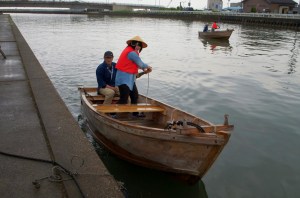
Honryousen – This project to model a Niigata kawabune is a fallback from plans to build a second Himi Tenmasen for Douglas Brooks. But, in actuality, it would have happened anyway. It’s a pretty simple subject and should be quick to build. The original was built with Mr. Nakaichi Nakagawa.
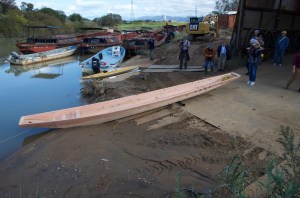
Senzan maru – This is one of the more ambitious of the projects which I now feel has to see the light of day. This Edo period whaleboat-type craft was owned by the Hachisuka clan of Tokushima prefecture. It is a particularly important project, as it was made possibly by my Japan research trip back in 2016, for which I received a lot of support from friends and family. For this project, I have a book and drawings published by the Tokyo Museum of Maritime Science.
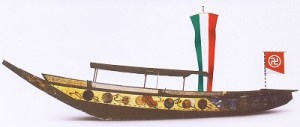
Tonegawa Takasebune – One of the great mysteries to me has been the details of this important river cargo transport of old Edo. There’s much mentioned about these boats which carried food and bulk goods down river to the bustling metropolis of the Japanese capital, but it’s been difficult to find enough technical details to feel comfortable taking on a build of this type. But, the design is actually pretty simple, so I feel there’s no reason to wait on this one any longer.
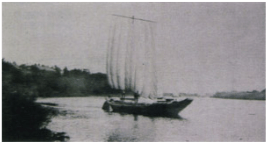
1/20-scale Hozugawa Kudaribune – I’ve modeled this boat in smaller scale and it’s a beautiful boat. I was planning on sending the 1/40-scale version off as a gift. And, while that gifting is on hold at the moment, I still don’t want to be without a model of this boat, so I’m just scaling up what it did before, but with maybe some adjusted details.
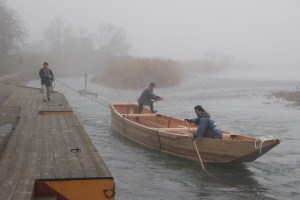
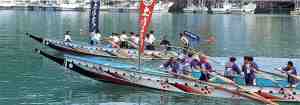
Sekobune – A chaser-type whaleboat is particularly significant right now, as a number of my fellow NRG (Nautical Research Guild) members attended a conference held at the New Bedford Whaling Museum in Massachusetts. As it turns out there is a beautiful model of a Japanese whaleboat on display there that was brought there by one of my Japanese contacts. I was sent many photos of this model by friends in the NRG and offers of assistance from my Japanese contact, who happens to be the curator of the whaling museum in Japan. With a set of plans in hand, this project is calling for me, but at what scale?
 

So, it does all seem to be happening at once. But, that’s not a terrible thing. At least I don’t feel stuck. The Honryou will likely be the first started and finished, since it is such a simple design – It basically only has 5 planks, a beam and some boards that make up a seat. Now, I just have to get some measures for it. Ω

Wood Shipment Received

Well, I now have no more excuses on not having enough wood to work with. I just picked up a 12 pound box from the post office, shipped from Japan. I had no idea my wood order was going to be this big and heavy. The whole thing cost me about $100 in wood and another $100 in shipping.

When I got home to open it up, my suspicions were correct that Tanimura-san, my wood supplier, had thrown in a bunch of extra stuff he didn’t need.

So, now, I’ve got plenty of wood in the 3mm and 4mm sizes I need. Plus, a whole bunch in 2mm and even down to 1mm veneer. Not quite sure how I’ll make use of the smallest stuff, but it seems like there ought to be some way I can use it.

The wood is mostly sugi, or Japanese cedar and it’s pretty different from anything that is available in the U.S. It is not actually an ideal wood for model building, because of its grain structure. However, I’m using it to build models as a boatbuilder would. And, I’ve found that the majority of Japanese boat builders tend to use the same wood they use to build there boats. It’s a lot like the way some people like to use real teak for the deck of a sailboat model.

The other wood that is commonly used in Japanese boat models is hinoki, or Japanese cypress. This is the wood you find in all Woody Joe kits, whether ships or temples. In fact, I managed to make a special order from Woody Joe for some standard sized wood that they produce. It’s not something they sell through the hobby channels. I think they produce the wood for Japanese craft suppliers, but I’m not positive about that. But, I was able to get it from them in 2mm, 3mm, and 4mm sheets. They’re not very wide sheets, but for the smaller scale models I would use this for, they should be fine.

For the largest projects I’m considering, I’m going to have to rely on domestically available wood. I should have that covered with a supply of Port Orford cedar I picked up in Oregon a few months ago. I’m going to have to dig into this supply if I’m going to build that 42″ 1/10-scale Japanese whaleboat model I’ve been thinking about(!). Ω

丸子船 – Marukobune Model by Mr. Masami Sekiguchi

When I visited Japan in 2016, I had the pleasure of having dinner with a couple Japanese ship modelers in Tokyo. One of these gentlemen is Mr. Masami Sekiguchi of the Yokohama  Sailing Ship Modelers Club. We’ve been regularly in touch via email as he has helped to answer questions for me on Japanese traditional boats, architecture, and anything else I need help with from Japan.

Mr. Masami Sekiguchi, left, visiting a display of wasen models built by Mr. Yukio Nakayama, right.

It was he and the other gentleman I had dinner with in Tokyo, Mr. Norio Uriu, who went and investigated a collection of models at the regional museum in the Ota ward, that I discovered when researching a spreadsheet I found online regarding wasen model dispositions. They took many dozens of photos documenting the models, which were in storage at the museum.

Continue reading

とやまの和船 – Book on Traditional Japanese Boats of Toyama Prefecture

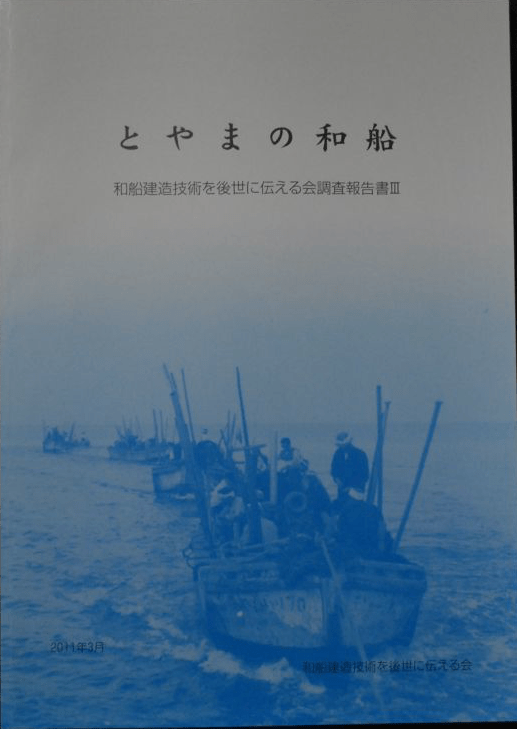
The first treasure of my recent Japanese book buying binge arrived late last week. The book is in Japanese and is called Toyama no Wasen, which means Toyama’s traditional Japanese boats.

This is a beautiful book and it is loaded with drawings. I flipped through it and counted about 30 boats detailed in drawings, though some drawings offer more details than others. Also, some of the rice field boats are little more than floating wooden tubs that are pushed or pulled through the fields by the farmer.

This book appears to be a 2011 publication by the Himi City Museum. I found my copy through Yahoo! JAPAN Auctions. I haven’t seen it listed even on Amazon Japan. I suspect it normally purchased directly from the Himi City Museum and, as it’s a museum publication, isn’t going to be found anywhere else.

Continue reading

Douglas Brooks Building Honryousen

American Boatbuilder Douglas Brooks has been studying traditional Japanese boatbuilding techniques from master Japanese craftsmen for more than 25 years. He recently completed building a boat in Niigata prefecture under the guidance of Mr. Nakaichi Nakagawa. The boat is a simple river boat called a Honryousen.

Joining him in Japan is Nina Noah, Director of Student Affairs and Outreach at the Apprenticeshop, a non-profit organization located in Rockland, ME, dedicated “to inspiring personal growth through craftsmanship, community, and traditions of the sea.” She is also working on the boats and helping to document the work being done.

The following video was put together interviewing Mr. Nakagawa and documenting the work on this lovely boat.


Japanese Book Buying Binge

While I have plenty of projects and potential projects to work on, I seem to be hungry for new material. Recently, I was hunting for the source of a pdf copy of an out of print book that I had originally obtained from the Nippon Foundation Library a few years ago.

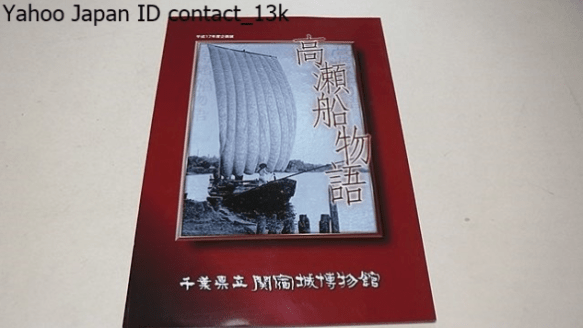
But, try as I might, I couldn’t find it anywhere. In fact, most of my saved links to the site appear to be broken. I hunted for the pdf book, but couldn’t manage to locate it. However, I did manage to run across an actual physical copy on a Japanese auction site. Now, I don’t actually need the book, since I have the pdf file, but it’s always nice to have a physical resource.

The book I found was one on the history of the Takasebune, a term for the various types of shallow-draft transports found on the rivers across Japan. Watch for an upcoming post on researching and reconstructing the Takasebune of the Tone river system.

Continue reading

Looking for Yodogawa river craft detail

I haven’t tried this yet with this blog. Normally, I just post what’s new and what I’m working on, etc. But, this time I’m going to try asking for help…

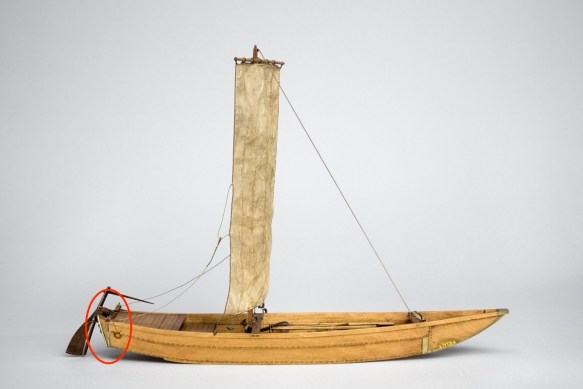
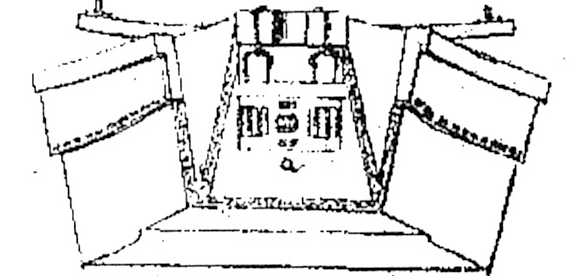
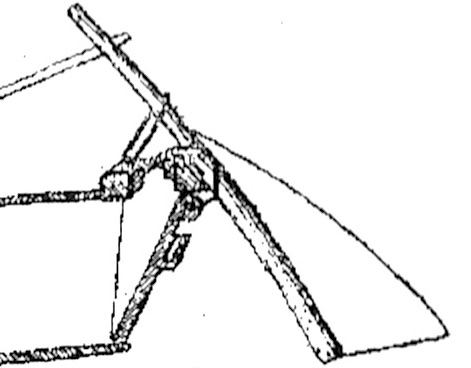
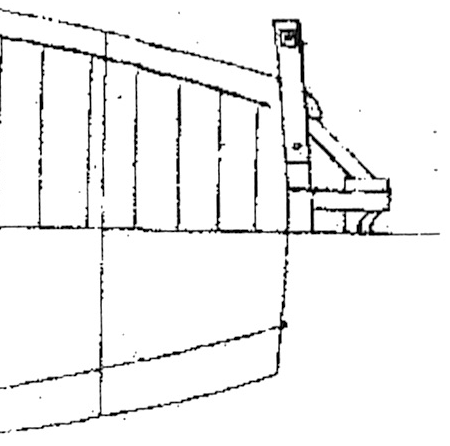
Some Yodogawa 淀川 river boats and some sea boats in the Osaka area show a kind of stern structure that is different from other boat types, but I can’t quite make out the details from the few drawings and photos I’ve seen.

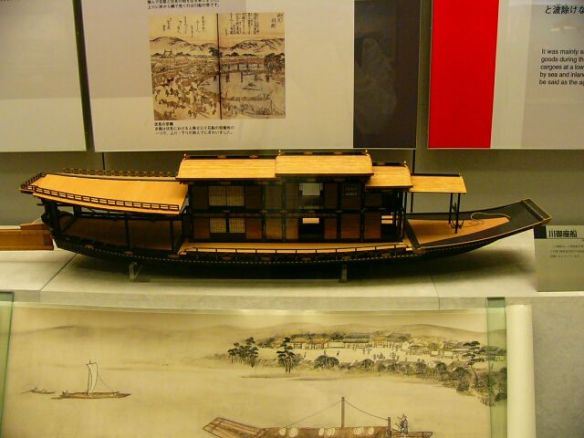
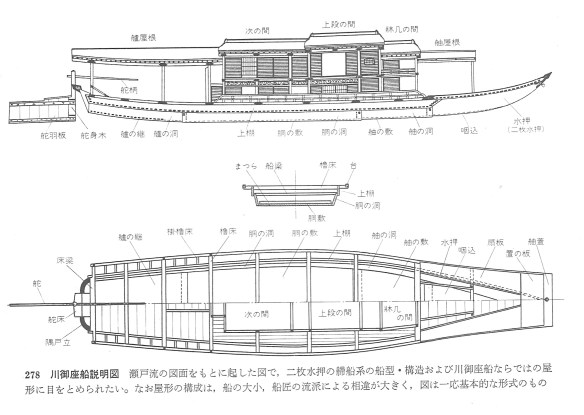
In another case, there is a model of a river gozabune from the Tokyo Museum of Maritime Science. I have some photos of it, but again, nothing that shows the stern in detail. Again, this is a boat from the Yodo river.

This is a beautiful model for which I have a nice drawing, but there is no scale and again I don’t really understand the construction of the stern.

Now, I could take a guess based on the drawings I have, but this is a very well known and often viewed model, so I’m hoping someone out there has some better closeup photos of it. Also, I need the exact length of model or of something specific on the model, as well as the scale, to be able to determine correct measurements.

There might be other models besides this specific one that shows stern features in detail, if you have any info, please contact me here through the comments section. Thank you!


9th Japanese Boat Models Display, October 2019 – Extended

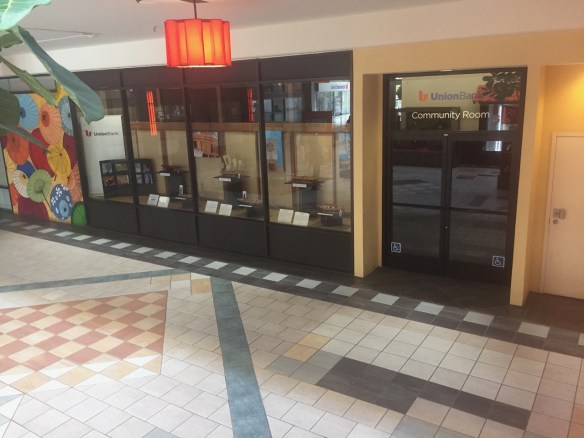
Setting up and taking down my display of Japanese boats takes a lot of time and effort, and when I don’t have the display up, I have to have a place to put all the models at home. So, a couple days ago, I contacted Union Bank and arranged to have my Japanese boats display extended for an additional two weeks.

If you happen to be in the San Francisco Bay Area sometime before November 15, 2019, you can still see my display in the Union Bank Community Room window of the Japan Center’s East Mall (Mikyako Mall), which is located between Geary in Post near Buchannan street.

In the future, I’d like to make more instructional, perhaps focussing on a certain type of boat or certain region and how they’re used or how they’ve evolved. Unfortunately, that’s going to take a lot of work, lots of study, and more models than I have now.

I figure I’ll probably have to stick with this display as it is at least one more time. Next time, I should be able to include the Kitamaebune and it would be nice to have both that and a Higaki Kaisen model shown together, but that means I have to not only get the Kitamaebune finished, but I have to build another Higaki Kaisen as well.

Well, one thing at a time. Ω

Hozugawa Kudari Bune in 1/40 scale

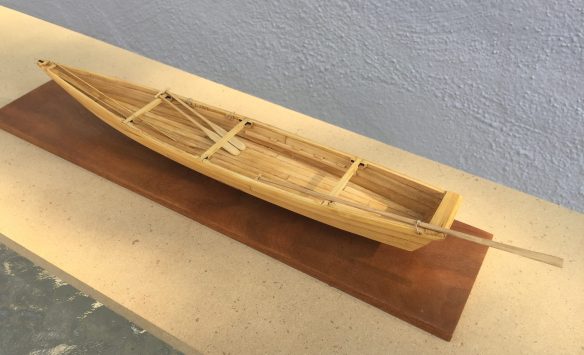
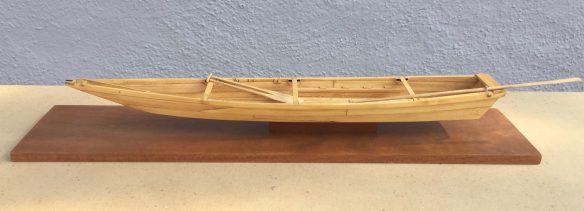
If you’ve been following my blog, you might have read this one about the Hozugawa downriver boats: Wasen Models in Miniature – A Hozugawa Downriver Boat

I’ve since added a few details to the model, modernizing it slightly, with the addition of iron reinforcement brackets and a full complement of poles and oars.

I also added the loops to the hull which hold the paddles and steering oars in place when running down the river.

I wasn’t able to get official measurements on these, so I had to rely on photos and estimate the sizes. These are the sizes I came up with:

Sao (pole) – 18 shaku

Paddle (2) – 9 shaku, 7 sun wide blade

Steering Oar – 20 shaku, 7 sun wide blade

Pushing Pole – 9 shaku

Recently, I got myself a miniature shaku square about 3 sun long, so I didn’t actually need to convert to metric, like I sometimes do. Scaling down to 1/40, these come out as:

Sao – 4.5 sun

Paddle – 2.25 sun, 1.75 bu wide blade

Steering Oar – 5 sun, 1.75 bu wide blade

Pushing Pole – 2.25 sun

Since the poles are very thin, less than 1mm diameter at scale, I had to resort to using brass rod, which I sprayed with Tamiya Surface Primer, then finished off with a mix of acrylic paints.

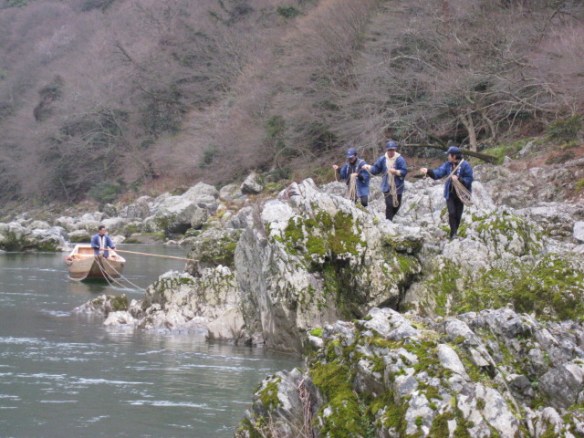
At one time, before the arrival of motor vehicles, the boats ran down river and were manually hauled back up the river by the boatmen, who wore harnesses attached to long ropes. I’ve considered adding rope coils, but my model, with it’s iron fittings and fittings for seating clearly suggests it’s from a later period. So, it probably wouldn’t make sense to add them.

Earlier boats had removable beams to make storage easier. These had a more unfinished, rounded look, and did not have iron fastenings. Douglas Brooks suggested to me that the iron fastenings were likely added to the beams so that they could be used to more easily lift the boats onto trucks for their return journeys.

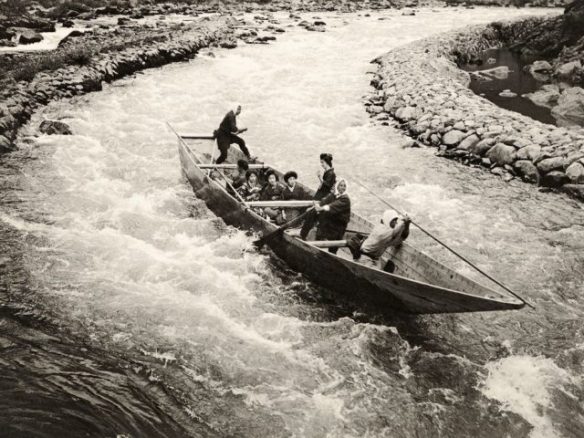
Historical photo I found on the Internet. I do not know what date this was taken.

A successful attempt in 2009 to recreate the task of hauling a kudaribune back upstream, a task known as hikibune. More details at http://hozugawa.cocolog-nifty.com/blog/2009/11/post-9f96.html

So, short of adding a platform to the inside bottom of the boat, which would be removable anyway, the model is done. The path is now clear to move on to finish another project in the wasen mokei boat shop!