Higaki Kaisen on the Cover of Ships in Scale

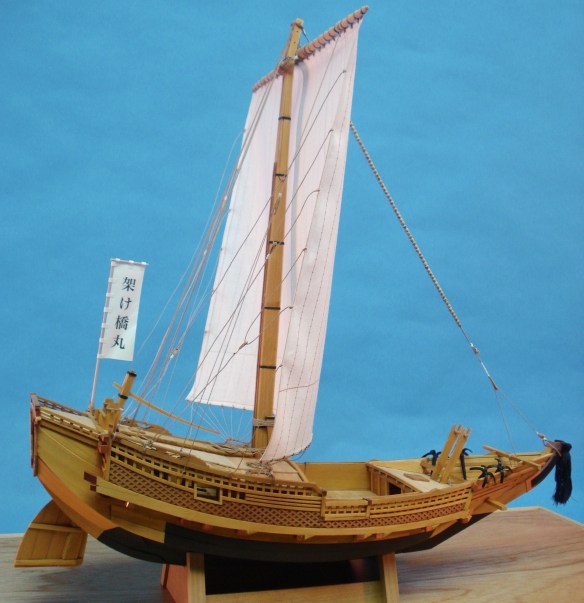
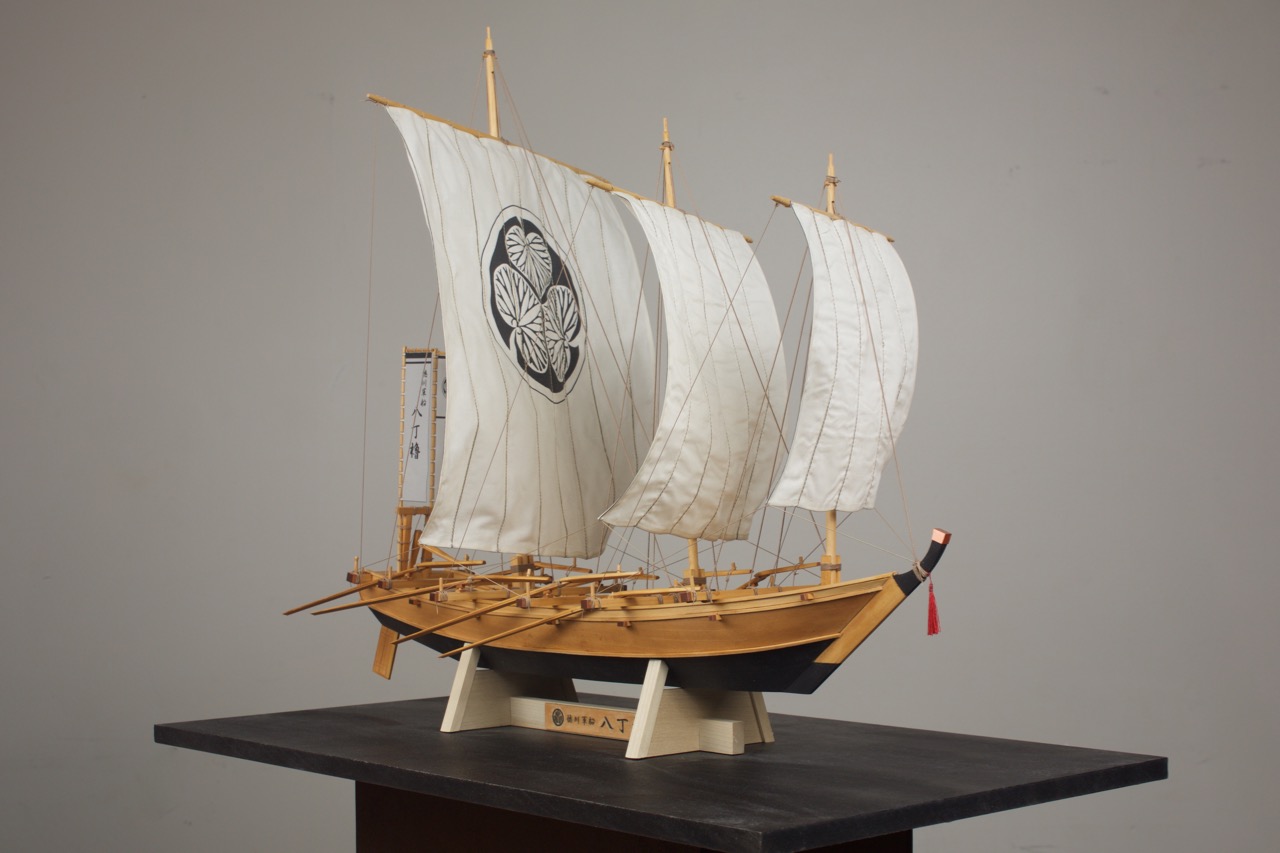
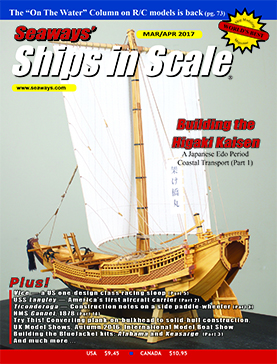
It’s official! I heard from a fellow ship modeler who said he really enjoyed the first installment of my Higaki Kaisen article. I hadn’t received my author’s copy yet, and my own subscription expired a few months ago, so I went onto Seaways.com to renew. When I was there, I saw the ad for the magazine showing this month’s issue and, lo and behold, there was my Higaki Kaisen model on the cover.

It’s actually the second time the model has been on a magazine cover. The first time was on the cover the of Nautical Research Journal. But, it was really nice to see it on the new Ships in Scale. I have to admit, the photogenic aspect of the model has more to do with the interesting nature of the subject and the incredible work done on the kit’s development by the manufacturer, Woody Joe.

Still, I’m pretty proud of the model and of the article. I hope readers here will have a chance to read the article. More importantly, I hope more modelers will take an interest in building the kit and other Japanese boats.

Special thanks to all the people who’ve helped me with this article and in better understanding Japanese traditional watercraft including Douglas Brooks, Toshihiko Shibafuji, Masaki Tanimura, Norio Uriu, Masami Sekiguchi, Jean Pierre Mélis, Hiroyuki Kobayashi, Yukari Gojo of Woody Joe, and Kazunori Morikawa of Zootoyz, as well as supportive fellow ship modelers Don Dressel and Richard Rubinger, and a special thanks to Ed Von der Porten for all his editing help.

Higaki Kaisen Build Article – Ships in Scale March/April ’17 Issue

I hadn’t heard any word at all from the editors of Seaways’ Ships in Scale magazine after submitting my article on the construction of Woody Joe’s Higaki Kaisen kit. I submitted the article in late November, so I figured I’d send them a note to ask what the status was. I got their reply a short time later and it’s good news, the article is scheduled to appear, starting with the March/April issue.

Image Extra 4 - 994A9623

Given the size of the article, I expect it will appear across 3 issues. That’s the what happened with my Mary Taylor model article a few years back, and it was of similar size. This one actually might be a little longer, so maybe it will span a 4th issue. I don’t like super long articles, so I hope it gets limited to 3, but certainly no more than 4.

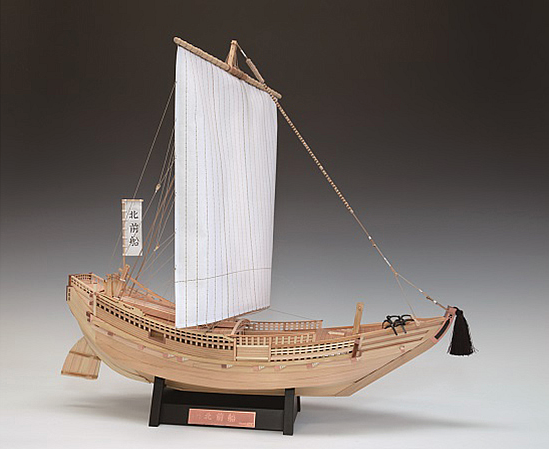
As a reminder, Zootoyz is selling Woody Joe kits again, and they’ve revamped their website a bit and added the newer offerings, like the Kitamaebune. That, by the way, is a slightly beefier cousin to the Higaki Kaisen, built for the long journeys between the northern ports and the large port cities of the south. If you are interested in a less complicated kit, but really like the look of the Higaki Kaisen, consider the Kitamaebune. It’s a newer kit, same 1/72 scale, with simplified construction for about $20 less.

Kitamaebune

Woody Joe’s Kitamaebune kit. A beefier bezaisen than the Higaki Kaisen.

If you don’t subscribe to Ships in Scale, now is a great time! You can find out more information from their website here: http://seaways.com/. Back issues include my reviews of the Woody Joe kits Higaki Kaisen, Kanrin Maru and the Charles Royal Yacht, as well as my article on scratch building the pilot boat Mary Taylor.

At some point, I am considering detailing Woody Joe’s Hacchoro kit too, and writing up an article about that. I already have the kit sitting and waiting in the closet. Too many other things to finish up first!


Higaki Kaisen Build Article Submitted

Those of you interested in building Woody Joe’s Higaki Kaisen kit, I just completed the final edits to my article and sent in the 29-page work to Seaways’ Ships in Scale magazine, and is accompanied by a selection of 44 photos and illustrations.

hk-photo-35

I’ve been working on this writing project for a terribly long time, at least 2-1/2 years, if I recall correctly, though the model only took a matter of a few months to complete. The big hold-up has been in trying to develop an accurate and informative background on these coastal Japanese transports.

This will be my sixth article submission to this magazine. And, while the last 4 articles I’ve written have been 3500-word kit reviews, this one is a good 25% larger than my 8500 word, 3-part article on scratch-building the pilot boat Mary Taylor, which probably means it will be a 4-part article. I would have preferred no more than a 3-part article, but the background on the type of ship is so unknown to ship modelers that I devoted one-quarter of the article just to that. Anyway, I think people will find it interesting.

I won’t know if the article will be accepted for certain. But, it is an unusual subject, and not your run-of-the-mill western-style ship. Hopefully, I’ll know more in a few weeks, so stay tuned.

In the meantime, if you want to purchase one of these kits, as always, I recommend purchasing from Zootoyz in Japan. Ω

Woody Joe Kits are Back at Zootoyz

This should make it easier to get your wasen model kit!

catopower's avatarShip Modeler

Those of you who are interested in kits from the Japanese manufacturer, Woody Joe, will be happy to hear that after more than a year, Zootoyz is now carrying Woody Joe kits once again. I received word from Zootoyz owner Kazunori Morikawa on Sunday. The purchase links for Woody Joe kits on his website, http://zootoyz.jp, are now active again.

Japan's Online Hobby Dealer Japan’s Online Hobby Dealer

He just made the announcement, so it may take a little time to make some corrections to the site, as there are several new Woody Joe kits that aren’t listed yet, like the new Kitamaesen, and the I400 submarine, etc. There are also some old items that may be no longer available that are still listed on the site. Finally, it looks like the exchange rate calculator may need to be updated, as the prices are off slightly.

So, give him a little time to fix things up…

View original post 29 more words

Yaizu’s Hacchoro (八丁櫓) Fishing Boat

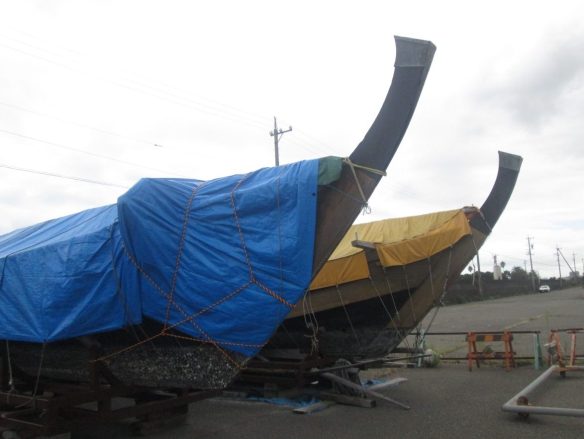
Yaizu is a coastal city on Suruga Bay, 10 miles south of Shizuoka, and about 50 miles southwest of Mt. Fuji. On a clear day, you can see Fujiyama. I visited Yaizu during typhoon season, and the mountain was obscured by clouds. Yaizu is the home of two replica Hacchoro (hot-cho-ro), fishing boats that got their claim to fame as boats of these types were once commissioned as escort boats for the retiring Shogun, Tokugawa Ieyasu.

img_0886

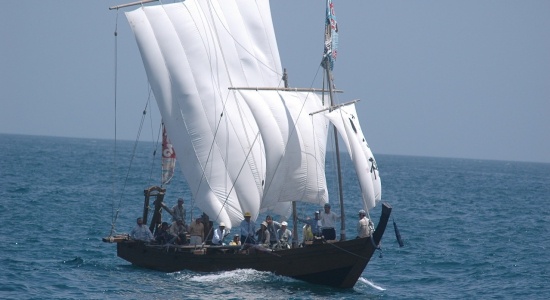
Hacchoro at the port of Yaizu, wrapped up for the season.

The story goes that the Shogun, or military ruler of Japan, liked to hunt game using a falcon. Travel to the hunting grounds required a trip by sea. To provide escort, 24 fishing boats were commissioned. But, the fishermen operating the boats had a difficult time keeping up with the Shogun’s boat due to strict limitations in place on the number of oars that could be implemented on fishing boats – a limitation imposed to limit the military capability of the craft. The fishermen of Yaizu were then granted permission to use 8 oars, which gave the boats their name – Hacchoro, translates to “8 oars”.

Continue reading

Japanese Boats Display in Japantown (v 4.0)

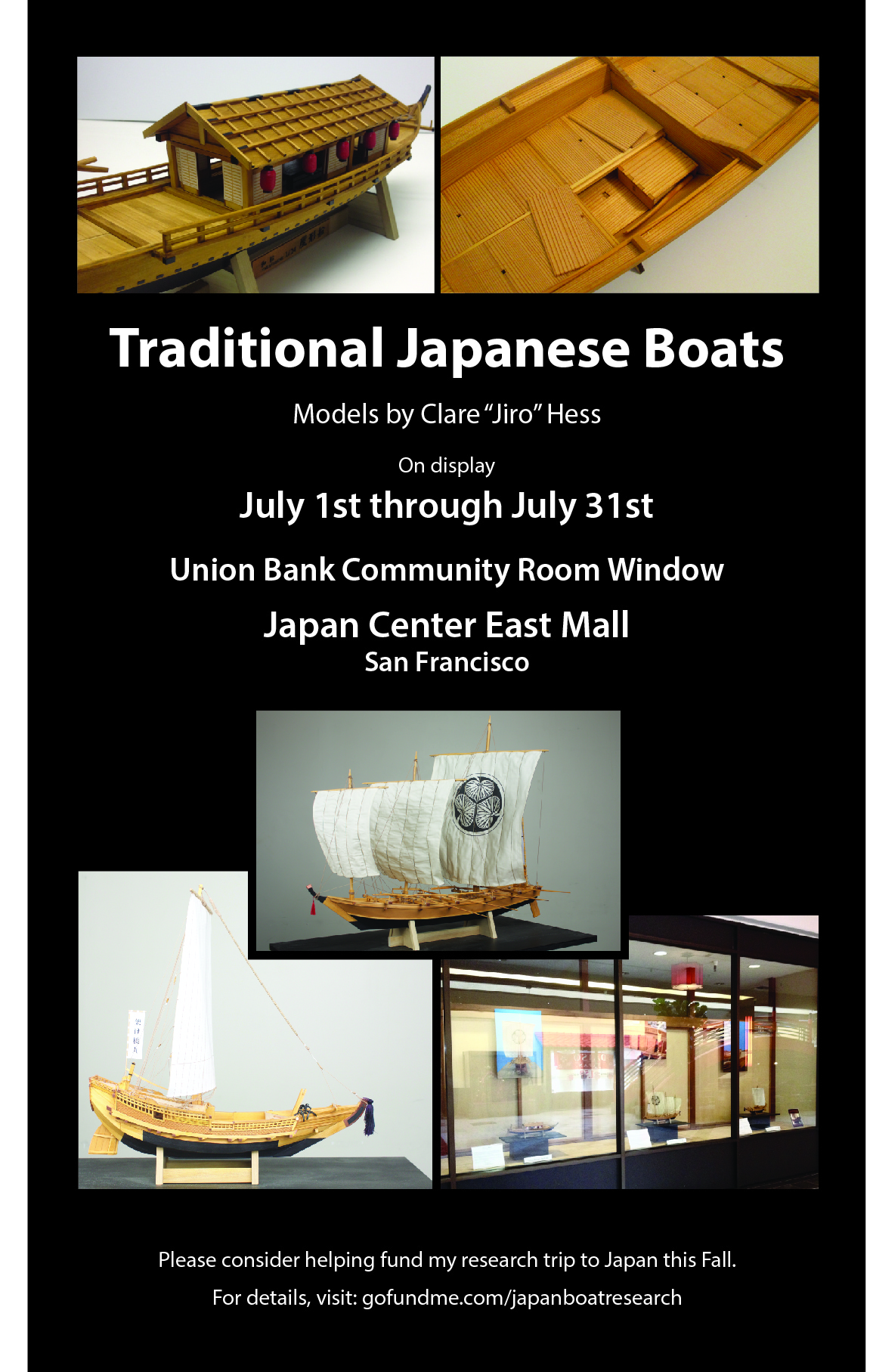
Last week, I spent an entire afternoon in San Francisco setting up my latest display of models of Japanese traditional boats in the Japan Center Mall in San Francisco. This is the largest display I’ve done, which is now up to 5 models. It’s probably about as large as it will get as I can’t imagine that I can possibly cram any more into my car. And, given that I live about an hour’s drive outside the city (or two hours in bad traffic), I’m not likely going to be making two trips to set it up. But, the size is actually pretty good now.

Since I’m doing some fundraising to go to Japan this Fall to do some more first-hand research on Japanese watercraft (don’t forget to check out my gofundme page), I’m taking the opportunity to really get some attention for this display. As with those people involved in the fine arts, I’ve made up an announcement card that I’m having printed up that I will be sending to various friends and people that  I think will be interested in it and possibly interested in helping me out (as well as those who have already done so). In addition, I’ve made a simple email announcement photo that I’ve been sending to people.
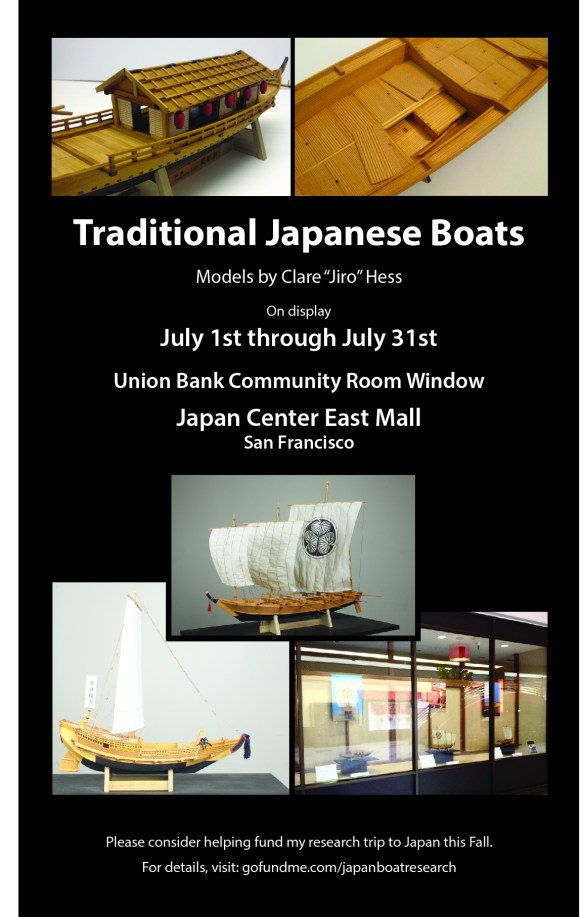
Announcement Emailer L plus

My email announcement card

If you’re already familiar with the last couple displays, you will see two new models added, a simple Japanese traditional boat shop display and the Tosa wasen model. Both are a nice, big 1/10 scale, so the details are better for a window display like this.

IMG_2398

The 1/10-scale Tosa Wasen is the newest boat model added to the display.
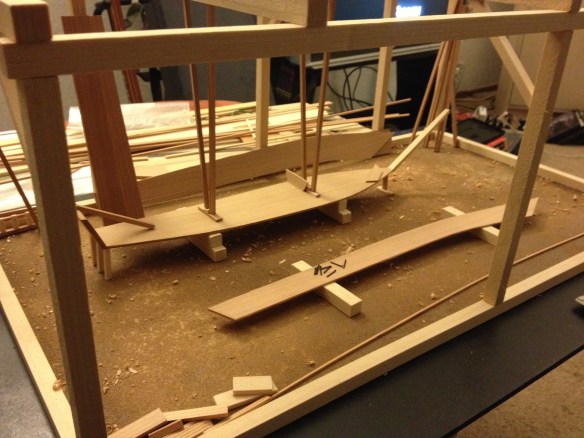
IMG_2382

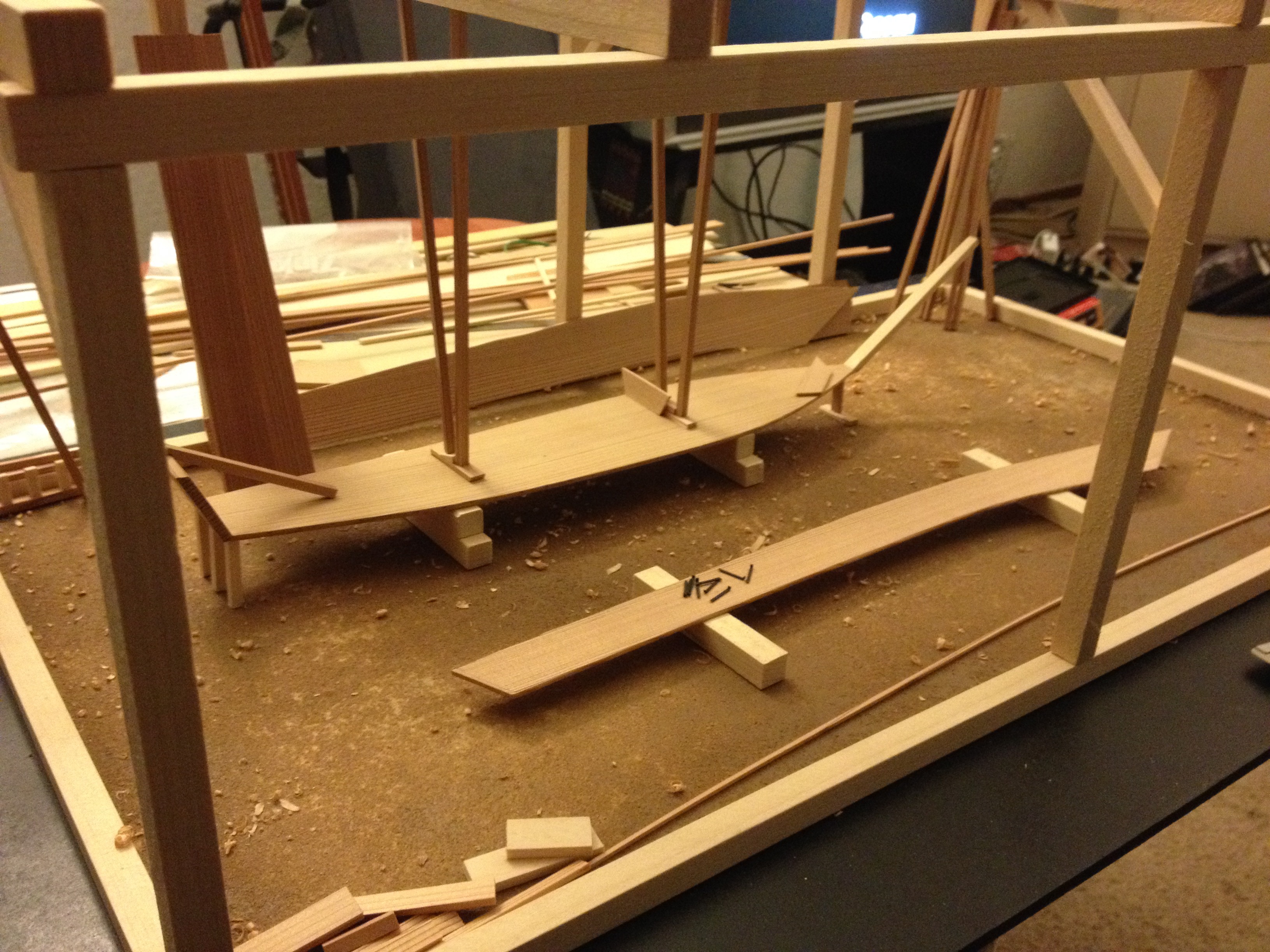
This is my simple model of an Urayasu boat workshop, showing some of the aspects of traditional Japanese boatbuilding. Under construction is a Bekabune, a seaweed gathering boat that was once used on Tokyo Bay. The model still needs a few additions – a work in progress.
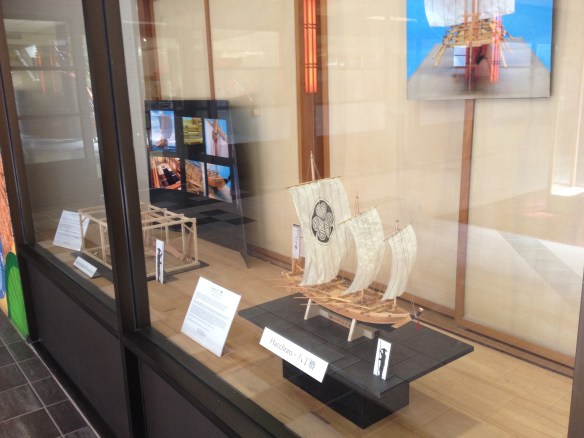
IMG_2403

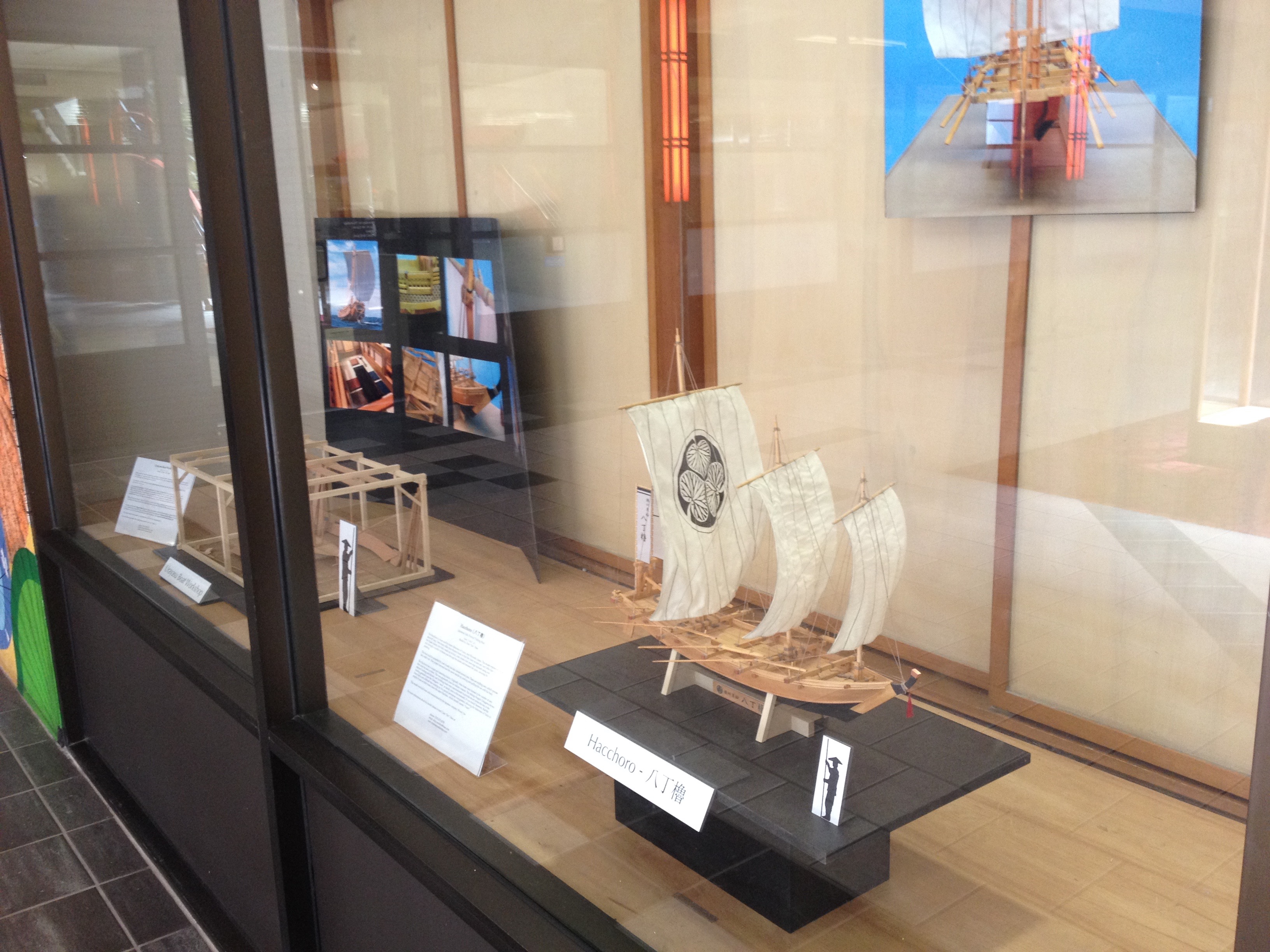
The Hacchoro and the Urayasu boat workshop with their scale boatmen silhouettes. The Hacchoro is one of the boats I will be focussing my attention on while researching in Japan this Fall.

You may notice in that display window photos that I’ve created little silhouette boatmen to provide scale reference for each model. This was a last minute effort, though I’ve been thinking about it for months. I finally sat down and scoured the Internet and found photos of boatmen dressed in traditional outfits on someone’s blog photos. I took the best one and did some Photoshop work to turn him into a silhouette, which I scaled to the needed sizes, printed them, and mounted them on cardboard.

There are, of course, things to do differently next time, which I’ve already noted. The boat workshop display should probably be on some kind of a riser, like the other models, there is enough room to put up another large, hanging photo board, and there’s room for at least one more model, using the tall stand I introduced in this display. I suppose I could consider staggering them a little too.

That tall stand, by the way, is actually a better stand for me to use because it’s simple two boards hinged together. This makes them foldable and they take up a lot less space in my car. I’m seriously thinking about replacing the box pedestals on the other models with short folding stands, which would allow me to carry more stuff in my car. And, actually, if I build models without sails, I might be able to fit one or two more in that car. Of course, that means building more models and I’m pretty far behind on other projects as it is. We’ll see… Ω

 

Hacchoro – Notes for building the Woody Joe kit

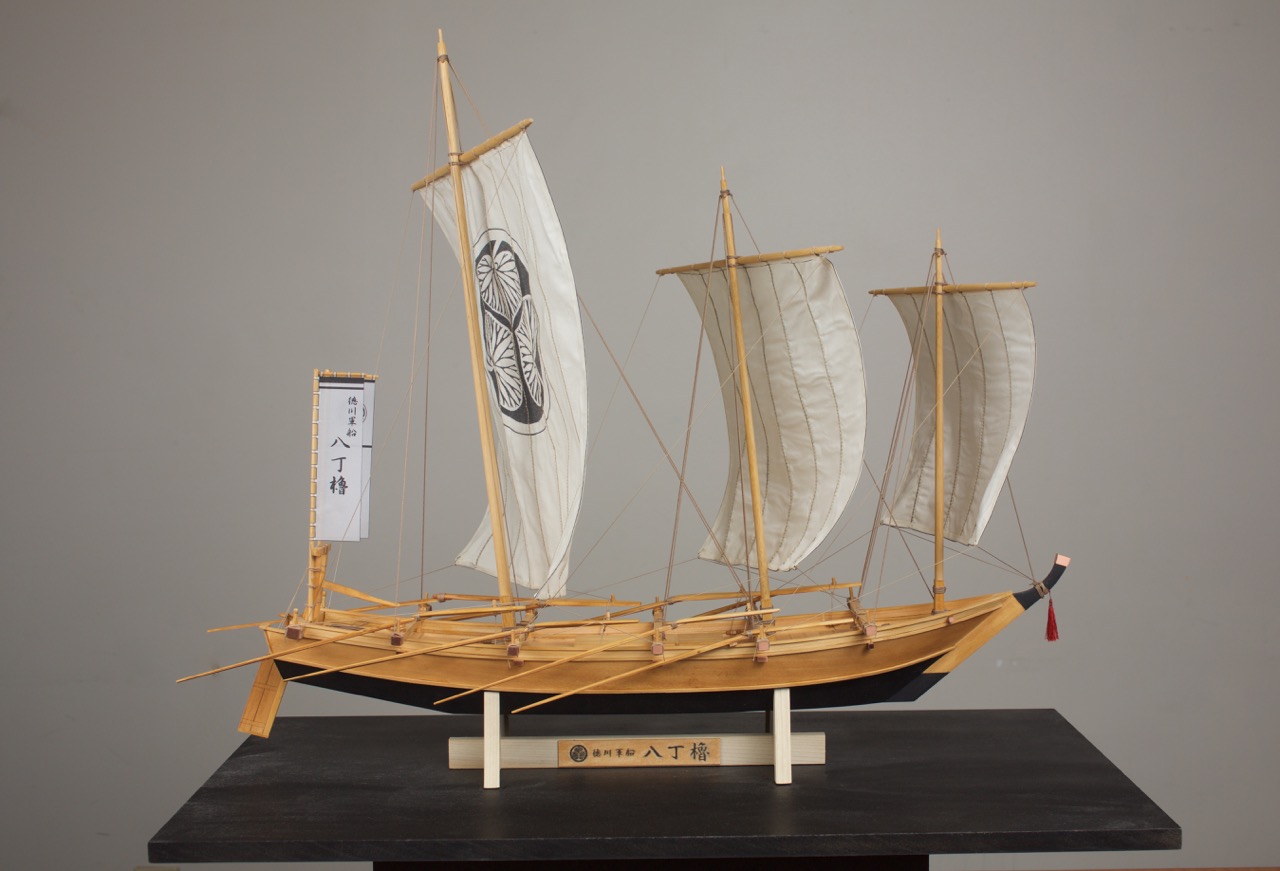
I have completed an initial draft of notes I compiled on building the Hacchoro kit by Woody Joe. The kit is a model of an 8-oared Japanese finishing boat from the area of Yaizu, Japan, which is on the coast, roughly about 100 miles southwest of Tokyo. The boat is a traditional type boat, following the classic 5 sided Japanese construction. That is, bottom, garboard strakes and shear strakes in a hard-chine hull configuration.
994A9695

The real boats were roughly 45 feet long and could carry 3 square sails on masts that could be stepped as needed. There are still Hacchoro in existence today, though I don’t know what the total number is like. I also don’t know how they are used today, except that there are Hacchoro races where teams man the boat’s oars to race each other on a short course.

DSC_0077

I am aware of two operating Hacchoro in Yaizu. With the help of a wasen authority in Japan, I have made contact with a gentleman in Yaizu who has offered to show me the Hacchoro there. So, I am now making arrangements to see them in order to record some of their finer details for later use in modeling them. This is part of my Japanese Boat Research Trip that I’m trying to raise some funds for. If all works out, I will take lots of photos and record the details.

For now, anyone who is building Woody Joe’s Hacchoro kit can download a copy of my notes.

But, in using these notes, you must accept that these are just suggested guidelines and there are always the possibility of errors in the document. Also, the document includes my own translation of the text of the Woody Joe instructions. I am not an expert in translating Japanese into English. Use them to give you more confidence in using the kit instructions, but you must agree not to hold me responsible if you end up gluing a part into place wrong. The kit is pretty well buildable using just the illustrations in the instruction book. But, sometimes it helps to know what the text says. Also, note that there are a lot of labels in the instructions, and I’m only translating the descriptional text and not all the individual labels.

Download Hacchoro Notes and Translated Instructions

Of course, if you have any questions about the document, just send me a comment with your email address and I’ll answer as best I can. Ω

Japanese Wasen Model Display in San Francisco

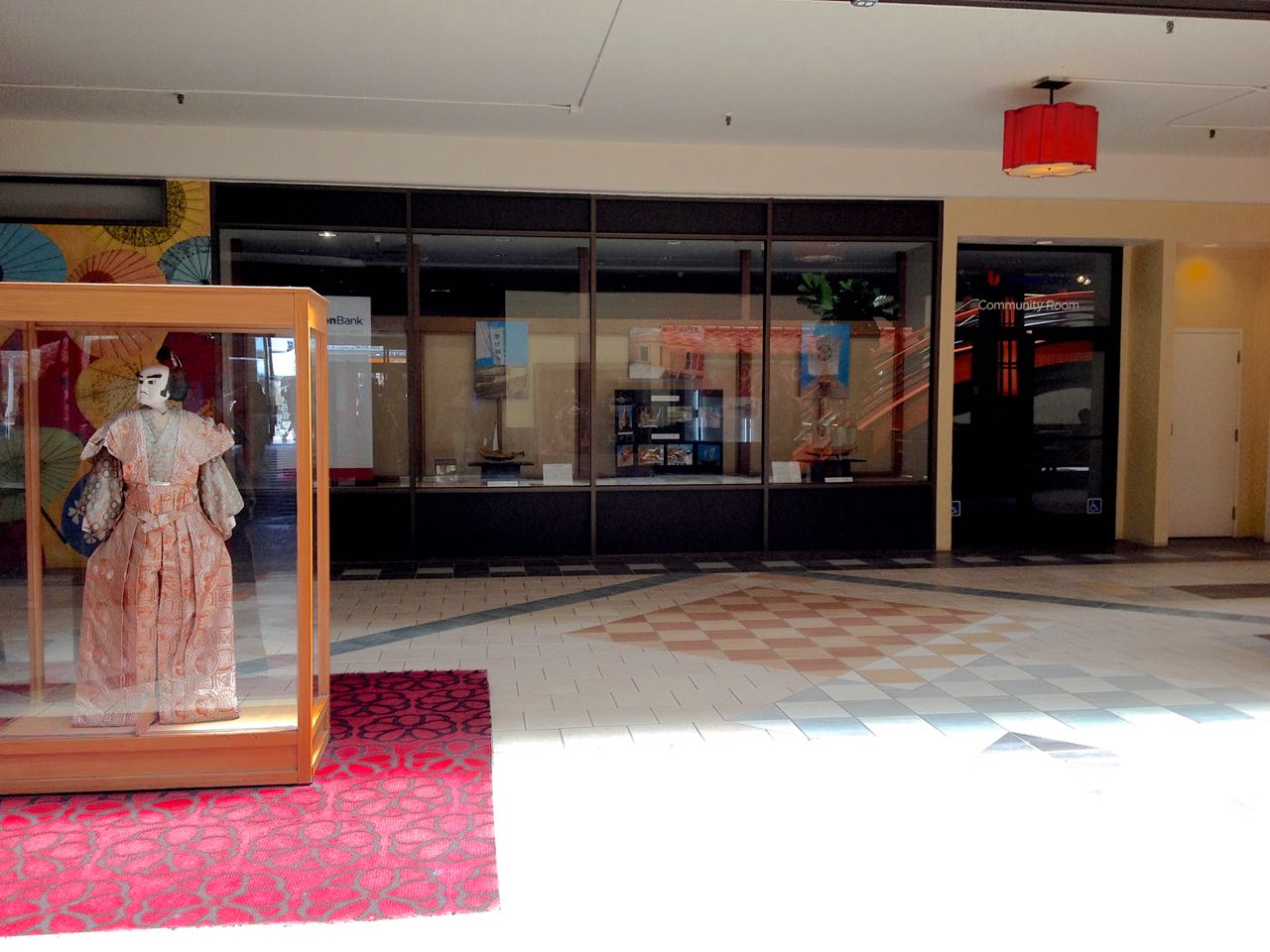
This week has been a kind of crazy week of dealing with the display of ship models. I now have 4 models out on display. Two of them are part of a display at the San Mateo County Fair headed up by the South Bay Model Shipwrights club. The other two are part of my own display that I’ve put together in the big window of Union Bank’s community room in Japantown, San Francisco.

The models are my Higaki Kaisen and Hacchoro models that I built from Woody Joe kits. The display is my second now, and I’ve learned a lot from my first display that I put up earlier in the year. That display was small for the window area and the models were hard to see and the display was not very attention grabbing.

This time around, I’ve had posters printed up using some new photos I’ve taken. I mounted these on foam core poster boards and also set up a large display board with 8″x10″ photos showing details of the models. To make the models easier to see, I removed them from their cases and raised them up closer to eye level by placing them on some pedestals I made from MDF board.

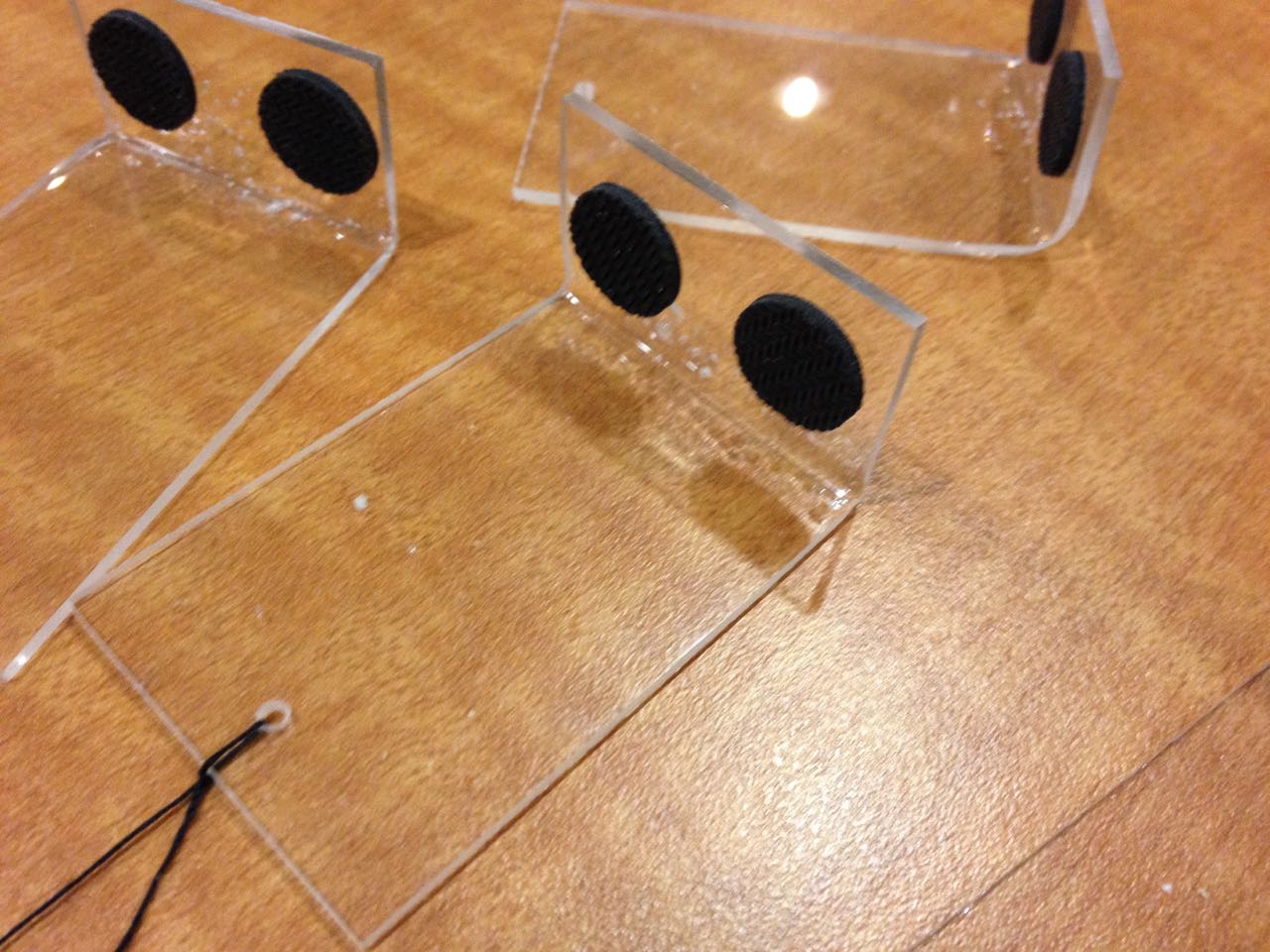
At the last minute this morning, I cut some acrylic sheet into strips and made some plastic clips to hang the posters from. The strips were cut to size and drilled and then heat bent to shape using a small torch. They aren’t perfect, but they work.

Late this morning, I crammed everything into my car and drove to San Francisco to set it all up.

IMG_1091

Models set up and ready to put on display.

IMG_1088

Homemade clips for hanging the posters.

This time, with all the display elements, it took me a lot longer to set up than I’d expected. I could imagine what it’s like to work setting up displays in department store windows. Overall, it was a good 45 minutes to bring everything up from the parking garage and to set it all up. The posters and the hangar clips took the most time to set up so that the posters hung at the right heights.

I felt I was kind of rushing the layout. It would definitely be helpful to get a second person to help with this so that one person can look at it and recommend adjustments while the other put the display elements into place.

In the end, I think it all worked pretty well and I’ve definitely got thoughts of Wasen Display 3.0 starting to develop. Having the third model will be good, which will most likely be Woody Joe’s Yakatabune as that’s a nice looking model and a quick build.

IMG_1093

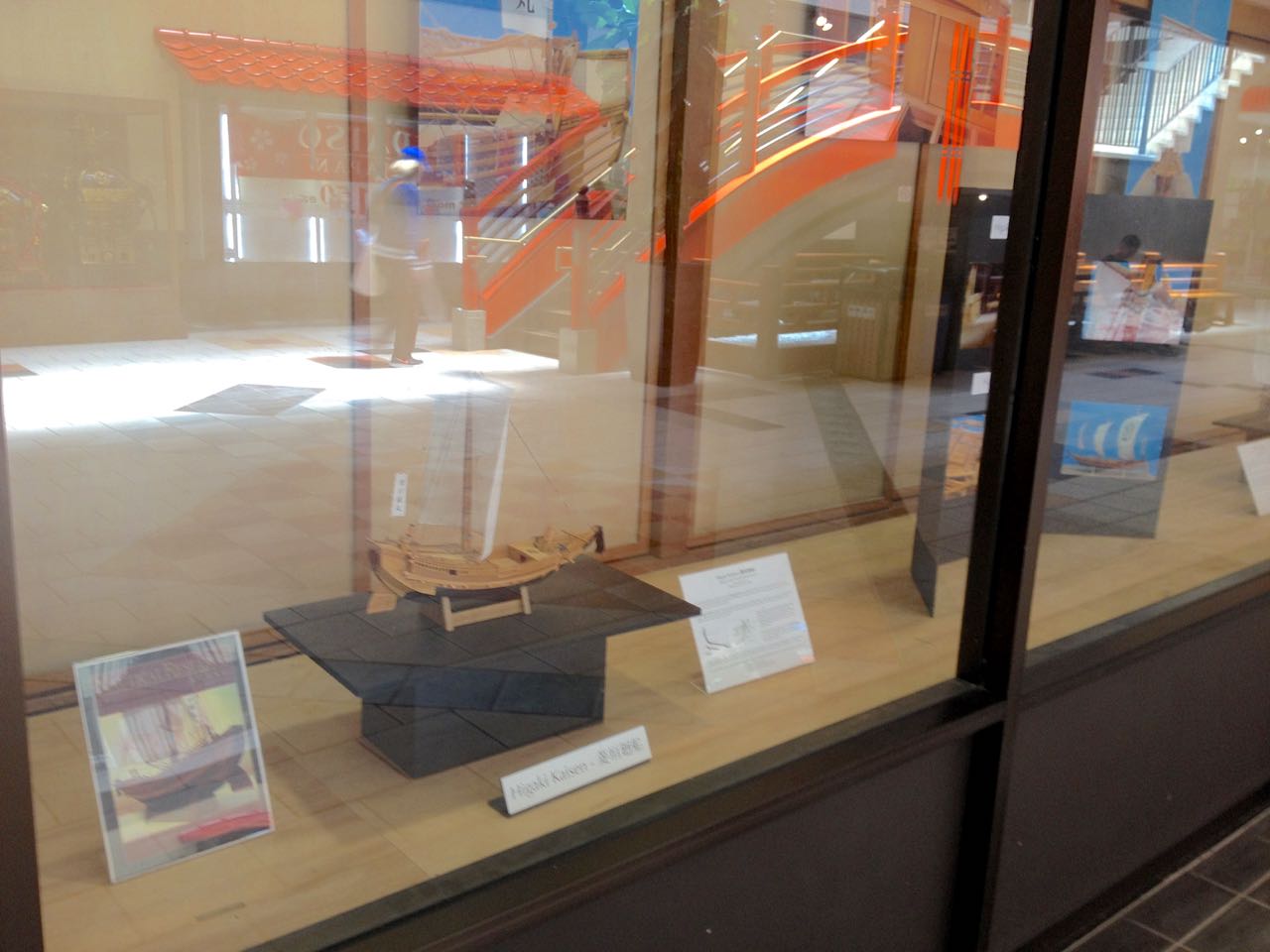
Higaki Kaisen model.

IMG_1092

Photo Board and Hacchoro model. Note the hanging posters.

One thing I realized was that every time I’m in the mall where I have time to take photos, it’s roughly noonish and the sun comes streaming straight down through the skylights in the mall. So, I mostly get a lot of glare in these photos. I think at other times of the display, it is much easier to see the models and photos. I’m going to have to check out that theory and take some photos maybe late in the day or evening early evening. Maybe I can get some decent photos of the display then.

IMG_1096

A much improved display over the last one.

Wasen Display 2.0 will run from Friday, June 5th through Friday, July 10th. I hope you will stop by to see it and let me know what you think!