Absolutely in Awe – My New Wasen Modeler God

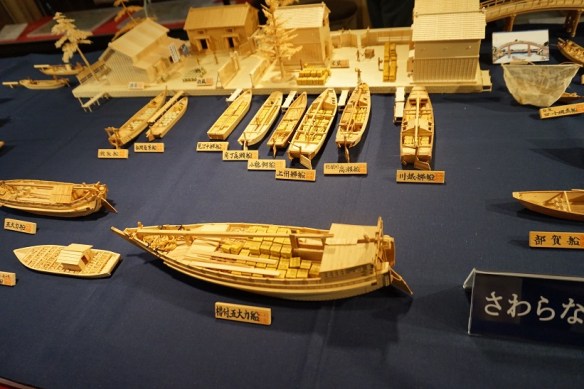
Today, I was digging through my usual research websites. In particular the Nippon Foundation’s online library, studying an article on Takasebune, when I ran across this photo, clearly depicting an entire collection of wasen models, all at the same scale. Translating some of the text around this image, I discovered that they appear to all have been built by a Mr. Yukio Nakayama.

011_02

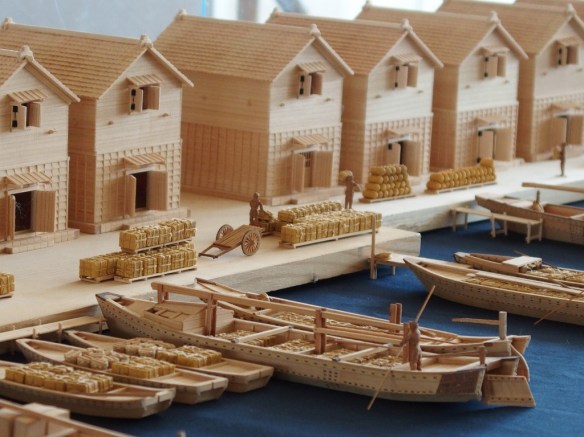
Not knowing anything about this person, I began digging around using his name in Japanese for my searches, 中山幸雄. What I found is a gentleman who has been built more than models of traditional Japanese boats and buildings, all at 1/70 scale.

636847_1462952095

OLYMPUS DIGITAL CAMERA

I don’t know much more about him, aside from the fact that he was born in 1953 and has been doing this for a long time, but it appears that the information on his work is fairly current. It seems that there are periodically exhibits of his work.

I will do what I can to find out about him and see if I can contact him. Being that my Japanese isn’t very good, I suspect that I won’t be able to do much communicating.

Time to send out some calls for help through my network of contacts!


What I Learned Today – Wasen Names

Last night, I finished writing a post about the set of books published in the late 19th century called Souvenirs de Marine, which contain drawings of ship from around the world, and specifically contain several examples of traditional Japanese wooden ships and boats.

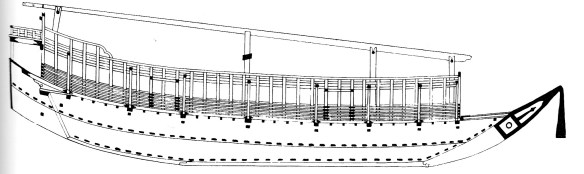
Afterwards, I was inspired to do some hunting around for images on the Internet of a specific type of ship I was looking at called a gozabune (Goh-zah-boo-nay). This is a type of large river or coastal ship that was highly ornate and used as official yachts by daimyo and other aristocracy. Many are simply warships, sekibune, dressed up during peacetime.
 

seto-ryu-sekibune

A Sekibune

In order to get the best hits on Internet search engines, I went to my Glossary of Terms page and copied the Japanese text for the gozabune to use for the search. This, by the way, is the reason I added the Japanese text to the page. If you’re looking for something specifically Japanese, the best way to find it is to do the search in Japanese. So, I searched for images using the text, 御座船, for gozabune. 

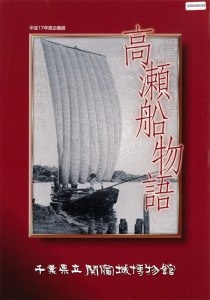
I found what I was looking for: lots of images of gozabune. But in my search, I stumbled across many things. One drawing, in particular, got my attention and it led me to a great article in the Nippon Foundation’s online library on the story of the Takasebune. To the best of my understanding, this was a book published by the Chiba Prefecture Tsukigaki Castle Museum in 2005.
h02

I don’t know if it’s still in print or available somewhere, but this appears to be the contents of that book: https://nippon.zaidan.info/seikabutsu/2005/00589/mokuji.htm

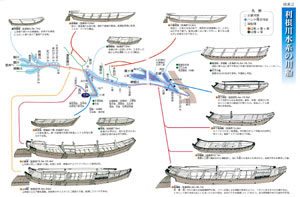
There was one image in particular in this article that showed various types of Takasebune and on what rivers they were used. Click on the image if you want to see the full-sized version on the Foundation site.
008

Now, I recognize some of these boats and their names, and specific information is great. But, what I’ve come to realize, more than anything else, is that the specific names of these boats may be irrelevant unless you are looking at a specific river system. This article is about Takasebune, but all the boats shown here have different names and are still Takasebune, even though some are called Hiratabune.

I think the issue may be that academics, and in this case I think I have to put myself under this group, attempt to classify these boats by names, but the names were given to them by the local people. They didn’t plan out how they were going to name them, they just named them.

So, I learned that when you hear or read the name of a boat, don’t think you know anything about the boat or what kind of boat it is unless you know the location it was used and have actually seen one or a drawing of one. There is much to learn!


Paris’s Souvenirs de Marine

There are a several kits available to the wasen modeler, between Woody Joe and Thermal Studio, but if you want to scratch build something unique, you’re going to have an extremely difficult time. Japanese boat builders didn’t draw detailed plans the way western boat builders did, and pretty much all that is available are those created from a study of an existing boat type.

61golufxt7l-_sl500_

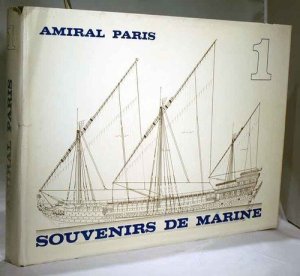
However, there is one fairly accessible set of drawings of Japanese watercraft that was made in the 1880s and published in a set of books called La Souvenirs de Marine by French Vice-Admiral François-Edmond Paris. This set of large-format books has seen a number of re-prints, and I’m not sure what the date is on the most recent reprint. But, there should be copies accessible in most of the larger library collections, and used copies can be found on Amazon and other booksellers, with prices that vary greatly depending on edition and condition.

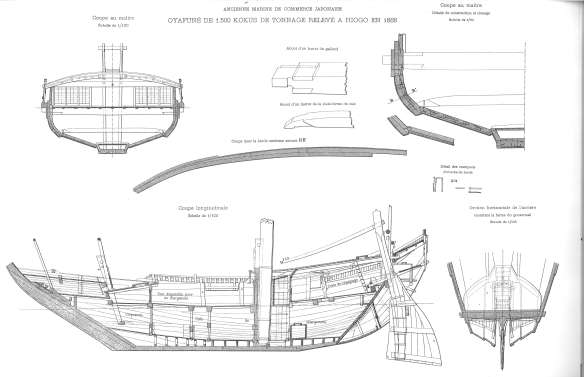
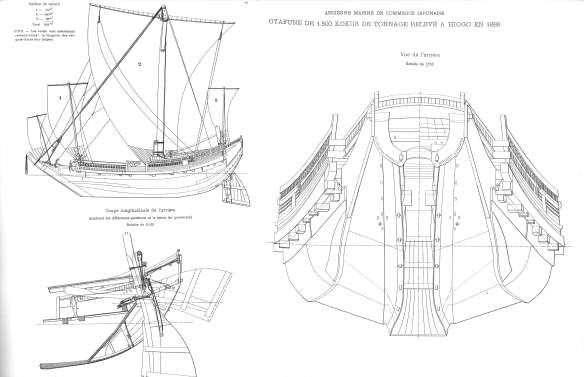
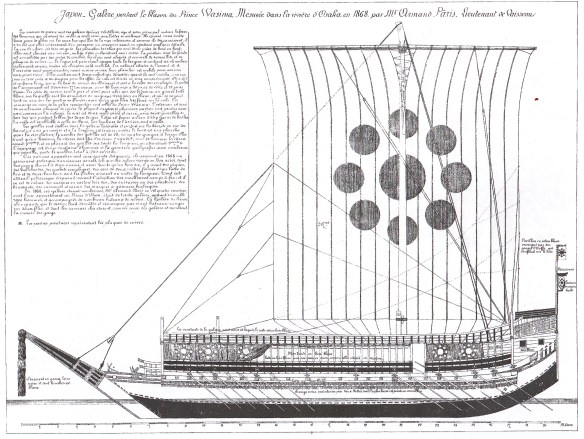
Drawings included are of ships from across the globe, and the text is in French, but this collection contains some of the few contemporary records of traditional Japanese watercraft available. Of the sections I’ve collected from the books, one illustration plate shows four different riverboats of various types. Other plates show two examples of bezaisen, or coastal transports. Other plates show a couple examples of highly ornate row galleys, one of which bears the crest of the Chiba clan on it’s large squaresail.

page-355

I haven’t studied these drawings in too much detail except for the two sets of bezaisen drawings, which are specifically of what appear to be northern port coastal transports, or Kitamaebune. The text doesn’t mention any Japanese terms, and again, it’s all in French. But the drawings are fairly well detailed. And, I suspect the text doesn’t give a huge amount of detail about the watercraft as it’s mostly limited to labels and sidebars.

page-356

Now, that I look at it more closely, I’m seeing how I might be able to model some of the other boats illustrated in the books, so I’m finding myself more interested in learning about them. If I find out more, I’ll post about them here.

image-2

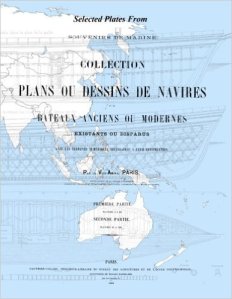
There are a couple of paperback books of selected plates that were published by James E. Hitchcock, which you can find on Amazon.com for less than $10. While the images are scanned and reprinted from an original copy, and the French text is very difficult to read, the book provides a handy reference so you can determine which plates you may be interested in.

51rr-z63tol-_sx384_bo1204203200_

I have found that the San Francisco Maritime Research Center has the set of books available, and will scan whatever figures you need and will email them to you at your request at no cost. You can contact them for details at 415-561-7030 or email them through the Park’s website.