Building a Himi Tenma in 1/10 Scale – Part 2

Reviewing photos of the Himi Tenma that Douglas Brooks worked on last Fall, I’ve been comparing them with the drawings from the Himi City Museum. There are a number of differences which I’ve marked on a copy of the drawings.
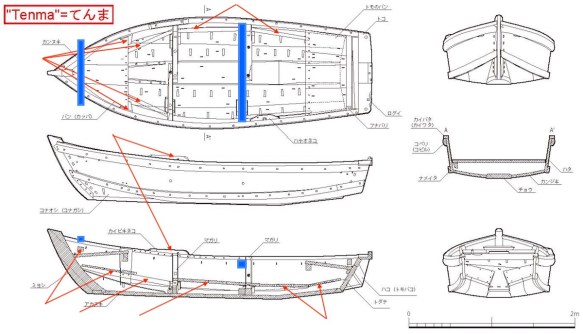
Modified copy of the Tenma drawings provided by the Himi City Museum, shown here with permission of the Himi City Museum.

To match the Himi Tenma built last Fall, the features that I’ve marked with red arrows will need to be omitted from my model. The blue rectangles represent the approximate size and location of beams which will need to be added to the model.
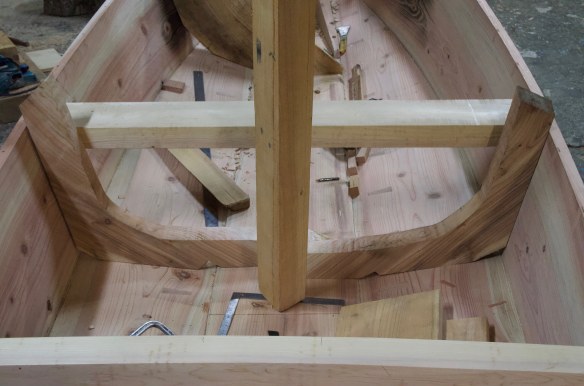
Photo showing the positioning of the overlapping frames. Photo courtesy of Douglas Brooks.

In addition, the other main difference is that if you look at the frames in the drawing, they are offset so that the starboard frames aren’t directly across from the port side frames. However, in the boat built last Fall, the tops of the frames actually sit directly across from each other, but since the frames still overlap one another, they are canted slightly. For now, I’m just making a mental note of these things, and will deal with them when the time comes.
Continue reading

“Fune” Build by Alexandru Gurau

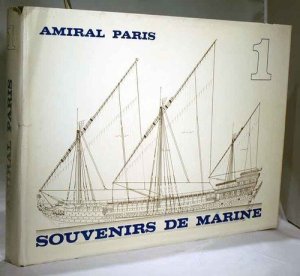
Years ago, ship modeler Alexandru Gurau of Canada had been building a model of a bezaisen, an Edo period coastal transport, based on drawings recorded by French lieutenant Armand Paris, and recorded in the book Souvenirs de Marine.

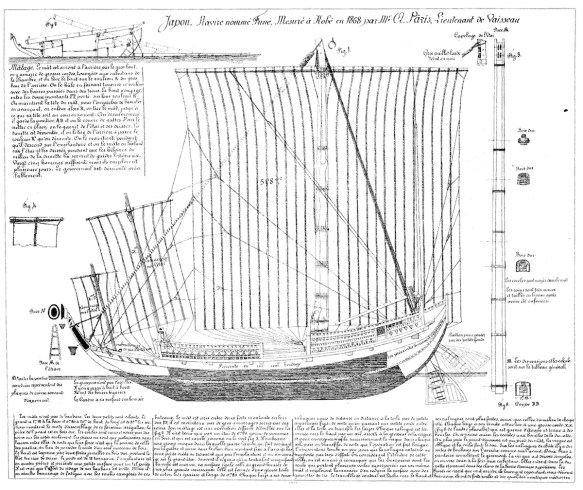
I was particularly impressed by Mr. Gurau’s work, as the information contained in the Paris drawings are a bit difficult to follow on their own. My own experience with the building a model from Paris drawings resulted in my own Kobaya project. In that particular case, I had discovered that the drawings may have been somewhat incomplete as they were based on vessels that were no longer in use and seemed to be missing features. I believe that problem was unique to that particular vessel, and the other Japanese boats recorded in the book appear complete. Still, not always easy to decipher all the information needed. Not to mention that the note contained in the drawings are handwritten in French.

Still, for the larger subjects in particular, like Mr. Gurau’s Fune model, It just seems difficult to wrap one’s head around the details due to the unusual nature of the hulls of these coastal transports – unusual to the western eye, anyway.

Scan of what Paris describes simply as “Fune”, recorded at Kobe, Japan, in 1868.

The Mr. Gurau’s model was mostly completed in 2013-2014, but he recently updated some things, which brought the model back to my attention. His dealing with the sails of the vessel have given me new inspiration to complete the sails of my own kitamaebune model, which is based on a kit from Woody Joe.

His build photos are available to view on his personal ship modeling website here:  http://www.alexshipmodels.com/2016/10/28/fune-build/

He also documented the build on The Nautical Research Guild’s Model Ship World (MSW) online forum here: https://modelshipworld.com/topic/3230-fune-by-alexandru-finished-japanese-ship-of-1868-scale-150/#comments

The one thing to note on the MSW forum’s topic title and first entries say that the model is built at 1/50 scale, but it appears that his model was actually built in 1/100 scale.

In any case, it’s nicely done and worth checking out. Ω