A Blog Site on Illustration of Historical Japanese Ships (和船図譜)

I was digging around on Youtube a few weeks ago and discovered an interesting 3D walk-around video of a traditional Japanese boat. In the description, I found a link to a Japanese website called Wasen Zufu (和船図譜) or Illustration of Historical Japanese Ships. This is apparently a blog site of someone in Japan who has created some virtual 3D models of a few wasen. Some of these are shown as a textured image, with a couple shown in walk-around video clips of them.

Many people might not take much notice, but I saw that a couple of these reminded me of boats I had seen in a book on boats of Toyama prefecture. Looking more closely, sure enough, three of the boats from Toyama are included.

3D digital models are interesting, as you should then be able to view then from any angle, and thus get a better sense of what they look like. I suppose they’re really no different from physical models, though these digital models lack some details, such as planking and fastening. But, on a small enough scale, my own wooden models may lack some of these features. So, that does cause me to rethink those smaller models of mine.

But in any case, the site, as I say, is interesting. One of the most interesting things to me, was to discover a link to the text of a talk given by Mr. Naoki Hirose, the curator of the Himi City Museum, and someone I actually know. I already wrote about the details about this in a previous post here: Funabashi – Boat Bridges in the Edo Period (船橋).

Anyway, you can check out the site here: https://blog.canpan.info/wasenn-zufu/

I’ve written to the owner of the site and he indicated he was going to keep making illustrations. So, while the site doesn’t seem to have been updated in a while, perhaps we’ll seem some new information there in the future. Ω


Funabashi – Boat Bridges in the Edo Period (船橋)

The term Funabashi, is probably most recognized as a city immediately east of Tōkyō, in Chiba prefecture. But the name literally translates to boat bridge. This is a totally unknown subject to me – I never knew they even existed until a few days ago.

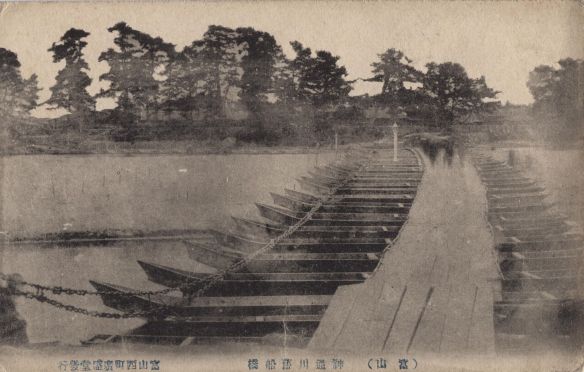
Photo of the funabashi near the mouth of the Jinzu river in Toyama prefecture.

While following Internet leads, as I often find myself doing, I ran across the text of a Japanese lecture that turned out to be by Mr. Naoki Hirose, who I know from his connection with Douglas Brooks’ work in Himi City, Toyama prefecture, and more recently from the Wasen Kenkyu Kai meetings that I’ve been attending recently via Zoom. He is the curator of the Himi City Museum. As I already know and communicate with Hirose san now and then, what a coincidence and discovery! The lecture was actually part of some kind of event focused on railroads, but this was an article that talked about how things and people traveled on the “boat highway”.

Continue reading

Site Updates, Tarukaisen (樽廻船)

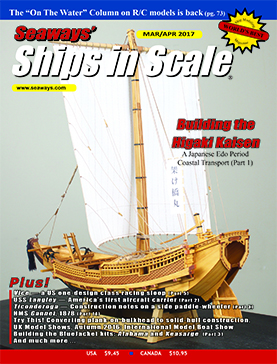
Today, I just added a couple new items to my Downloads page, including the full pdf files of the Higaki Kaisen article that I wrote for Seaways’ Ships in Scale. The magazine, now defunct, included my article as a 3-part series on the building of Woody Joe’s 1/72-scale Higaki Kaisen kit.

I wish the magazine were still around, as I would most certainly still be writing articles for them. They were very easy to work with and I thought they compensated authors pretty well.

The three files are actually the proofs that I got from the publisher prior to print, but that’s all I have. There were very few corrections that needed to made, and they were pretty minor, so anyone following these articles shouldn’t run into any issues.

At the same time, I went ahead and added a link to the Japanese text on the building of the cormorant fishing boat, which was written by Douglas Brooks and company. Again, it’s all in Japanese, but hey, it’s a free download.

Website Organization

Meanwhile, I’m thinking I need to better organize my blog material, so I can write more often. I do a lot from day to day, and I need to be writing about it more. Meanwhile, I want to keep specific topics easily accessible and uncluttered. So, that’s something to work on. Please feel free to email me if you have any ideas.

Taru Kaisen (樽廻船)

And, as long as I’m just doing some general blogging, I thought I’d put out a request for any information that you all may have found on Taru Kaisen. For those that don’t know, these are coastal transports specifically used for transporting barrels of sake. They actually started off transporting other high value foods from the locations that were best known for them. However, by the late Edo period, they were carrying only sake, and lots of it.

I found a website showing the making of this beautiful 1/35-scale model of a Tarukaisen. You can click on the image to link to the site.

There’s a great article in a past issue of the Sake World Newsletter from January of 2007 that has some interesting information about Tarukaisen and sake in pre-modern Japan.

http://www.esake.com/Knowledge/Newsletter/SW/SW2007/sw2007_0.html

This doesn’t answer the big question for a wasen modeler, which is if there is any visible characteristics that identify a bezaisen (Japanese coastal transport) as a Tarukaisen. I’m reviewing the Tokyo Museum of Maritime Science publication about Higakikaisen and Tarukaisen now. But, if you know of any good information on the subject, please let me know. You can comment on the blog or just send an email to info@wasenmodeler.com. Ω

Cormorant Fishing Boats Book by Douglas Brooks (Japanese) – Free Download

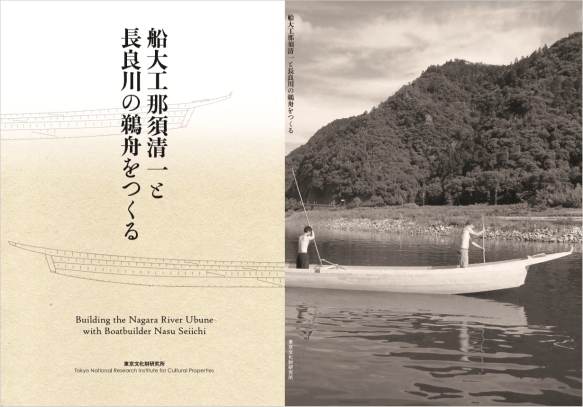
A couple days ago, a new publication by the Tokyo National Research Institute for Cultural Properties was posted on their Tobuken website.

船大工那須誠一と長良川の鵜舟をつくる

Building the Naragara River Ubune with Boatbuilder Nasu Seiichi

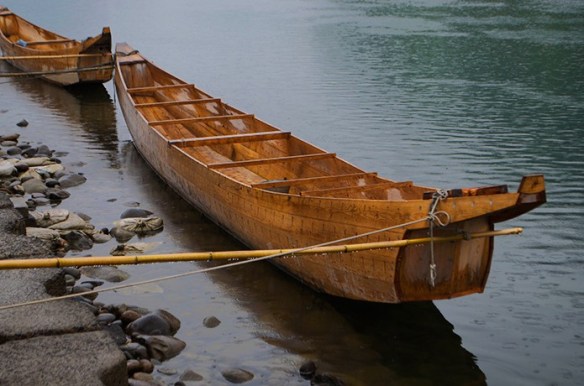
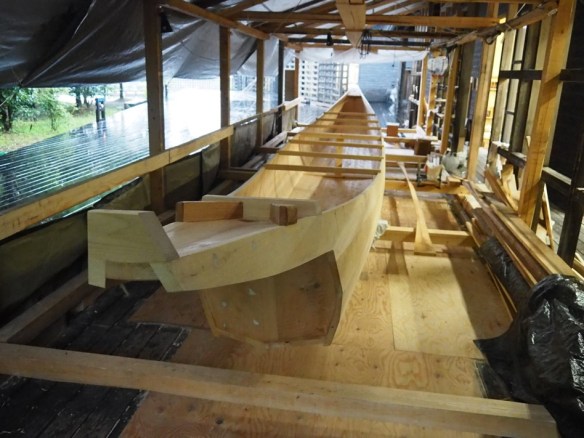
The publication is compilation of the work by boatbuilder Douglas Brooks in Gifu, Japan, in 2017, working with 85-year old boat builder Mr. Seiichi Nasu, on the construction of a cormorant fishing boat. The boats are called Ukaibune or Ubune, the latter being a the local term and simply meaning cormorant boat.

Photo courtesy of Douglas Brooks.

The book is in Japanese, but contains Mr. Brooks’s writings about the project, as well as a section by Mr. Masashi Kutsuwa on riverboat culture. For those interested in the tools used in the boatbuilding process, there is a huge section in the back with photos and scale line drawings of each of the tools used.

Photo courtesy of Douglas Brooks.

Only 500 copies of the book are being printed and provided to libraries and research institutions, and none are available for sale to the general public. However, a pdf version is available for download, free of charge, and was recently posted on the Tobunken website:

https://www.tobunken.go.jp/…/wp-con…/uploads/ubune2020-1.pdf

Also, Douglas Brooks has also completed a manuscript for his own english language book, which will be printed and available for purchase. This will be available, hopefully, in early 2021. Ω

Simple Cargo for a Wasen Model

I’ve been thinking about making a diorama to include my recently completed tenma-zukuri  chabune. One of the uses of such a boat was for transporting cargo. So, a diorama is going to need something for the boat to carry. An empty boat is fine for displaying the boat itself, but it’s not going to look right in a diorama.

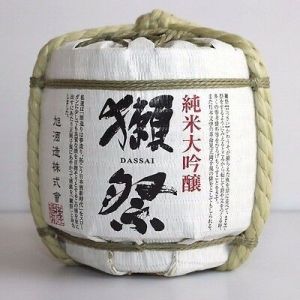
Possibilities include barrels of sake or miso, or bales of rice. But, I’ve found that these are can be just bit complicated due to their shape and the way that are wrapped. Sake barrels, called taru, have a somewhat fat, squat shape and, at least in modern times, are wrapped with colorful logos and writing. They would be interesting to include, but a bit complex for what I want to do here, especially with the unique rope wrapping.

One of the simpler examples of a sake barrel I’ve found on the Internet.

Continue reading

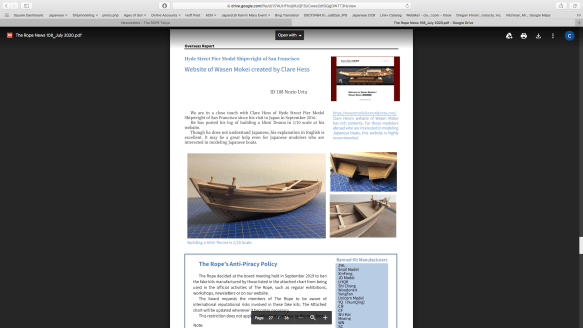
Wasen Mokei Website in The Rope Newsletter

My wasen modeler / wasen mokei website got a nice little blurb in the most recent issue of The Rope Newsletter. This issue, due to the coronavirus, is an expanded issue based on member reports, and not just based on members attending a meeting, as they usually are, so it’s a big issue, 36 pages!

In a half-page section of their Overseas Report, my Himi Tenma model got some mention. But, probably more importantly, the website got some attention. The writeup even goes so far as to suggest that “It may be a great help even for Japanese modelers…”. So, it’s nice to see that there is enough content here to gain a little recognition. Hopefully, I’ll be able to keep building up the content for some time to come. Below, is a link to the full newsletter, so you can see what’s going on with some of the ship modelers in Japan:

https://drive.google.com/file/d/1i7WJHFhxjbRJQF3UCweo2dfGQgDWTT3N/view

Ω


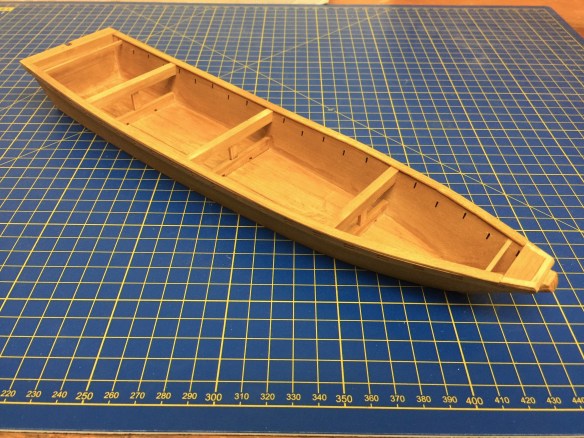
Building a Tenma-Zukuri Chabune (伝間造茶船) – Part 5 – Final

First off, my apologies for taking so long to post an update on this project. The Tenma-zukuri Chabune is actually done. It sat for a long time with all the construction work done, needing only the coppering detail. I finally got the nerve to get back to it and it is now finished. But, when I last posted, there was still work to do, so let me take a step back to go over what was done.

Last we left off, the nail mortises had been cut and I was ready to add the decks at the bow and stern, or the omote and the tomo.

I don’t know if the boards that make up these decks were removable. Underneath, I left the ends open, so things could be tucked in there for storage, but only for smaller things, as the support posts of the beams cut the openings in half. If the deck beams were removable, there should be finger holes in at least some of the deck boards, so they could be easily lifted up. Sometimes, there was also a V-shaped pattern inscribed across the boards to make it easier to identify which boards go where. This is less important at the bow, where the boards lengths vary greatly, making them more easily identifiable as to which one goes where.

At 1/20 scale, I decided to keep things simple and didn’t add either finger holes or the alignment inscription. This would be more important on a larger scale model, like 1/10 or 1/15. So, adding the deck boards was just a matter of laying them down.

Continue reading