Wasen Mokei Website in The Rope Newsletter

My wasen modeler / wasen mokei website got a nice little blurb in the most recent issue of The Rope Newsletter. This issue, due to the coronavirus, is an expanded issue based on member reports, and not just based on members attending a meeting, as they usually are, so it’s a big issue, 36 pages!
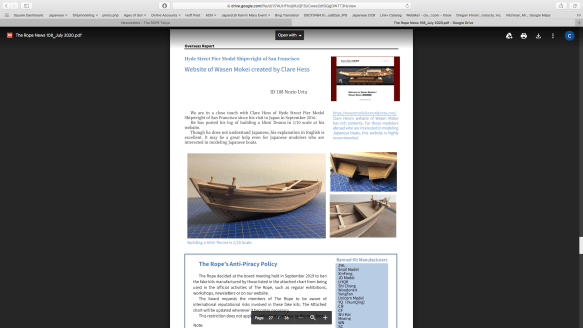
In a half-page section of their Overseas Report, my Himi Tenma model got some mention. But, probably more importantly, the website got some attention. The writeup even goes so far as to suggest that “It may be a great help even for Japanese modelers…”. So, it’s nice to see that there is enough content here to gain a little recognition. Hopefully, I’ll be able to keep building up the content for some time to come. Below, is a link to the full newsletter, so you can see what’s going on with some of the ship modelers in Japan:

https://drive.google.com/file/d/1i7WJHFhxjbRJQF3UCweo2dfGQgDWTT3N/view

Ω
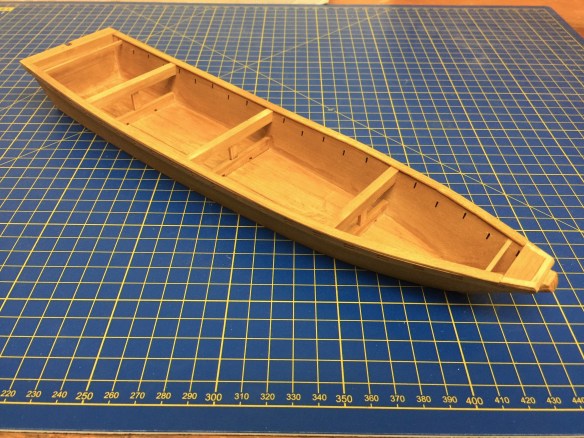
 

Building a Tenma-Zukuri Chabune (伝間造茶船) – Part 5 – Final

First off, my apologies for taking so long to post an update on this project. The Tenma-zukuri Chabune is actually done. It sat for a long time with all the construction work done, needing only the coppering detail. I finally got the nerve to get back to it and it is now finished. But, when I last posted, there was still work to do, so let me take a step back to go over what was done.

Last we left off, the nail mortises had been cut and I was ready to add the decks at the bow and stern, or the omote and the tomo.

I don’t know if the boards that make up these decks were removable. Underneath, I left the ends open, so things could be tucked in there for storage, but only for smaller things, as the support posts of the beams cut the openings in half. If the deck beams were removable, there should be finger holes in at least some of the deck boards, so they could be easily lifted up. Sometimes, there was also a V-shaped pattern inscribed across the boards to make it easier to identify which boards go where. This is less important at the bow, where the boards lengths vary greatly, making them more easily identifiable as to which one goes where.

At 1/20 scale, I decided to keep things simple and didn’t add either finger holes or the alignment inscription. This would be more important on a larger scale model, like 1/10 or 1/15. So, adding the deck boards was just a matter of laying them down.

Continue reading