Wooden Japanese Traditional Boats – The World of Yukio Nakayama

木造和船 中山幸雄の世界

Yes! I managed to stumble across Mr. Yukio Nakayama’s wordpress blog site by pure chance today. I’ve know about this man and his work for about a year now. One of my Japanese ship model contacts even sent me some photos of the man’s work at an exhibition several months ago, but he never put me in contact with him.

I wasn’t too worried because my Japanese language skills are not good and I figured it would just be either frustrating or annoying for Mr. Nakayama if I tried to communicate with him, though I did find someone else who offered to put me in touch with him. Now that I’ve found his blog, I may just have to try.

In the meantime, you can visit his site and poke around and see some of his work on his blog. You’ll find a few drawings, plus photos of several of his models.

All his models are the same scale, 1/70 I believe.

江戸木造和船細工師

Source: 木造和船 中山幸雄の世界

The above link will take you to his blog, but here’s the URL: http://edowasen.wordpress.com

Higaki Kaisen and Tosa Wasen Build Logs

Today, I finally got around to migrating two important build logs from my shipmodeler blog over here to wasenmodeler. The blogs cover the building of Woody Joe’s Higaki-kaisen model kit and Thermal Studios’ Tosa wasen kit.

My Higaki-kaisen model built from a Woody Joe kit

My Tosa wasen model built from a kit from Thermal Studio

While the blogs are not step-by-step instructions, it’s my hope that they may prove helpful to someone building the kits or interested in them. The original build logs are still on shipmodeler, but I’ve managed to use the WordPress system to export them from the other blog and import them here. Quite easy, actually.

The only other build logs that I would consider moving from shipmodeler are for the two Woody Joe mini-kits, the Hobikisen and the Yakatabune. Since these are just simple mini-kits that aren’t particularly accurate, I’ll probably just leave them where they are. After all, there is plenty write about and post here.

To access the newly migrated build logs, simple choose them from the Wasen Model Blogs menu above.

Painted Patterns on Kujirabune (Whale boats)

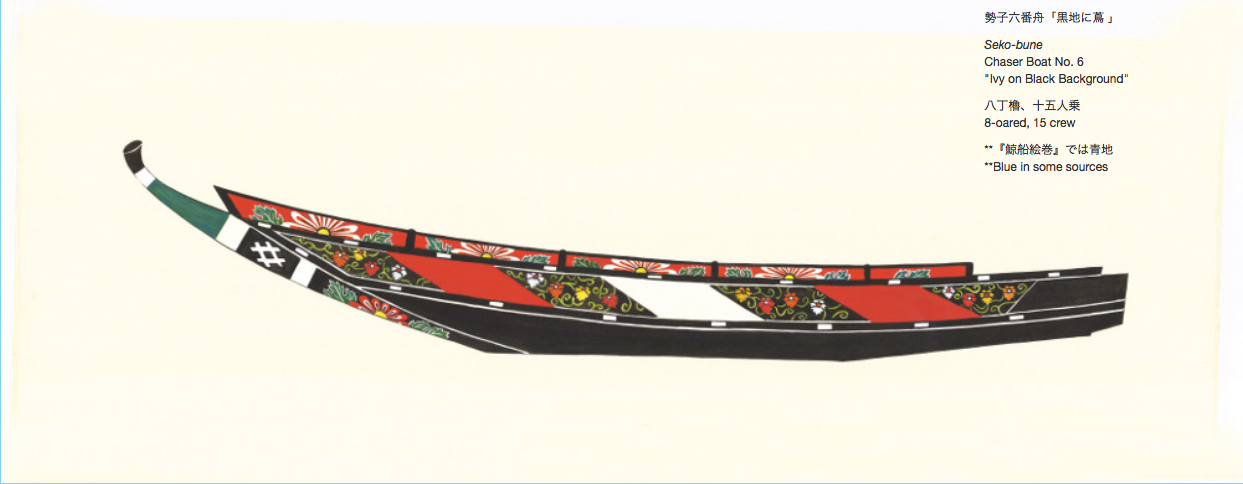
Kujirabune, also know as Isanabune, were fast boats designed for hunting whales. These boats often had brightly painted sides, decorated with symbols, crests, chrysanthemums, and other themes.

One such boat that I’ve mentioned specifically here is the Senzanmaru, a boat used by the  Hachizuka to deliver dispatches and to tow large gozabune, highly decorated yachts used by the clan.

Senzan-maru, a whale boat used by the Hachitsuka clan.

Today, I was admiring a Facebook post by a gentleman I’ve recently been in contact with who has an interest in wasen and took some photos of a group of whaleboats that were on shore in Kumano city, on the Southeastern tip of Shikoku island. I looked up the city on the Internet and one thing led to another. Next thing I know, I ran across an english language web page for the town of Taiji, which illustrates a large number of whaleboats of different types and their colorful painted hull patterns.

Chaser Boat No. 6, an 8-oared boat with a crew of 15. From the Taijiri town website.

There are more than 40 boats and patterns viewable on the web page: http://taiji.town/kujirabune/

But, the whole website is actually very interesting and informative. It appears that it was purposely designed to be a politically neutral, informative site on Taiji an its history in Japanese and English. Visit http://taiji.town

One thing I’m intrigued about is from the whale boats page when you click the About button. There is a detailed plan on the page. It’s too small to use, but I will be asking some friends if they can find out if these plans might be available from the museum. If so, you’re sure to hear about it here.

The Rope: Article on the Funakagami and Historical Japanese Boats

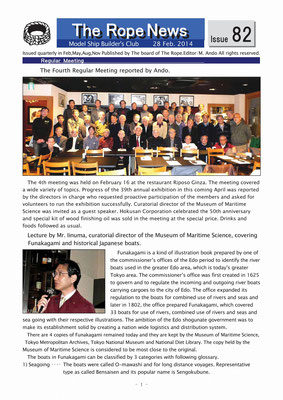
Continuing with a string of posts about the Japanese ship model society, The Rope, here’s a short, but very interesting article describing a talk given by the curatorial director of the Tokyo Museum of Maritime Science. In this talk, Mr. Iinuma describes Japanese historical boats and the role of the book, Funakagami. I posted about this earlier in the year, along with a link to a downloadable pdf copy of the book. This article in The Rope News is a better discussion of the book that mine, and it’s a very short summary.


Cover of the Funakagami

I read this and, learned a few key things that I didn’t know about. One in particular was why the stem (the term bowsprit is mistakenly used here) on many yakatabune shown in wood block prints, look incomplete. I’ll let you read that answer for yourself. You can read the article online or download a copy:

https://drive.google.com/file/d/0B6tkJLrPbZUEa21zZ0JmMmMxYTQ/view

And, here is a link to my own blog post on the Funakagami where you can download a copy directly from the Tokyo Museum of Maritime Science: https://wasenmodeler.wordpress.com/2016/08/18/funakagami-a-pdf-book-on-japanese-boat-types-2/


The Rope: Photo Gallery of Japanese Sailing Ships and Boats

I only just discovered that there is a page on the website of the Japanese ship model society The Rope that features models of Japanese ships. These include some modern era ships, but several Edo period ships are represented. This group does some really beautiful work, which I recommend checking out.

Here’s a link to the page, which is on the English language section of their website: https://theropetokyo-en.jimdo.com/japanese-ships-1/photo-gallery-of-japanese-ships/


Building the Kamakura Period Umi-Bune, Part 6

As I mentioned in my last post on this model, I’d been wrestling with the configuration of the roofs. The 1/20-scale museum model that I often see reference on the web, differs from Professor Ishii’s 3-view illustration that I’ve mostly been basing construction on. Those drawings are more of a match to the early scroll paintings. Oddly enough, none of the models I’ve seen match them exactly. Is it possible that the builders had access to more updated information? Or did they just decide that the Ishii-san was wrong? But, then what about the scroll paintings? Are they simply written off as being wrong?

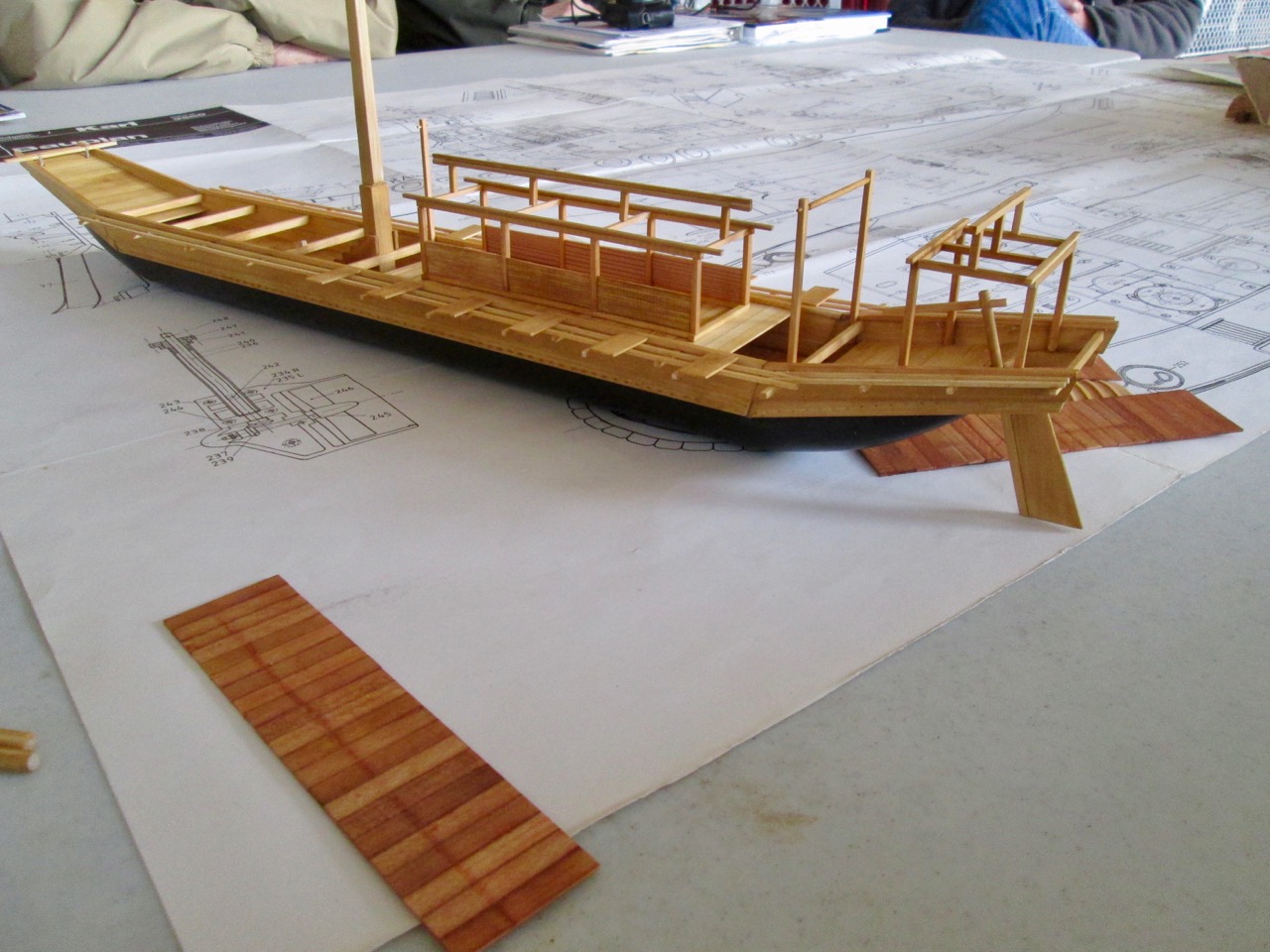
As you can see in the photo below, which was taken at a ship model club meeting, I initially made flat roofs panels. If I could justify them, they would certainly be the simplest to construct.

Flat roof panel initially constructed is seen in foreground.

Continue reading

On Amazon – Illustrated History of Japanese Traditional Boats by Kenji Ishii

I had to post this, because it is a very rare find. This book, written by Professor Kenji Ishii, was published in 1983 and is pretty much the bible of historical Japanese watercraft.

Illustrated History of Japanese Traditional Boats

This is the primary source for my own research on the subject of wasen, or traditional Japanese boats. I bought my copy used from Japan and it cost me around $170 with shipping. It was definitely worth the investment, as this information is extremely hard to  find anywhere else, especially outside of Japan.

Well, today, I was updating my post on my Kamakura period large sea boat project and I thought I see if I could find a link to this book on Amazon.com. I did and lo-and-behold, there’s an actual copy available in the U.S. for about $100!

https://www.amazon.com/Wasen-Shiwa-History-Japanese-Ships/dp/B00IOZFMPG/ref=sr_1_9?ie=UTF8&qid=1502065748&sr=8-9&keywords=kenji+ishii

I had to pass this along to readers here – this is a steal! I’m surprised to even see it listed here, because it’s written entirely in Japanese, so I wouldn’t expect copies to be turning up in the U.S. again, except in very rare cases. In fact, I don’t even see it listed on Amazon Japan at the moment.

Buy it before it’s gone. Seriously.