
More progress on the model and I’m on something of a roll now, as the trickiest questions I had I’ve now managed to pretty well answer. Let me begin by posting a translation of the French text that accompanied the drawings in Le Souvenirs de Marine. This is something of my own interpretation based on direct translation of the text using Google Translate and my own knowledge of French, and of a Japanese translation of the text that I found on the Internet, which I then translated into English, again using Google Translate. Correlating the translation, and the translation of a translation, I then went and rewrote the description based on the drawings and on my knowledge of Japanese watercraft. The notes in square brackets are my own clarifications.
From Paris:
No.15-1
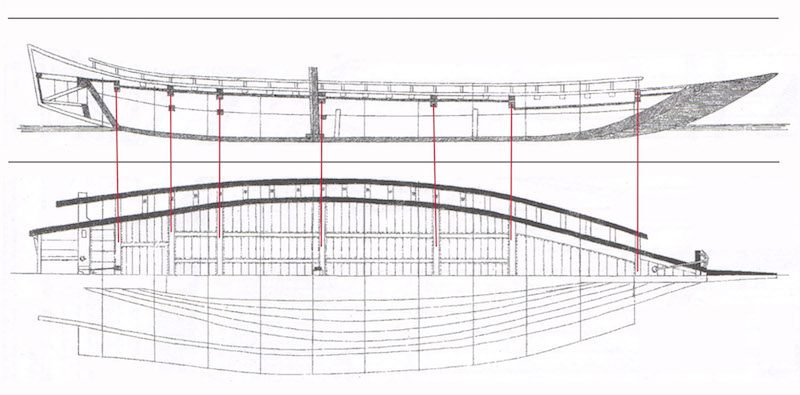
Japan, Small Galley Measured in Yokohama in 1868 by Mr. Armand Paris, Ship’s Lieutenant.(Drawing No. 15-1)
This kind of small galley belonged to the Taikun [ “Great Prince,” the Shōgun Tokugawa]. The construction of extreme lightness is very careful and the method of assembly of parts is the same as that of other boats with a single layer of planks. The stern differs in that it is closed by a panel [false transom], and it has bulwarks raised at the back. The beams are in pairs and placed one on top of the other the lowest one carries the joists, on which rest the deck planks.
The upper beam protrudes and carries the galleries, which are supported by the beams. Between these are short hanging beams mounting the oars like aboard the great galleys [sailing ship], but at their short length, only one rower is on each oar.
On the deck near the bow is a lowered section, above which is placed a flying hut [a framework covered over by an awning]. In the galleries on the side there are no oars here. Instead, boards for walking are placed.
The mast is square and set up as on other boats. Sails are not known, but they must be of little use for a boat so well made for rowing.
In Yokohama there were three such ships, but the dimensions of the largest ship are shown in the layout diagram.
The dimensions of the two smaller:
Maximum length 12 m 81 12 m 62
Ship width 2 m 96 2 m 52
Maximum width 3 m 80 3 m 30
Mold depth 0 m 93 0 m 79
These ships were abandoned and in poor condition, like other Japanese ships, the days of these ship have passed. Continue reading


 Wasen Mokei 和船模型