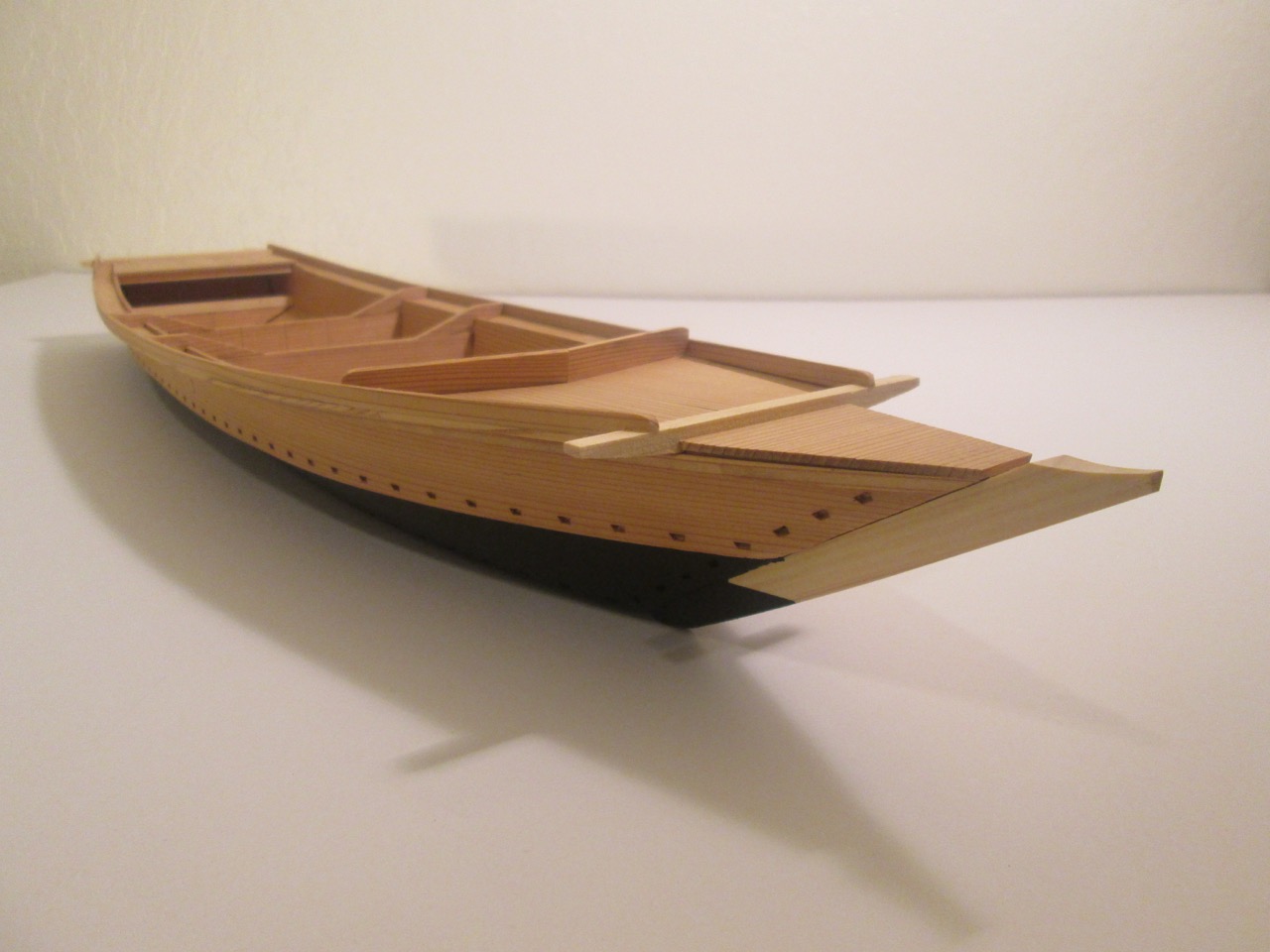
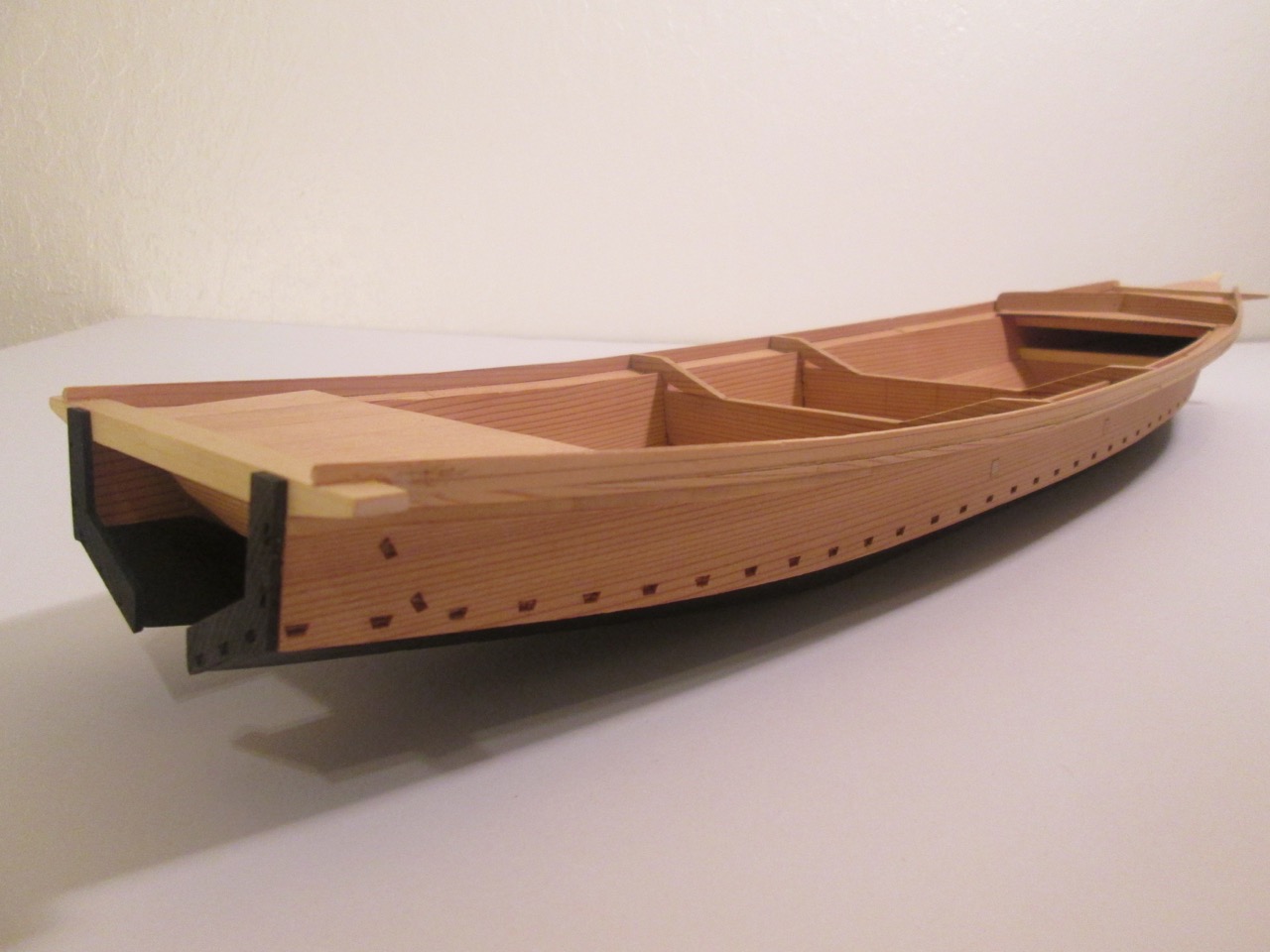
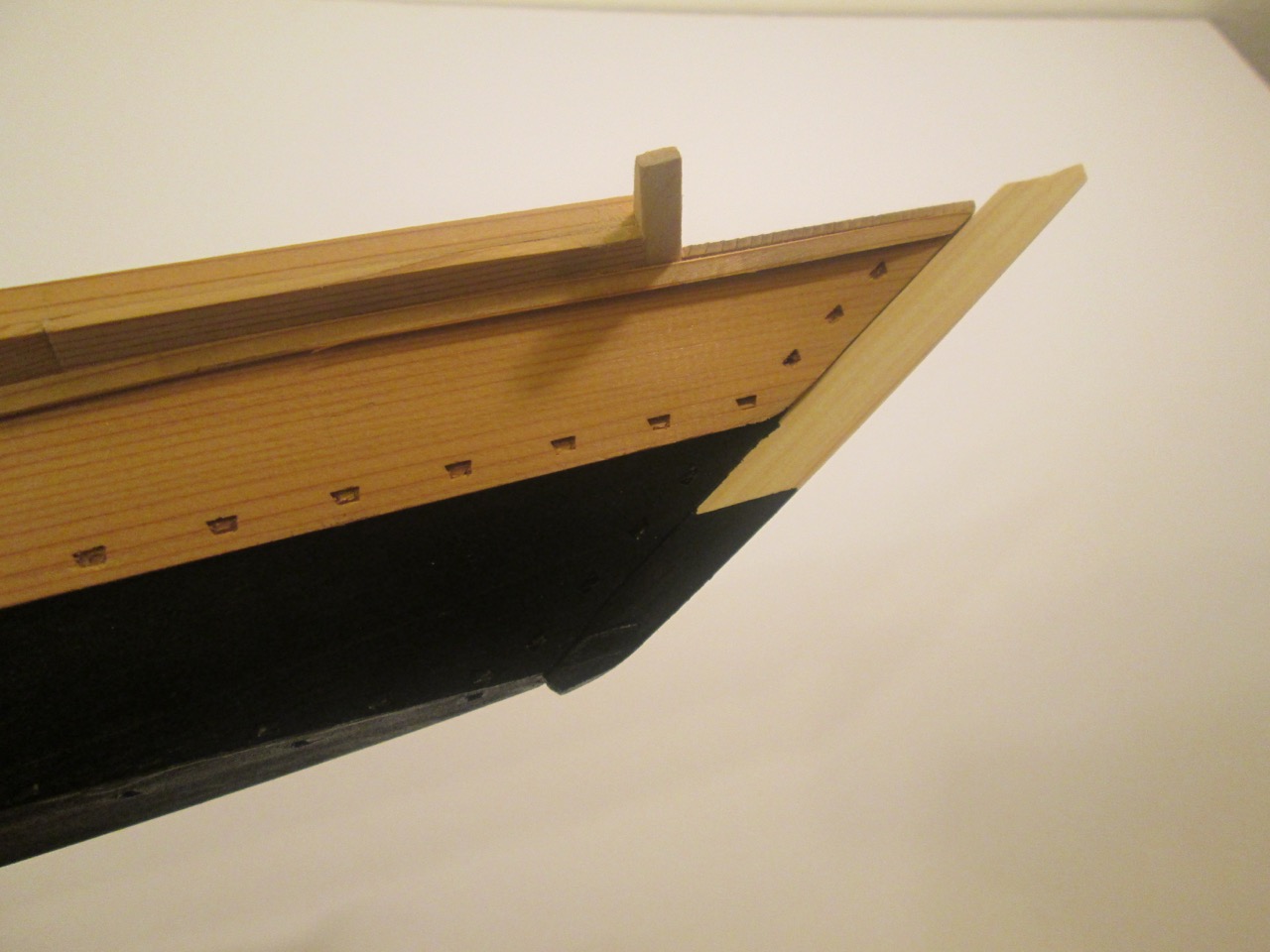
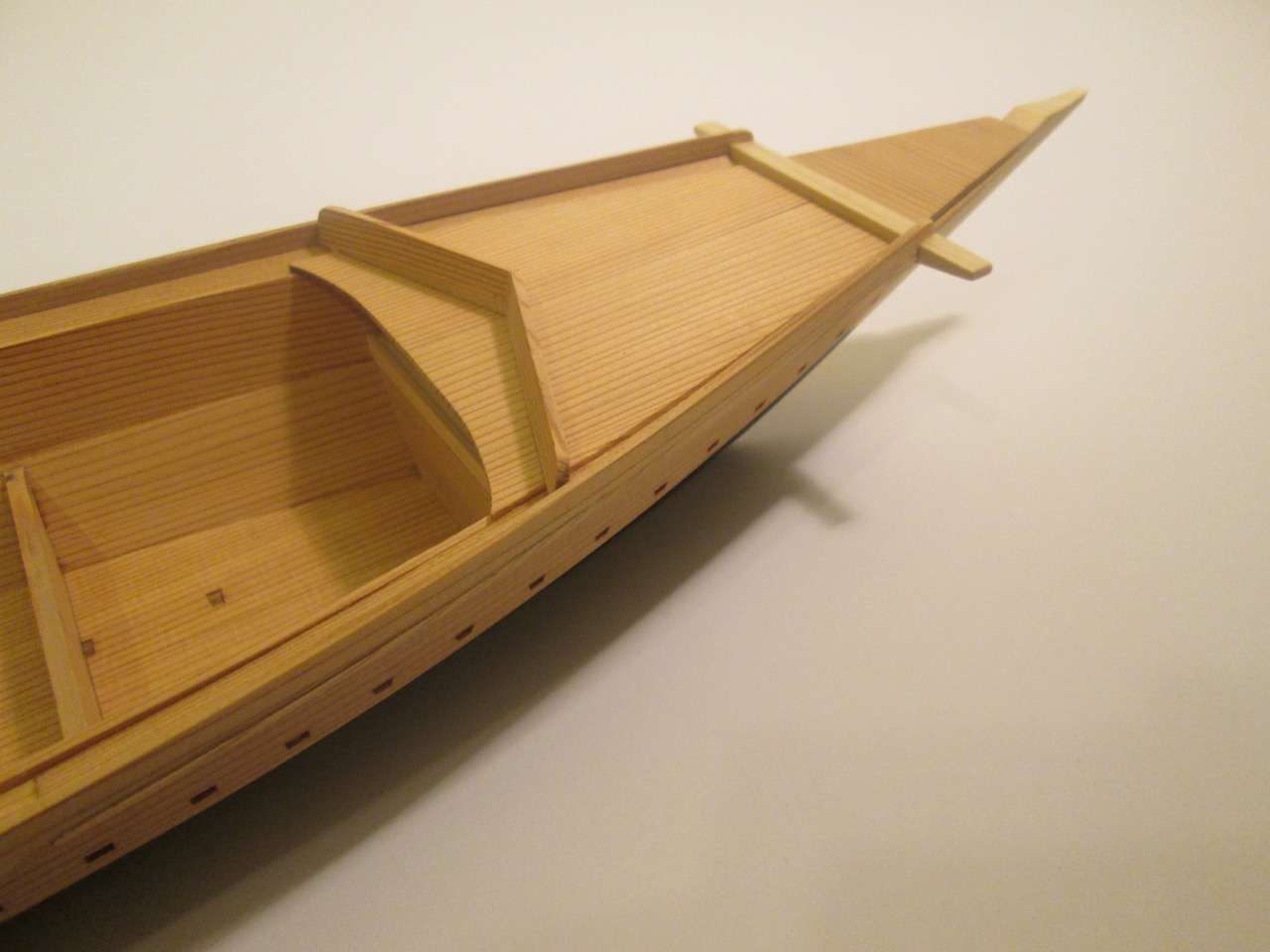
Visiting the Umi no Hakubutsukan

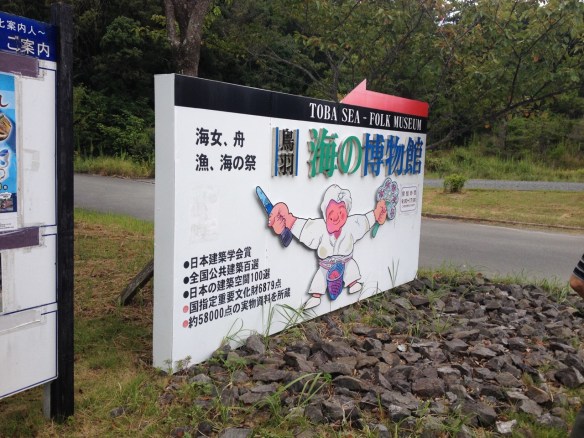
That’s what the Toba Seafolk Museum is called here in Japan. While there are some signs in english on occasion, if you ask anybody for directions or about the museum, it really helps to say it in Japanese: Umi no Hakubutsukan (oo-mee-noh-ha-coo-boo-tsoo-kahn).
IMG_2688

After a really long first day in Japan, which included visiting Woody Joe in Shizuoka and then getting a good look at the Hacchoro in the port of Yaizu, I was a bit burned out and decided to just relax in my room in the morning. The museum opens at 9:00am, but I didn’t get there until a little before noon.

First, a note about using Google Maps, which I used heavily during trip planning. If you look on the web about the museum, it would appear that the museum is open daily except for a small handful of holidays. Well, Google Maps, has a neat feature where you click on a public place like the museum, and it will tell you how popular the place is over the hours of the day. This would help you figure out when to avoid crowds. Well, I had a last minute freak-out before I left home when Google indicated that the museum was closed on Tuesdays, the main day I was to be in Toba.

So, I made contingency plans, and when I arrived at Toba, I asked about the issue at the hotel, but they said it was open. Could the hotel owner not know the museum is closed on Tuesdays? Seems unlikely. And, in fact, the museum is open on Tuesdays. Google lied, so just beware of that online feature.

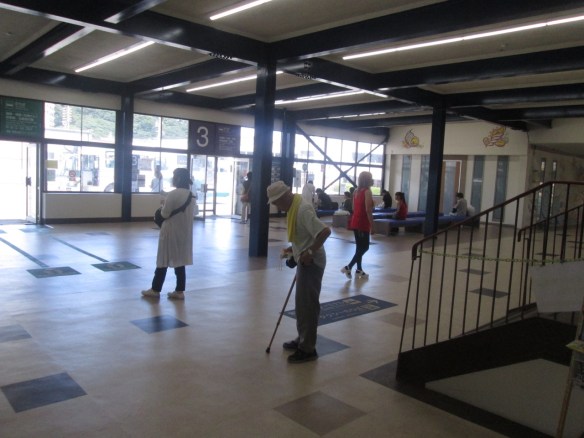
Getting to the museum from town is very easy. There is a great local bus system here that you want to use called the Kamome Bus (kah-mow-may). The bus center is attached to the Toba JR station. Just be aware it’s on the ocean side of the tracks. The bus to Umi no Hakubutsukan is the No. 4 bus and it picks up at station number 2. The person at the ticket window can indicate which door the bus arrives at.
IMG_0946

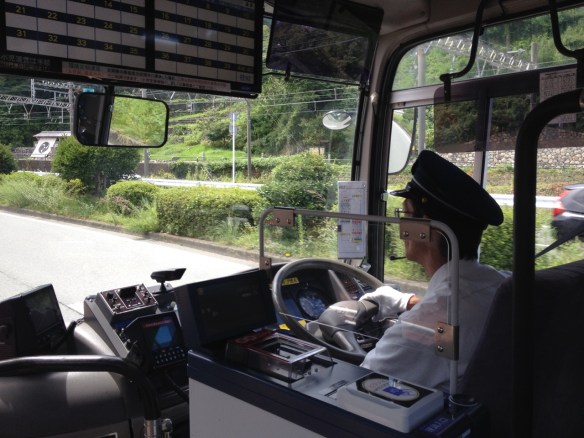
The round-trip is 500¥, but you don’t have to pay until you arrive at the museum. As you enter the bus, grab the little return ticket that’s sticking out of the machine just inside the bus door. You’ll give this to the driver when you exit the bus on your return to the bus center.
IMG_2648

At the Museum

I read something that indicated it was a 10 minute walk from the museum bus stop to the museum itself. Another lie. The bus stops directly in front of the museum entrance. Just be sure to push one of the stop request buttons when you get close so the bus driver knows to stop there. Maybe he’d stop anyway, but why chance it?

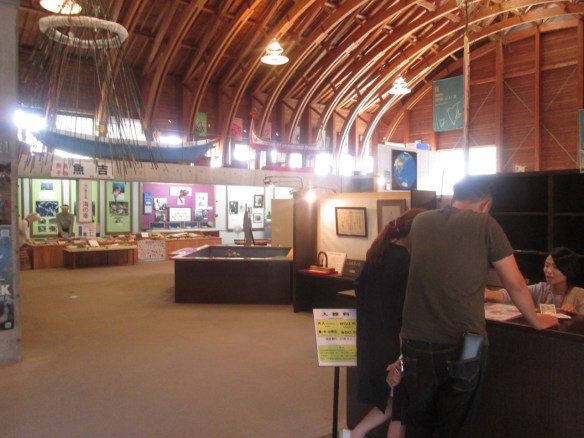
Admission to the museum is 800¥ for adults and 400¥ for children under 17. If you want a refreshment, there is a little café right across from the museum entrance. It appears to be staffed by the museum people, so you may have to let them know at the front desk that you want to sit in the café. If it’s a hot day, you might take a respite from the heat as the café is air conditioned. Note that the rest of the museum is not, with the exception of movie viewing theater, where you can watch some film about Ama, the female divers of Japan.
IMG_0953

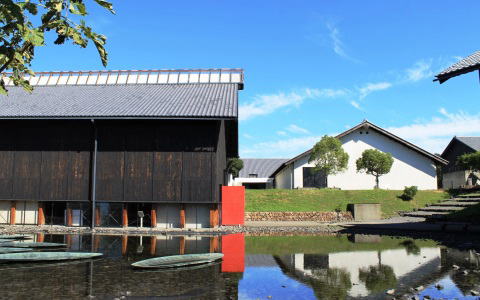
Museum entrance and main building.

If I had more time, I would have take more time to learn about the Ama, as there is a great deal of information about them at the museum. There is also “Pearl Island” in Toba, where I believe you can learn more about the Ama.

As it was, I spent about 3 hours looking at boats, fishing history, models of boats, the history of Toba, boats, and more boats. I did my best to learn and collect as much information as I could. I ended up burning up one camera battery, filling up my iPhone (doesn’t take much), and collecting more than 500 photos throughout the day. Of course, some were just countryside photos, a few selfies, and views of the bus, etc. But, for the most part, they were boat pictures.
IMG_2676

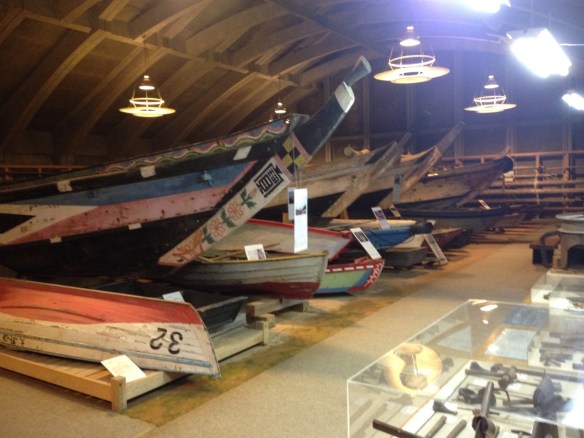
Inside the boat repository building.

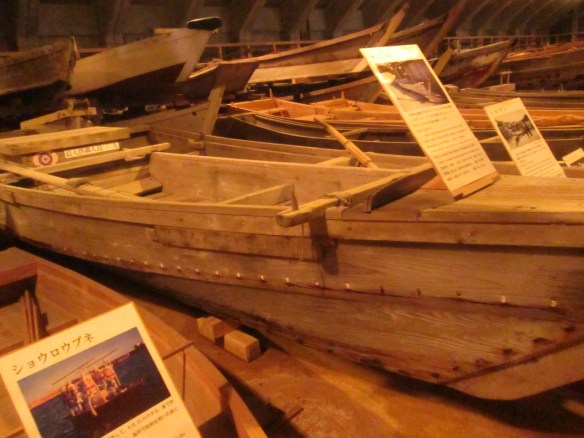
I will have to admit that the value of most of the photos may be somewhat less than might be expected. There are so many boats in the repository that you can’t even get close to most of them. Also, the lighting is so bad that it’s hard to get good shots. Some are blurry and when I used the flash, it over exposed some of the pics.
IMG_1385

Not a lot of room to get close to the boats.

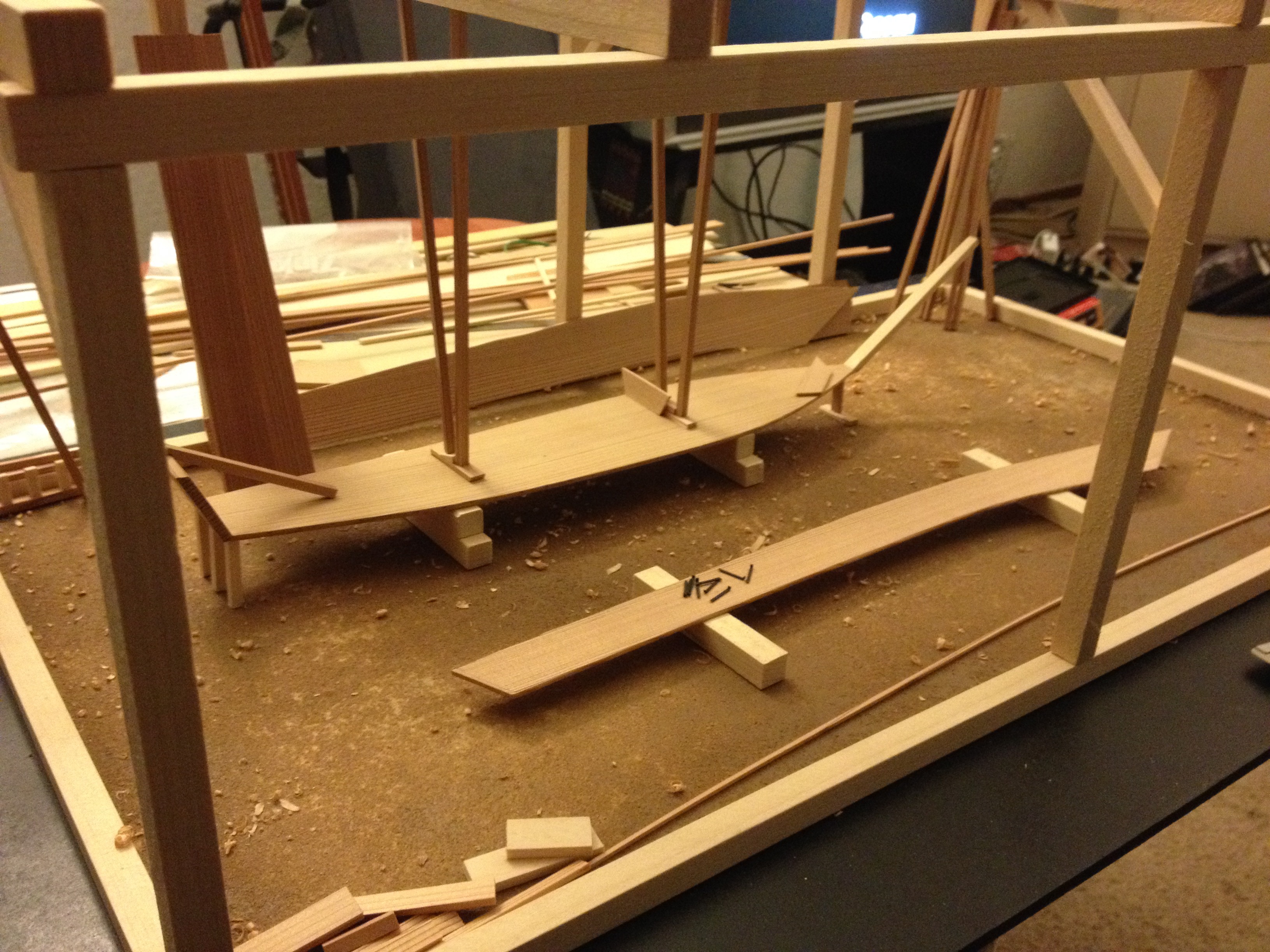
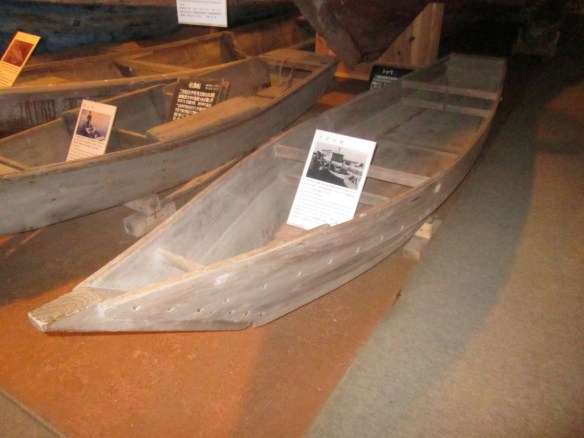
One subject that was really hard to shoot because it was in a dark corner, in the shadow of a bigger boat, was a small score for me. The boat is a nori gathering boat called a Bekabune, and I happen to be currently modeling one of these. So, this was a particularly nice find.
IMG_1298

Bekabune, once used on Tokyo Bay for harvesting seaweed.

Besides the full-sized boats, there’s a nice assortment of models in the main building. Again, there was a problem with lighting. But some in a glass case were well lit. Others that were not well lit suffered further by being in a glass case, where glare was a bigger issue.

Amazingly, some models were not in a case, and one European style galleon model made me nervous because I was carrying a backpack, and if I was careless, I could have easily stepped back or turned around and broken some of the rigging. The Japanese visitors must be amazingly careful around this stuff!

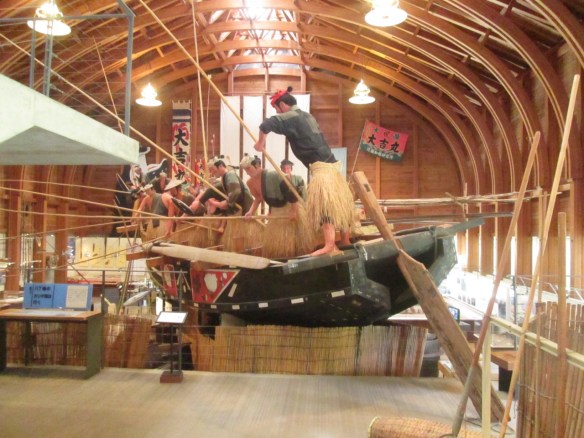
One of the things I found the most interesting were the dioramas showing how fishing was carried out. One was a full-sized boat suspended above the floor, with fishermen wearing what is most easily described as grass skirts, pole fishing over the side. It looked very dynamic, and I think it must have been a very accurate image, as there was a video playing in one part of the museum below the boat where a the bow of a modern day fishing boat was lined with fishermen with long poles just hauling up fish after fish. One fisherman pulls up a big fish and flings the line overhead and behind him with a big catch. He then throws the line back in and it looks like within seconds he’s caught another. So, the boat display seems authentic.
IMG_1179

But, the big score for me, turned out to be the museum store. I found a whole section on Japanese boats, most of which were from the currently closed Maritime Science Museum in Tokyo. It took me a while to decide what to get, but I ended up buying about 6000¥ on books. Sadly, there were many others I wanted to get too, as they are really hard to order and have shipped to the U.S. But, I figure I’ll have an opportunity to find the same books when I’m in Tokyo or in the Ogi Folk Museum on Sado Island in a few days.

Well, after about 3 hours, I was pretty well spent given the 80 degree weather and 87% humidity. I cooled off in the café while waiting for the bus. I almost decided to just hang out there around the museum and in the café until closing time, 5:00pm. But, at the last minute, I figured I’d better head back and get to work writing.
IMG_2687

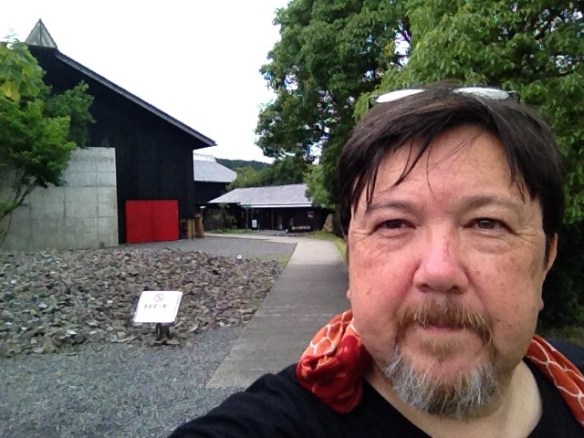
Hot, tired, wet, stuffed brain, but satisfied.

Tomorrow, I could go back to the museum in the morning for a bit, but I don’t think I’d get that much more out of it if I did. At least not so soon after, and without specific goals in mind. So, I’ll be leaving for Ise-shi station tomorrow. Not sure if I will stop at Ise now or not. It’s a beautiful place, but, I have been there before, and there’s so much to see everywhere that it might be better to get settled in Tokyo, where I’ll be staying the next two nights.

Sometime in the future, when I have more time to sort through things I’ll start posting more of the photos from the Toba Seafolk Museum. Ω
Japan Boat Research Trip 2016 Update

For those who don’t know anything about this trip and why I’m making it, please check my page: Japan Research Trip under my Japan Trip Blog menu.

Note that I’ve been fundraising for a few months now to try to gather up the resources to make the trip happen. Thanks to very generous friends and family, I’ve been able to fully fund this trip. It’s still going to be a pretty “lean” trip in many ways, and it’s way too short for visiting Japan. But, it’s going to have to do.

Toba Sea Folk Museum

Toba Sea Folk Museum

There may be some obstacles once I’m there as it’s typhoon season and trains may be delayed and that may put a real hamper on some of my plans. But, life is what it is, and I’ll just go  with the flow as best as possible.

My flight leaves out of SFO late Saturday night and, mostly, I’m prepared to go. Passport is in order, accommodations are booked, got a friend to stay with my cat, I’ve gathered the things I need to take, gifts to present to people I’m meeting, etc. I just need to finalize my rail pass, possibly obtain a “Pocket WiFi”, and it might be a good idea to reserve my tickets for the ferry to Sado Island.

The flight and some of the hotel stays were booked months ago through Travelocity. I actually got a tremendous deal on the flight, which is how all of this got started in the first place. Most of the hotels were booked through Booking.com, and together, those two sites seemed to do a decent job of securing my accommodations.

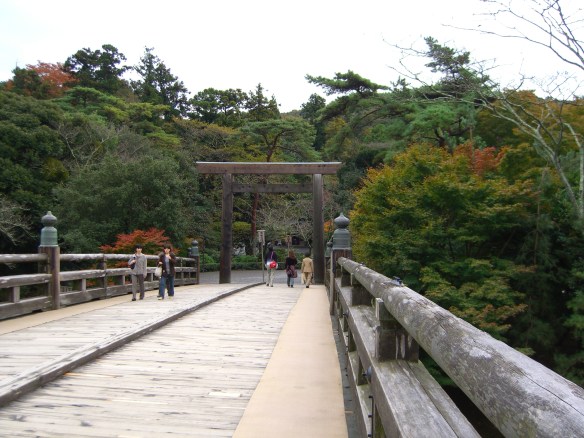
Bridge at the Ise shrine in 2006

Bridge at the Ise shrine in 2006

So, here are the places where I’m going with the major items / points of interest. Asterisk* indicates overnight stay.

  • Shizuoka
    • Visit Woody Joe
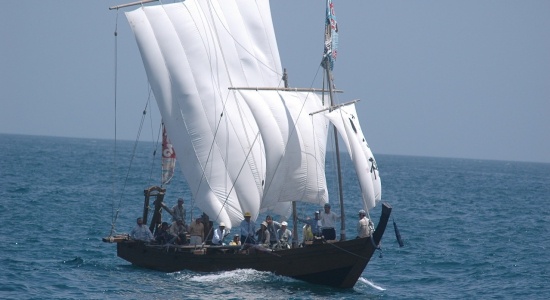
    • Hacchoro at port of Yaizu
  • Toba*
    • Toba Seafolk Museum (Warehouse of boats)
    • Ise-jingu Shrine
  • Tokyo*
    • Edo Tokyo Museum
    • Urayasu Boat Museum
    • Visit Wasen Tomo no Kai
    • Dinner with friends from The Rope, Tokyo
  • Ogi village, Sado Island*
    • Ogi Folk Museum
      • Hakusan Maru (Kitamaebune replica ship)
    • Taraibune Excursions / Taraibune maker
  • Tokyo*
    • Final Day of sightseeing, visiting people


Google Maps

I have to say that in the last couple weeks, I’ve made very heavy use of Google Maps. Actually, I’ve been using it for months to make sure place I’m staying at are actually in convenient locations. But, the last couple weeks, I’ve been going crazy working out how to get to various places, looking for convenience stores, places to eat on the cheap (most of my money will be tied up in travel and accommodations), etc.

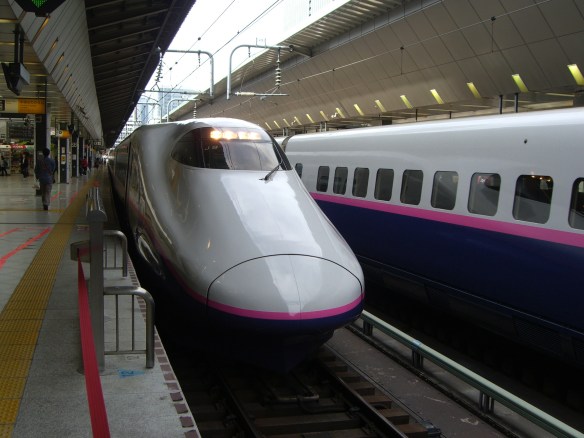
Something that has been invaluable is the “Schedule Explorer”. My first day in Japan is going to be a bit tricky. I land at Haneda around 5:00 am, need to take the airport monorail  to Tokyo Station to get to the JR Office. But, that doesn’t open until until 7:30 am, at which time I need to pick up my Rail Pass (I’m planning on getting a 7-day pass with Green Car access), hop on the Shinkansen toward Nagoya, but get off at Shizuoka Station. There, I will take a cab to Woody Joe, meet my long-time contact Mrs. Yukari Gojo, the president (her father), Mr. Tsuneki, and the staff. Aftewards, Yukari has offered to drive me in her car to the port of Yaizu, where we will meet with Mr. Hiroyuki Kobayashi, who is a member of the group that operates the Hacchoro boats, who will show us the boats and let me examine them.

Shinkansen

Shinkansen to Tohoku in 2008

Afterwards, they will drop me off at Yaizu Station. This station is not on the Shinkansen line, so I have to take this regular train either back to Shizuoka Station or  onward to the next Shinkansen station. Then, I will continue on to Nagoya and switch to another train, possibly one called the Rapid Train Mie (mee-eh), which I can then take all the way south to Toba, where I will stay for a couple nights.

So, all of this is to point out that there’s a lot of travel planning on the first day, and Google Maps seems to have made it very simple for me to figure out how much time I will have in Yaizu. Of course, there will be some glitches and things it can not predict. But, I’m not going to be any better at predicting issues myself.

Also, being able to “walk” around the places has allowed me the opportunity to figure out that my initial accommodations in Ise, while homey and inexpensive, are too hard to find from the train station, especially if I’m running late and don’t get there until after dark. So, I found some alternative places that were actually in Toba and again did a virtual walk around and found the places very easy to get to.

Of course, I haven’t physically been there yet, so I won’t really know how successful this has all been until after I’ve gotten there. I’ll let you know how it turns out.

For now, it’s all pretty well planned out and so I’m setting it all aside and it will be what it will be!

The Wasen Modeler Launch

I’ve finally decided to bite the bullet and launch my wasenmodeler site. I’ve been posting my work on my shipmodeler blog for a while now, but there have been stretches when I’ve been working a lot on Japanese traditional boats, or Wasen. So, I started a page on my site, Japanese Watercraft.

Since I began my first Japanese wooden boat, my work has matured a lot, and I’m giving a talk together with boatbuilder Douglas Brooks at the 2016 Nautical Research Guild conference in San Diego in October (my segment is on modeling Japanese boats, and it will be very short). In addition, I’ve been scheduled to do one of the roundtable discussions there on modeling Japanese boats. And, now that I’m finally heading to Japan for a week of research and networking, it seems that the time has come to spin off wasenmodeler as a stand-alone blog site.

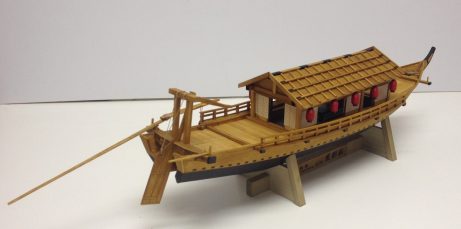
Woody Joe’s Yakatabune kit

Of course, this is just getting off the ground, so I’m just beginning to build content and create new site pages. Now, visitors who are interested in Japanese boats and their models no longer have to wade through my ship modeler posts about building english sailing ship models in paper, etc.

I do want to point out that this is actually a massive topic. Even though I’ve been building Japanese boat models for a couple years now, I’m only just now scratching the surface. The more I learn, the more I discover how limited my knowledge is. The amount of available information in English is minimal, and it really helps not only to be able to read Japanese, but to actually be in Japan to access information first-hand. I neither read much Japanese (just a few words and can read the phonetic alphabets), or speak much Japanese (better than I read). Nor do I live in Japan.

Cover of the Funakagami

Cover of the Funakagami

But, heavy use of scanning and OCR, the trackpad handwriting recognition technology and Japanese language input system on my Mac, and a good network of helpful friends and associates (ship modelers, maritime experts, Japanese boat builders, and native Japanese speakers) helps to overcome some of these obstacles.

So, please bear with me while I work my way through the subject and building up the content here. In the meantime, make sure to check out these links:

English sites

Japanese sites/links

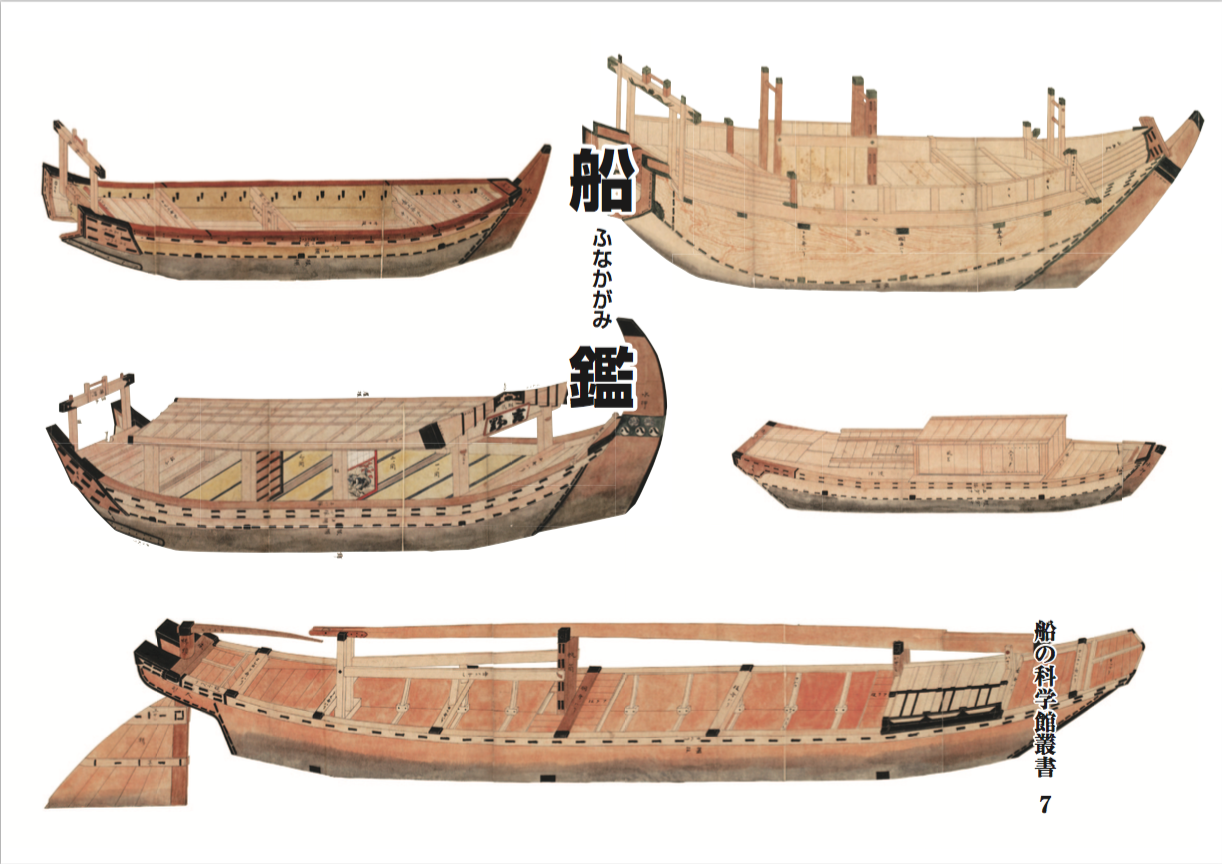
Funakagami – A PDF Book on Japanese Boat Types

As I’m preparing for my study trip to Japan in, I’ve been checking on museum websites and such. The Maritime Science Museum is closed, except for a small museum annex, their website still lists the museum publications.

I don’t see any place to actually purchase these, but there are a couple books that you can download as a pdf. The one that immediately caught my interest had a number of Edo period boats on the cover. So, I immediately downloaded it and started looking through it.

Funakagami cover

Funakagami cover

I’m still working to understand the text, but the first part of the book is mostly old illustrations. Apparently, this is taken from a book called a Funekan, which was used by the Bakufu, or Shogunate government, to aid in identifying the many types of small boats on the rivers of the Kanto district, which is the region of old Edo (Tokyo) and its surroundings. The identification was necessary for taxation purposes.

Such a book is a boon to anyone who is trying to learn about different types of Japanese boats. There is little information about the boats themselves, but there is a nice large illustration of each boat type, and an index which classifies the boat. In the back of the book is a section which identifies the names of the parts of each boat. In the end, the text gets very meaty with, as far as I can tell, discussion about taxes, etc.

The book can not be printed as it is a password protected pdf. But, I discovered I can still copy text and take screen shots of the images to compile into my own notes. The copied text can be pasted into Google Translate or similar service. I’ve found that the translation is sometimes not as useful as the pronunciation/romaji spelling that is shown – For those who are familiar with Google Translator, just look under the box on the left, which is where you paste in the original text.

Click here to download the pdf

For me, the book has confirmed things I’ve already learned, taught me a number of new things, allowed me to see things I’d only read about, and raised a number of questions that I will be researching answers to. Ω
Japanese Boats Display in Japantown (v 4.0)

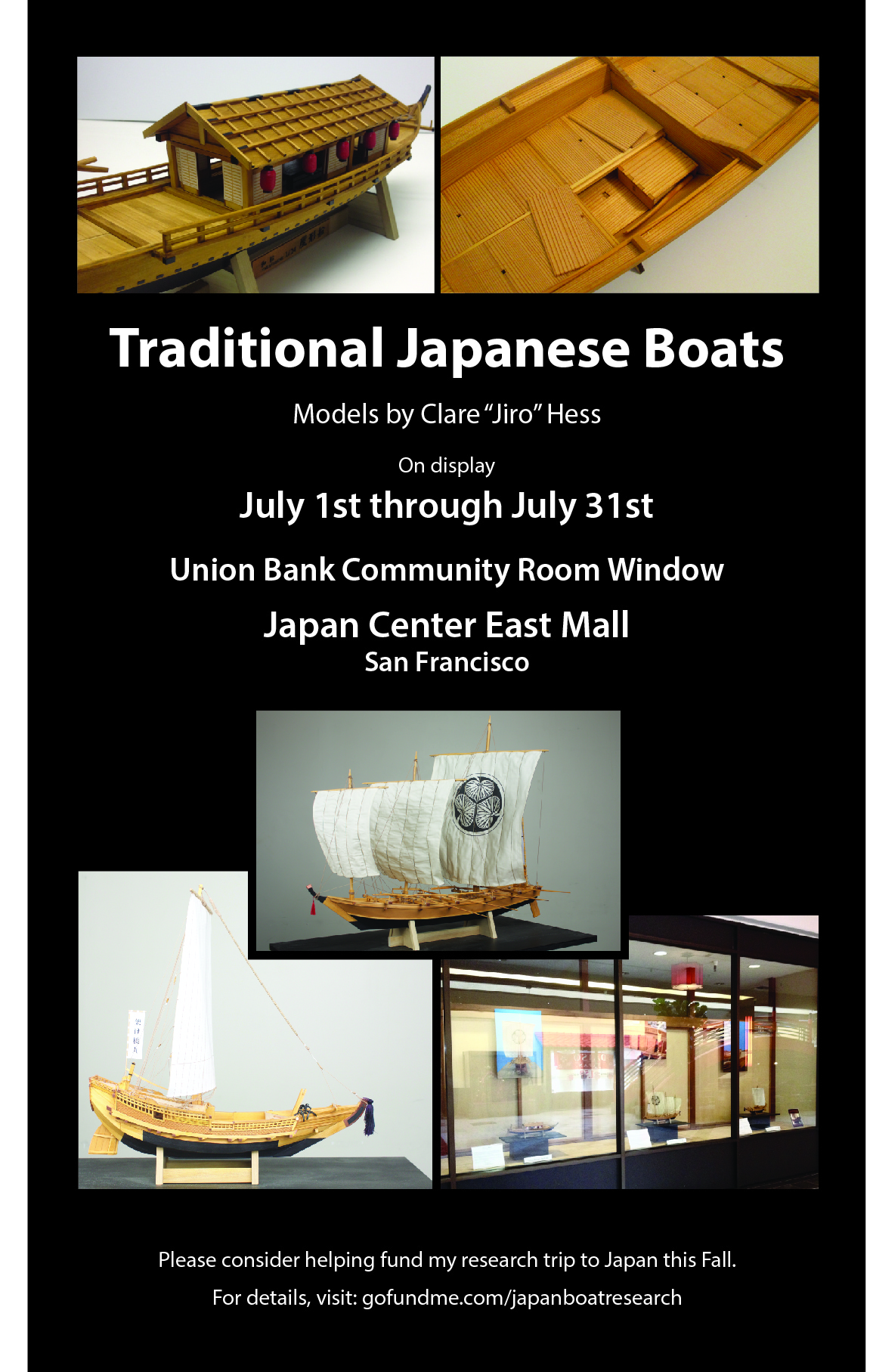
Last week, I spent an entire afternoon in San Francisco setting up my latest display of models of Japanese traditional boats in the Japan Center Mall in San Francisco. This is the largest display I’ve done, which is now up to 5 models. It’s probably about as large as it will get as I can’t imagine that I can possibly cram any more into my car. And, given that I live about an hour’s drive outside the city (or two hours in bad traffic), I’m not likely going to be making two trips to set it up. But, the size is actually pretty good now.

Since I’m doing some fundraising to go to Japan this Fall to do some more first-hand research on Japanese watercraft (don’t forget to check out my gofundme page), I’m taking the opportunity to really get some attention for this display. As with those people involved in the fine arts, I’ve made up an announcement card that I’m having printed up that I will be sending to various friends and people that  I think will be interested in it and possibly interested in helping me out (as well as those who have already done so). In addition, I’ve made a simple email announcement photo that I’ve been sending to people.

Announcement Emailer L plus

My email announcement card

If you’re already familiar with the last couple displays, you will see two new models added, a simple Japanese traditional boat shop display and the Tosa wasen model. Both are a nice, big 1/10 scale, so the details are better for a window display like this.

IMG_2398

The 1/10-scale Tosa Wasen is the newest boat model added to the display.

IMG_2382

This is my simple model of an Urayasu boat workshop, showing some of the aspects of traditional Japanese boatbuilding. Under construction is a Bekabune, a seaweed gathering boat that was once used on Tokyo Bay. The model still needs a few additions – a work in progress.

IMG_2403

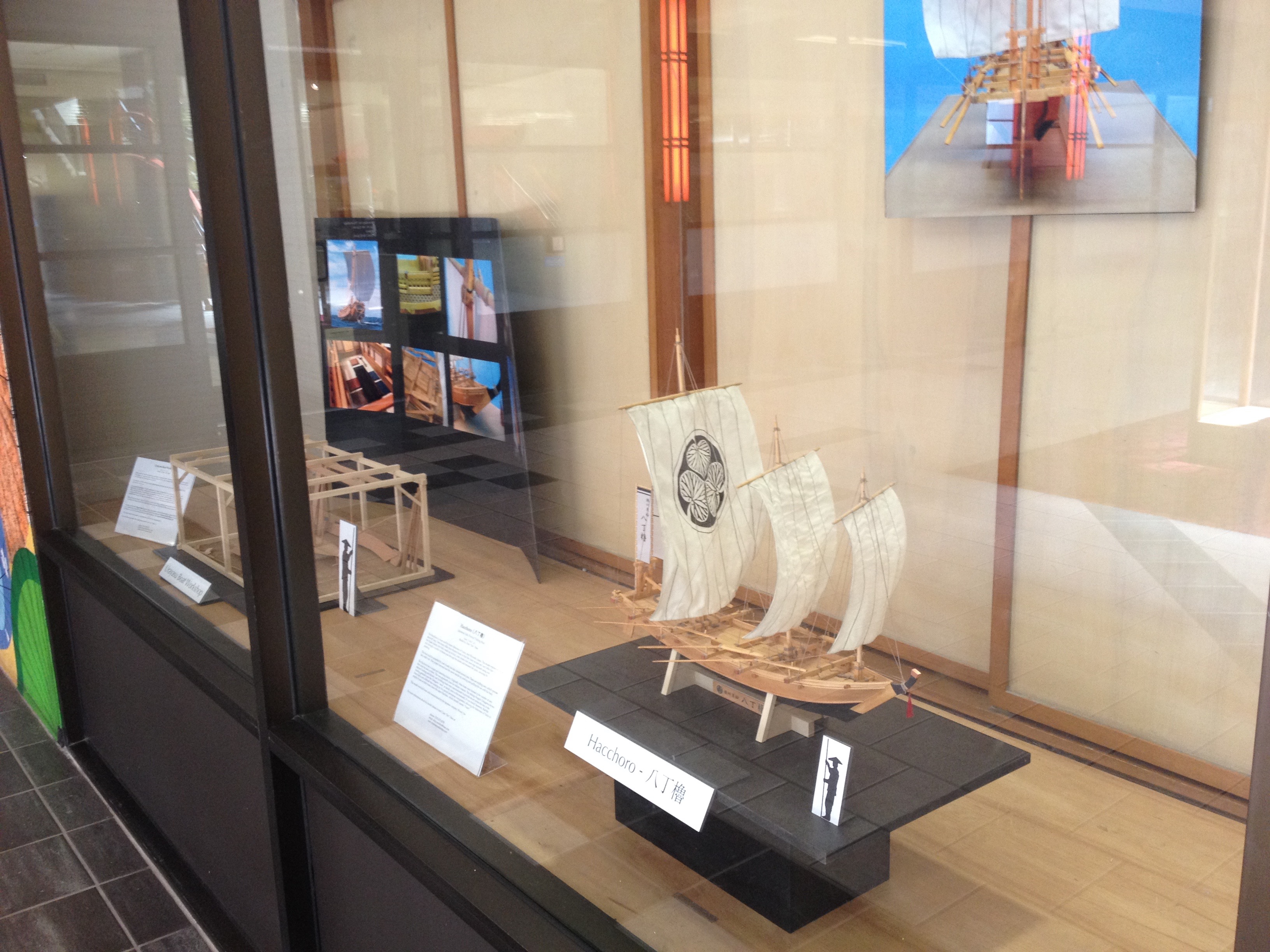
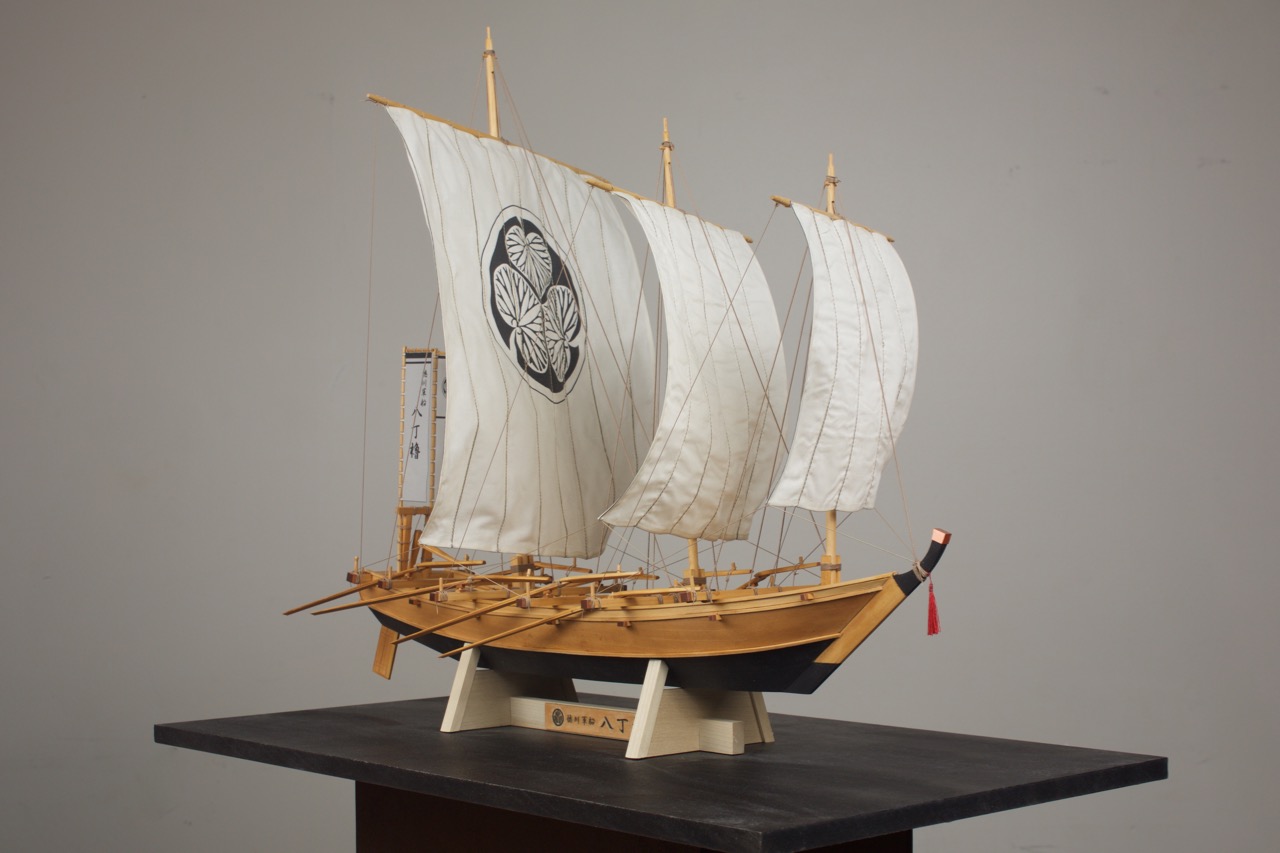
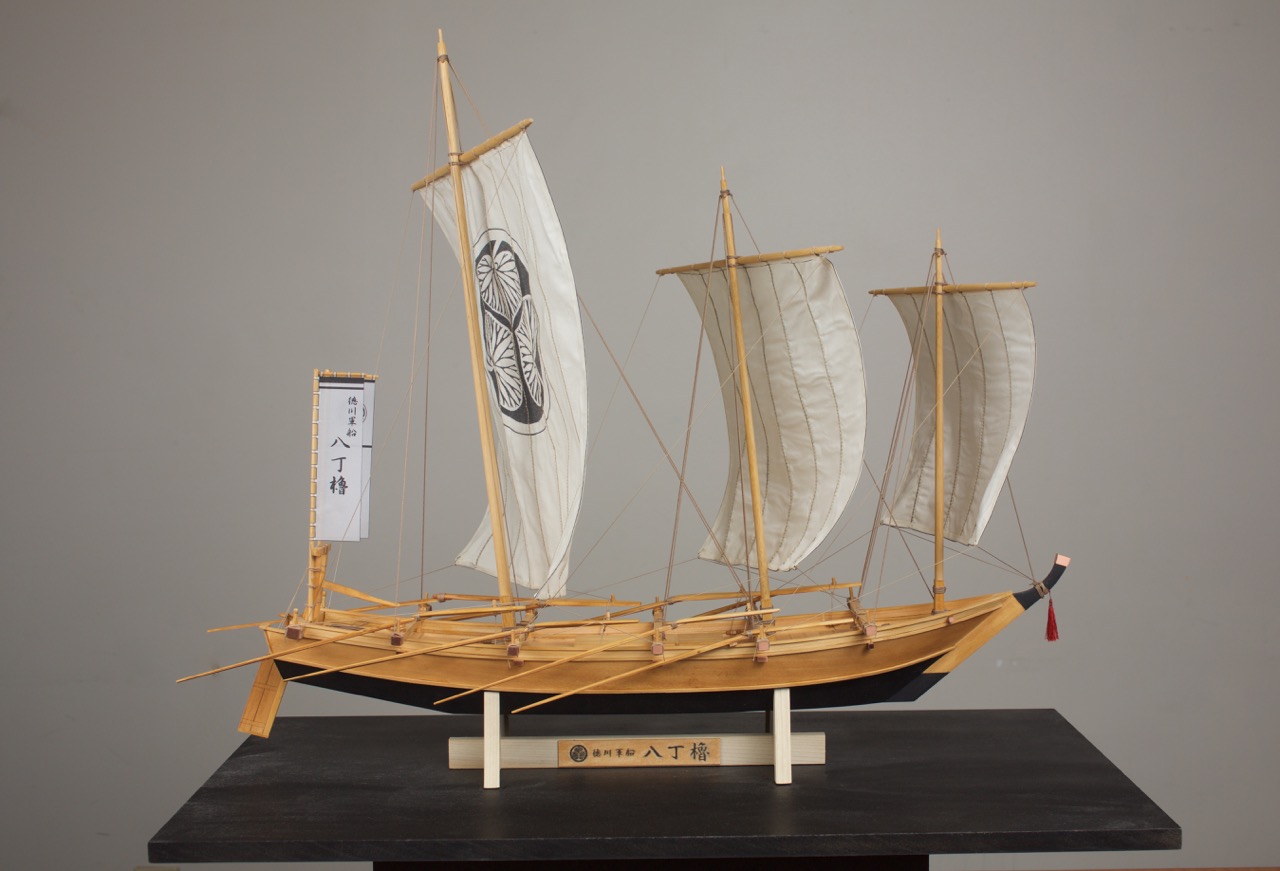
The Hacchoro and the Urayasu boat workshop with their scale boatmen silhouettes. The Hacchoro is one of the boats I will be focussing my attention on while researching in Japan this Fall.

You may notice in that display window photos that I’ve created little silhouette boatmen to provide scale reference for each model. This was a last minute effort, though I’ve been thinking about it for months. I finally sat down and scoured the Internet and found photos of boatmen dressed in traditional outfits on someone’s blog photos. I took the best one and did some Photoshop work to turn him into a silhouette, which I scaled to the needed sizes, printed them, and mounted them on cardboard.

There are, of course, things to do differently next time, which I’ve already noted. The boat workshop display should probably be on some kind of a riser, like the other models, there is enough room to put up another large, hanging photo board, and there’s room for at least one more model, using the tall stand I introduced in this display. I suppose I could consider staggering them a little too.

That tall stand, by the way, is actually a better stand for me to use because it’s simple two boards hinged together. This makes them foldable and they take up a lot less space in my car. I’m seriously thinking about replacing the box pedestals on the other models with short folding stands, which would allow me to carry more stuff in my car. And, actually, if I build models without sails, I might be able to fit one or two more in that car. Of course, that means building more models and I’m pretty far behind on other projects as it is. We’ll see… Ω
 

Speaking at the Northern California Japanese Sword Club

On Sunday, June 19th, I was at the monthly meeting of the Northern California Japanese Sword Club as a guest speaker, talking about Japanese boats, their construction and history. Their meetings take place at the Japanese Cultural and Community Center of Northern California, which is located in San Francisco’s Japantown.

Now, I’m not a particularly comfortable speaker, but it’s something I’d like to be better at doing, and this seemed like a really good opportunity. Now, I’m no expert on the topic of Japanese boats, and even less so on their history. But, the subject is one that I’m very interested in, and have been spending a lot of time actively studying  this past year, so I wasn’t totally unprepared for it.

The speaking engagement came about as a direct result of my Japanese boat models displays that I set up in the window of the Union Bank Community Room in the Japan Center Mall. Their member who organizes the themes for each meeting saw the display and thought the club members would enjoy a talk on the subject.

In all honesty, I was a bit worried about what I could talk about that a group of sword collectors would want to hear about. My knowledge of Japanese history is limited, particularly about the early use of boats by warring armies or about the warships of the Sengoku period. But, I agreed to do it, with assurances from Tom that the group would enjoy the talk regardless.

I ended up delaying my participation for a bit to brush up on my Japanese history and did some intensive study on the development of Japanese boats. Most of the available material was in Japanese, so it took a bit of an effort. But, I managed a basic level of competency in the subject.

In the end, the talk went swimmingly, and I really had a great time talking to the club about Japanese boats. I started off by talking about the four models I brought and then using that to lead into how boats developed over time, how they were constructed, talked about how they were used in battle and about purpose-built war vessels.

It helped that I was really familiar with the meeting place, having met there on many occasions with my shamisen teach, who also happened to be in the room next door giving lessons, which we could hear during the meeting.

But, most importantly, the members of this group were some of the nicest people I’ve met. They were a very receptive, very appreciative, and a very supportive group. I couldn’t have asked for a better audience!

I can’t imagine how the next talk I give could go any better than this one, but at least I’m better prepared for it now. Ω
Hacchoro – Notes for building the Woody Joe kit

I have completed an initial draft of notes I compiled on building the Hacchoro kit by Woody Joe. The kit is a model of an 8-oared Japanese finishing boat from the area of Yaizu, Japan, which is on the coast, roughly about 100 miles southwest of Tokyo. The boat is a traditional type boat, following the classic 5 sided Japanese construction. That is, bottom, garboard strakes and shear strakes in a hard-chine hull configuration.
994A9695

The real boats were roughly 45 feet long and could carry 3 square sails on masts that could be stepped as needed. There are still Hacchoro in existence today, though I don’t know what the total number is like. I also don’t know how they are used today, except that there are Hacchoro races where teams man the boat’s oars to race each other on a short course.

DSC_0077

I am aware of two operating Hacchoro in Yaizu. With the help of a wasen authority in Japan, I have made contact with a gentleman in Yaizu who has offered to show me the Hacchoro there. So, I am now making arrangements to see them in order to record some of their finer details for later use in modeling them. This is part of my Japanese Boat Research Trip that I’m trying to raise some funds for. If all works out, I will take lots of photos and record the details.

For now, anyone who is building Woody Joe’s Hacchoro kit can download a copy of my notes.

But, in using these notes, you must accept that these are just suggested guidelines and there are always the possibility of errors in the document. Also, the document includes my own translation of the text of the Woody Joe instructions. I am not an expert in translating Japanese into English. Use them to give you more confidence in using the kit instructions, but you must agree not to hold me responsible if you end up gluing a part into place wrong. The kit is pretty well buildable using just the illustrations in the instruction book. But, sometimes it helps to know what the text says. Also, note that there are a lot of labels in the instructions, and I’m only translating the descriptional text and not all the individual labels.

Download Hacchoro Notes and Translated Instructions

Of course, if you have any questions about the document, just send me a comment with your email address and I’ll answer as best I can. Ω

Douglas Brooks’ Japanese Boatbuilding Class Project

American boatbuilder Douglas brooks recently finished teaching a one-month class on building a traditional Japanese wooden boat at Middlebury College, in Vermont. The subject was a boat that was once used on the Agano River in Niigata Prefecture.

DSC_0005 (28)

What an awesome class to be part of! The students did an amazing job. I can only wonder if they realize how fortunate they are to have been part of this experience.

DSC_0089 (14)

You can see more photos and description on Douglas Brooks’ blog here. Ω

Building the Tosa Wasen – Part 6

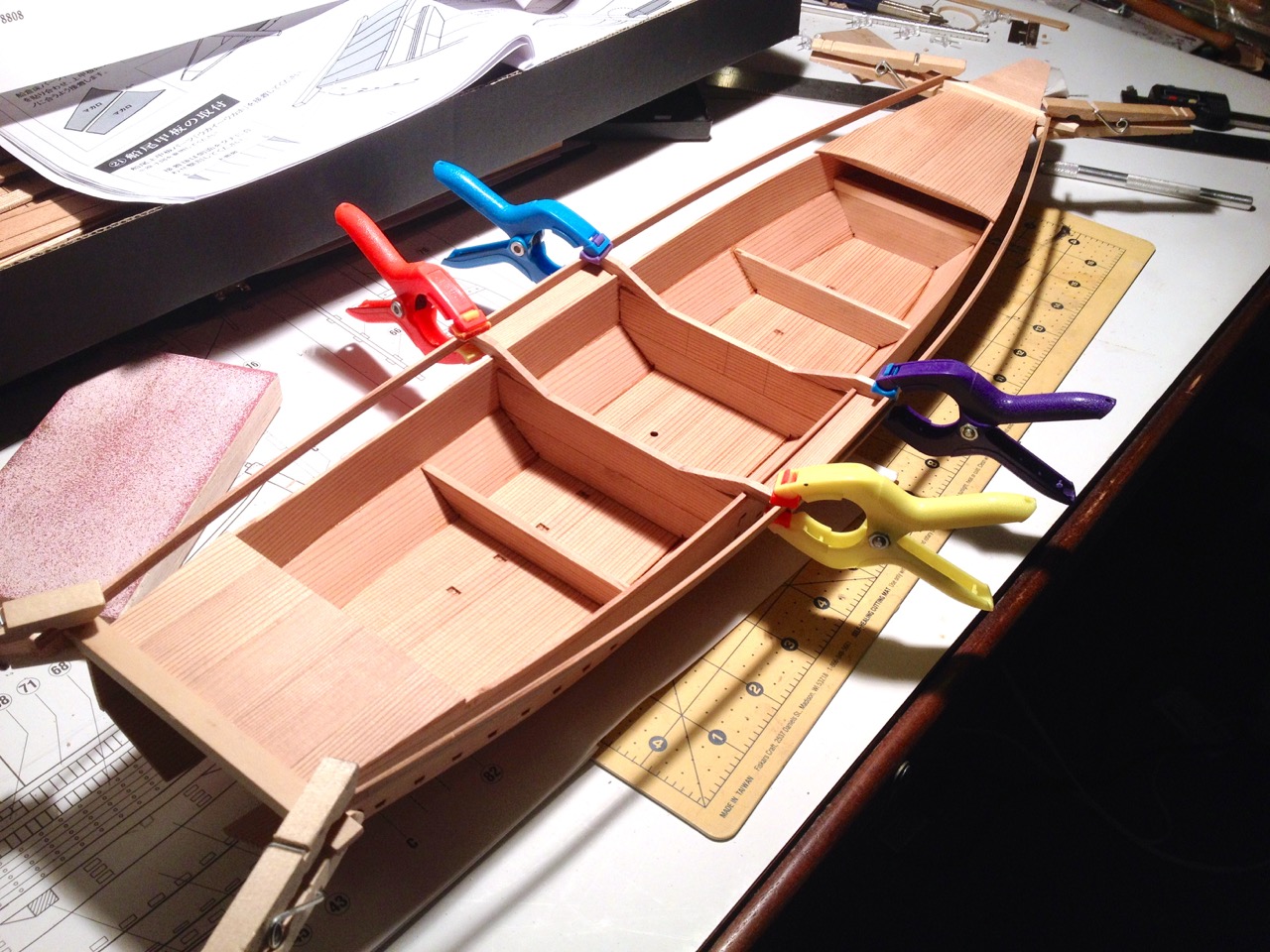
The next step in construction of the Tosa Wasen kit is the addition of the deck boards.

This part of the build turned out to be a lot tricker than I’d expected. This is an area where you really want to take your time, and it’s easy to want to rush through it. The deck boards serve as a deck to walk (or sit) on and work on, but they are also designed to be removable, allowing the fisherman access to storage space under the deck. This allows the deck to be kept clear and free of clutter, making for a tidy looking boat.

IMG_1936

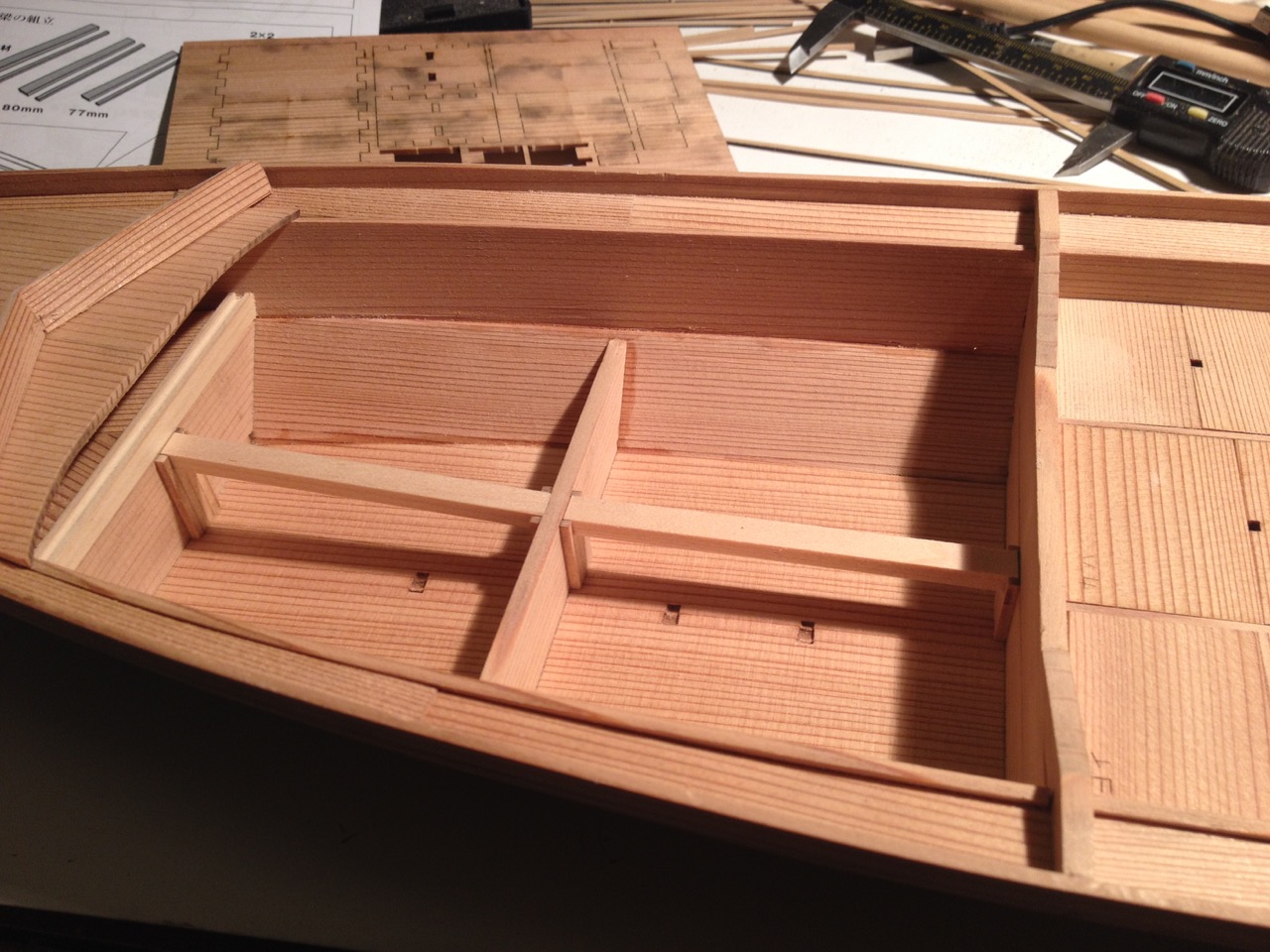
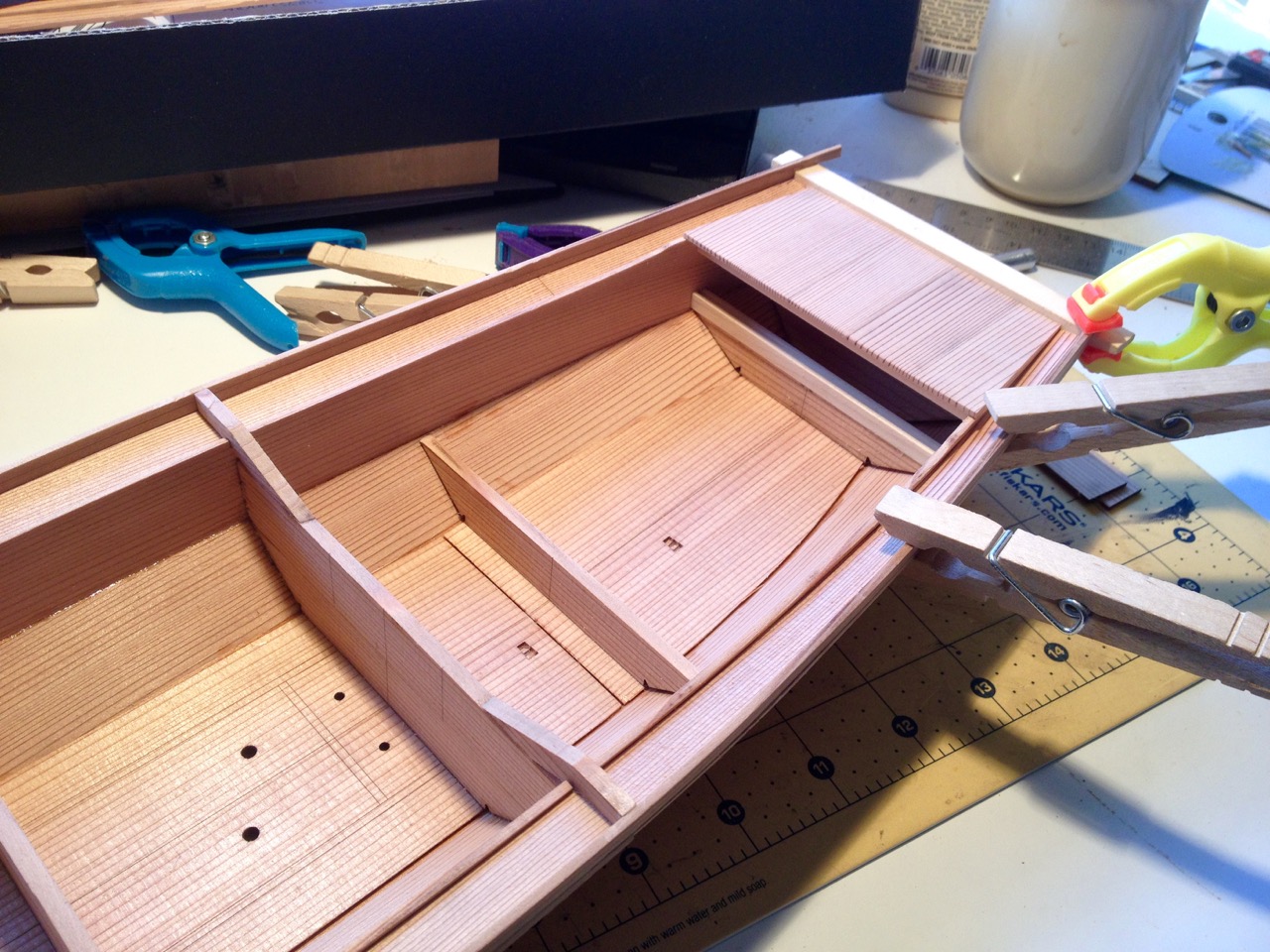
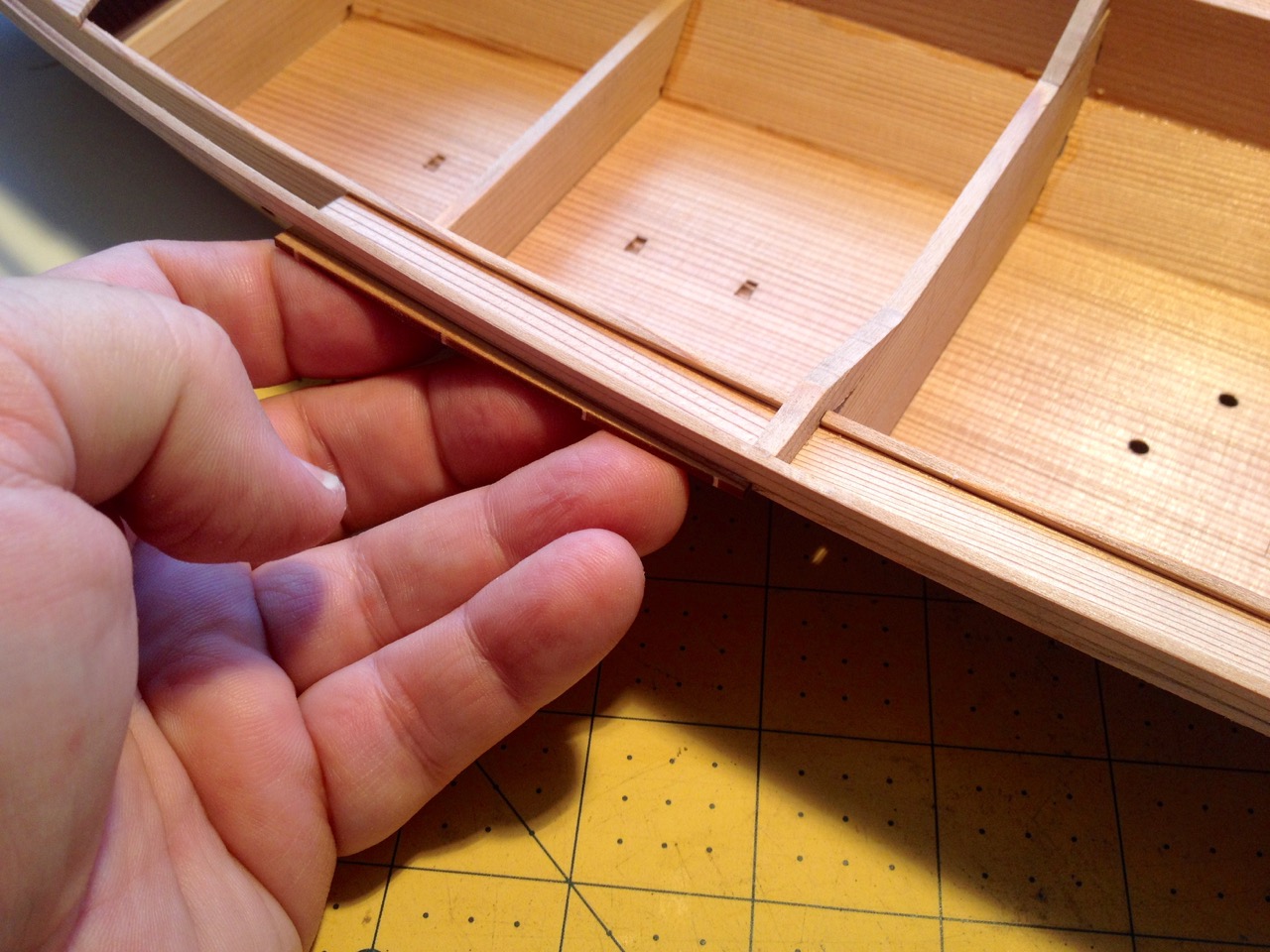
Beam supports glued into place. The beams are sanded to fit, but I left them unglued, so they’ll remain removable. Ledges are then cut to length and glued to the beams for the deck boards to rest upon.

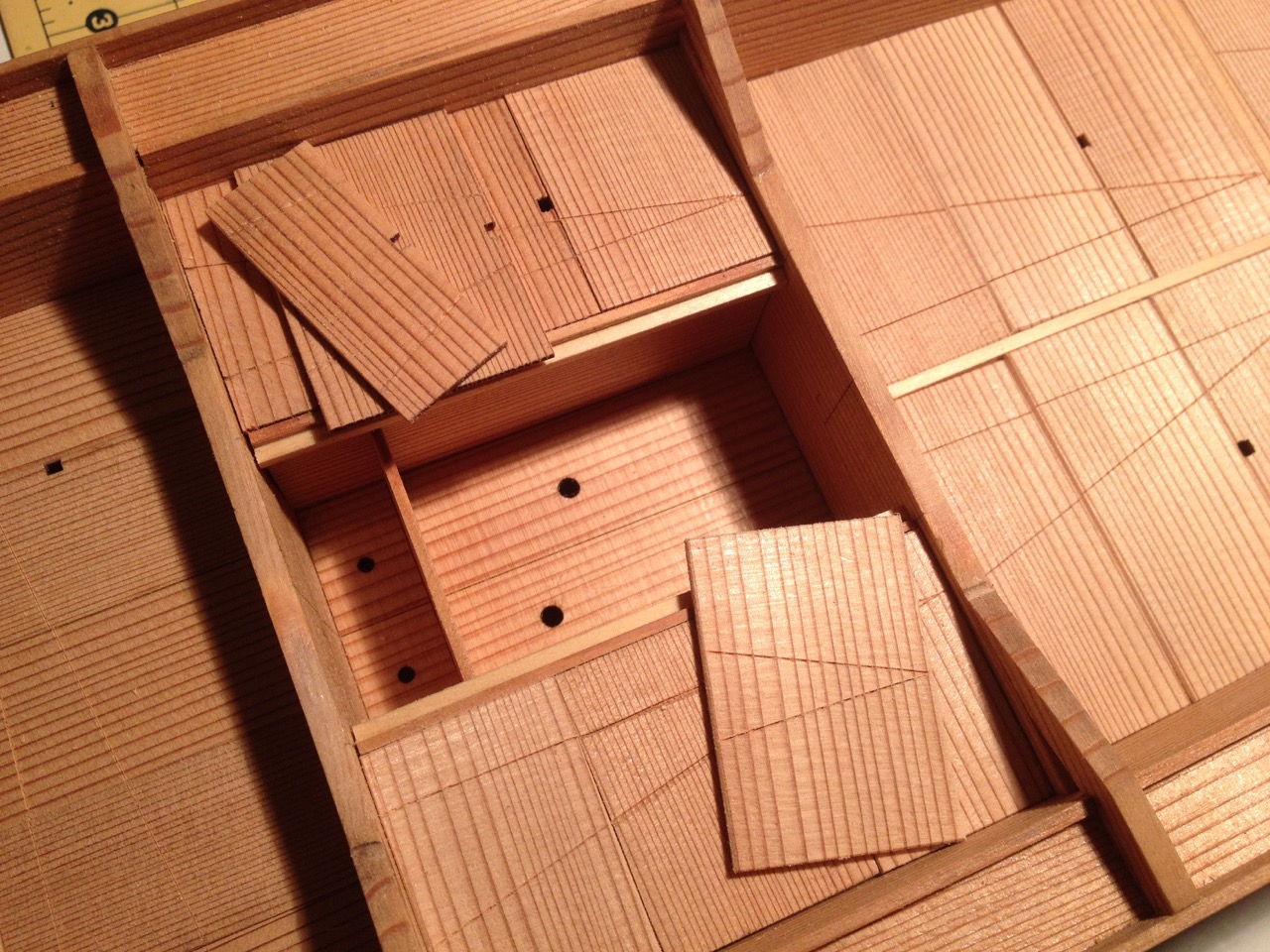
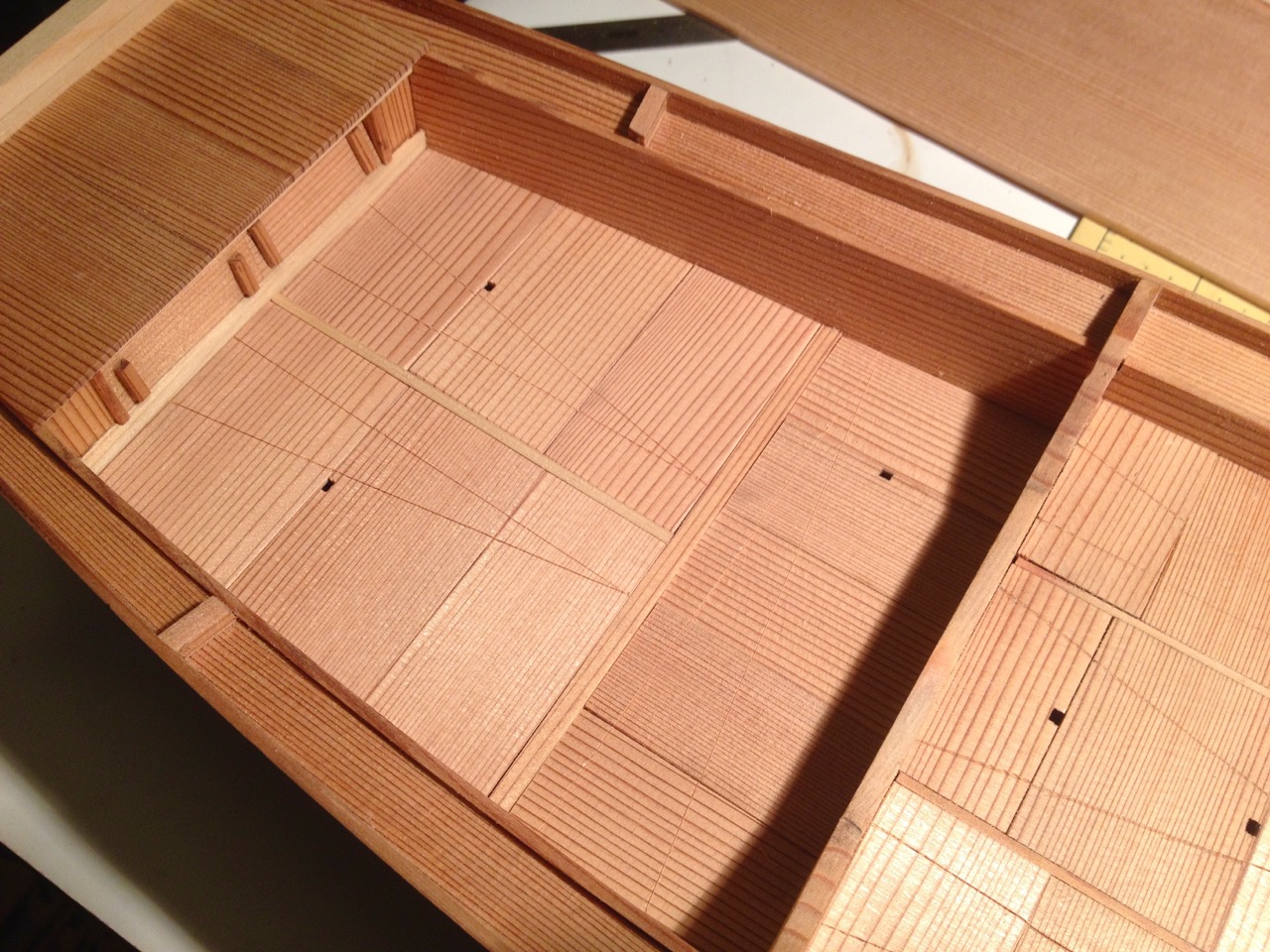
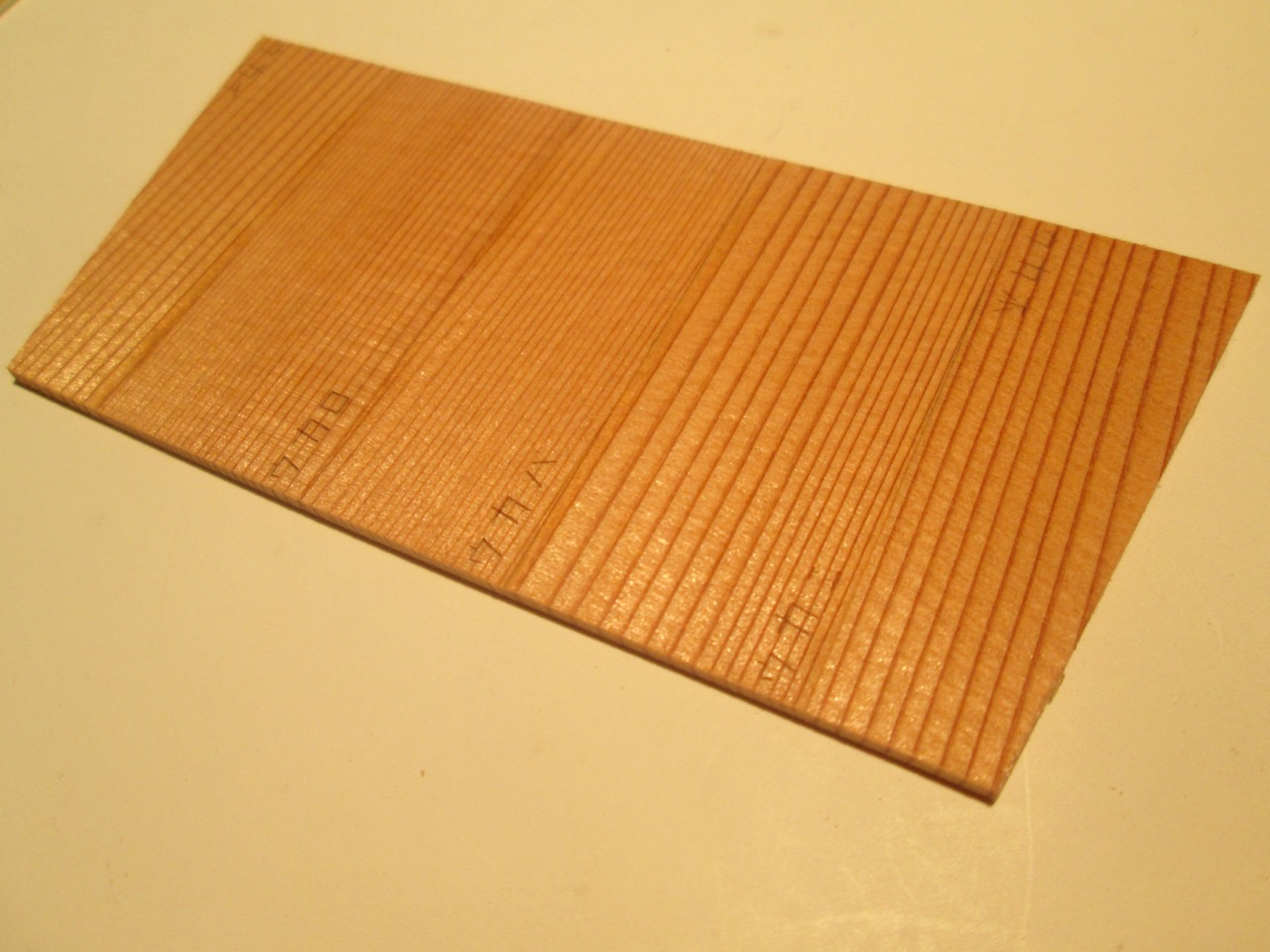
The deck boards themselves are rather interesting in that they are made so that almost no two are alike. Each one can only fit in one location, with the possible exception of the boards that cover the live wells in the center of the boat. But, given that there are many boards, it would seem to be something of a puzzle trying to figure out which one fits where. To make the positioning more obvious, there are two lines scribed into the top of the boards.

IMG_2035

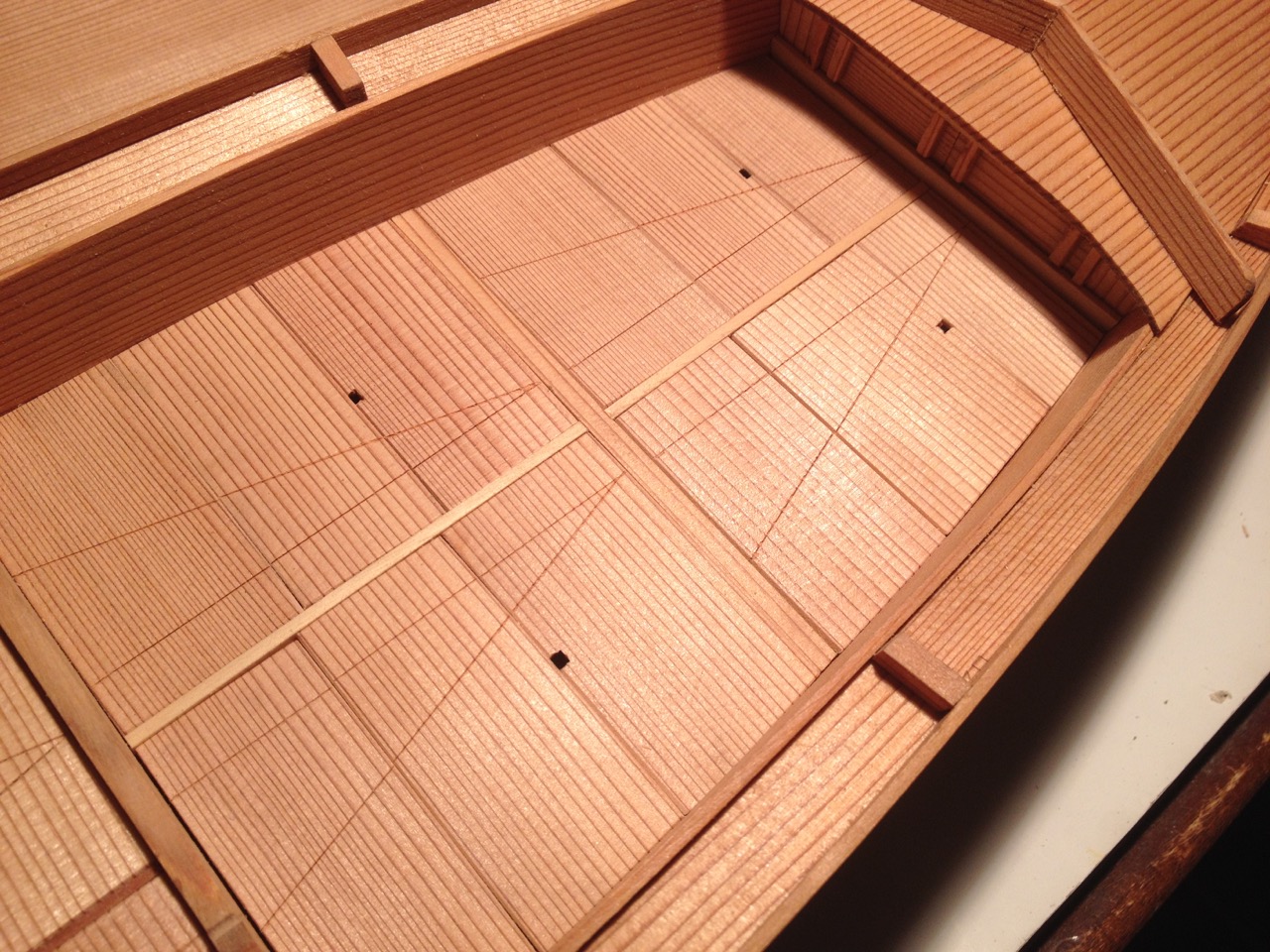
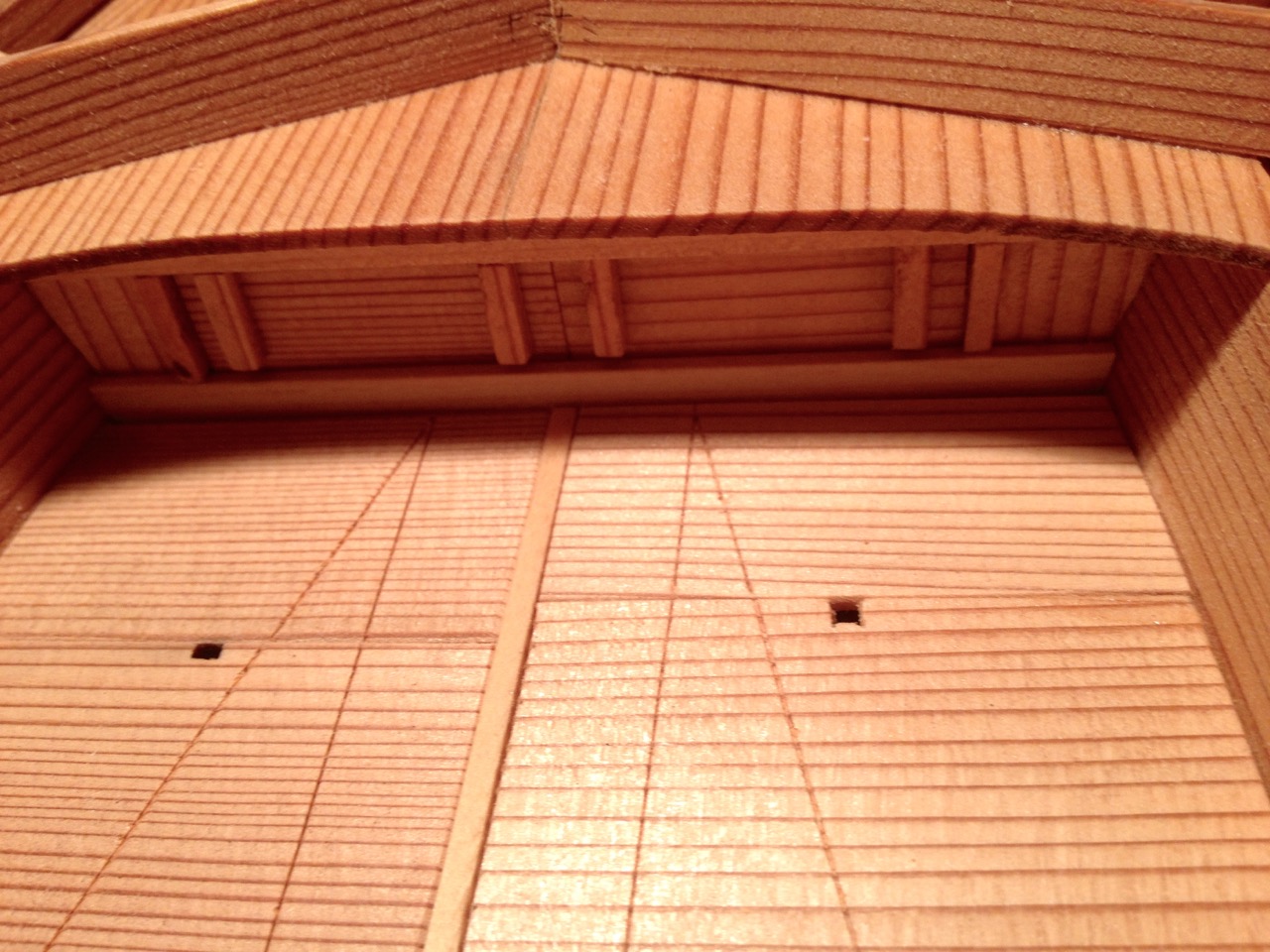
The lines form a sort of an arrowhead with the point at the front of the forward most board, and each compartment has a 3 or more deck boards covering it, with its own arrowhead pattern scribed on it. This makes for a quick recognition of the order of the deck boards and also makes it easier to keep from mixing them up, kind of the way a picture is printed on jigsaw puzzle pieces.

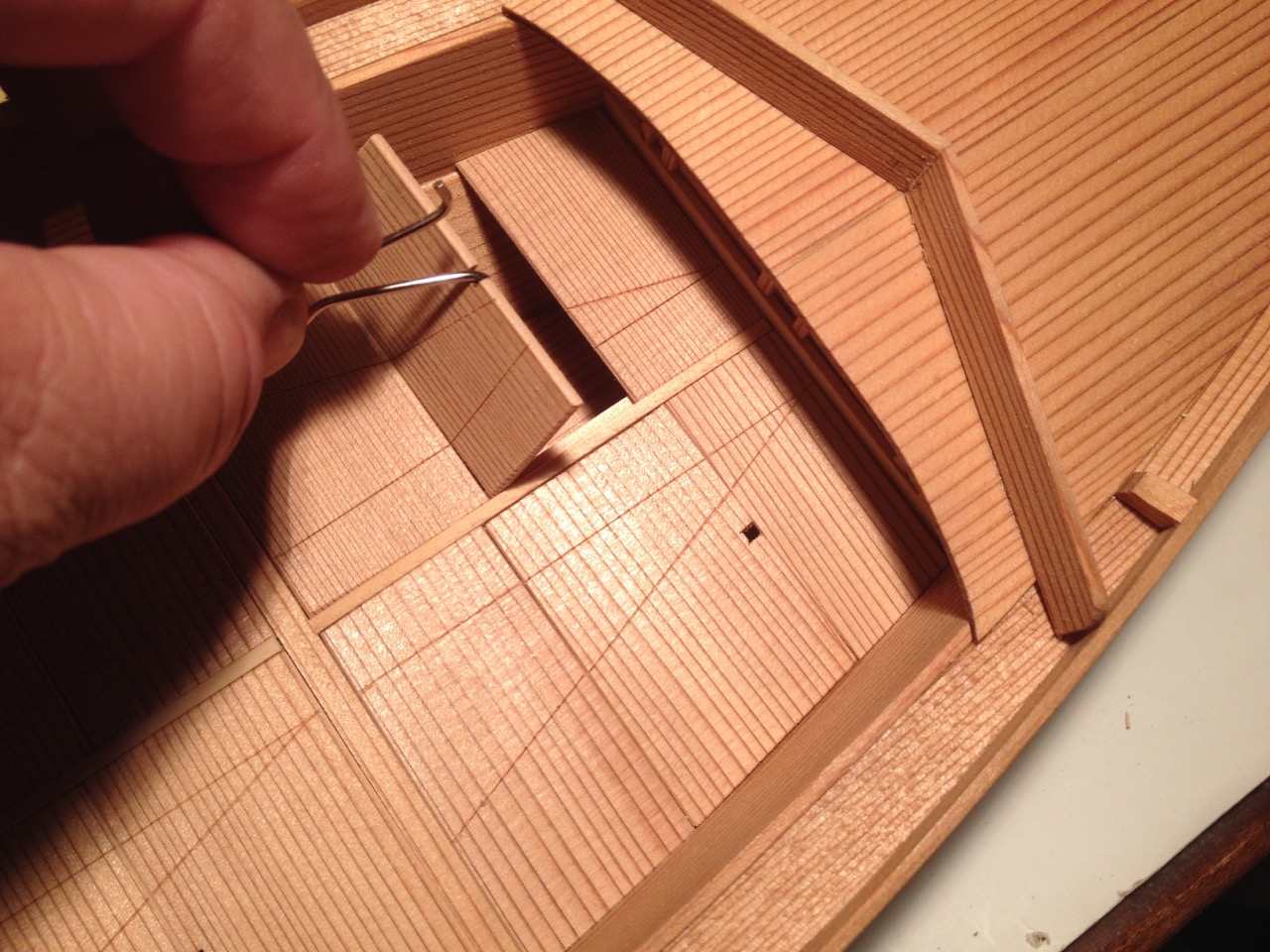
Note that one deck board of each set has a square notch cut into one edge that serves as a finger hole to make it easier to pull up the boards. This also makes it easier to pull up the boards on the model using a paperclip or other small tool.

IMG_2041

IMG_2042

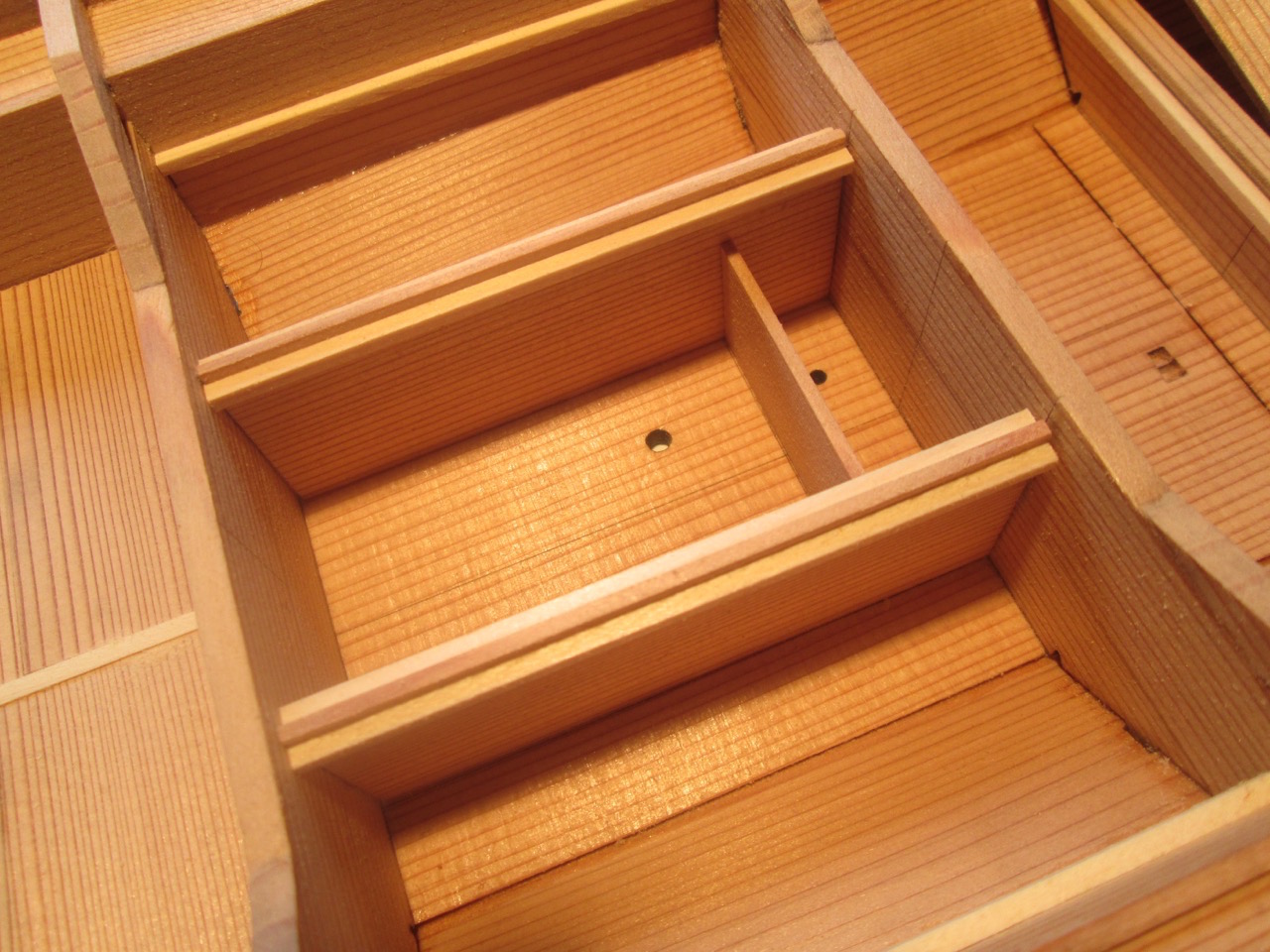
Live wells with holes in the bottom of the boat, open to the sea. The large one is for the catch, the small one is for bait.

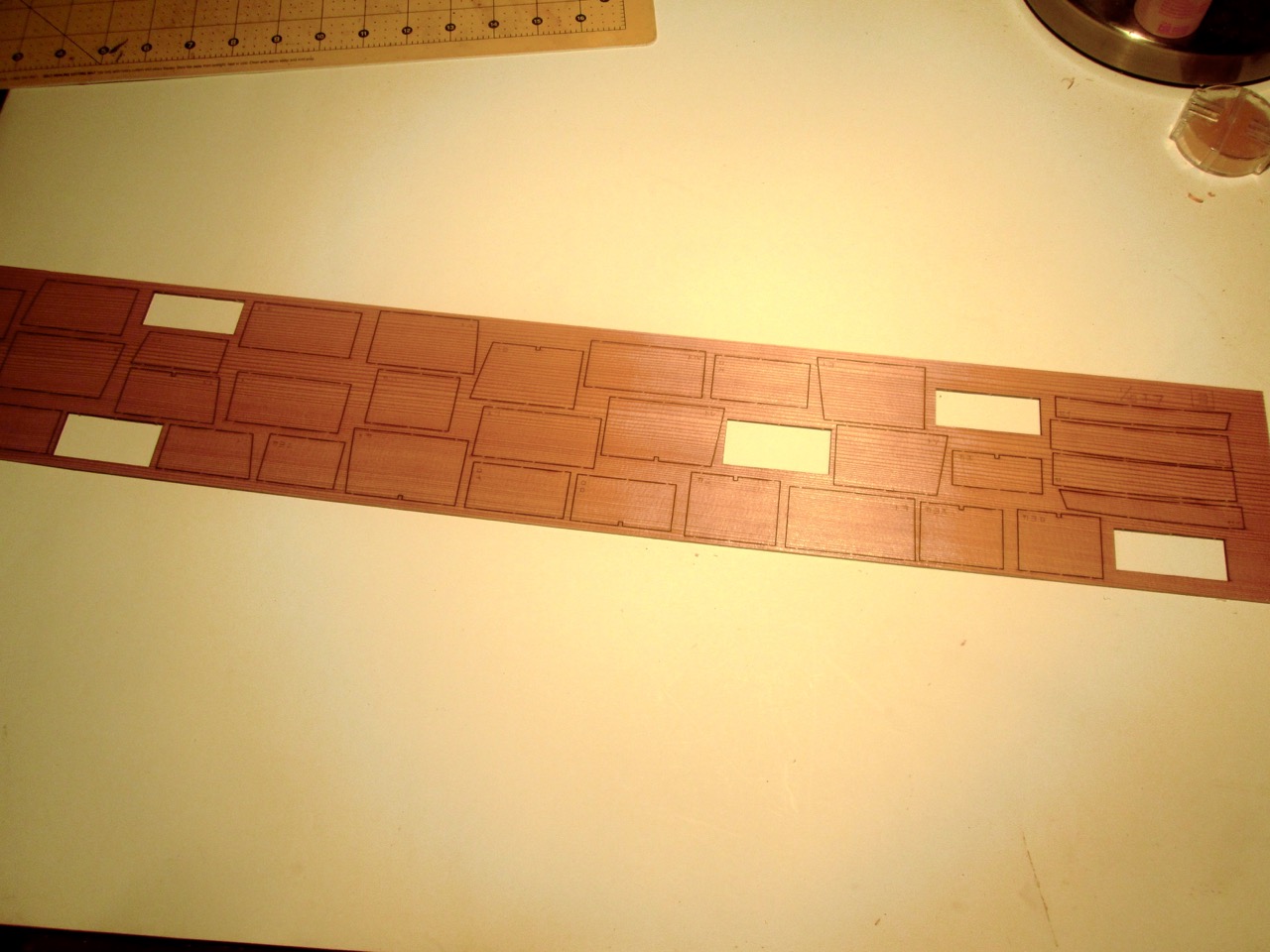
The kit supplies the deck boards as laser-cut pieces, which look they’d make it easy to put them into place. However, in order to allow some variation between models, these parts are cut over-sized, so they have to be sanded to fit. This turned out to be a far trickier than I’d expected, as the Japanese cedar is pretty soft, and really wanted to avoid small gaps between boards. In fact, I used every scrap piece of cedar that I could find in the kit in order to finish the deck boards.

If you’re building this kit, Proceed Very Carefully here.

The next step was to scribe the patterns into the deck boards. I found it easiest to take each group of deck boards which are part of the same pattern set and marking the endpoints on the first and last board, then scribing them all together as a group. I lined them up against a straight edge to keep them in alignment (each set of boards has at least one straight side).

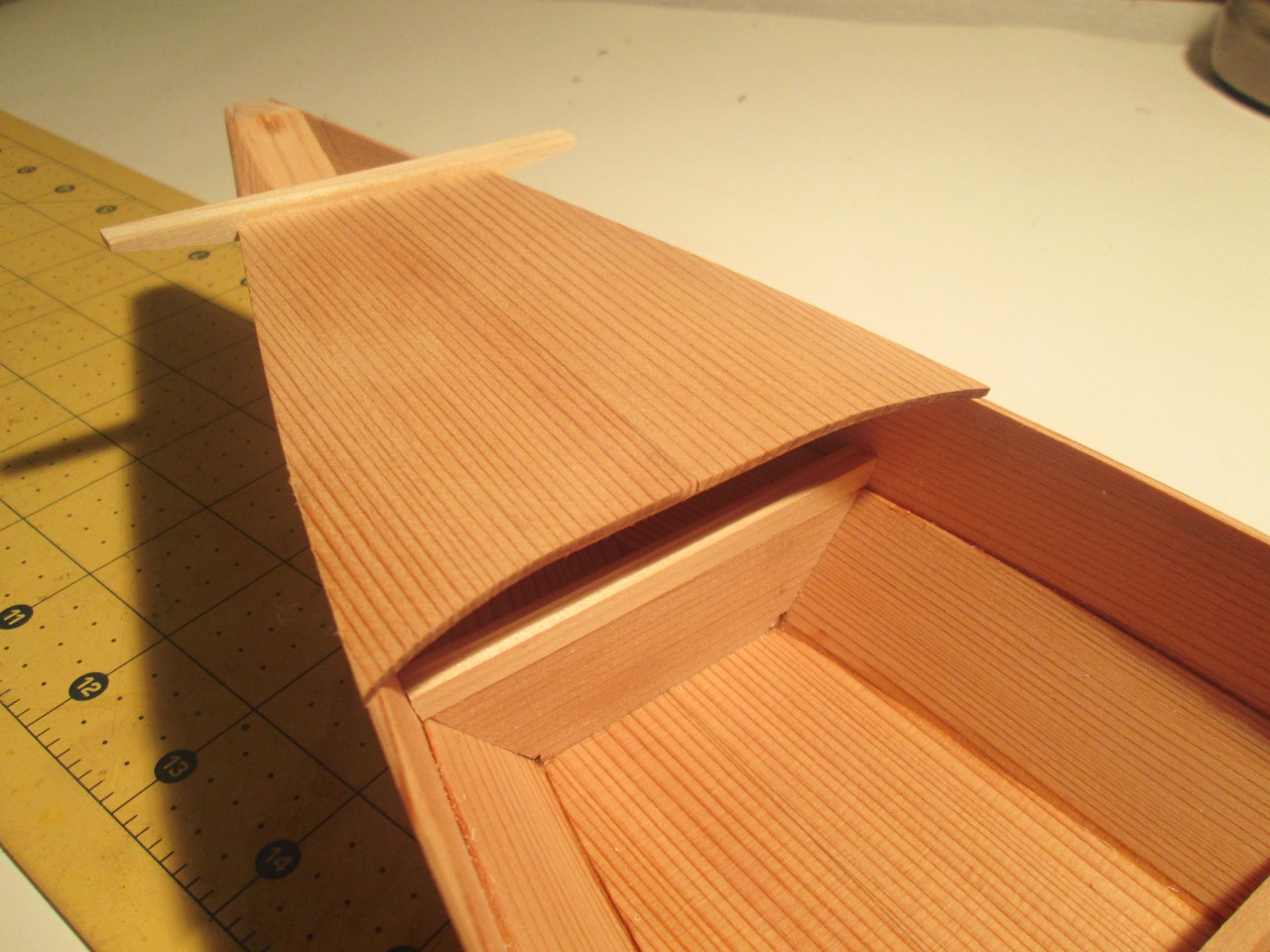
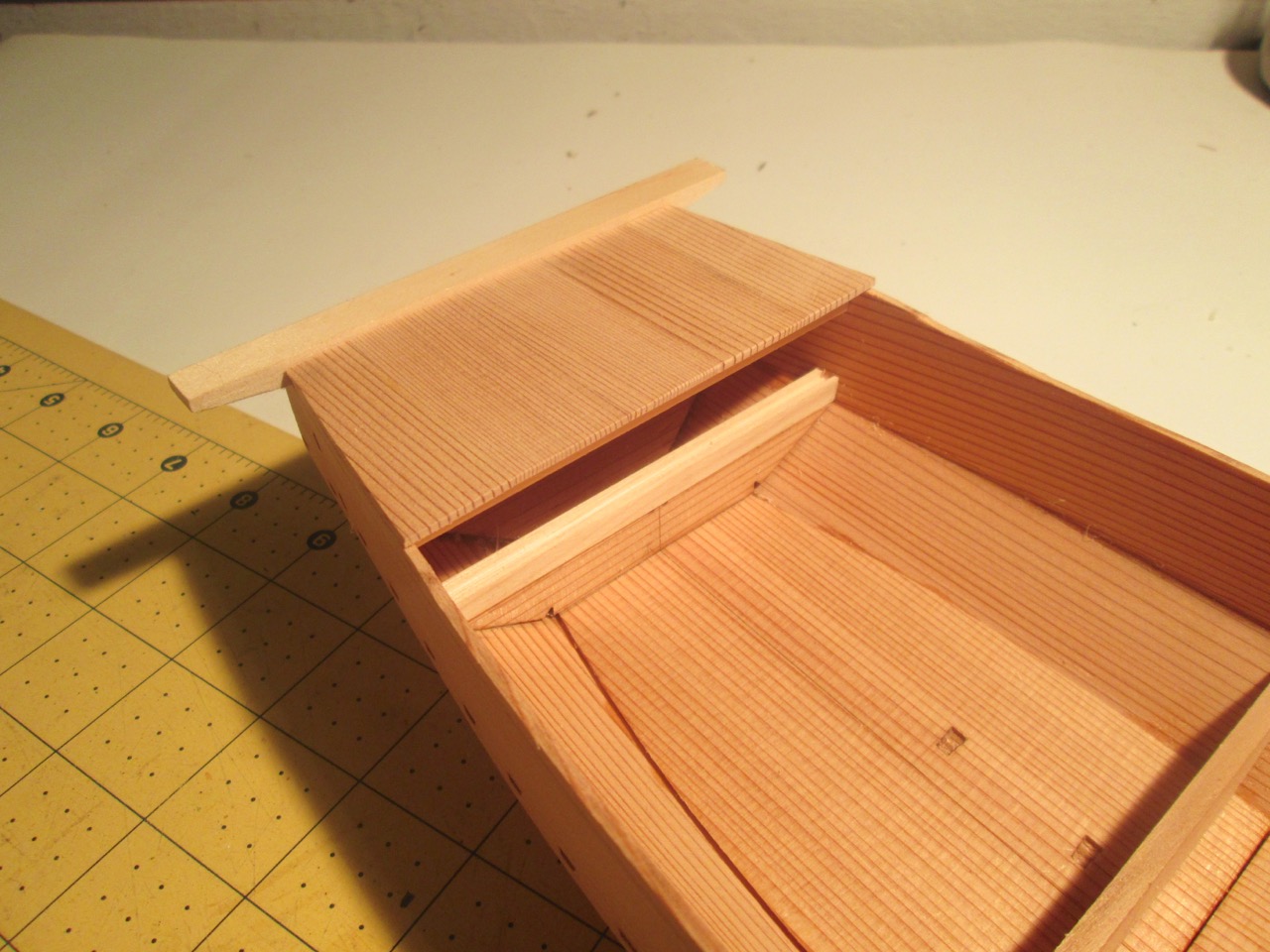
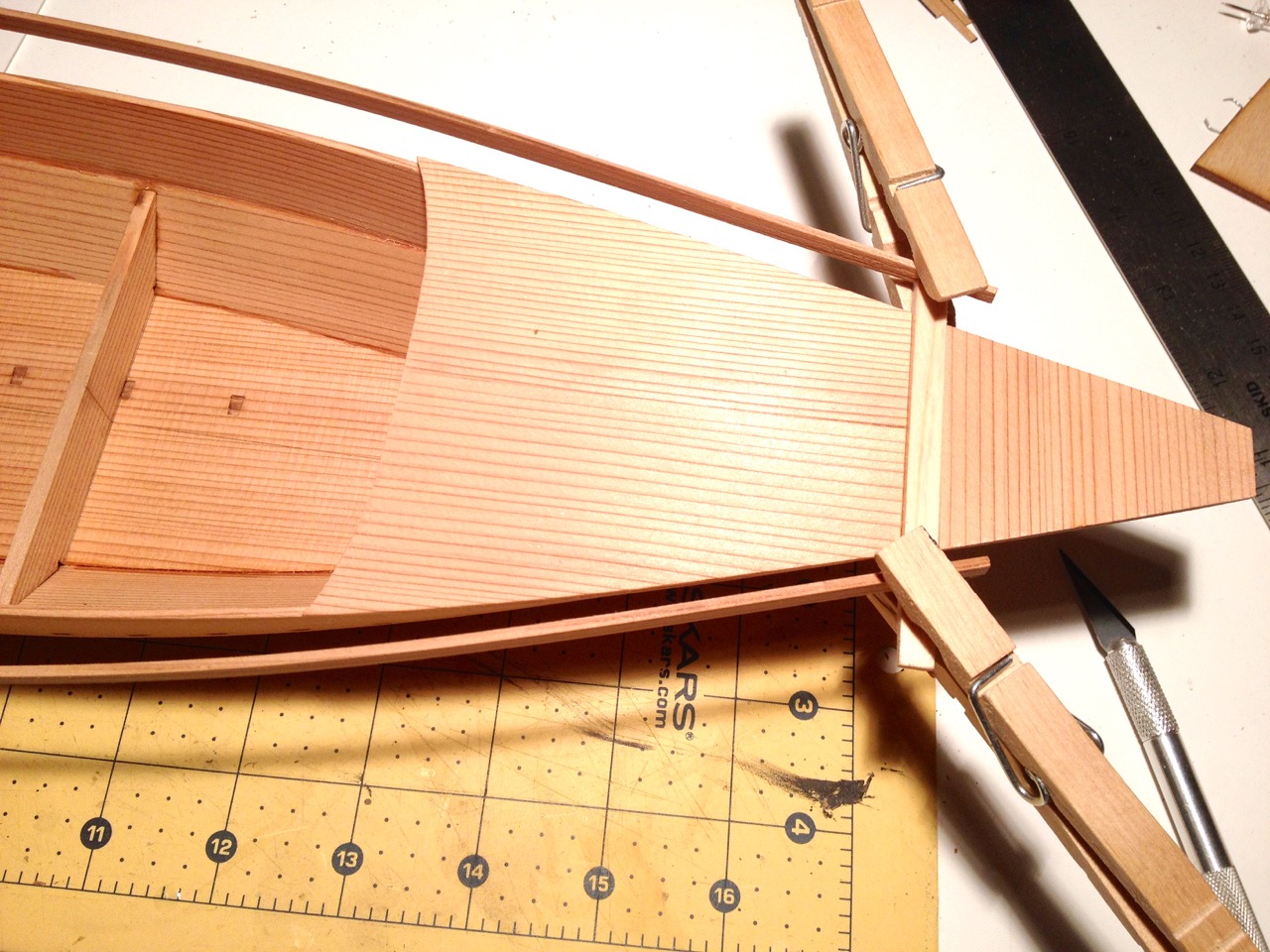
This was pretty much the last of the difficult work. There is one more step that was a little tricky, but in a completely different way, and that was the next step. For those following along with the kit instructions, this is step 33. This involves the construction of the covers for the cargo compartments in the bow and the stern of the boat. If you haven’t built the model kit yet, I would consider doing this work in steps 17 and 18 before the compartments are decked over. It seems it would just be a lot easier.

IMG_2033

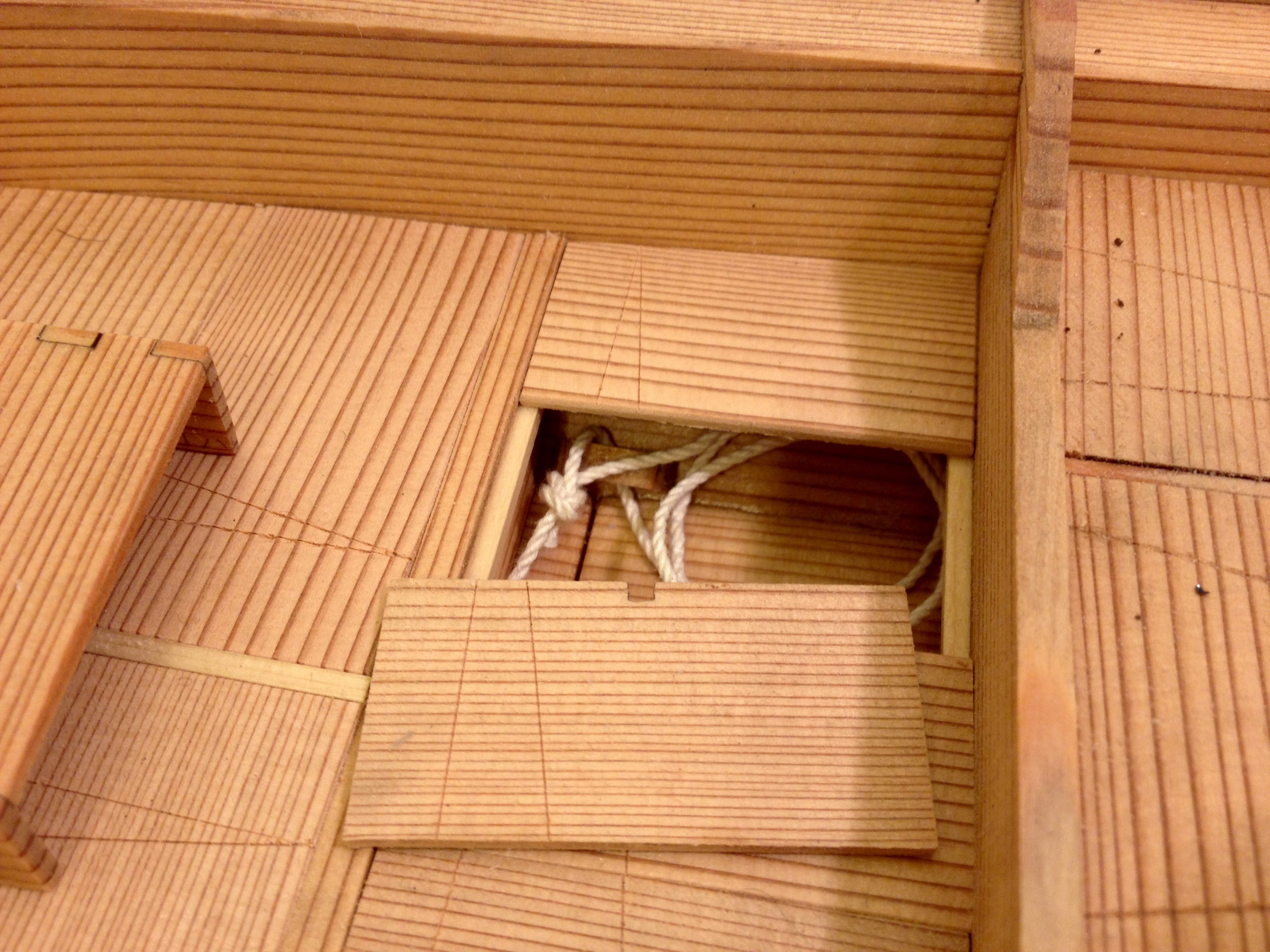
I’m not positive why the kit has you build the compartment covers at this stage instead of earlier in the build. Possibly, it’s because the real boat might be built in the order shown in the kit. That would be okay, except that trying to reach in with your finger and thumb to get the covers into place without knocking parts into the compartments is pretty difficult.

The kit includes a small pair of wooden tweezers that you’re instructed to build for handling those compartment doors. In the long run, these will be necessary in order to be able to remove or replace these doors without damaging the soft wood.

Completing the Rail

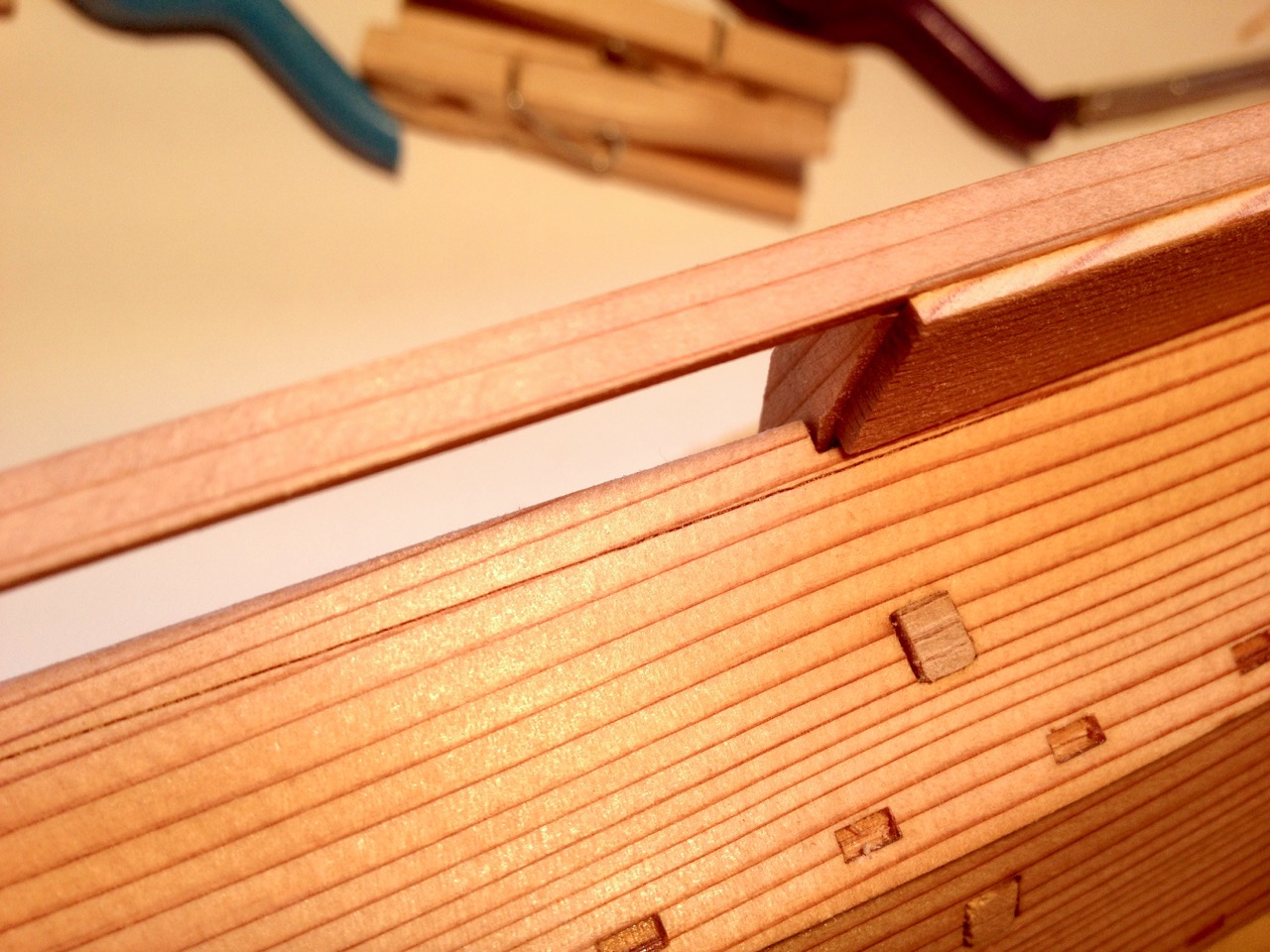
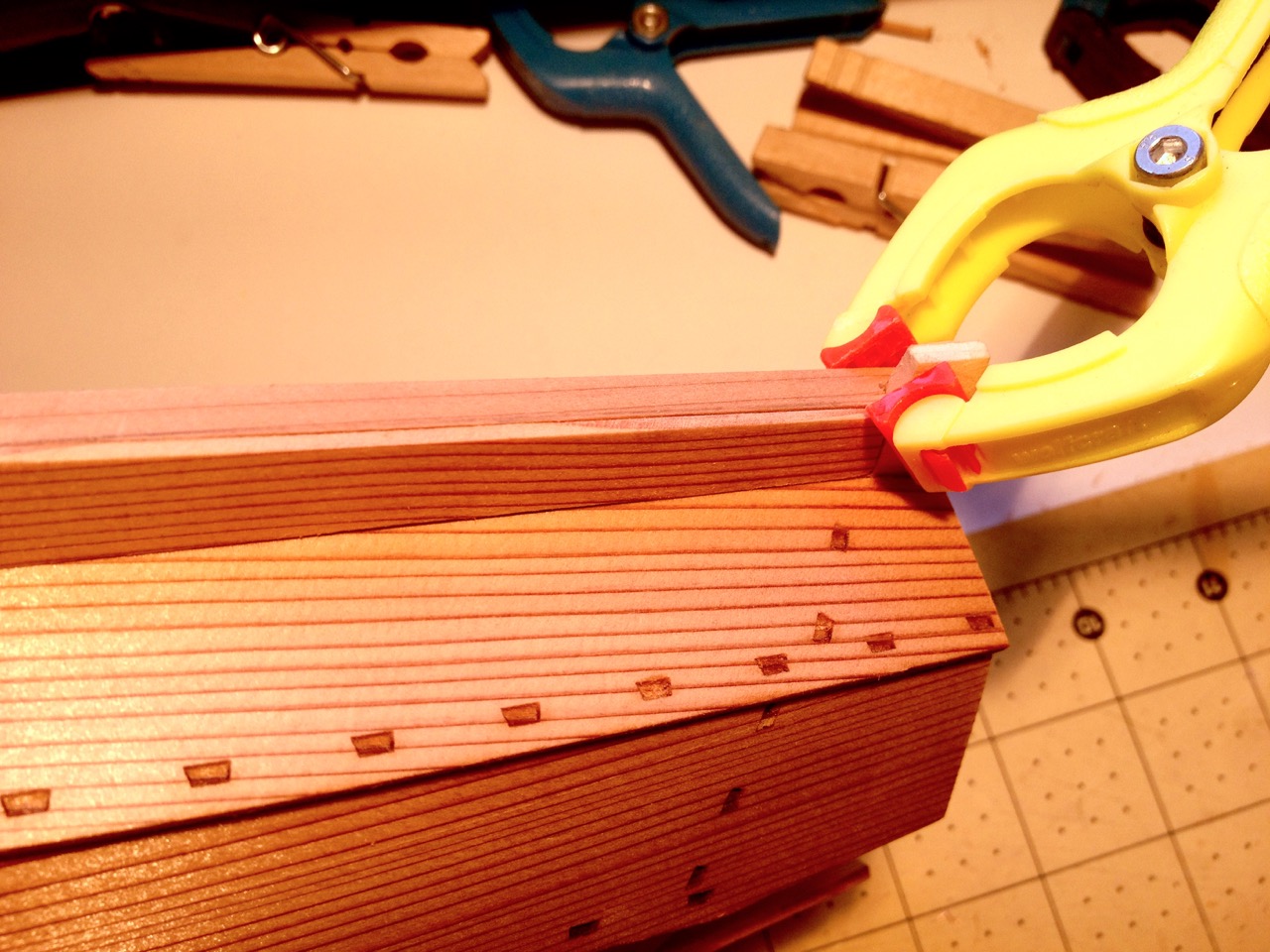
I jumped ahead just a little bit with the compartment covers since I was kind of on a roll with the trickier stuff. So, afterwards, I went back to deal with the rail supports. These are tapered blocks that are added to the rail after it has been constructed. By constructing the rails first, the nice fair curve has already been established and doesn’t need to be engineered into the design. Afterward, the support blocks were added to give the structure more rigidity.

You can see the support blocks of the rail in the photo below, and also in the second photo shown above.

IMG_2037


Finishing Details

The last steps of the Tosa Wasen kit involve adding the finishing details. These included the rail supports, oar, ringbolts, anchor, oar and some fisherman’s accessories.

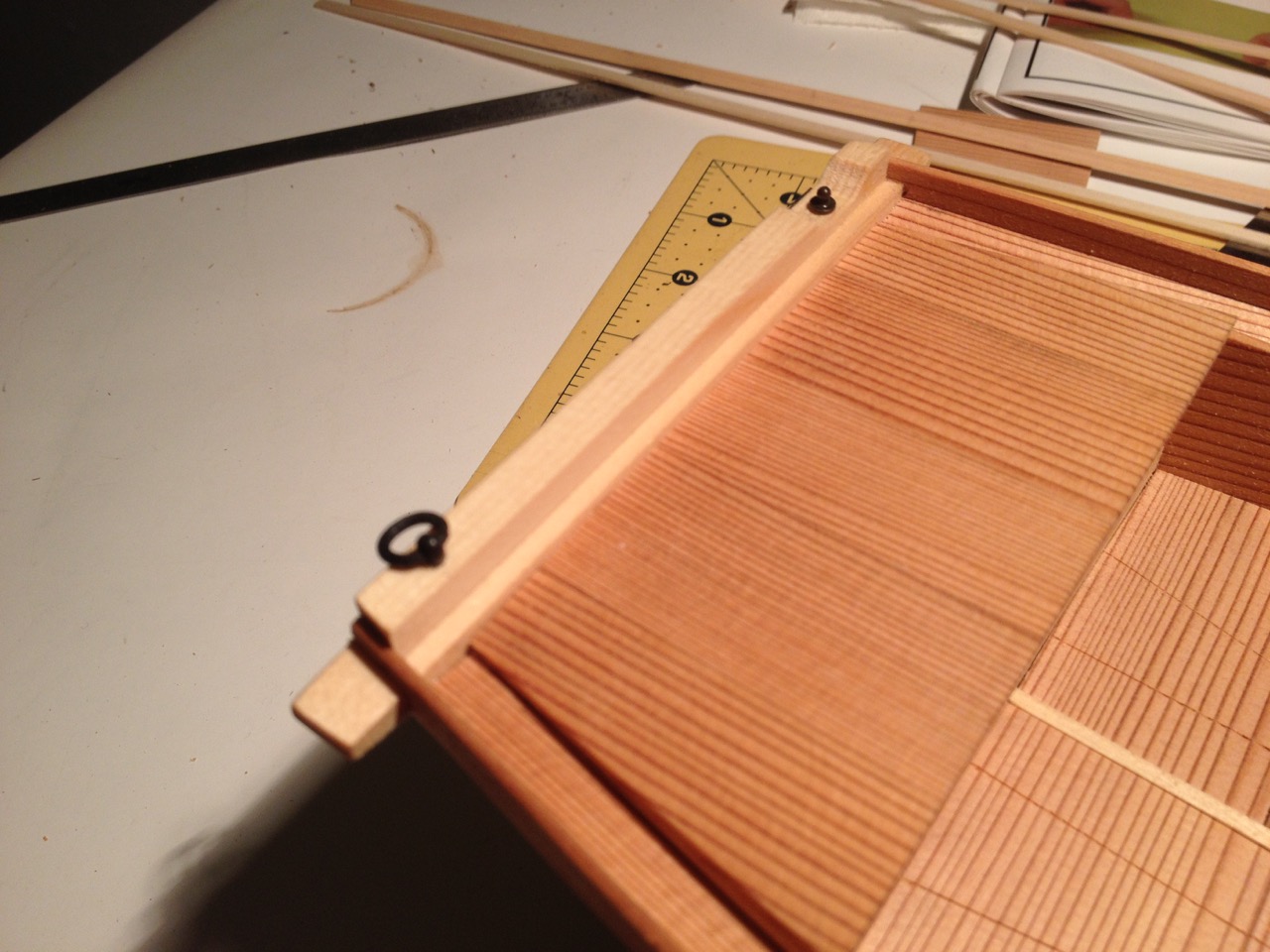
Dealing with the details on the boat first required drilling some 2mm holes to accommodate the ringbolts, etc.

IMG_2044

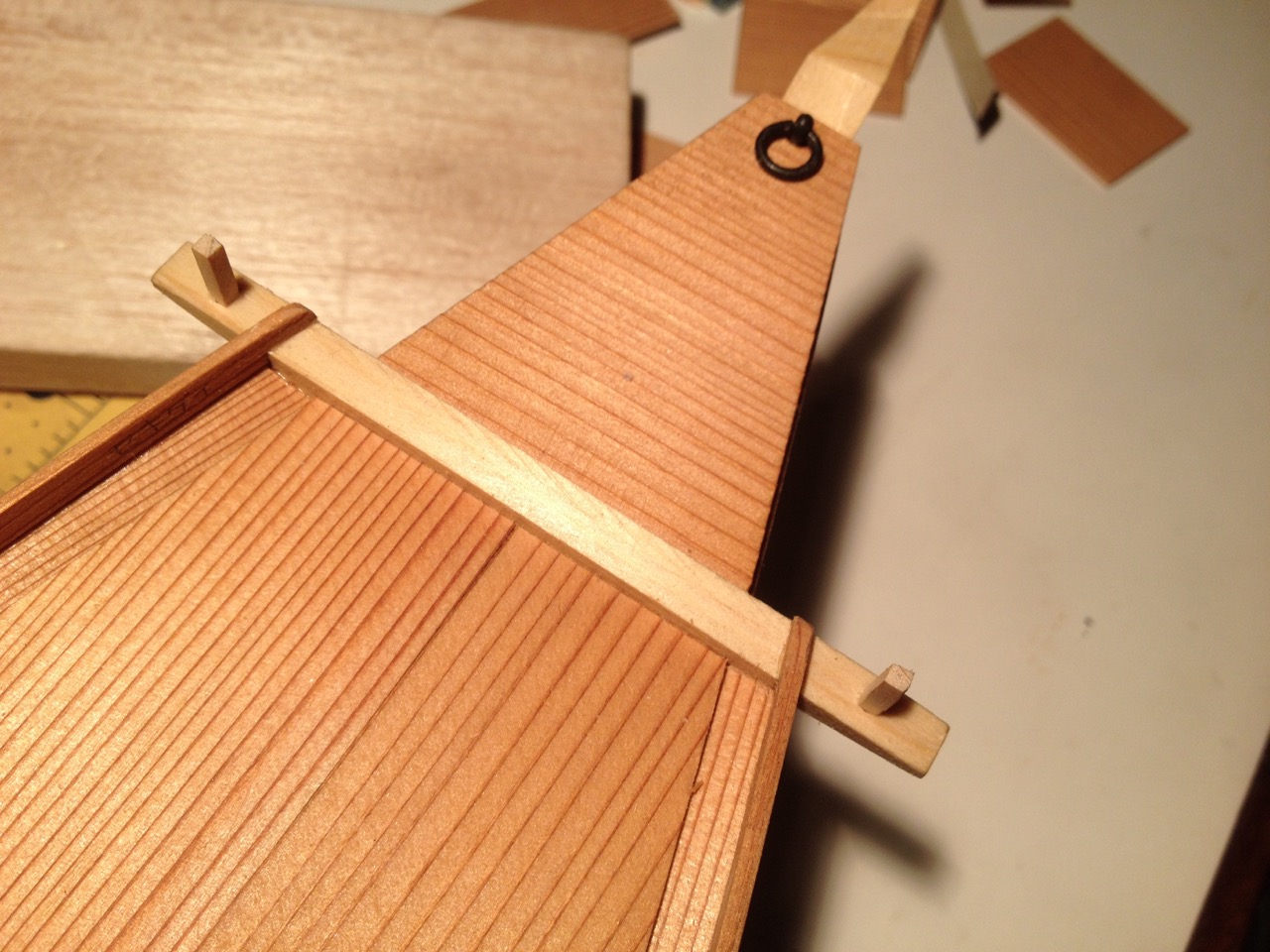
Ringbolt and the pin for the sculling oar added to the stern beam.

IMG_2043

Ringbolt and, for lack of better term, “belaying pins”, which are mounted on the bow beam.

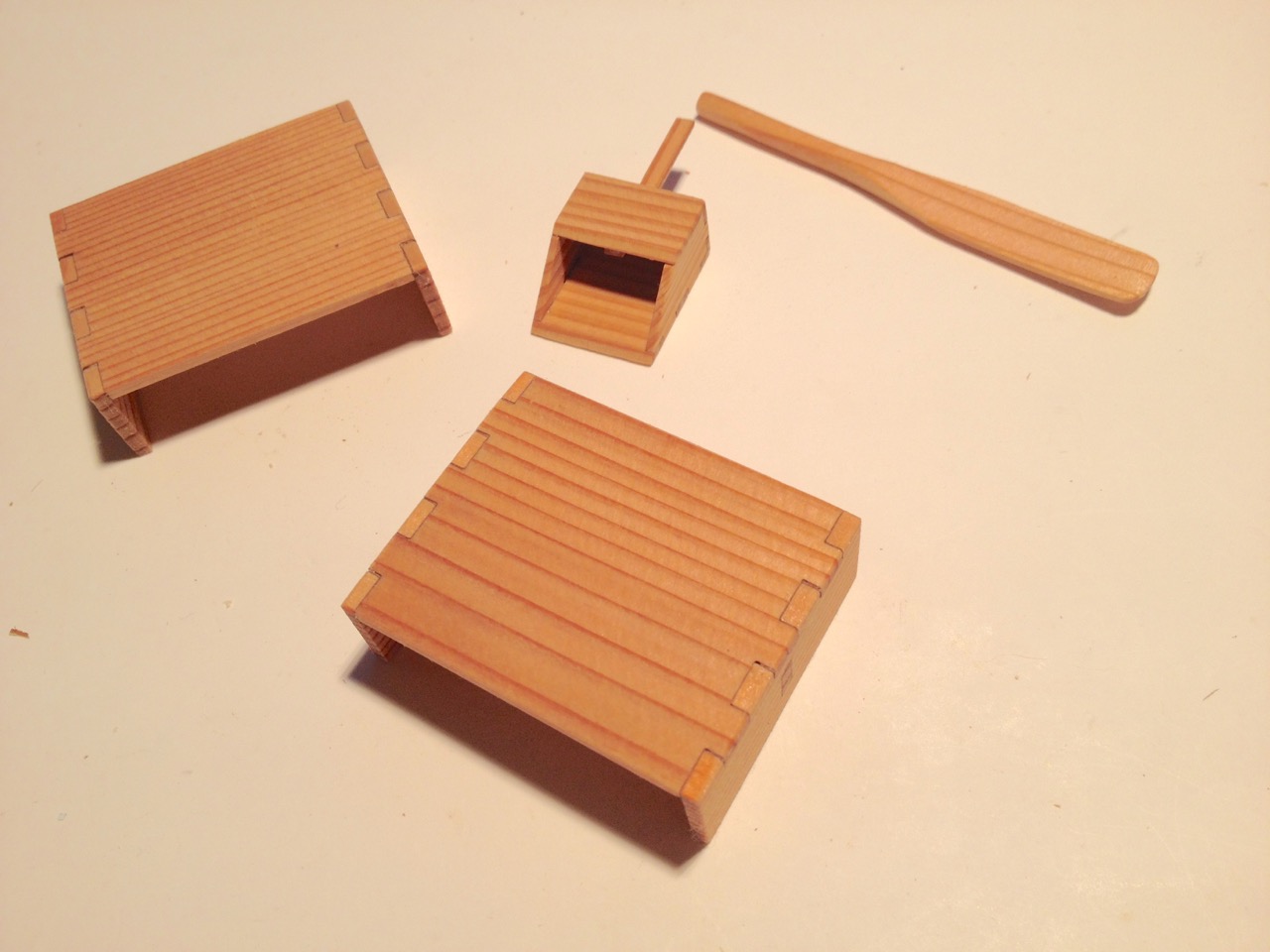
The kit includes some accessories that I jumped ahead and worked on because they looked fun and interesting. Specifically, there are two wooden seats, a small hand-paddle, and a bailer for scooping water out of the boat.

IMG_2045


The laser-cut pieces are designed to create nice box joints between all the parts, and as with everything else, the parts go together in a perfect fit. This is true of the bailer as well as the seats. The hand-paddle, called a Tekaki, was the only item here that required any shaping. Everthing else just went together and took a little sanding to soften the edges just a bit.

Afterwards, if you don’t want to display them on deck, they fit quite neatly in the storage spaces below the deck.

IMG_2046


The Sculling Oar

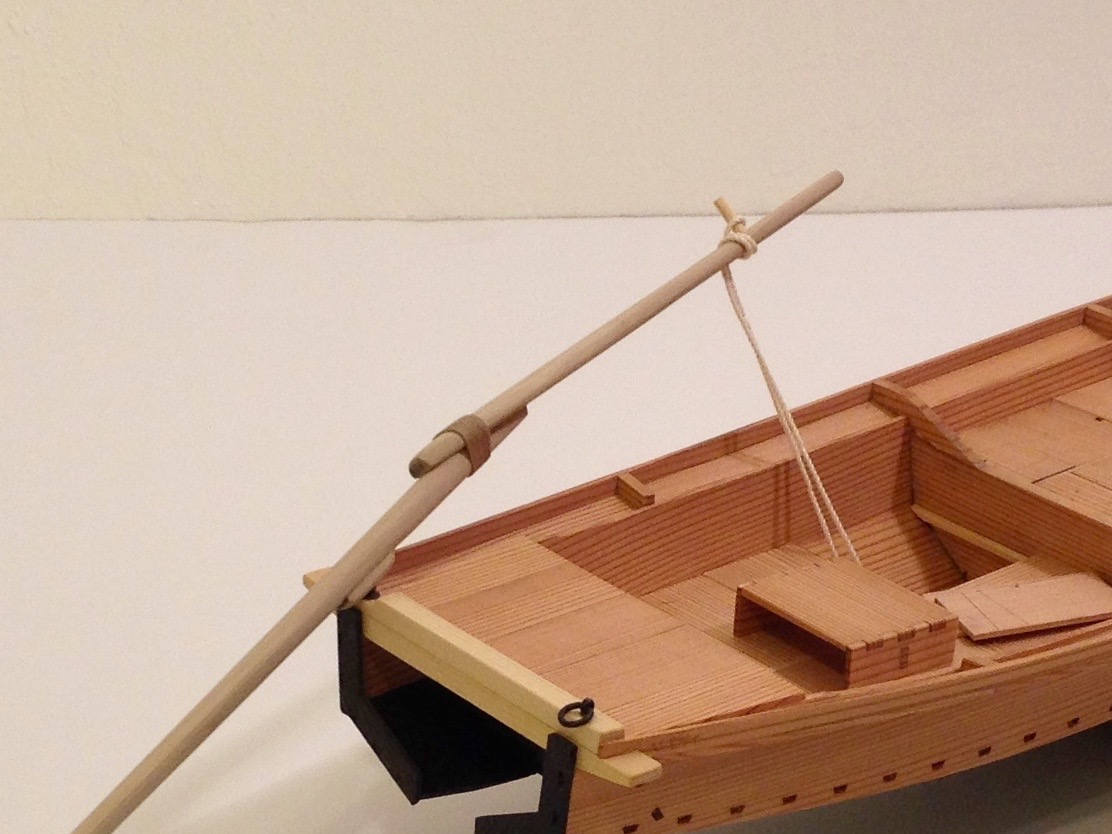
The boat, like most traditional Japanese boats, is propelled by a long, rearward facing sculling oar called a “Ro”. The sculling oar in this kit makes an accurate representation of a Japanese sculling oar. The plans show the cross-section of the oar at different points along its length, and the scale is large enough for people to see the shape detail.

The oar comes in two main pieces where were milled, not laser-cut, from Japanese magnolia, or “Ho”. This is kind of a grayish colored wood with a fairly fine grain that is harder than the cedar or cypress in the kit.

I varied a bit from the kit design here in that the kit included a tiny screw and nut to fasten the parts together. This is how the real Ro are made today and for the last 100 years or so. But, going for the Edo period look, I decided to wrap them together with rope instead.

IMG_2084

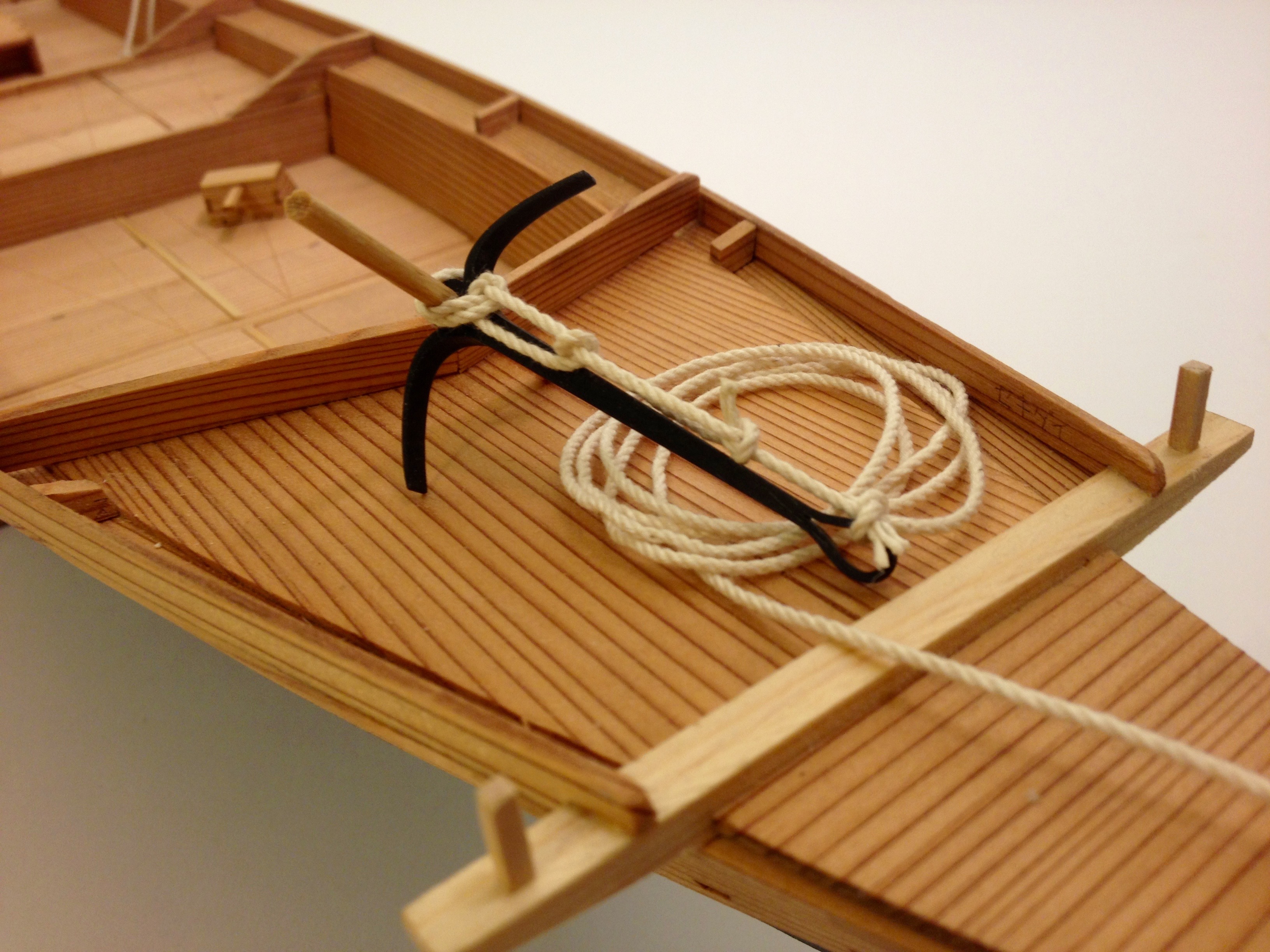
The anchor is the last item of this build. Not sure how they form this, but it seems like a piece of cast acrylic. It’s just a ted flexy, but has a good shape to it. It comes a little too thick, so it required some sanding to get it to look a bit more like the photos in the instructions. I ended up speeding up the process by using my belt sander. The part held up well and didn’t melt, so this worked out pretty well.

The anchor’s shape has a bit of taper, so it’s thinner at the top than at the bottom. At the base, there is a hole from a cross piece, making it look something like a grappling hook.

IMG_2071

The hardest part was tying the knots. I tried translating the text with Bing Translate, but all I got was a Japanese name for the knot. However, Google Translate came up with “Bowline”, which made life much easier. Basically, there’s a bowline at the base, a pair of half hitches, and the a separate rope ties the anchor cable to the eye of the anchor. The cable is then fastened to the ringbolt on the stem using a bowline.

A short piece of the supplied rope for the anchor cable was needed for the loop that secures the sculling oar. When not in use, that loop of rope stores away nicely under the deck.

IMG_2086

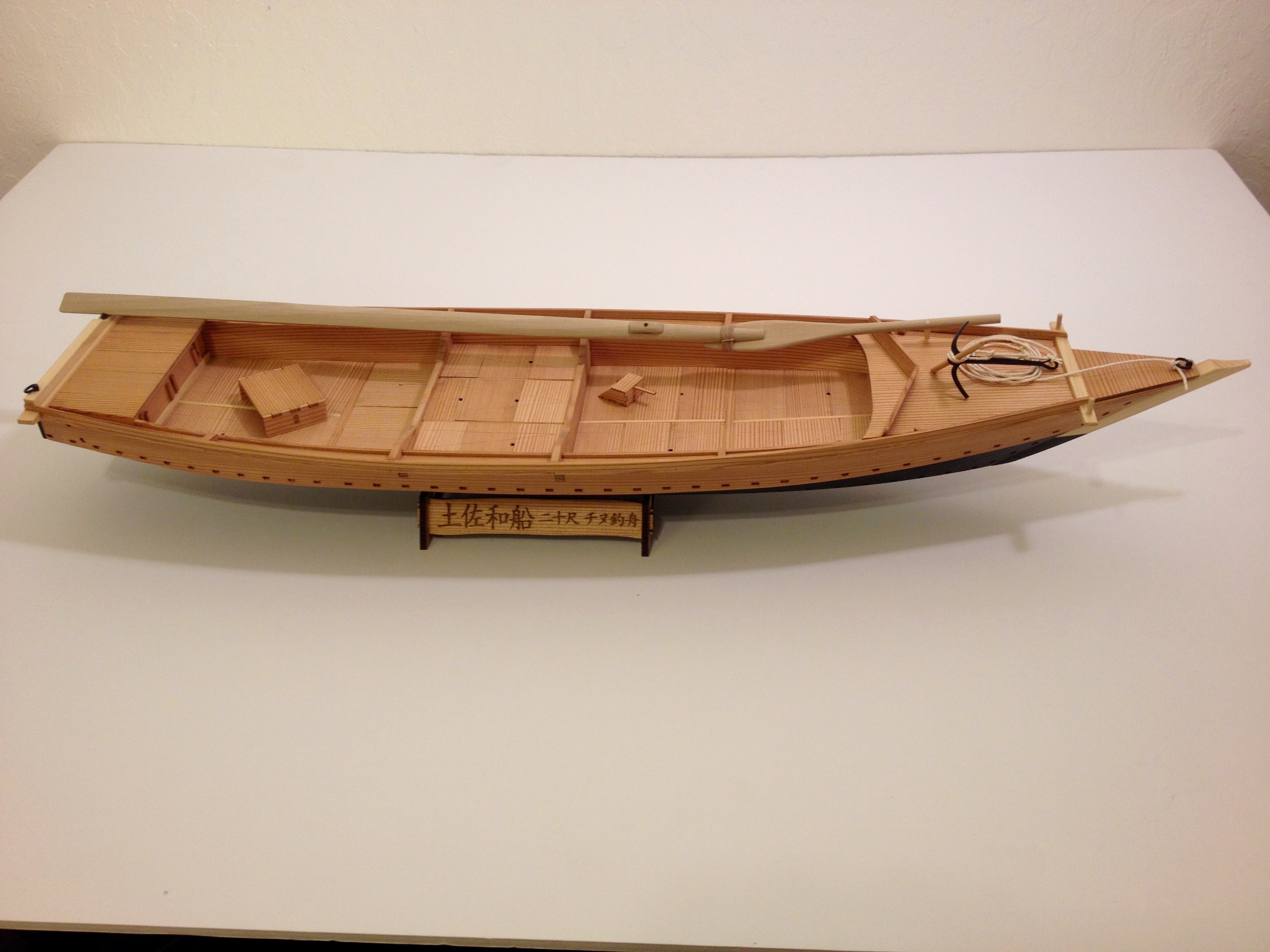
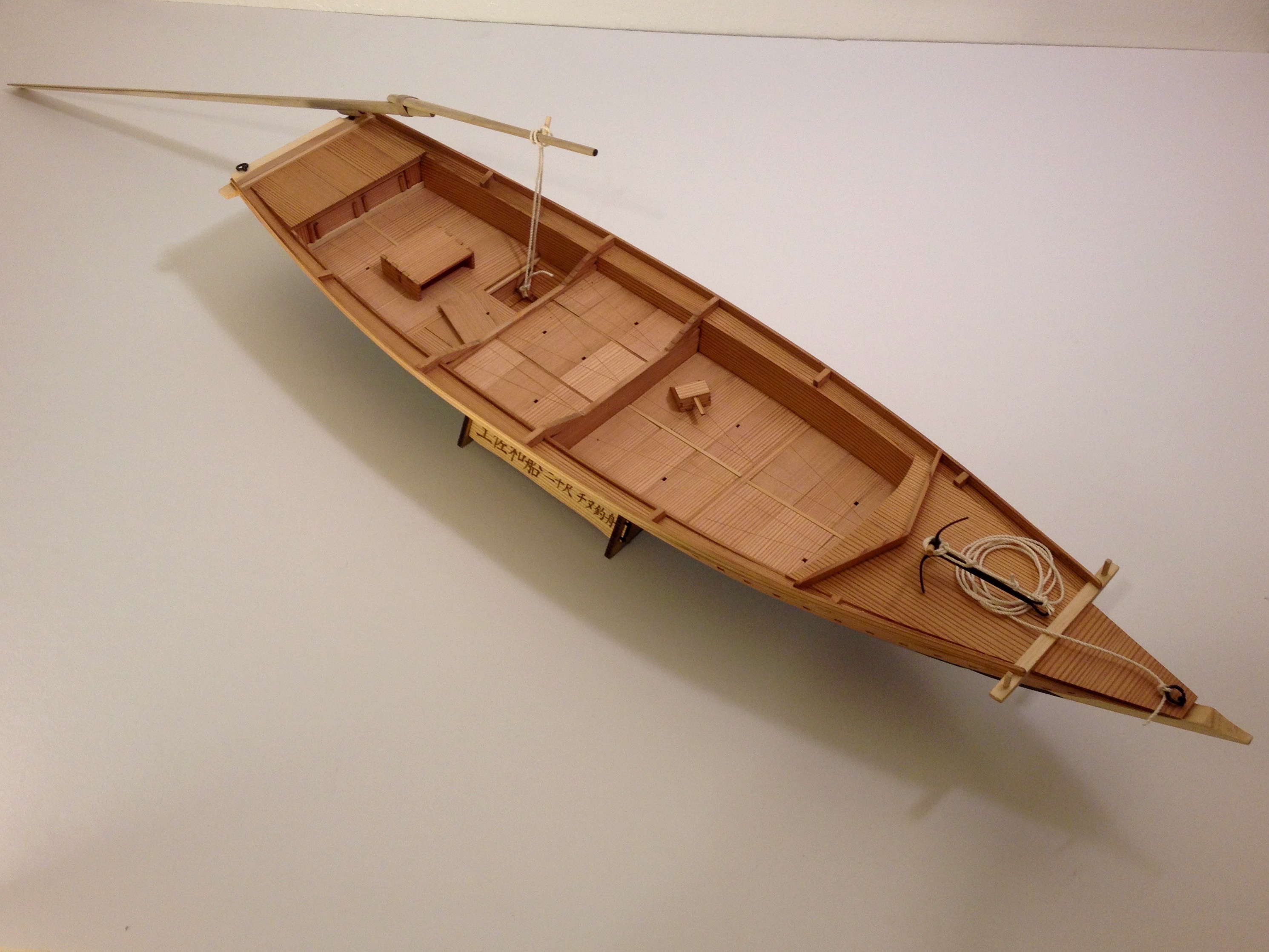
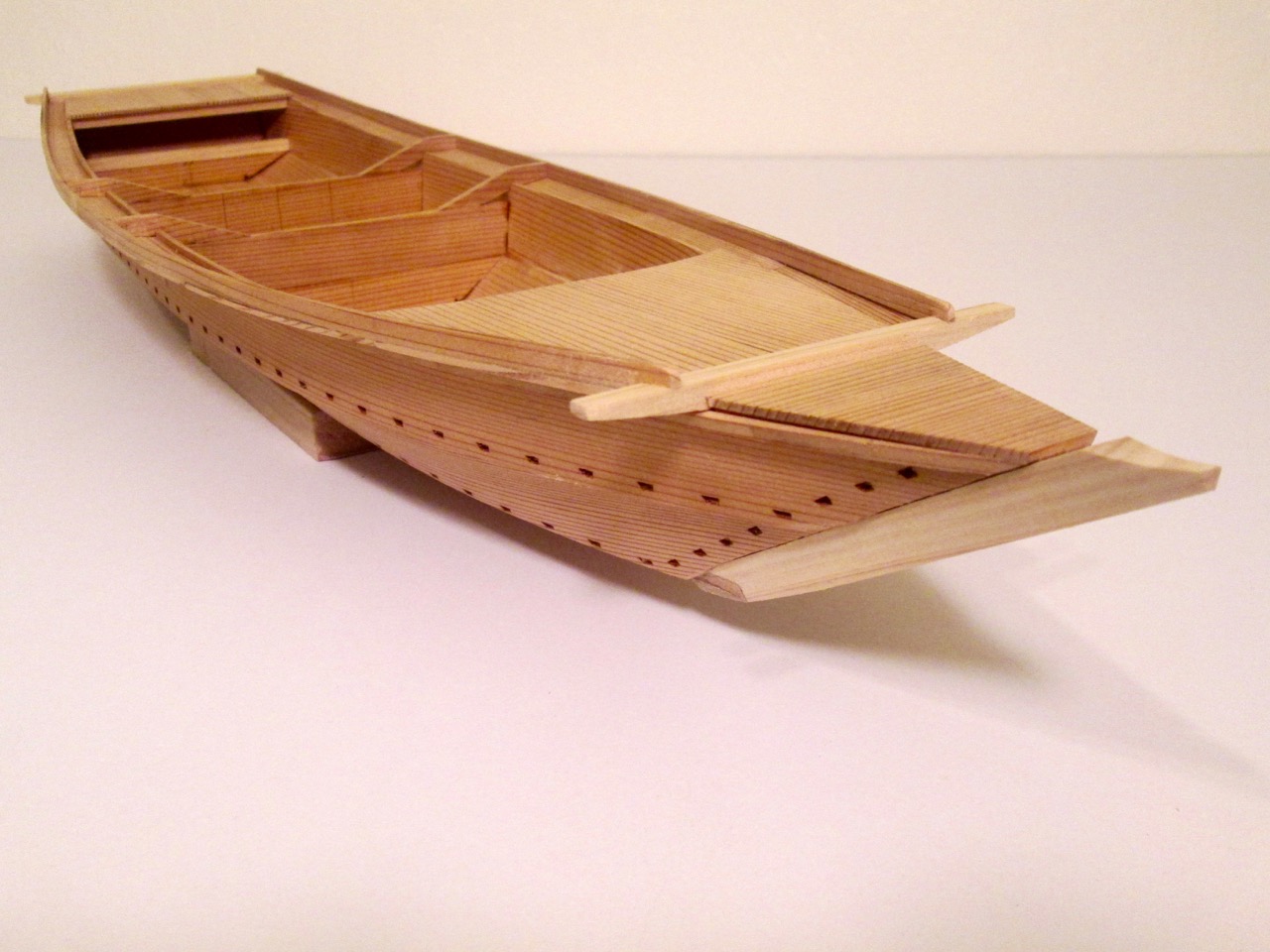
The finished project turned out beautifully. I used a coat of natural stain to finish it off and seal the wood. According to the label on the Minwax can, it seals, so that should help the longevity of the model as well as bring out some of the color of the wood.

I’ll eventually build a case for the model. With not masts, a cased Tosa Wasen model will fit easily in the bookcase. My Wasen Display is still running at the bank in San Francisco’s Japantown, but I have plenty to do with other projects, so I won’t worry about adding this model until Wasen Model Display 4.0 maybe in the Summer.

IMG_2087 IMG_2070 IMG_2085

Again, this is a great model kit for those interested in traditional Japanese boats. Email info@thermal-kobo.jp for ordering information. For now, the kit has a very low price – about $130 shipped by express service, payable using Paypal. If you would, tell them I sent you. Ω

Building the Tosa Wasen – part 5

Continuing with the detailing now starting with the bow and stern decks.

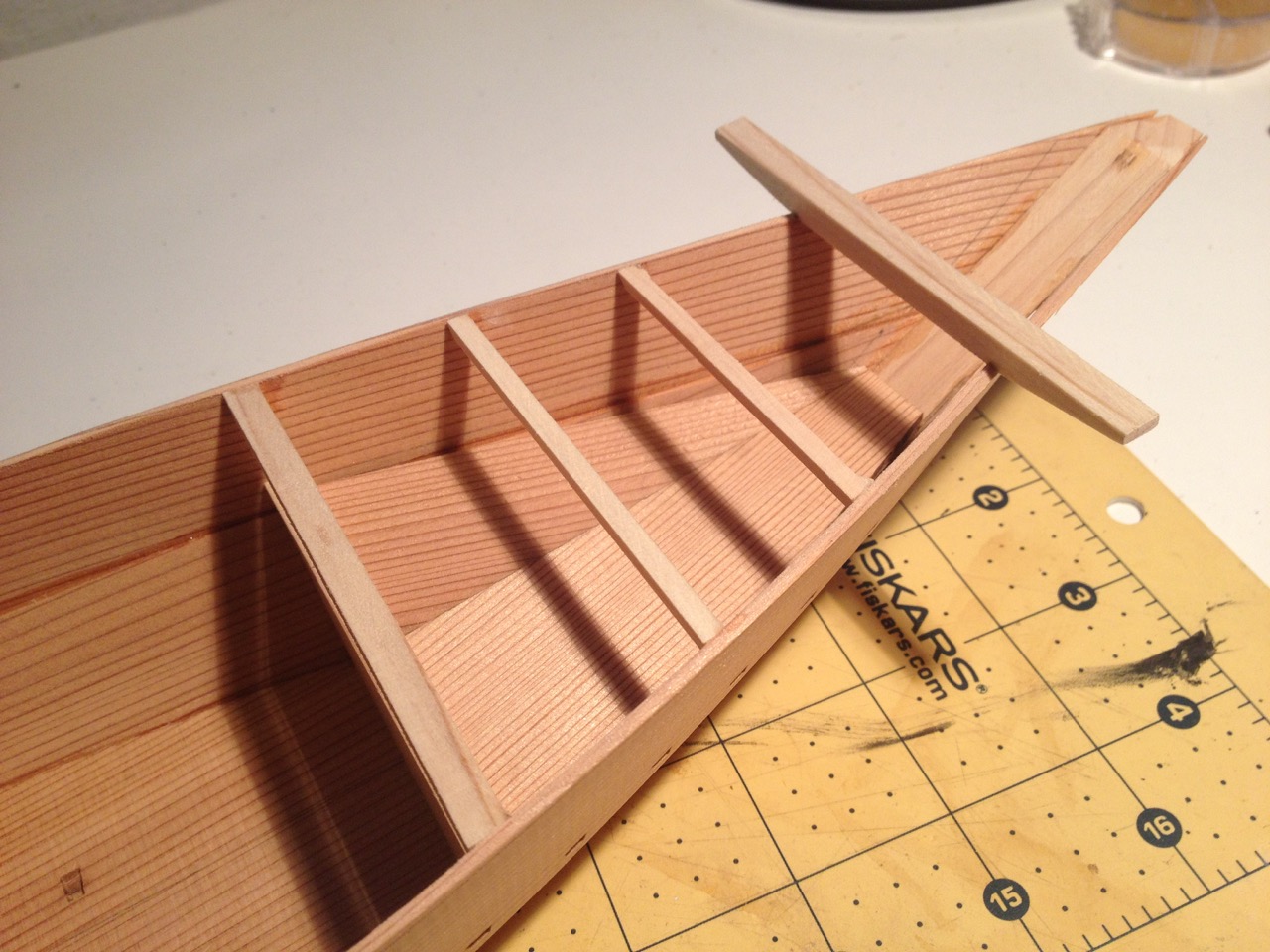
The bow deck required installation of support beams. The beams are provided pre-cut, but the ends needed to be tapered to fit snugly against the hull planking.
IMG_1905


The deck itself is made up of two pre-cut pieces of cedar.
IMG_0286


The stern deck is made up of 5 pre-cut boards, but the pieces are of different widths. The instructions don’t show you, but the plans provide the labels, so you can locate the needed pieces. You don’t have to read Japanese, but you do have to match the characters on the plans with those on the parts.

To those familiar with Japanese, the labels are all in the phonetic alphabet known as Katakana. In this case, the parts are:

ウカイ

ウカロ

ウカハ

ウカニ

ウカホ

These characters don’t actually mean anything here – They’re basically no different than labeling parts as A1, C2, etc. Most of the parts in the kit are identified this way.

Something else to note is that the pieces aren’t necessarily placed on the sheets in any order. Efficiency of material was very obviously given precedence here, so related parts may be separated  quite a bit. You can see this by how these deck pieces are located on the laser-cut sheet.

IMG_0287


The deck parts were glued up and I then placed them on the hull and traced the edge onto them using a pencil. This was then trimmed by knife and sanded to fit the hull. As I mentioned before, trimming Japanese cedar with a knife can be quite tricky as the wood is soft and the grain is hard, so the knife catches the grain and wants to follow it, so extra care is required.

IMG_0283


One thing you’ll notice is that the part labels are etched onto each part, so you have to either hide the labels or sand them off. Or, you could always just ignore them. They’re not that easy to see unless you’re looking closely. In this case, I just glued the boards so that the labels will all be on the underside of the deck.

IMG_0285


Adding the Rail

We’ve now come to the stage on the Tosa Wasen model where I became a bit confused about the next step of construction. It involves installing a rail, and I suppose that it may simply be a matter of getting accustomed to traditional Japanese building methods which, as far as I can tell, this kit seems to follow quite closely.

The first problem I ran into was that the ends of the long rail pieces that have to be added first. These are notched to fit to the beams at the bow and stern, but the pieces are too long to fit. So, the notch at one end can be used, but the other end has to be cut to deepen the notch.

More than this, where on a western style ship, we’re accustomed to installing framing and then attaching the rail onto that, with Japanese boats, the process is reversed. The rail is installed to only a few attachment points first, then the supports are added afterwards. This is something that I’ve seen in hull construction of Japanese boats too. The hull planks are edge fastened and bent/clamped into place in the process, and the framing is installed afterwards – Lessons in traditional Japanese boatbuilding!

Page 12


Of course, this isn’t limited to the Japanese or Asian ship/boat building. Thinking back, I recall local ship modeler and marine archaeologist Ed Von der Porten (he’s written a number of articles that have appeared in Ships in Scale) talk about modeling a Basque whaler and about how frames were added after the planking process had begun.

Anyway, I finally worked it out in my head, and the rail construction progressed.

IMG_1907

IMG_1911


I completed construction of the rail, adding the pieces that make up the underside. With these in place, it’s a much stronger structure.

To fit the pieces into place, I had to soak the cedar pieces a little bit to impart a slight bend or twist here and there. I took the shortcut of wrapping the pieces with a wet paper towel and putting them in the microwave for about 30 seconds. This was just enough to do the trick.

IMG_1914


Along the underside of the rail on the upper hull planks there is a laser-scribed line to help position the underside pieces of the rail.

IMG_1915


The pieces glued and clamped into place
IMG_1917

IMG_1912

After the rail was completed, I went ahead and added the stem and other hull details, including a thick strake located on the upper hull planking, just underneath the recently completed rail.

IMG_0364


You may notice that the stem is lighter than the rest of the hull. Like the stern beam, the stem is make of Hinoki or Japanese Cypress instead of Sugi, Japanese Cedar.

Painting the Hull Bottom

Next, it was time to paint the bottom of the hull. The finish of the hull bottoms changed a bit over time. But, what we see as common for the Edo period would be black paint. The kit actually included a roll of narrow yellow masking tape from 3M which worked very well. For paint, I used a model paint sold by Caldercraft as part of their Admiraly Colors line.

There was no particular reason I used this other than to test the paint out. For all other wasen models I’ve built, I used artist’s acrylics Mars Black from Liquitex. In fact, the result using the Caldercraft paint was just a bit shinier than I would have preferred, but it came out fine. I keep trying other hobby paint brands and often end up just coming back to the artist’s acrylics.

IMG_0367

IMG_0369

IMG_0370


While I was at it, I went ahead and added the splash rail, which sits on the bow deck. The joint where the two piece meet and also the bottoms of the pieces had to be beveled to fit properly.

IMG_0368


IMG_0371


Finally, I built the well area. This was pretty straightforward, though I did start to run into little discrepancies in parts alignment, which is going to happen on kits with pre-cut parts. Also, a reminder that it’s REALLY easy to over sand the kit’s Japanese cedar.

The bottom of the boat will be comprised of covered compartments. So, beams and ledges will be added to seat the deck boards / compartment covers. The well section is the tallest compartment.

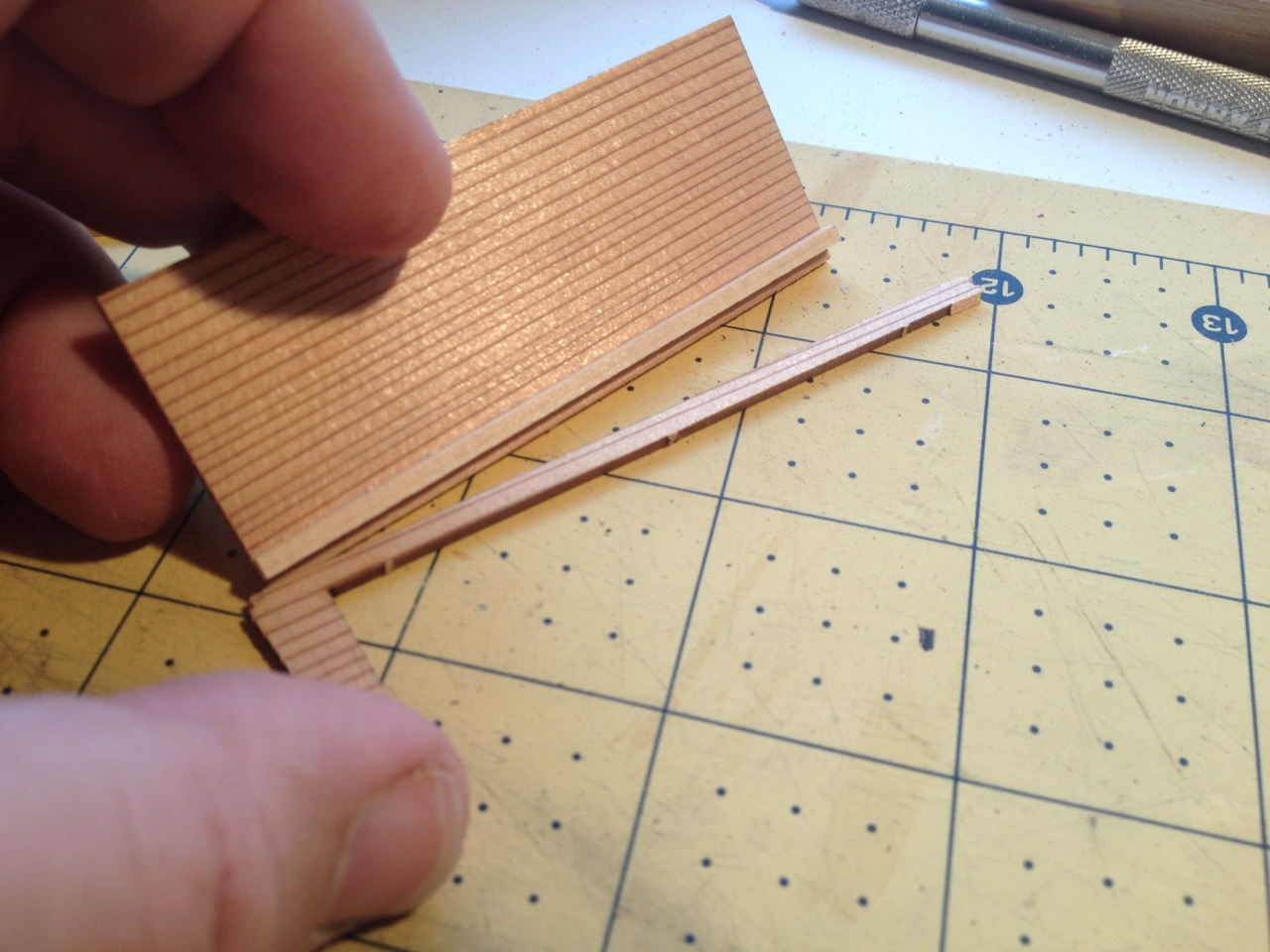
Here, I’m adjusting the position of the ledge that I’m gluing into place on one of the well partitions. I used wood from the sheet of deck covers as a guide for exact positioning of the ledge. This assures that the deck covers will be flush with the tops of the partitions.
IMG_1931


Here’s the completed well area. Note the ledges glued to the hull.

IMG_0381


Before the deck covers can be added, beams and more ledges have to be added. I’ll cover this next time, along with the covers for the bow and stern holds, making the “Ro”, which is the Japanese name for the long sculling oar, and the final accessories such as the anchor and the bailer, etc. The next installment should see the completion of our Tosa Wasen.