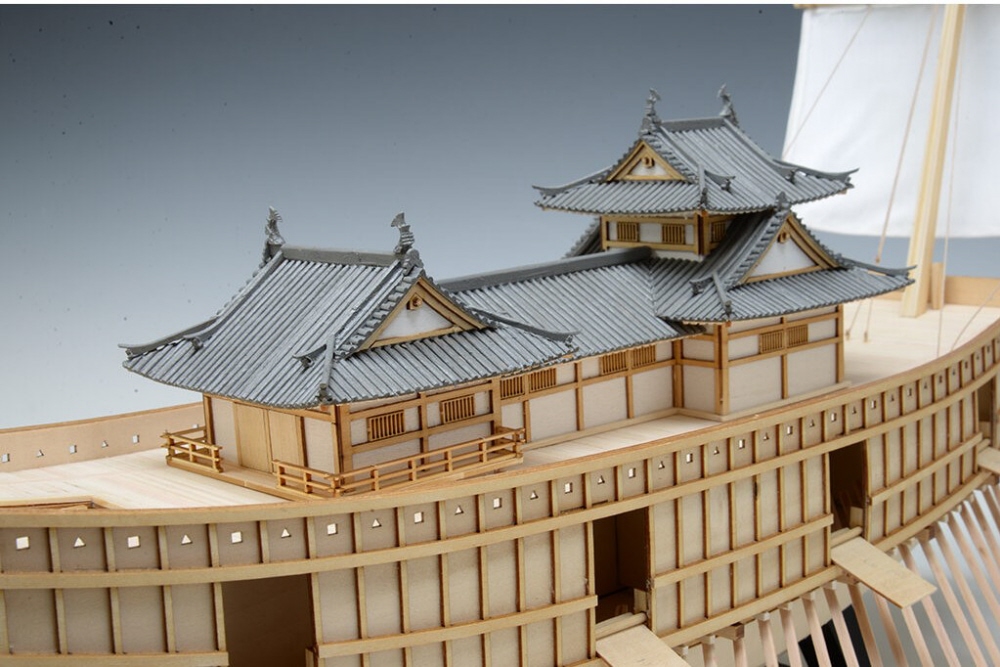
The Atakebune is the subject of a new kit from the Japanese wooden kit manufacturer Woody Joe. It’s something that I, Kazunori Morikawa of Zootoyz, and a few others were actively petitioning Woody Joe to produce. There was hesitancy on their part as there is actually very little solid information on the construction of these largest of Sengoku Period Japanese warships.
Category Archives: Wasen Modeling News
Utasebune 打瀬船 Fishing Boat – 1/72 Scale Model from Paris Drawings – Part 3
It’s been a busy few days for the Utasebune project. This is a really good thing, as I haven’t made much model progress over the past several months, and I’ve found that the Japanese boat models I make at this small scale tend to progress rapidly. There’s really not that much to say about the current progress, as I’m now basically cutting and fitting the upper beams and deck boards.
There is quite a bit of review of the hull details I can do here, but I’m mostly trying to focus on getting this model completed. At a future date, I may sit down and do a more thorough writeup of the details show in the Paris drawings, and how they relate to some of what I have learned about Japanese watercraft in general, and fishing boats, specifically.

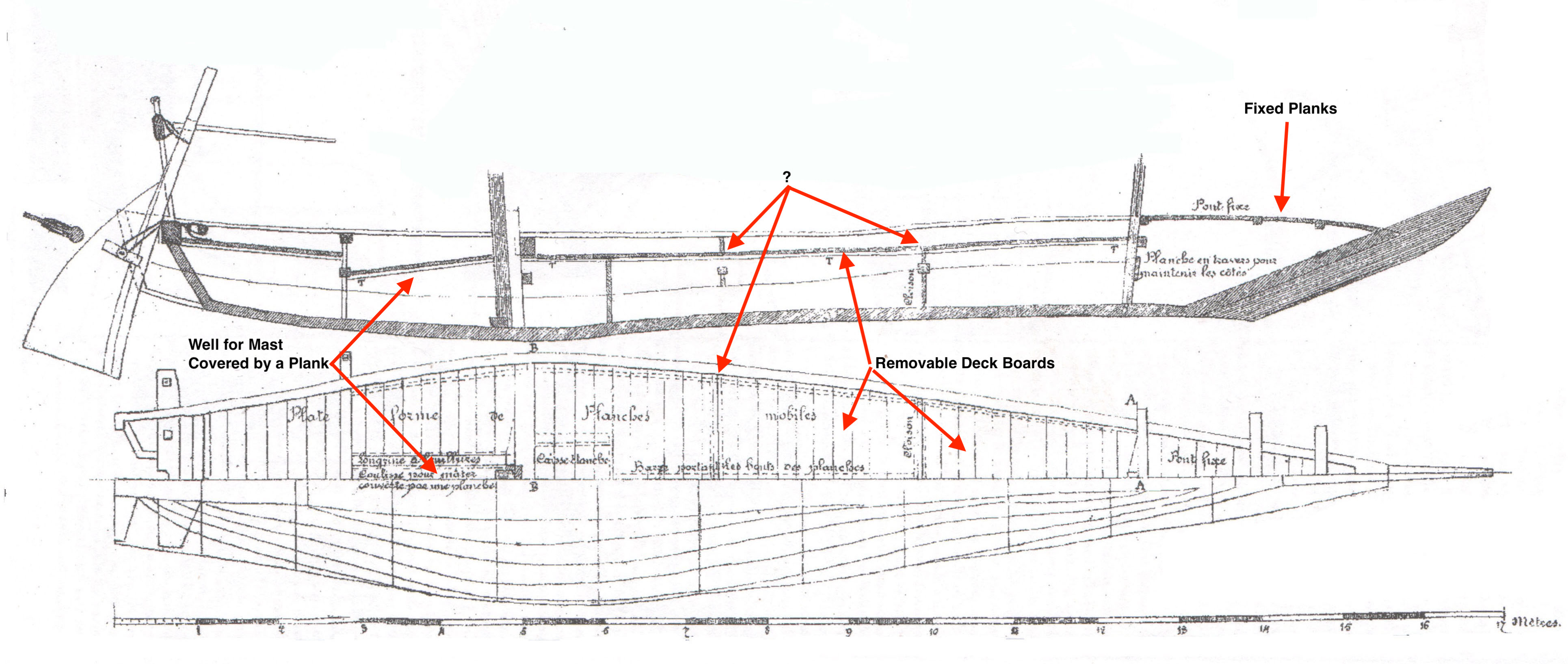
Hull details from the Paris drawings. I’ve labeled some general items. The items marked with the question mark “?” are features where I’m not quite sure how they manifest themselves on the deck. Rather than go into a lot of explanation here, in later photos of my model, you can see how I dealt or didn’t deal with them.
Utasebune 打瀬船 Fishing Boat – 1/72 Scale Model from Paris Drawings – Part 2
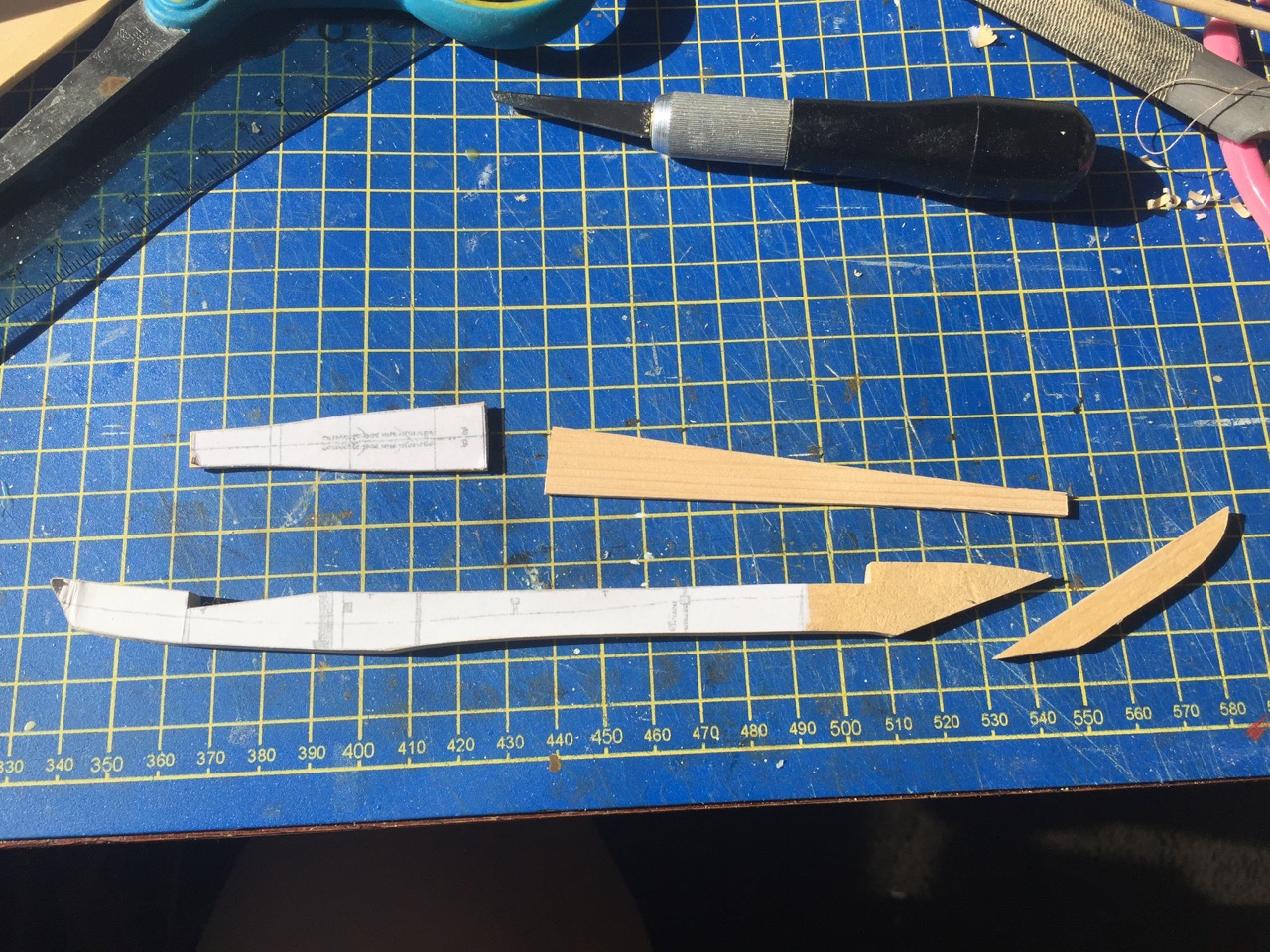
When there are available drawings, if at all possible, I’ll scale them and print them out to use as patterns for the shaping of the shiki, or the hull bottom, and the miyoshi, or stem, and also to create some kind of temporary former to simplify the shaping of the hull. I make copies of the drawings, cut them out, and glue them directly to the wood.
For this small model, with its completely enclosed deck, a removable internal former seems unnecessary. So I’m going to do the same as I did for the first Japanese boat model I built from Paris drawings and build it with a permanent internal frame. This frame consists of a strong back and a couple bulkheads that define the shape of the hull planking. 
Atakebune Kit Now Available
Woody Joe has officially announced the release of their new Atakebune kit. This kit is based on the model at the Saga Prefectural Nagoya Castle Museum, which is located near Fukuoka, Japan. That model represents a large Atakebune, which was the largest class of warship used by the Japanese armies during their warring states period.
The 1/100-scale kit sells for ¥38,000, which at the current exchange is about $335. Woody Joe will begin shipping the kits to resellers this coming Sunday, October 31st, but you can place your order now.
Japanse online hobby deal Zootoyz has the kit listed here: https://www.japan-wooden-model-kits-zootoyz.shop/contents/en-us/p25066.html
From the kit photos, the model looks a little on the simple side, but that just leaves room for some good detailing. As posted before, the dimensions of the kit are: Length 490mm Width 230mm Height 310mm (overall, including oars and stand).
I have two kits on order, which will hopefully arrive within a couple weeks. I’ll post a brief out of the box review when I get them. Ω
A Day of Display at the SF Asian Art Museum
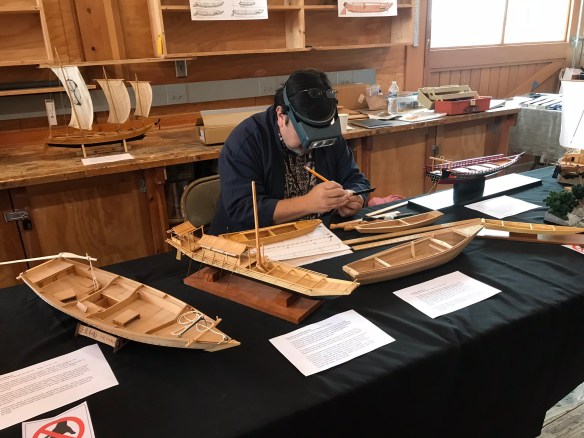
Sunday, October 17th, was my first display at the San Francisco Asian Art Museum and it went pretty well. It was a bit stressful getting everything together in time, but once I had all the models displayed and was talking to people about them, it was pretty relaxing. The event was just a one day showing, and there were many other things taking place as part of the event.
I had 10 of my completed models on display, and I decided to bring several models that I had in early stages of construction, so I could show how I build them. Information cards provided visitors with the basic information about the model and what it represented. There was a lot of information I had to leave out in order to fit the text onto those large index cards.
Behind the models, I displayed what artwork I could find that showed the specific boat types in Japanese prints and paintings.
Four of the models were built from kits, including Woody Joe’s Hacchoro, Yakatabune, and Kitamaebune, as well as Thermal Studio’s Tosa Wasen. That’s probably the weakness of this specific display, as I think most people would like to see models that I built from scratch, and most of those that I have are smaller boats, whose detailed construction I’ve been studying.
The bigger models attract the most attention, and they are kit builds. For my Japantown bank window displays, I mostly use the kits. For displays at the Asian Art Museum, it would have been nice to focus on the scratch builds. It’s something I’ll work on in the future. It means not only scratch building more models, but models of larger boat types, and ideally, models with sails, as they attract the most attention.
I had several in-progress projects on hand to illustrate how the models are built. This drew some interest too, though I didn’t have much time to actually demo the construction of the models in the morning, as that’s when I had the most people coming, asking questions about the models.
The best part is probably that it got the interest of many kids. There was one in particular, who was half Japanese with a Japanese mother and an American born father. He was maybe 8 and spent a lot of time hanging out with his dad and he was the most interested. So, I showed him everything I could that he seemed the most interested in. He had lots of questions and his dad was very encouraging. His mother came by too. She was originally from Ibaraki prefecture, around Lake Kasumigaura, which is well known for a type of side-trawling fishing boat called a Hobikisen.
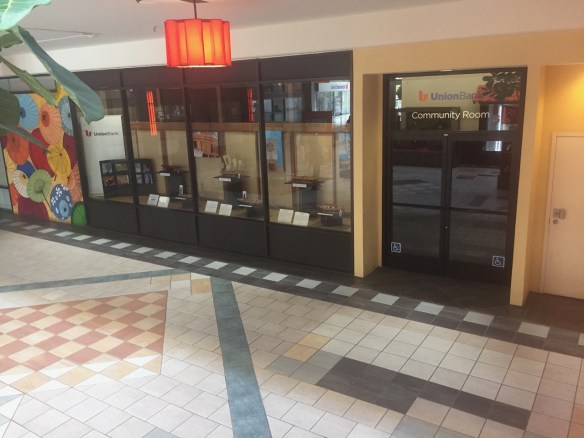
The display was pretty well received, but it would be a lot easier to set it up somewhere, and leave it for a period time, like when I have my Japantown displays in the Union Bank window. They still won’t allow that due to Covid restrictions. Makes absolutely no sense to me, and I think the bank management is just being lazy about it. Japantown needs more things of interest and putting these in their community room window isn’t likely to increase the spread Covid.
I talked to a few visitors who had some ideas about displaying them again in Japantown, so well see what I can do again. In the meantime, I have some other display possibilities I will look into for maybe early 2022. Ω
The Tonegawa Takasebune (高瀬船) – a Model in 1/72 Scale, Part 6 – Final
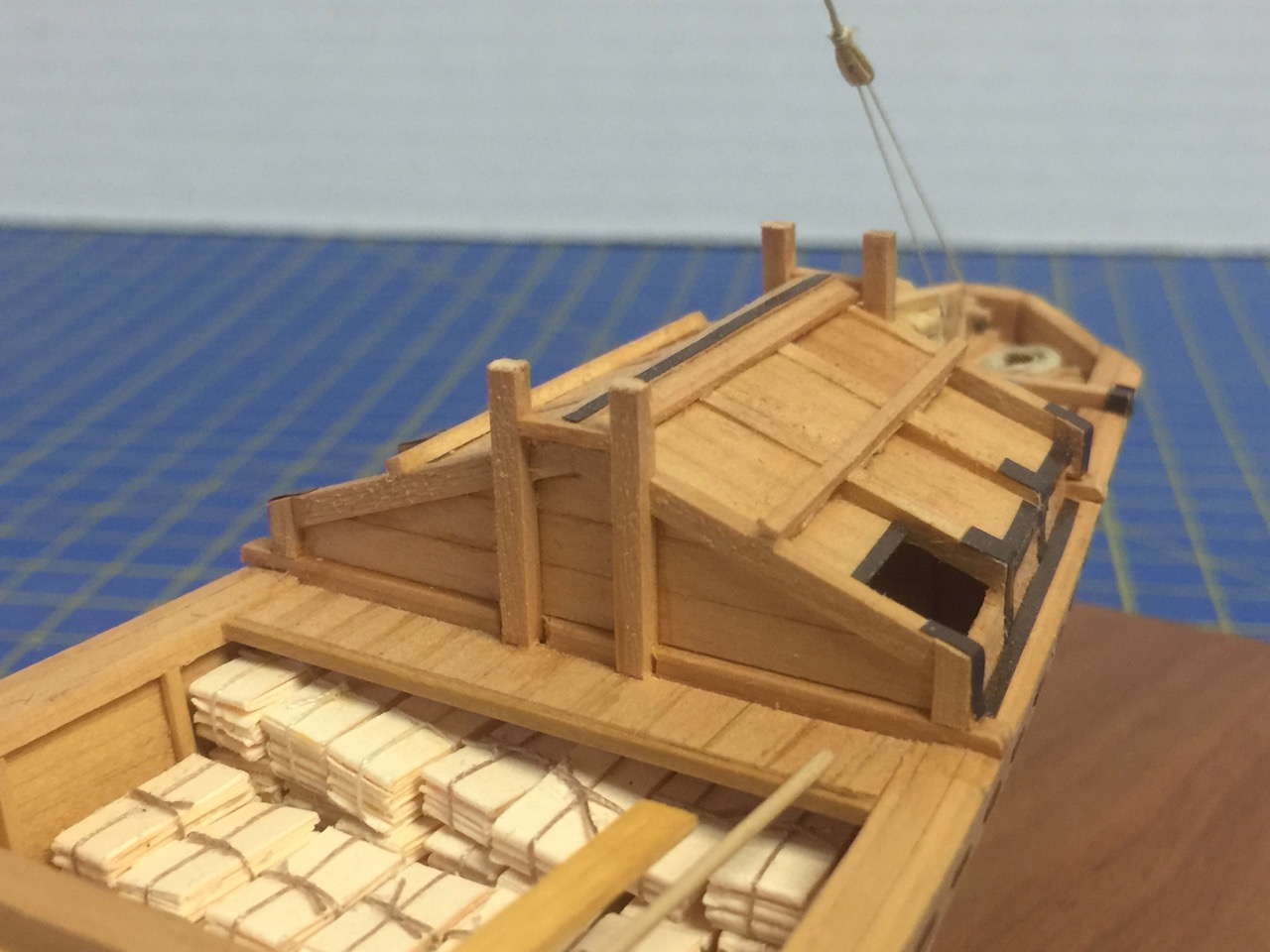
I finally managed to finish enough cargo to call that stage of the model complete… Or, at least as complete as it’s going to get for this model. As you can see in the photos below, I’ve come up with a third kind of cargo. Probably not a very accurate type, as it appears to be some kind of finished product.
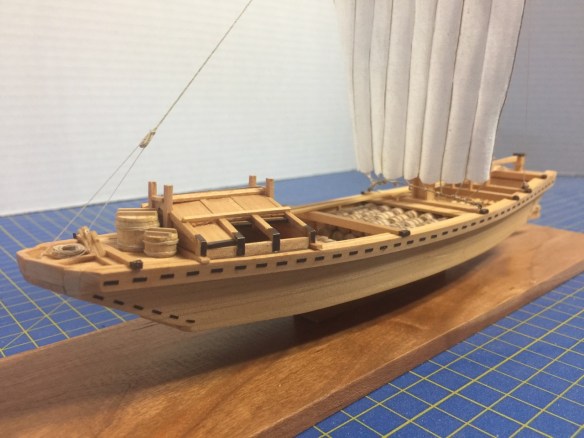
Perhaps the boat is carrying something downriver from one of the larger towns along the way where somebody produces a product that’s very flat. I think it might be somewhat unlikely that the boat should carry rice bales, some kind of vegetable in buckets, plus some kind of finished goods. But, I think it looks good, and keeps the viewers wondering what kind of goods those can be.
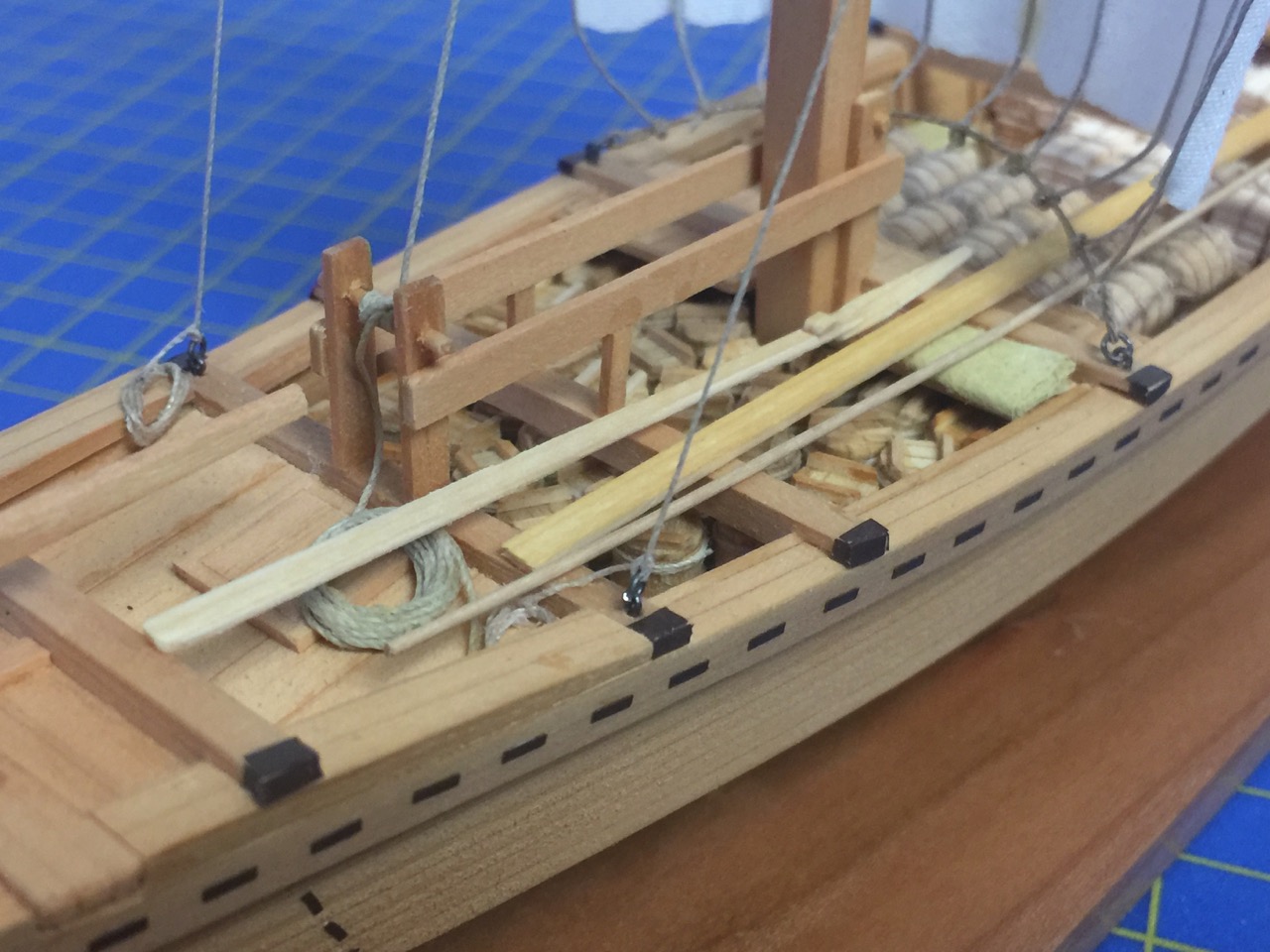
By the way, you’ll notice in the photo below, and the previous one above, that the main stay runs down to the deck and I had to make a small structure that’s effectively a pair of bits holding a simple winch. This was not on the drawings I was using, but appears on many of these boats. Without more knowledge of how the stay might be secured, this seemed to be reasonable.
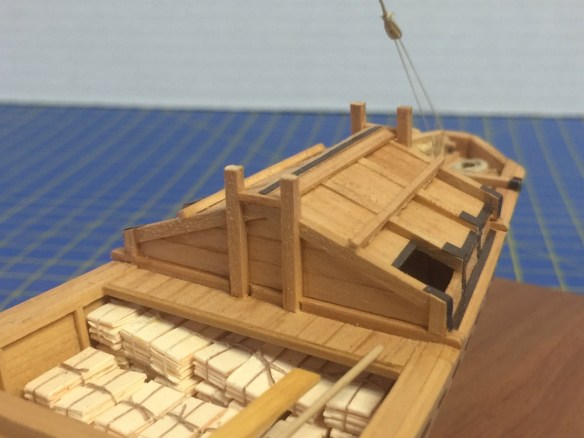
The stay leads down to a simple wooden block, which I basically copied from those on the Woody Joe Kitamaebune model. The block I made is a very simple teardrop shape with no sheave. I don’t know this for sure, but I believe early blocks in Japan did not have a sheave. This was suggested to me by someone I spoke with in Japan when I visited the Hacchoro in Yaizu harbor.
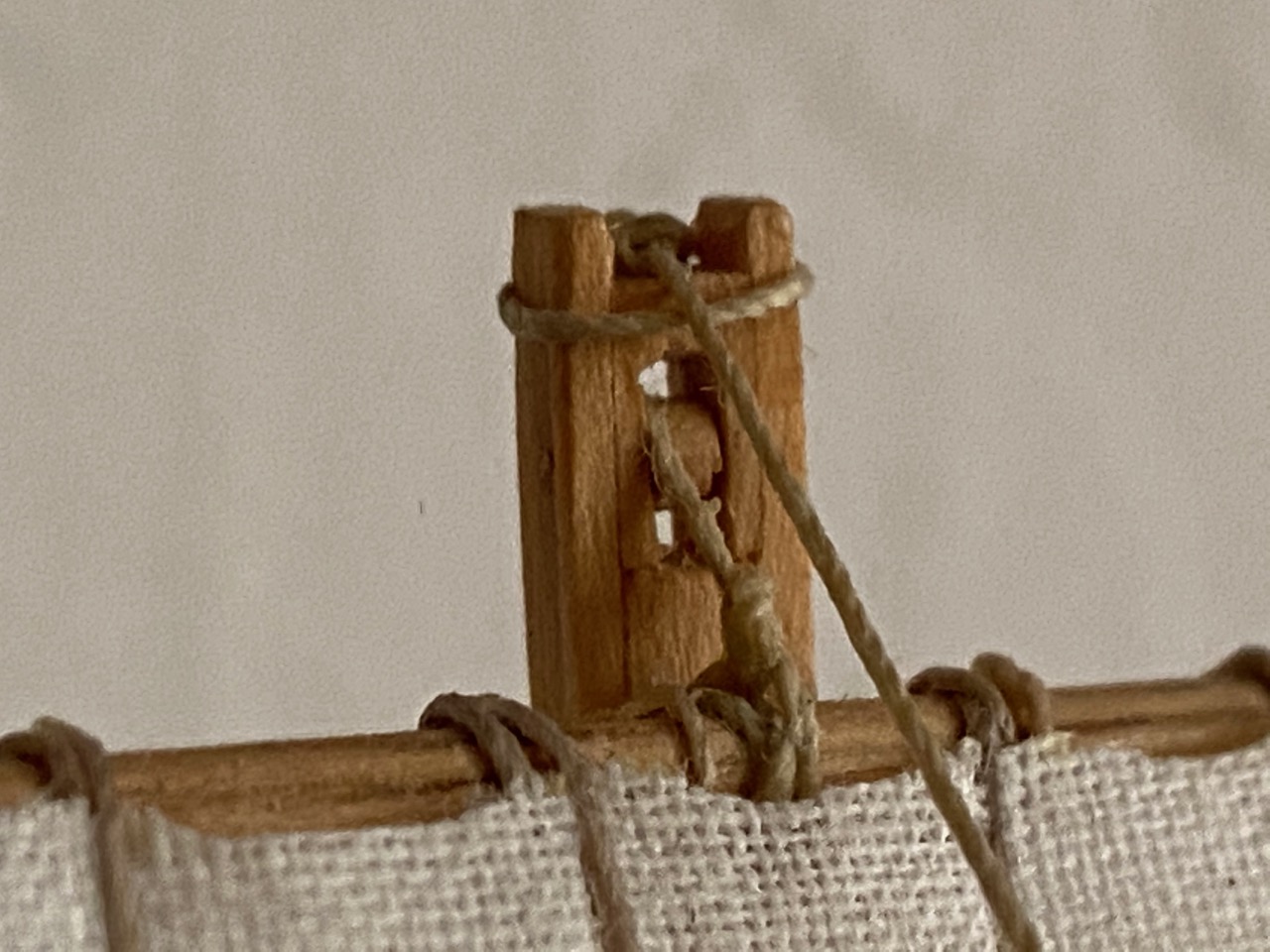
At the top end of the stay is a small loop that goes around the mast from the back side. The stay itself goes back over the loop and down the front side. In this way, the stay holds itself in place.
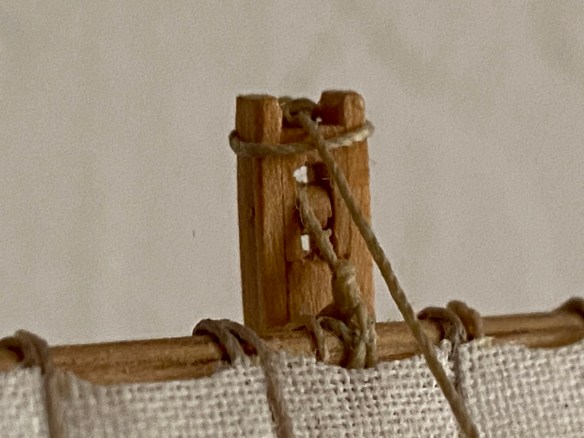
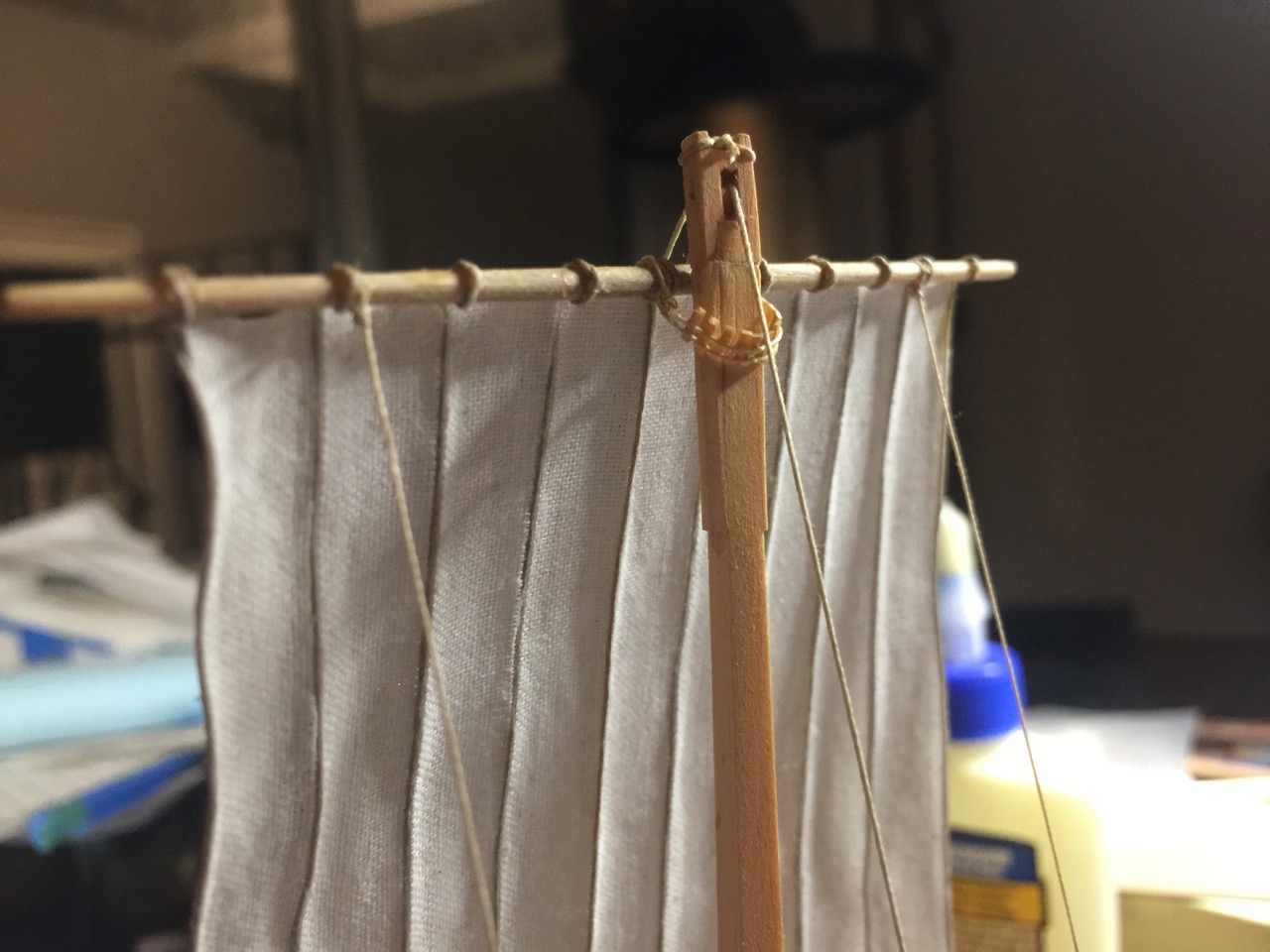
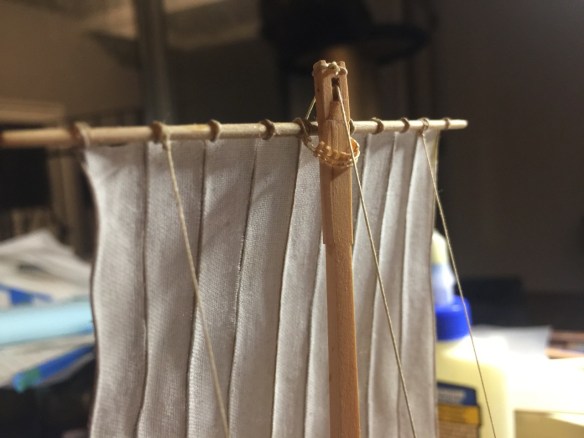
I completed the rigging by securing the halliard, and adding braces that hold the yard at a proper angle. I also added parrals that hold the yard to the mast.
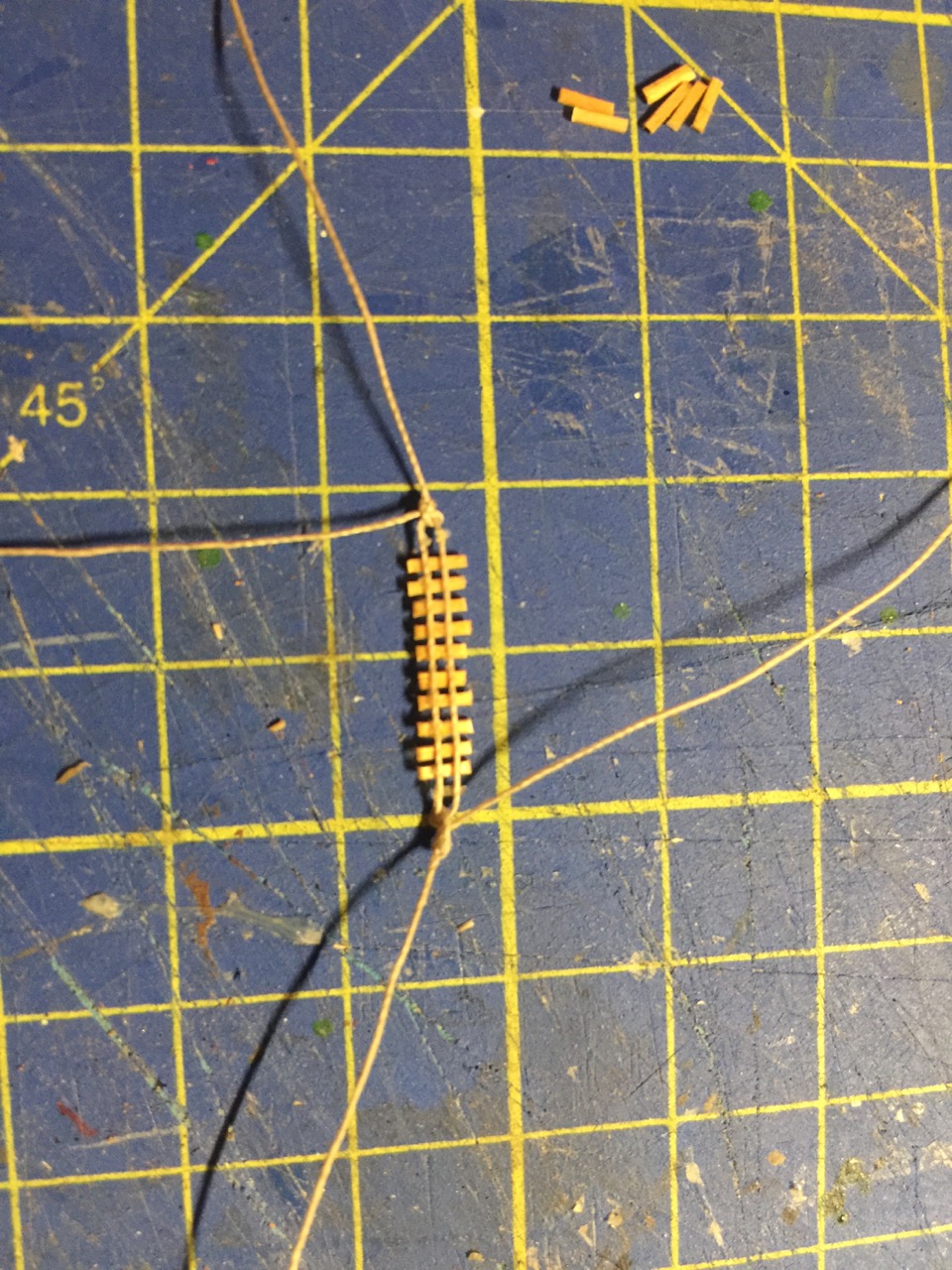
Larger Japanese boats basically had two loops around the mast with wooden battens attached that prevented chafing of the ropes. At 1/72 scale, this feature is pretty small, but still noticeable. I simply cut some tiny wooden strips to use for the battens and glued them a couple thin ropes across their backs. Some double-sided tape helped hold them into place on the work surface while the ropes were tape down across the battens as the glue dried.
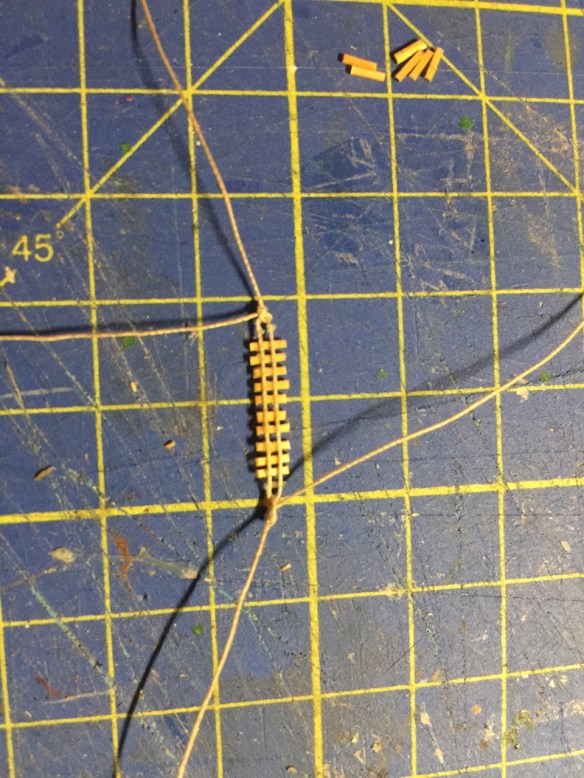
The final assembly was tied to the yard, and hung somewhat loosely around the mast. This feature appears on the larger coast transports as well, but I haven’t seen anything like this on small boats. I don’t know how large a boat would have to have been before it required something like this.
The last step in the construction of the Tonegawa Takasebune was to add some working “stuff” into place. I figured there needs to be a plank, which can be used for loading and unloading, as well as for walking over the top of the cargo, as well as a pole or too for pushing the boat along where necessary, and a sculling oar for the same.
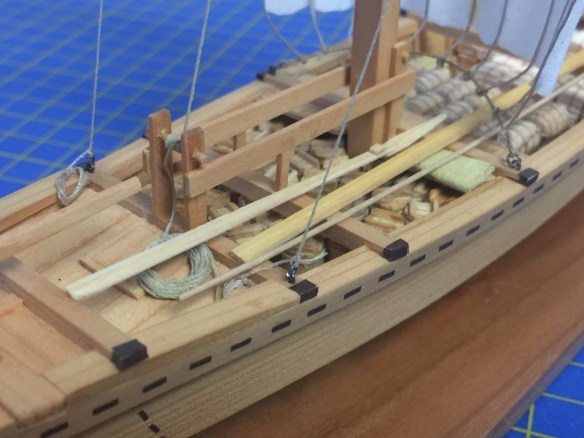
I also folded a piece of painted tissue paper to represent a matt or tarp that could be used to cover some of the cargo in bad weather. I say tarp here, but I suppose that really depends on when this boat is represented, as it was used up into the early 20th century, and probably back into at least the 18th century, but I really don’t know how far back it goes. Something to look into.
In any case, in early days, the tarp would have actually been more like a thin straw mat. Realistically, these boat probably would have been piled high with as much cargo as they could handle, and the straw mat would probably allow the boatmen to better secure the cargo, as they could tie the mat down over the cargo to help keep any from shifting loose off the pile of cargo.
Some woodblock prints depict canal boats loaded high and covered with a tarp or mat with planking riding on top so the boatmen could climb more easily over the mountain of cargo.
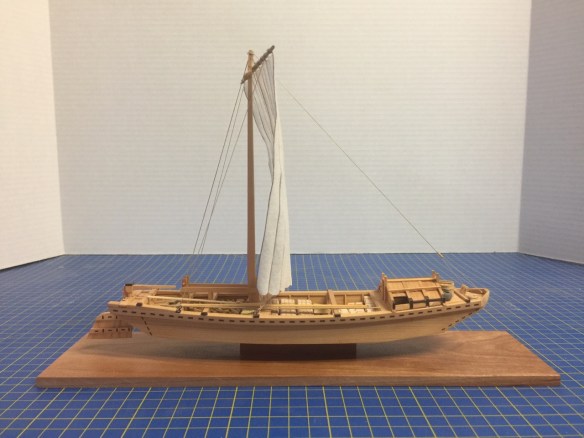
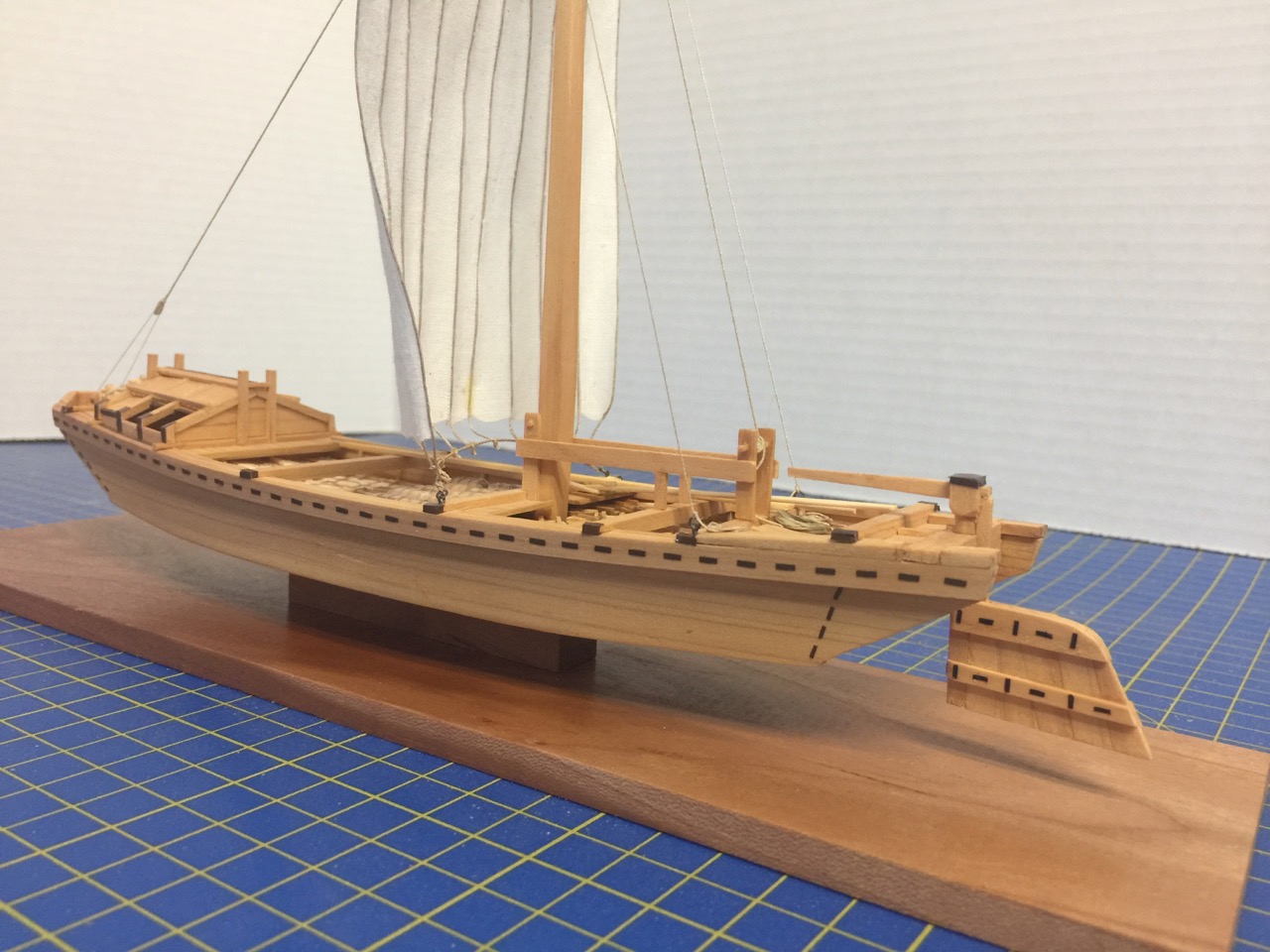
The final model was mounted with double-stick tape onto a very simple cherry wood display base I cut for it that I gave a simple satin lacquer finish. The model raised up on a cherry wood block, allowing the rudder to properly hang down.
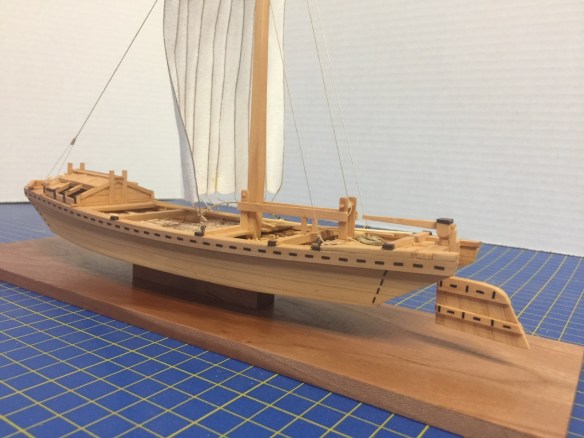
The 60尺 (60-shaku or about 60 foot) Tonegawa Takasebune model is only 10″ long at this scale. So, it’s a pretty small model, but perfect for scale comparison with Woody Joe’s Kitamaebune and Higaki Kaisen models, which are both also in 1/72 scale.
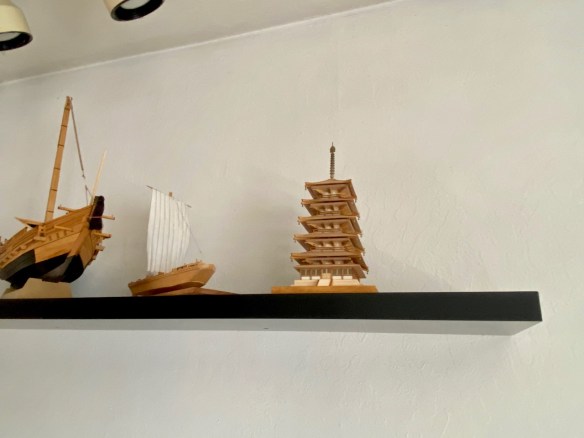
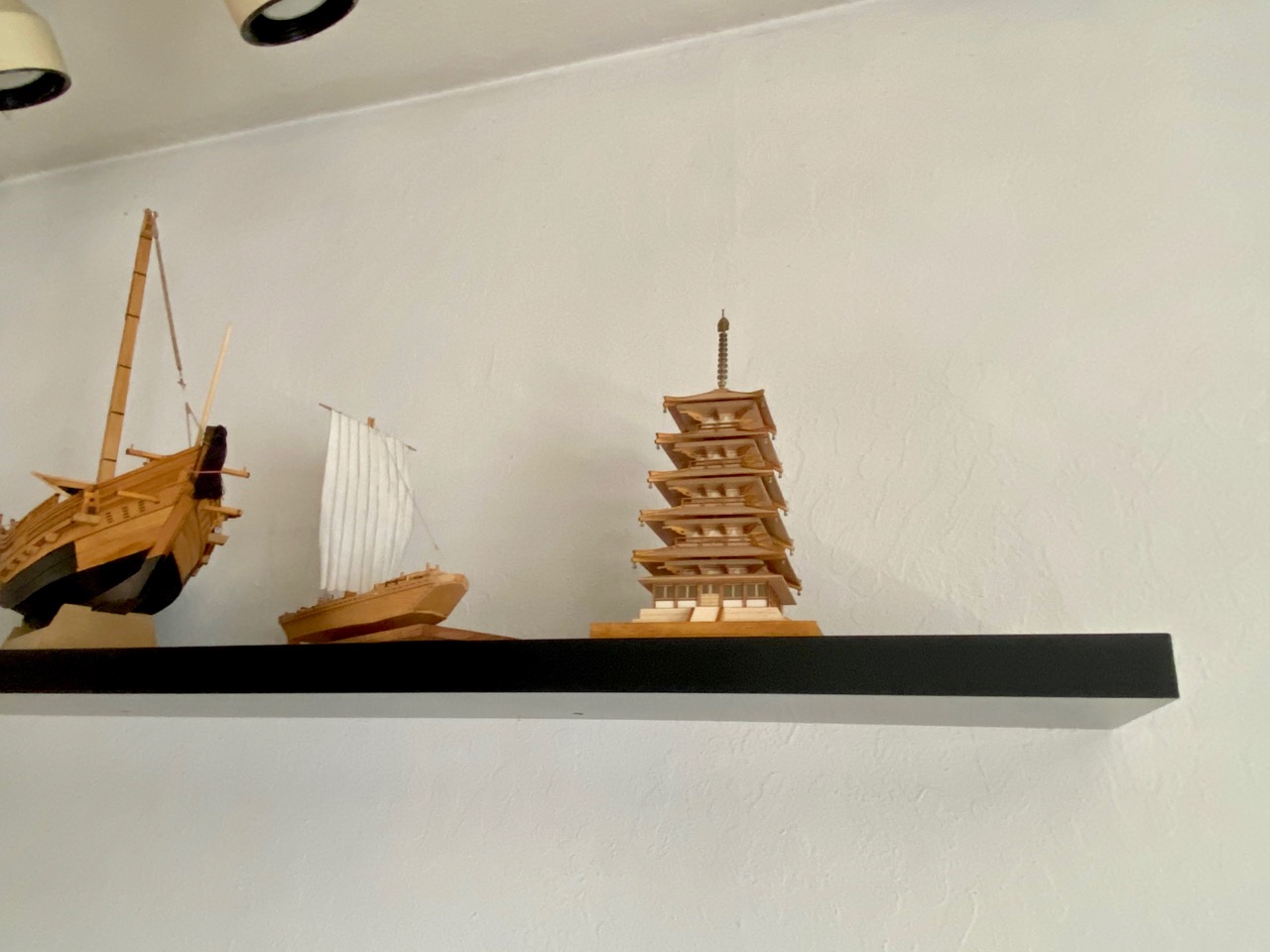
In the photo above, you can see the model sitting up on the shelf with the still incomplete Kitamaebune model on the left, for size comparison. The model on the right is a Woody Joe kit of the Horyu-ji 5-story pagoda, but that’s in a completely different scale of 1:150.
But the Tonegawa Takasebune is now complete. I will be including it at an upcoming display of my Japanese boat models at a Japan Day event next month at the Asian Art Museum in San Francisco. The date for that is October 17th, 2021, but I’ll post more info shortly. Ω
Sanjugokubune (三十石舟) Information Discovery
My apologies for not posting more information and updating my wasen modeling site very much lately. There are other things I’ve been trying to get done, and between this pandemic and the heaviness of having my mom in a nursing facility, I’m definitely not at my best. I did finally have a chance to play some traditional Japanese music with my music group at a couple events in Santa Rosa and San Francisco these past few weeks, but it’s not really enough.
It wasn’t until I set aside some things I’ve been trying to get done, and started paying attention to my wasen modeling, that things started feel so much better. So, I guess I’m going to have to make more time for wasen models, for mental health reasons, if nothing else!
The Sanjugokubune (三十石舟)
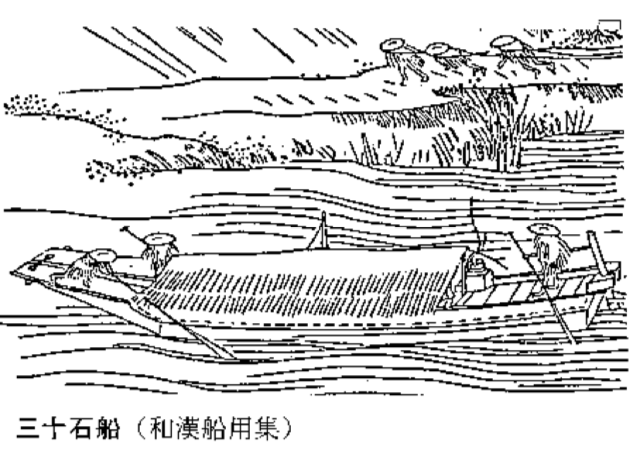
The most recent wasen topic that’s been on my mind is a type of riverboat transportation called the Sanjugokubune. These were large river boats that operated between Osaka and Kyoto during the Edo period. They are very famous for providing regular, scheduled, daily service for both cargo and passengers. I read somewhere that hundreds of these boats operated on this regular route every day.
In a recent post, I provided a link to a Youtube clip of a Sanjugokubune related story. More on that here.
Wasen Model in Monterey, CA – Follow-up
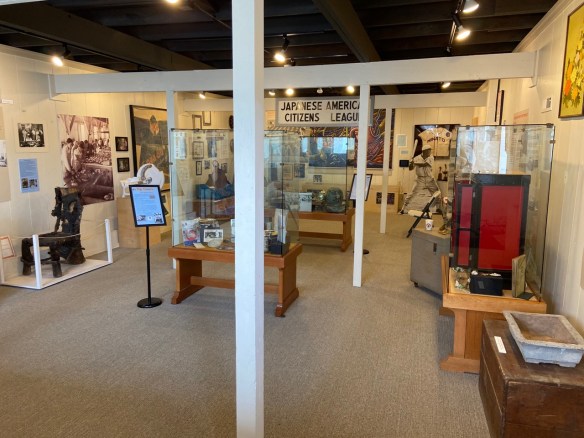
This week, I made the trip down to Monterey’s JACL Heritage Hall & Museum and met with curator Tim Thomas. He was waiting for me in front of the building when I arrived, and I was ushered into the museum room, where there were all sorts of displays of artifacts from the Japanese American community’s thriving past in Monterey.

The museum is small as it’s just the one room. But, the museum and the Heritage Hall apparently have their connections and access to a lot of knowledge about the Japanese American community, which was really thriving in Monterey before WWII. The curator has even given talks in Japan about the Japanese in Monterey.
Wasen Model in Monterey, CA
Earlier this Summer, I was in contact with a gentleman who is a former Historian/Curator for the old Monterey Maritime Museum. Apparently, part of that collection included some Chinese junk models as well as some Japanese wasen models. He didn’t have much information on the Japanese models, but commented that all the models were built back in the 1920s.
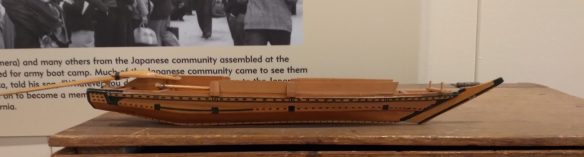
While the collection of Junk models has apparently been moved to the Pacific Grove Museum of Natural History, one Japanese boat model now resides at the Monterey JACL (Japanese American Citizens League) Heritage Center & Museum, where he now works as the Curator.

There is very little information on the model, except that it, along with the Junk models, is part of the Greatwood Collection. These were models commissioned by American oil company executive Royce Greatwood, working in the Far East in the 1920s. I’m sure there’s more to the story, but that’s all I know.
Wasen Model Table at the SF Asian Art Museum, October 17th
Sunday, October 17th, 2021, is Japan Day at San Francisco’s Asian Art Museum. A friend of mine is working with the museum on this and asked me to participate by displaying my wasen models. So, I will be setting up a table to display some models and, hopefully, have some room to do a little work on them – something like I did at the Wooden Boat Festival in Port Towsend a couple years ago.

Me, at the 3-day Port Townsend Wooden Boat Festival.
I’m hoping to have enough room to set up a few models in a nice, formal display with accompanying information. Since it’s at the Asian Art Museum, I’ll probably try to chose models that I can tie to artwork as much as possible. In general, I expect to make this a bit of a cross between the Port Towsend event above, and the Japantown display below.

One several (seven?) wasen model displays I’ve had at the Japan Center’s East Mall in San Franciso.
By the way, I haven’t been able to set up the Japantown display in over a year due to Covid related bank policies. Wouldn’t have gotten much in the way of visitors anyway. However, with this October event, and with so much having reopened, I’m reaching out to Union Bank, who operates this community room and its display window.
I’m hoping I can have something set up there maybe in September, leading up to the Japan Day event. We’ll see what I find out when I hear back from the bank contact. Of course, I’ll keep you posted.
As for the Asian Art Museum, my Japanese Boats Display is supposed to be set up from approximately 11am to 5pm on Sunday, October 17th, on the first floor of the museum. I won’t be alone there. Two other ‘stations’ are scheduled to be set up there as well, including a Origami Irises display and a Toro Nagashi Paper Lanterns display (floating lanterns).
Make sure to mark your calendars, so you can stop by and visit me if you’re in the area!
Ω