Building a Gozabune (Kobaya) from Paris Plans – Part 4

More progress on the model and I’m on something of a roll now, as the trickiest questions I had I’ve now managed to pretty well answer. Let me begin by posting a translation of the French text that accompanied the drawings in Le Souvenirs de Marine. This is something of my own interpretation based on direct translation of the text using Google Translate and my own knowledge of French, and of a Japanese translation of the text that I found on the Internet, which I then translated into English, again using Google Translate. Correlating the translation, and the translation of a translation, I then went and rewrote the description based on the drawings and on my knowledge of Japanese watercraft. The notes in square brackets are my own clarifications.

From Paris:

No.15-1

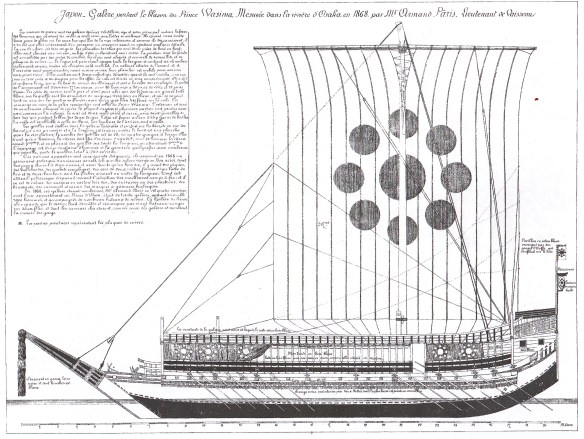
Japan, Small Galley Measured in Yokohama in 1868 by Mr. Armand Paris, Ship’s Lieutenant.(Drawing No. 15-1)

This kind of small galley belonged to the Taikun [ “Great Prince,” the Shōgun Tokugawa]. The construction of extreme lightness is very careful and the method of assembly of parts is the same as that of other boats with a single layer of planks. The stern differs in that it is closed by a panel [false transom], and it has bulwarks raised at the back. The beams are in pairs and placed one on top of the other the lowest one carries the joists, on which rest the deck planks.

The upper beam protrudes and carries the galleries, which are supported by the beams. Between these are short hanging beams mounting the oars like aboard the great galleys [sailing ship], but at their short length, only one rower is on each oar.

On the deck near the bow is a lowered section, above which is placed a flying hut [a framework covered over by an awning]. In the galleries on the side there are no oars here. Instead, boards for walking are placed.

The mast is square and set up as on other boats. Sails are not known, but they must be of little use for a boat so well made for rowing.

In Yokohama there were three such ships, but the dimensions of the largest ship are shown in the layout diagram.

 The dimensions of the two smaller:

    Maximum length             12 m 81             12 m 62

    Ship width                        2 m 96              2 m 52

    Maximum width               3 m 80                3 m 30

    Mold depth                     0 m 93                0 m 79

These ships were abandoned and in poor condition, like other Japanese ships, the days of these ship have passed. Continue reading
Building a Gozabune (Kobaya) from Paris Plans – Part 3

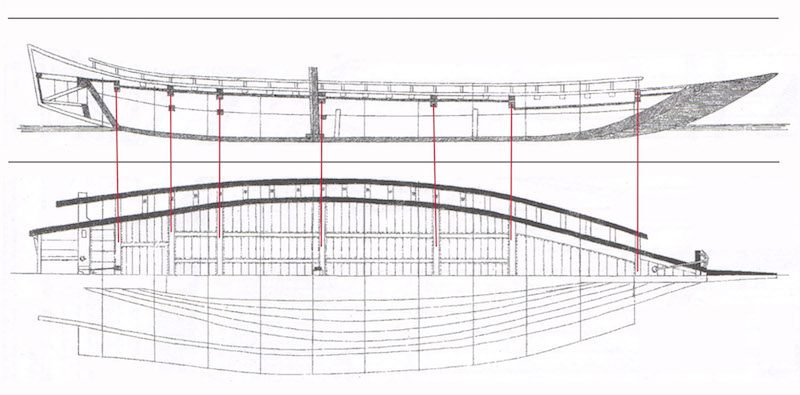
If you look at the Paris drawings, you will see that there are seven pairs of main beams across the hull, not including the otoko, or great beam, at the stern. In each pair, there is one beam above and one below. The lower beam runs between hull planks. The upper beam goes through the hull planks and supports the rail assembly, which supports the yokes for the sculling oars.

Below, you can see a general cross-section of the hull. There are actually three beams running the width of the hull. Since I already have the internal framework, I don’t need the lowest most beam, so I’m calling the one just under the deck the Lower Beam.

There are also several short longitudinal beams show in cross-section below, but I’ll be dealing with these later when I begin dealing with the deck.

Continue reading

Building a Gozabune (Kobaya) from Paris Plans – Part 2

I have seen the coastal transport replica on Sado Island, the bezaisen Hakusan Maru, up close, inside and out. The construction seemed much different from the smaller hacchoro, the bonito fishing boat replica that I visited in Yaizu. This gozabune is about 17 meters long, the hacchoro of yaizu was about 13 meters long, and the Hakusan Maru, about

Lower Planks

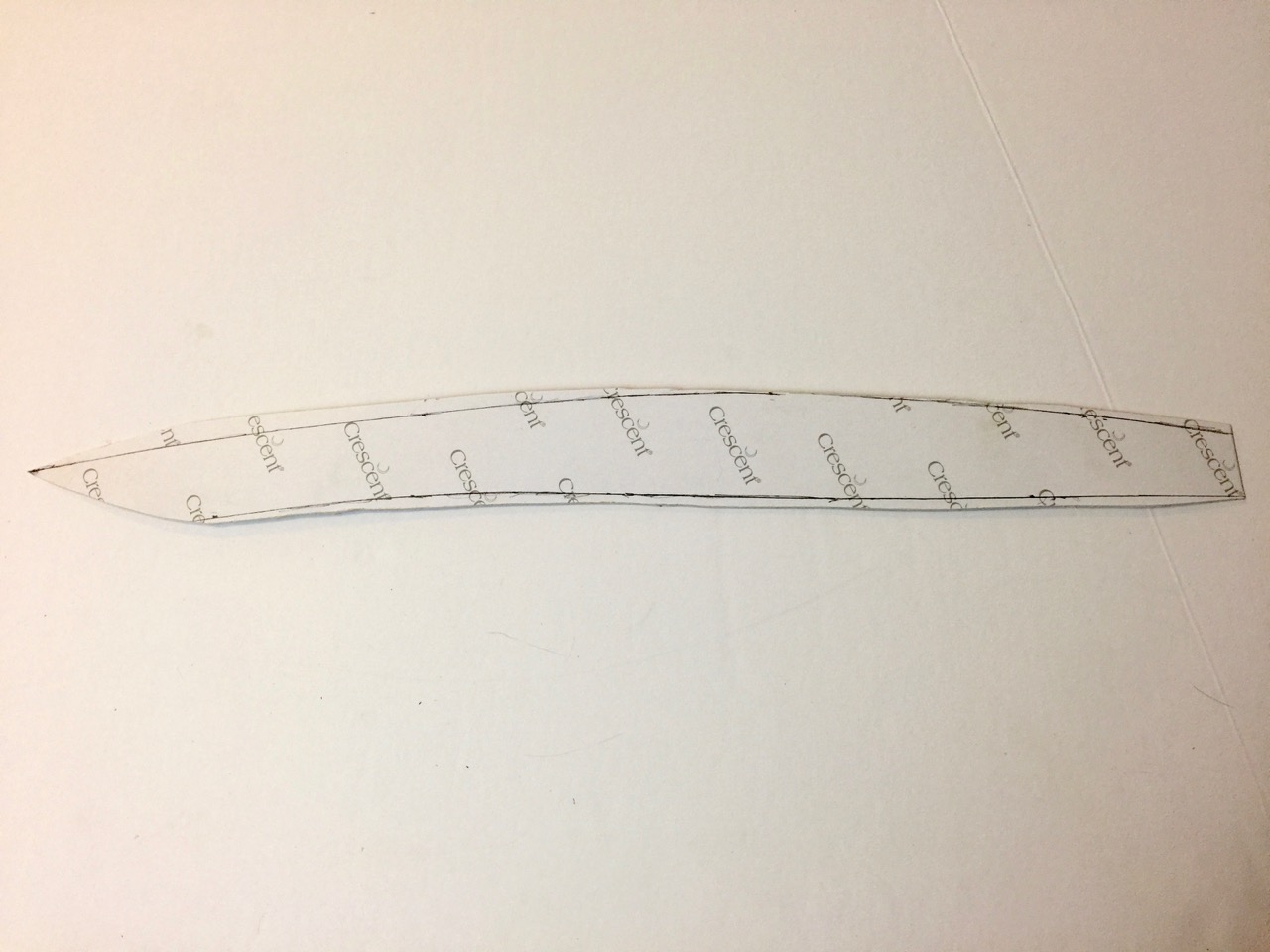
From building the Hozugawa-bune and the Bekabune, I learned that a card stock pattern is the best way to get the shape of the lower edge of the lower plank. Taping the cardboard into place, I used a pencil to mark the outer line where the bottom and the lower plank came in contact. Then, measuring the width of the station lines in the Paris drawings, I marked out the points on the cardboard template and drew in the curve of the upper edge of the plank.

Continue reading

Building a Gozabune (Kobaya) from Paris Plans – Part 1

Kobaya-bune (小早船), or simply, kobaya , is a term for a type of military-style traditional Japanese vessel that was fast and maneuverable. The size of the boats labeled kobaya, which translates literally to “small, fast,” seem to vary widely. I have seen boats called kobaya that had as few as 6 oars, and larger ones that had 24 or more oars, but my access to details on these warcraft is limited.

The largest warships were called atakebune. They were big, slow, lumbering craft with a castle-like structure atop. The mid-sized warships were called sekibune, and sometimes called hayabune, or fast boats, ostensibly because they were faster than atakebune. War boats smaller than this seem to have all been classed as kobaya.

During the Tokugawa period (A.K.A. Edo period), which began in 1603, daimyo were forbidden to have atakebune. During the time of relative peace, the smaller warships, most commonly sekibune, were turned into gozabune (御座船), highly ornate and brightly painted vessels used by daimyo and their clans for ceremonial and other official purposes.

A gozabune of the Hachisuka clan of Tokushima prefecture.

Continue reading

将軍家御座船 – Shōgunke Gozabune – Ships of the Shōgun

Gallery

This gallery contains 4 photos.

Originally posted on 木造和船 中山幸雄の世界:
御先船 麒麟丸(御召小早三十二挺立) ? 小早 住吉丸(御供小早三十挺立)   箱型八挺立川船 ? 引御船無屋形二十挺立 ? 八挺立押送型船 ? 三挺立御鳥船 ? 八挺立小碇船・大碇船 ? 八挺立水伝馬船 ? 十挺立御供船 ? 十二挺立伝馬船 ? 十四挺立箱型船

Paris’s Souvenirs de Marine

There are a several kits available to the wasen modeler, between Woody Joe and Thermal Studio, but if you want to scratch build something unique, you’re going to have an extremely difficult time. Japanese boat builders didn’t draw detailed plans the way western boat builders did, and pretty much all that is available are those created from a study of an existing boat type.

61golufxt7l-_sl500_

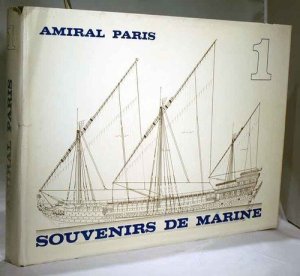
However, there is one fairly accessible set of drawings of Japanese watercraft that was made in the 1880s and published in a set of books called La Souvenirs de Marine by French Vice-Admiral François-Edmond Paris. This set of large-format books has seen a number of re-prints, and I’m not sure what the date is on the most recent reprint. But, there should be copies accessible in most of the larger library collections, and used copies can be found on Amazon and other booksellers, with prices that vary greatly depending on edition and condition.

Drawings included are of ships from across the globe, and the text is in French, but this collection contains some of the few contemporary records of traditional Japanese watercraft available. Of the sections I’ve collected from the books, one illustration plate shows four different riverboats of various types. Other plates show two examples of bezaisen, or coastal transports. Other plates show a couple examples of highly ornate row galleys, one of which bears the crest of the Chiba clan on it’s large squaresail.

page-355

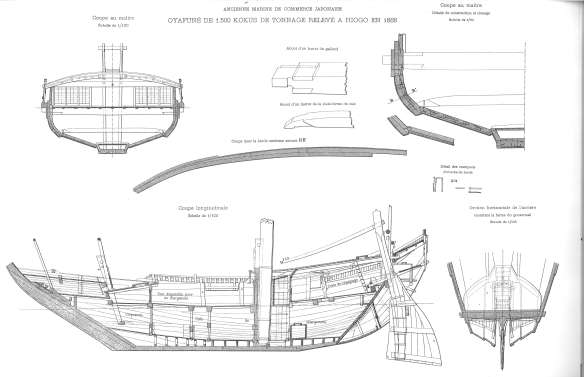
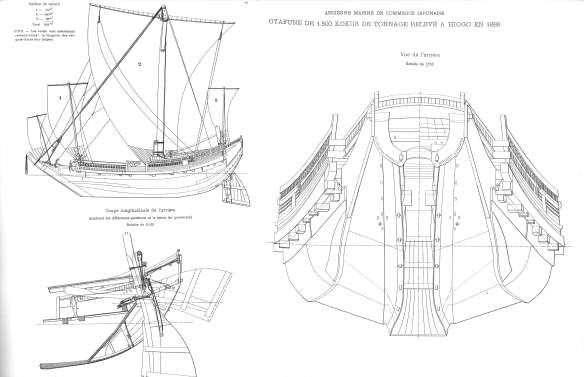
I haven’t studied these drawings in too much detail except for the two sets of bezaisen drawings, which are specifically of what appear to be northern port coastal transports, or Kitamaebune. The text doesn’t mention any Japanese terms, and again, it’s all in French. But the drawings are fairly well detailed. And, I suspect the text doesn’t give a huge amount of detail about the watercraft as it’s mostly limited to labels and sidebars.

page-356

Now, that I look at it more closely, I’m seeing how I might be able to model some of the other boats illustrated in the books, so I’m finding myself more interested in learning about them. If I find out more, I’ll post about them here.

image-2

There are a couple of paperback books of selected plates that were published by James E. Hitchcock, which you can find on Amazon.com for less than $10. While the images are scanned and reprinted from an original copy, and the French text is very difficult to read, the book provides a handy reference so you can determine which plates you may be interested in.

51rr-z63tol-_sx384_bo1204203200_

I have found that the San Francisco Maritime Research Center has the set of books available, and will scan whatever figures you need and will email them to you at your request at no cost. You can contact them for details at 415-561-7030 or email them through the Park’s website.