Unknown's avatar

About catopower

Ship modeling since 1993.

Kits Listed on Ebay

I’m doing some closet cleaning and raising some money for the holidays. So, if you’re interested, you might note the Hacchoro kit I’ve listed. Remember that you can download my build notes and instructions translations here on this site.

catopower's avatarShip Modeler

There are a lot of life changes going on for me right now, so I’ve decided to part with a portion of that ever-present stack of ship model kits. I’m still working out which kits I will never get to, and which ones I might want to take on some day. But, for now, I’ve managed to come up with a list of some of the simpler ones. So, if you’re interested in any of these, nab them off of Ebay, or send me a comment.

Model Shipways Phantom NY Pilot Boat 1868 Wooden Ship Solid Hull

Brigantine Newsboy, 1854 – Model Shipways Wood Ship Kit #2008 – Barely Started

Woody Joe 1/24 Sailing Japanese Fishing Boat Hacchoro 8-oar Wooden Model Kit

Chesapeake Bay Skipjack Midwest Products Wood Kit

Model Shipways Wood Ship Kit # 2016 – 1/64 scale Colonial Schooner Sultana 1767

Some of these are simple auctions to…

View original post 160 more words

Brief Blog Hiatus

I just posted this on shipmodeler.wordpress.com, and it applies here as well. However, I may be posting here sooner, as I do have a few more things to write updates about. Thank you for your patience.

catopower's avatarShip Modeler

Those following this blog may have noticed that I haven’t been writing much lately, nor have I done any ship modeling work. It is a temporary hiatus, but should last at least a couple more weeks as my 95-year-old mother was diagnosed as having had a mini-stroke.

After a night in the ER and a few days in the hospital for observation, she was transferred to a convalescent center, where she was quarantined, isolated from other patients for about 10 days. After she had sufficiently recovered, I was able to take her to her home. But, she is in need of full-time assistance and observation. So, that’s all I’m able to do for the time being, aside from posting this little update. Everything else is on hold until other arrangements can be made for her care.

So, I hope you are able to find enough on this site to keep…

View original post 28 more words

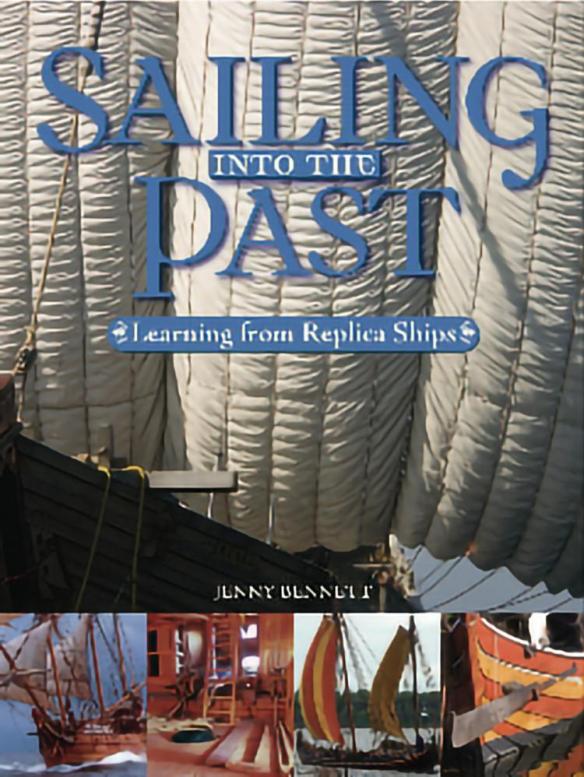
Sailing into the Past – A Book of Replica Ships

Douglas Brooks’s article on bezaisen, also known as sengokubune, was one of my first references on these big Edo period coastal transports.

It’s a very good article and has some nice photos in it. The cover photo was provided by Professor Kon, who heads the Wasen Research Society at Kanagawa University.

catopower's avatarShip Modeler

For those of you who might be interested, I just noticed that US Naval Institute has a nice sale price on the book Sailing into the Past. This book includes an article on bezaisen by Douglas Brooks, and features a photo of the replica bezaisen (also known as a sengokubune, or more specifically a kitamaebune) Michinoku-Maru.

The book is a compilation of articles about various replica ships around the world today, and it probably a very good general read. Of course, given my work with Douglas Brooks, I would love for everyone who might be interested to buy a copy.

I don’t know what the regular price is for this 200+ page hardcover book, but it’s only $11.49 at USNI.org. To me, Douglas Brooks’ article is worth the price of the book. Check it out here: https://www.usni.org/press/books/sailing-past

I think it was originally $45.95. So this is a very good…

View original post 2 more words

A Viewing of the Film Aru Sendō no Hanashi – The Story of a Boatman

Last year, almost exactly a year ago, I ran across a trailer for a Japanese film called Aru Sendō no Hanashi (ある船頭の話), or A Boatman’s Story, and I wrote a blog post about it that included a link to the film trailer.

Aru Sendō no Hanashi – The Story of a Boatman

I have waited and occasionally searched for a way to view this film or buy a copy of it. Then today, a friend of mine sent me a link to the New York Asian Film Festival, which is screening the U.S. premier of the film, subtitled in english! I thought it odd that it’s been retitled by its tagline to: They Say Nothing Stays the Same

Photo: © 2019 “They Say Nothing Stays the Same” Film Partners

This is a film about an old and lonely Meiji-era boatman in the midst of a changing world. According to the film festival site:

“Set in Meiji era Japan but timeless in its concerns —the sacrifices made in the name of progress, the loss of cherished traditions — it follows a lonely old ferryman (Emoto Akira), whose life is transformed when he rescues a mysterious young woman from drowning.”

I know nothing about Japanese film, but apparently there are many famous actors in it. You can read the rest of the description on the film festival site here: https://www.nyaff.org/nyaff20/films/they-say-nothing-stays-the-same

The film’s one-day screening takes place on Thursday, September 3. You have to purchase the tickets through their site, but the price is only $7.99 for one film.

The catch seems to be that you need to have an iPhone or iPad to watch it (I guess an Android device works too, but I don’t know much about them). If you have a current enough Apple TV box, you can then stream the movie to your larger TV.

I signed up on the website and then downloaded their viewer app to my iPhone, but I had a heck of a time trying to sign in to the newly created account. It finally worked out, but it was a very frustrating process that included a ridiculous race to enter a validation code and type a password on your phone in the 45 seconds they give you (they actually give you 60 seconds, but that includes the time necessary for them to send you the code and for you to retrieve it, which eats away at your diminishing available time).

If you sign up, just be persistent, and you’ll get your phone connected. I did not see a way to view the film on a computer’s web browser, which would be a nice and simple option. It might actually be easiest to download the app first and then purchase your ticket through the app instead of through the website.

For me, all is set up, and I’m looking forward to the movie now – I hope you are too. Ω

Building a Gozabune (Kobaya) from Paris Plans – Part 13

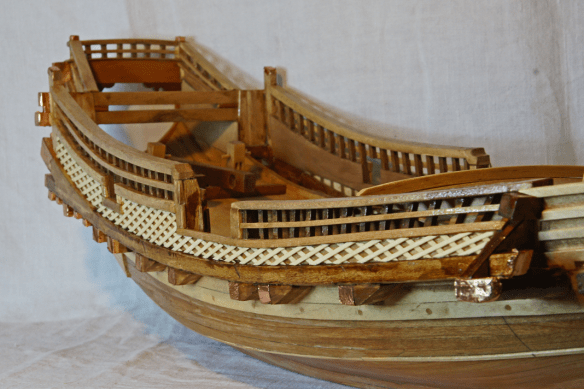
An update on this model is long overdue, and while I haven’t really been working much on the Kobaya model, it is a model that I’ve been very happy with. I’ve recently been researching old drawings, looking for atakebune information, but mostly finding sekibune and other small ships. As a result, I’ve found something of a renewed interest in finishing my kobaya model, and started working on it again.
The model keeps inching closer to completion, with the biggest hold-up being the making and mounting of the ship’s 28 sculling oars. Given the size of a person on the model, the deck would have been crowded with oarsmen. With such a sharp hull and relatively small size (17m) in comparison with the largest of ships at the time (30m, give or take), those 28 oars must have made her very fast.
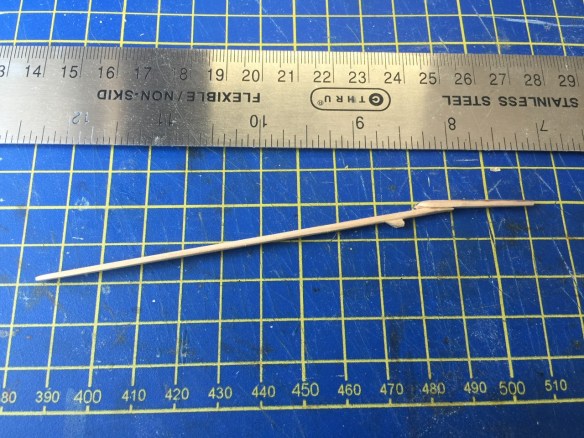
However, Japanese sculling oars are more complicated in shape than western-style oars, so this project involves cutting and shaping 56 pieces of wood, plus the addition of bindings, handle, and mounting yoke onto each oar. So, I have my work cut-out for me.

Continue reading

A Naniwamaru Build in German

Not sure how I missed this, but back in 2012, a ship modeler on an Austrian website researched and built a model of the Naniwamaru, one of four replica Japanese coastal transports at the time.

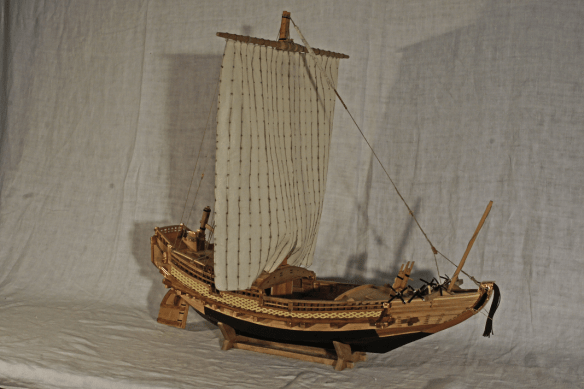
Naniwamaru model by Heiner Luh

Mr. Luh had contacted American boatbuilder Douglas Brooks, who had written an article on these ships, generally called bezaisen or sengokubune, in the the Shipwright annual for 2011.

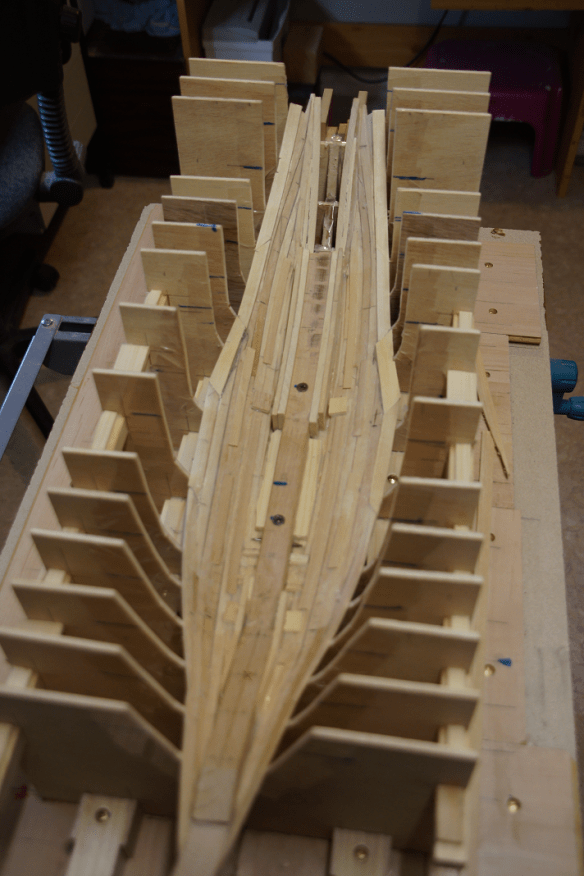
Mr. Luh’s model under construction.

The construction of the model is detailed on the modeler’s website here: http://www.googlehupf.at/shipwright/?page_id=276

I’m always very impressed by ship modelers who build models of Japanese watercraft with limited information. The only thing odd in the model is the narrow strip planking of the lower hull, but this is covered by the paint job anyway.

I couldn’t find mention of the scale of the model, but it’s pretty big. I’m guessing it’s about 1/50 scale, as the 30 meter long ship (give or take) looks to be about a 2 foot long model (give or take).

Anyway, it’s a very nice model and there are a lot of great construction photos on his website. Definitely worth checking out. Ω

Hunting for the Elusive Atakebune (安宅船)

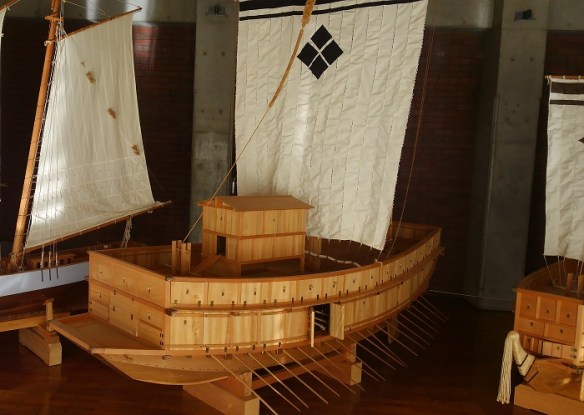
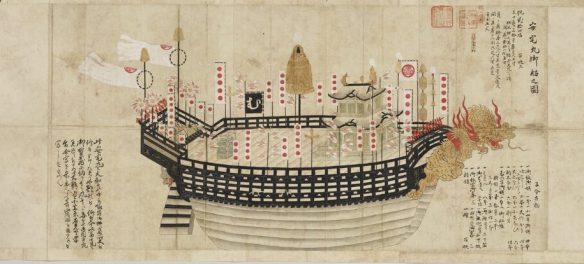
Atakebune were the largest class of purpose built warships that were used by the Japanese clans during the Sengoku period, or the Warring States period. These ships ranged from around 30 to 50 meters in length, were equipped with a large, box-like structure. Inside were the oarsmen, foot soldiers and samurai, protected by the wooden walls. The structure had two or three levels, with the top level being the roof of the structure. Firing and viewing ports were cut out and may have been closable with a hinged cover.

Atakebune model at the Verkehr Museum in Shizuoka.

In addition to a single-bank of sculling oars, the ship carried a large square sail hung from a single mast, usually mounted near the center of the ship. In bad weather, or when otherwise not in use, the mast could be un-stepped and lowered across the top of the ship. Usually, the ships were equipped with three sets of supports that the masts laid across.

Some ships carried a heavily constructe deck cabin that sat of the roof level of the ship. Some unusually large atakebune, referred to as an o-atakebune, carried castle-like structure atop.

Image courtesy of the University of Tokyo General Library – Atakemaru ship illustration / image edited

Continue reading

Interview with a Japanese Wooden Boatbuilder

Mr. Masashi Kutsuwa, whom I had the pleasure to meet at the Port Townsend Wooden Boat Festival in 2019, recently posted an interview on Youtube tat he had with one of Japan’s last traditional wooden boat builders, Mr. Seiichi Nasu. Mr. Nasu is now 89 and is no longer actively building boats, but he is still involved in teaching Japanese wooden boatbuilding.


American boatbuilder Douglas Brooks worked with Mr. Nasu in 2017 to build an ubune or ukaibune, which are used in the practice of cormorant fishing. Recently, a publication written in part by Mr. Brooks on the building the ubune was released, which is only available to the public in the form of a downloadable Japanese language pdf (see my July 17, 2020 post here: https://wasenmodeler.wordpress.com/2020/07/17/cormorant-fishing-boats-book-by-douglas-brooks-japanese-free-download/).

Nasu-san lives in Gifu prefecture, where Kutsuwa-san also lives. The 10 minute interview is in Japanese, but Kutuswa-san has added english language subtitles. Not all the conversation is translated, but enough is translated to explain it. In the video, you’ll see a river boat that’s being built called a ryousen. The subtitles have it written as ryosen, but ryousen (漁船) means fishing boat in Japanese, and this particular boat is a 26-foot, double-ended river fishing boat.

This is a very nice video and it would interesting to see more, and longer, interviews of these disappearing traditional Japanese boatbuilders. Ω

A 3D CGI Model of a Sengokubune

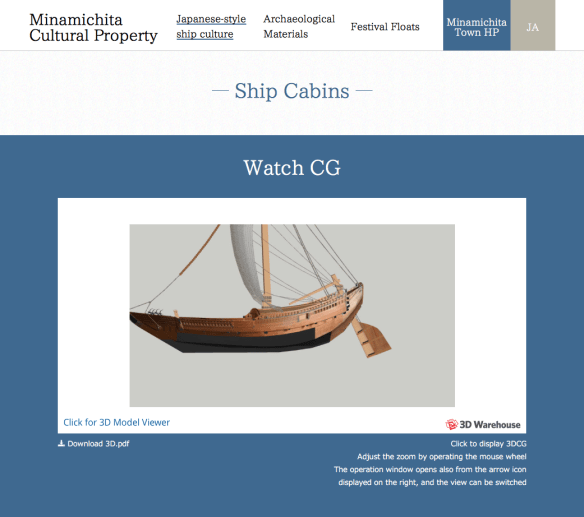
One of my Japanese contacts just posted a web page on his Facebook account. The page allows you to view a virtual 3D model that you can spin around and zoom in on. It looks pretty complete, and should be a benefit to those attempting to build a model of one of these ships, generally called Bezaisen or Sengokubune.

The website is that of the Minamichita Museum, which is located in the town of Minamichita on Ise Bay, south of Nagoya, and across the bay from Ise and Toba. The website is viewable in either Japanese or english, and not only provides this CG viewer of a bezaisen, but below it, there are some excellent photos, animations, and descriptions of important features and items carried aboard the ship.

Some of these items, I have never seen before. Check them out, and make sure to click on the animations, as they tend to reveal more information as they play. This site gave me a little more insight into the details of the interior of the ship’s cabin, and now I’m beginning to think it would be interesting to build a detailed vignette of one.

I also learned a few other things I didn’t know about shipboard details. Check it out and see what you learn: http://minamichita-museum.com/wasen/en/ship.html

Also, make sure to go to the main page and follow all the interesting information and links about Utsumi-bune, historical documents, the section on History that Survives in Minamichita, the links on festival floats, and more. Ω

Explore Inside Japan – Sengoku Period Warship Models

Today, I just ran across a website called Explore Inside Japan. It’s an english language blog site that appears to have begun in late 2016, and has had regular postings about once a month since then. There is no explanation on the site that I’ve found as to who the blogger is, but it’s nicely written and interesting.

I specifically ran across a post about some sights in Shizuoka city, Japan, and there was a good write up about Sunpu castle, this is the castle built for the first Tokugawa Shōgun, Tokugawa Ieyasu. The article explained nicely about the different types of castle layouts, which I never knew, and had a lot of detail about this castle.

But, the next post, remembering that blogs post newest entries first, described a trip to the Verkehr Museum (verkehn is German for transportation), also in Shizuoka city. This small museum I’ve mentioned in a previous post. It happens to house a number of models of old Japanese ships, including the warships of the Sengoku period.

Photo from Explore Inside Japan’s website.

As I said, I’ve posted about the Verkehr museum before and included photos of the ship models there, but this site has many more. So if you’re interested in reading about Atakebune, Sekibune, and Kobaya, check out this blog site:

https://uexinja.blogspot.com/2018/01/

Also, if you’re interested specifically in Japanese warships, there’s an interesting post about a visit to the Wasen Research Institute’s exhibition room at Kanagawa University, and the decline of the large wooden warships.

https://uexinja.blogspot.com/2019/04/japanese-style-battle-ship.html

Again, this is an interesting website and I highly recommend checking it out. Ω