October 2019 Wasen Mokei Update

Progress on my Kitamaebune slowly continues while the rest of my wasen models are on display through the end of October, though I may talk to the bank about extending the display, just to save me from having to pick up everything just yet.

In my model wasen “boat shop” I still haven’t finished the final details on my Tenma-zukuri chabune, as I’m still contemplating the darkening of the copper trim on it. On my Kitamaebune, I solved this by using brown vinyl, but I do want to try to make this work with copper on the smaller model.
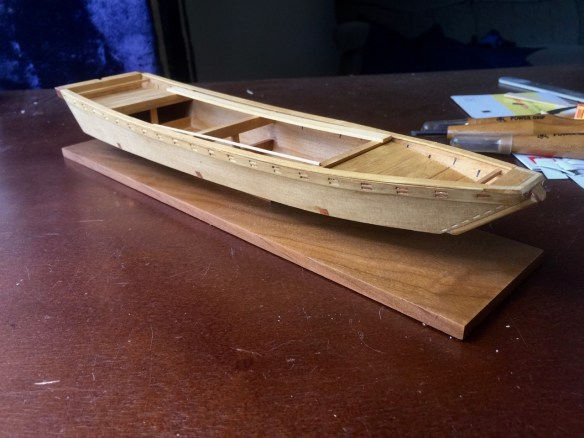
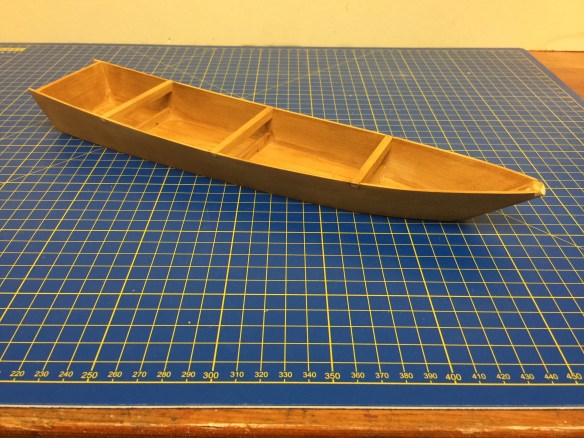
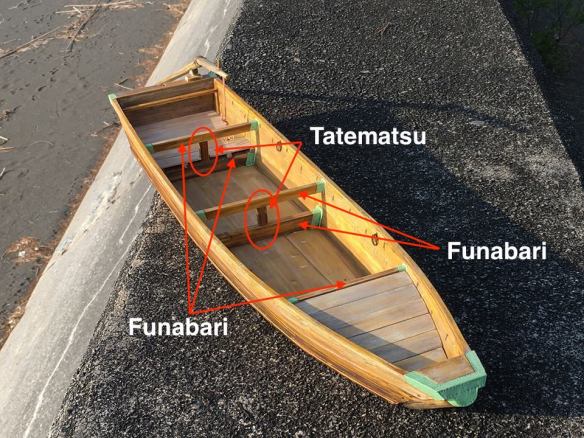
Also in my boat shop is a partially started Hozugawa Ayubune, which I want to be able to make as a gift, since it’s a simple contruction. However, it’s not so simple that I just make myself sit down and get it done. It probably has to do with the fact that I’ve already built one, so the challenge isn’t quite there.

Finally, I’ve cut the parts and created some drawings and a mold for a 1/10-scale model of a Himi rice field boat called a Zutta Tenma. This is something that Douglas Brooks built in Japan in early 2016 (click here to see his blog).
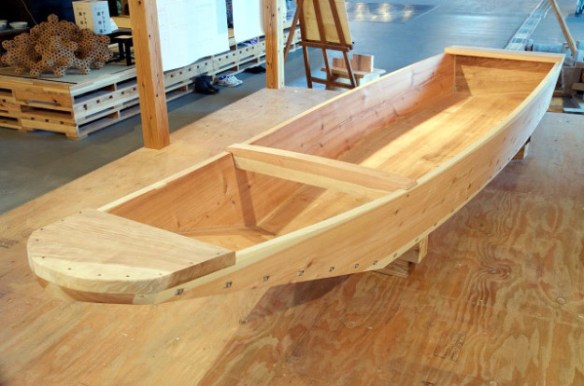
A Zutta Tenma, a rice field boat, built by Douglas Brooks in Himi, Japan, in early 2016.
Continue reading

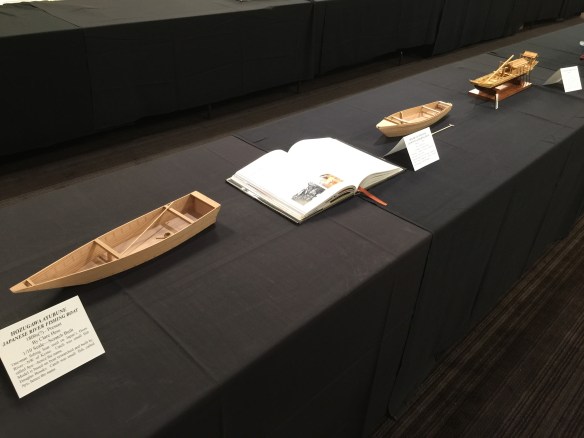
9th Japanese Boat Models Display, October 2019

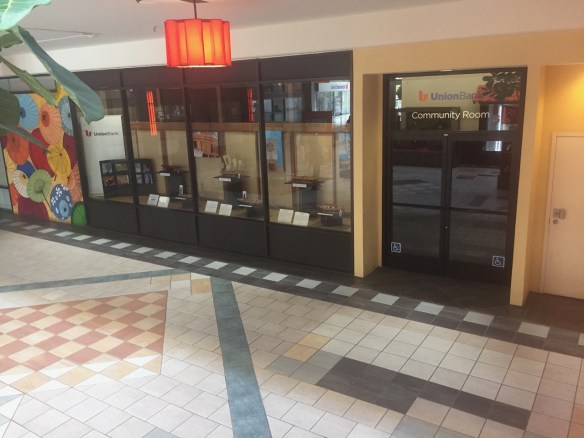
I just finished setting up Japanese wasen model display 9.0 yesterday. I was a bit late setting it up, which I had planned to set up 3 days earlier, but it was difficult for me to arrange my time this week for various reasons. But, it’s up now in the display window of the Union Bank community room inside the Japan Center’s East Mall in San Francisco.

Due to the sale of my Higaki Kaisen model, and to keep things manageable, I ended up scaling back to 6 models, plus a panel of photos. This fills up the display window just fine and allows me to set up more easily.

In fact, I have traditionally set aside 2 hours to handle the setup, but I must have become more efficient at it, as it only took me an hour to get the key from the bank, carry everything from my car, and set up the display.

The display includes:

  • Hacchoro – 1/24-scale Woody Joe kit of a Yaizu bonito fishing boat.
  • Yakatabune – 1/24-scale Woody Joe kit of an Edo period pleasure boat.
  • Tosa Wasen – 1/10-scale Thermal Studio kit of a Tosa fishing boat.
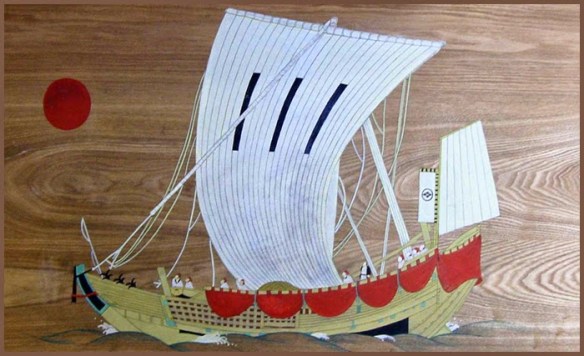
  • Kamakura period Umibune – a 1/50 scale model of a trade boat, c. 1300AD
  • Urayasu Bekabune – 1/10-scale model of a Tōkyō Bay seaweed gathering boat.
  • Kobaya – 1/32-scale model of a boat belonging to the Shōgun’s government.

Noticeably missing, at least to me, is a model of a bezaisen, or Japanese coastal transport, as I sold my Higaki Kaisen model last month and haven’t completed the Kitamaebune model yet.

The Kitamaebune will be ready for the next display, I’m sure. And, I do have another Higaki Kaisen kit. So, by that time, mabye I’ll have the second Higaki Kaisen model ready too.

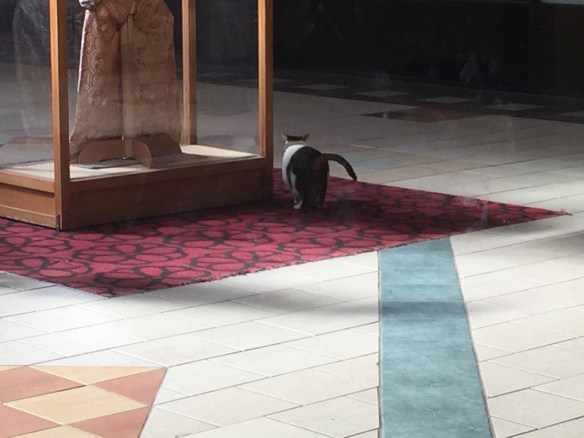
One thing different about this display is that while I was setting up the display window, a cat wandered through the East Mall and sat out in front by the bunraku puppet display. While the cat didn’t specifically come and look at the display, I like to think that he or she brought by some good luck to the display.

The display will run through at least the end of October. Given that I was several days behind schedule on the setup, perhaps I’ll leave it up a little longer if the window space is available. Ω

Aru Sendō no Hanashi – The Story of a Boatman

Just was made aware of a recently released film called “Aru Sendō no Hanashi”, which means “The Story of a Boatman”.

My Japanese is really not very good, so I would have a hard time understanding this film, but from this little Youtube video clip, I really want to see it.


Some digging around I did on this film reveals that it is a late Meiji period story of an aging boatman, named Toiichi, who lives in a small hut by a river. The nearby villagers are looking forward to the completion of a new bridge that will connect them to the modern world. He has been left behind by the changing times, but continues to row his boat. When a mysterious girl appears, his life begins to change drastically.

This is all I know except that the film is described as weaving a tale with visual beauty and music, and that I want to see it. Ω

Kitamaebune Website

Recently, I discovered a great website about Kitamaebune. I’m not quite sure who is running the site. It has some short, strange Youtube videos in Japanese, and some very basic travel information about the different port cities that were major places connected with Kitamaebune.

The site is simply kitamae-bune.com and it is in Japanese. However, there is an english language section that can be accessed at en.kitamae-bune.com, or to simply read about Kitamaebune, just go straight to en.kitamae-bune.com/about/main/ Ω

Port Townsend Wooden Boat Festival, Sept 6-8, 2019

catopower's avatarShip Modeler

The Port Townsend Wooden Boat festival is coming up this weekend, and I’m headed up to Washington state tomorrow for a long, long drive, to display a number of models of Japanese traditional boats the whole weekend inside the boat shop.

I’ll also be demoing construction of 1/20 and 1/10 scale models of a rice field boat from the area of Himi, a small town in western Toyama prefecture on the Japan Sea coast. I’ll be working on some other models too, since I’ll be there for three days.

Here’s a link to some of the info on the Himi rice field boat that boatbuilder Douglas Brooks built for the Himi museum: http://www.douglasbrooksboatbuilding.com/zutta-tenma.html

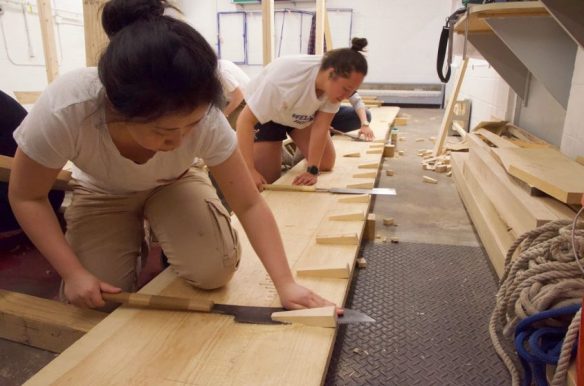
Mr. Brooks held a workshop in Port Towsend last week in which students spent several days learning to build a Japanese-style river boat using traditional tools and techniques. That boat will be on display at the festival, and there will be a…

View original post 100 more words

Building a Tenma-Zukuri Chabune (伝間造茶船) – Part 4

Uwakoberi, Koberi, and Iron Nails

So, with the koberi in place, I added the small deck at the bow and the ōtoko at the stern. I’m trying to find out the term for these small decks, which are more like steps. On the Hozugawa boats, the small deck at the bow is called omote-amaose. But, that’s an entirely different region, so I expect the term in Tokyo/Edo would be something quite different.

I also added the uwakoberi, which is what in the west, one would refer to as the gunwale or caprail. Each was made from a single piece of wood, wide enough to cover the edges of the hull planking and rub rail. I made mine a little wider, so that there is a slight overhang on the inboard side.

On tenmasen, the uwakoberi could be quite wide, serving as a walkway for the boatmen. I wanted to keep true to the Funakagami print, so I didn’t go too wide on this. Also, I had a hard enough time putting a bend in the wood. Any wider would have just made this task more difficult.

Continue reading

Wasen Models in Miniature – A Hozugawa Downriver Boat

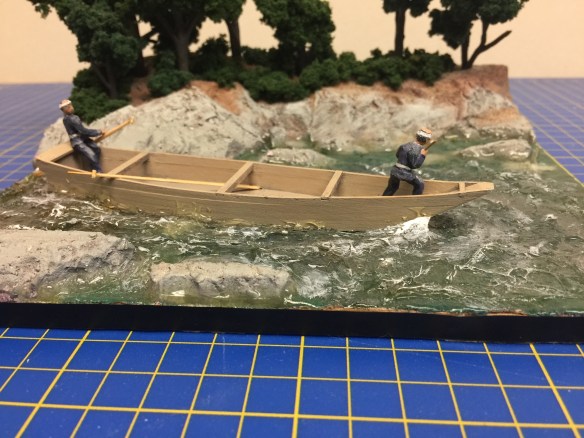
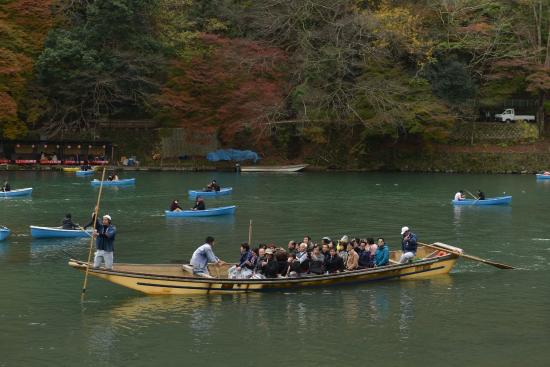
After completing the Hozu river diorama and showing photos to people, I got back some very good comments that led me to think about making a gift shop sized model of a large Hozugawa kudari boat, or downriver boat. These boats are fiberglass now, but they are based on a wooden boat that the river tour company commissioned many years back by the last boat builder of the region.

My Hozu river diorama

Douglas Brooks was kind enough to share a drawing of the boat that he obtained in Japan. I worked out the measurements, and the boat comes out to about 33 feet in length. Figuring a nice sized desktop model should be no more than about 10 or 11 inches long, that would put it at about 1/40 scale. That’s actually not that miniature, but for a boat of this type, it’s certainly miniature enough. Plus, it’s large enough scale to allow me to show some planking detail and maybe forgo the fastenings detail.

A modern fiberglass (FRP) version of the Hozugawa kudari boat.

Continue reading

Building a Tenma-Zukuri Chabune (伝間造茶船) – Part 3

Construction of the model continues as I’ve been working out how I want to tackle some of the details on this 1/20-scale model. The major issues to deal with are the copper mortise covers and other copper detailing as well as the detailing of iron nails used to fasten the koberi, or rub rail, plus wire nails used to fasten the uwakoberi, or the caprails. Some of this is quite simple.

Below, I’ve posted a photo of Japanese modeler Kouichi Ohata’s Tenma-zukuri chabune. He has been helpful in the adjusting of the design of the drawings and has completed a model based on the drawings.

His model is built at 1/10 scale. I may eventually build one at this scale, but for now, I’m happy building mine in 1/20 scale, and I’m considering building other wasen of the Funakagami in 1/20 scale also. It saves on space!

Photo of Japanese modeler Kouichi Ohata’s 1/10-scale Tenma-zukuri chabune based on my plans, with a few modifications and added details.

Continue reading

A Mention in The Rope Newsletter

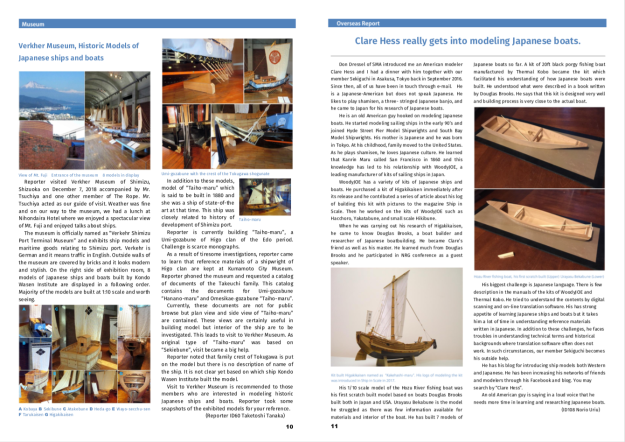
About a year ago now, there was a little write-up done on me and my work in the english language newsletter of the Japanese model ship society, The Rope.

I posted this entry on my ship modeling blog site, but realized today that I hadn’t shared it on Wasenmodeler. Much of the reason for mentioning me in the newsletter is due to my fascination for traditionl Japanese watercraft, so I figured I really should be posting something about it here.

catopower's avatarShip Modeler

It’s nice when you don’t have to toot your own horn because somebody else does it for you. In the latest edition of The Rope News, which is the newsletter of the Japanese ship model society in Tokyo, my friend Norio Uriu, who is the Director of International Relations for the group, did a nice little write up on me and my work on Japanese traditional boats.

I was introduced to Norio-san through ship modeler Don Dressel of the Ship Modelers Association of Fullerton, California. Don and I both built models of Woody Joe’s Higaki Kaisen kit and we exchanged a few emails about building Woody Joe kits. I built some of the other Japanese traditional boat kits, and he built a Japanese pagoda and Woody Joe’s Egyptian Sun Ship kit.

Having Norio-san as a contact in Japan, we made arrangements to meet for dinner one evening in Tokyo…

View original post 95 more words

Japanese Boats Theme at the 2019 Wooden Boat Festival

I’ve stepped in it this time… Having agreed to participate in this year’s Wooden Boat Festival with a display of Japanese boat models, I just learned today that they are making this year’s theme “Japanese Boat Building”, specifically mentioning, among other things, Japanese Boat Models.

This morning, I received an email from Douglas Brooks, who encouraged me to participate. He sent me a link to the following blog post that was recently published by the Northwest Maritime Center in Port Townsend, Washington.

Japanese Boat Building theme at 2019 Wooden Boat Festival

So, it looks like I’m in it as I’ll be the only builder of Japanese boat models there. I think I need to learn to be more confident about my knowledge of both the models and of Japanese boat building and to realize that I have a certain, if limited, expertise on the subject.

I’ll be bringing several of my models to the show, but will try to focus on my scratch projects. I do have my Hozugawabune, Bekabune, Kamakura period trade boat, and a mostly finished Kobaya. Also, I should have a completed Tenma-zukuri chabune and a miniature Hozugawa kudari bune, or river tour boat, that I recently started, but more on that later.

I’ll have a table set up for the models, but will also be demonstrating my Japanese boat building techniques at various times throughout the festival. That should give me two full months in which to refine my techniques!

Douglas is also trying to get me to sing a song at their boat launching ceremony that takes place on the last day of the event. I think he’s determined to make it happen. I also think I’m going to be urged to bring a shamisen too (3-stringed fretless lute played with a plectrum), and to play some music some time during the 3-day event, though I’m not really much of a soloist.

I would try to just stick to displaying my models, but he has gone out of his way to get me involved in the event and the event organizers have even arranged for a place for me to stay, so I think I’d better do what I can. And, who knows, maybe I’ll be “discovered” as a new Japanese music talent. Ω