Higaki Kaisen on the Cover of Ships in Scale

It’s official! I heard from a fellow ship modeler who said he really enjoyed the first installment of my Higaki Kaisen article. I hadn’t received my author’s copy yet, and my own subscription expired a few months ago, so I went onto Seaways.com to renew. When I was there, I saw the ad for the magazine showing this month’s issue and, lo and behold, there was my Higaki Kaisen model on the cover.
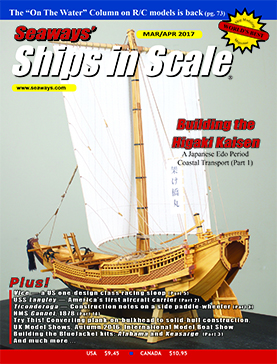
It’s actually the second time the model has been on a magazine cover. The first time was on the cover the of Nautical Research Journal. But, it was really nice to see it on the new Ships in Scale. I have to admit, the photogenic aspect of the model has more to do with the interesting nature of the subject and the incredible work done on the kit’s development by the manufacturer, Woody Joe.

Still, I’m pretty proud of the model and of the article. I hope readers here will have a chance to read the article. More importantly, I hope more modelers will take an interest in building the kit and other Japanese boats.

Special thanks to all the people who’ve helped me with this article and in better understanding Japanese traditional watercraft including Douglas Brooks, Toshihiko Shibafuji, Masaki Tanimura, Norio Uriu, Masami Sekiguchi, Jean Pierre Mélis, Hiroyuki Kobayashi, Yukari Gojo of Woody Joe, and Kazunori Morikawa of Zootoyz, as well as supportive fellow ship modelers Don Dressel and Richard Rubinger, and a special thanks to Ed Von der Porten for all his editing help.
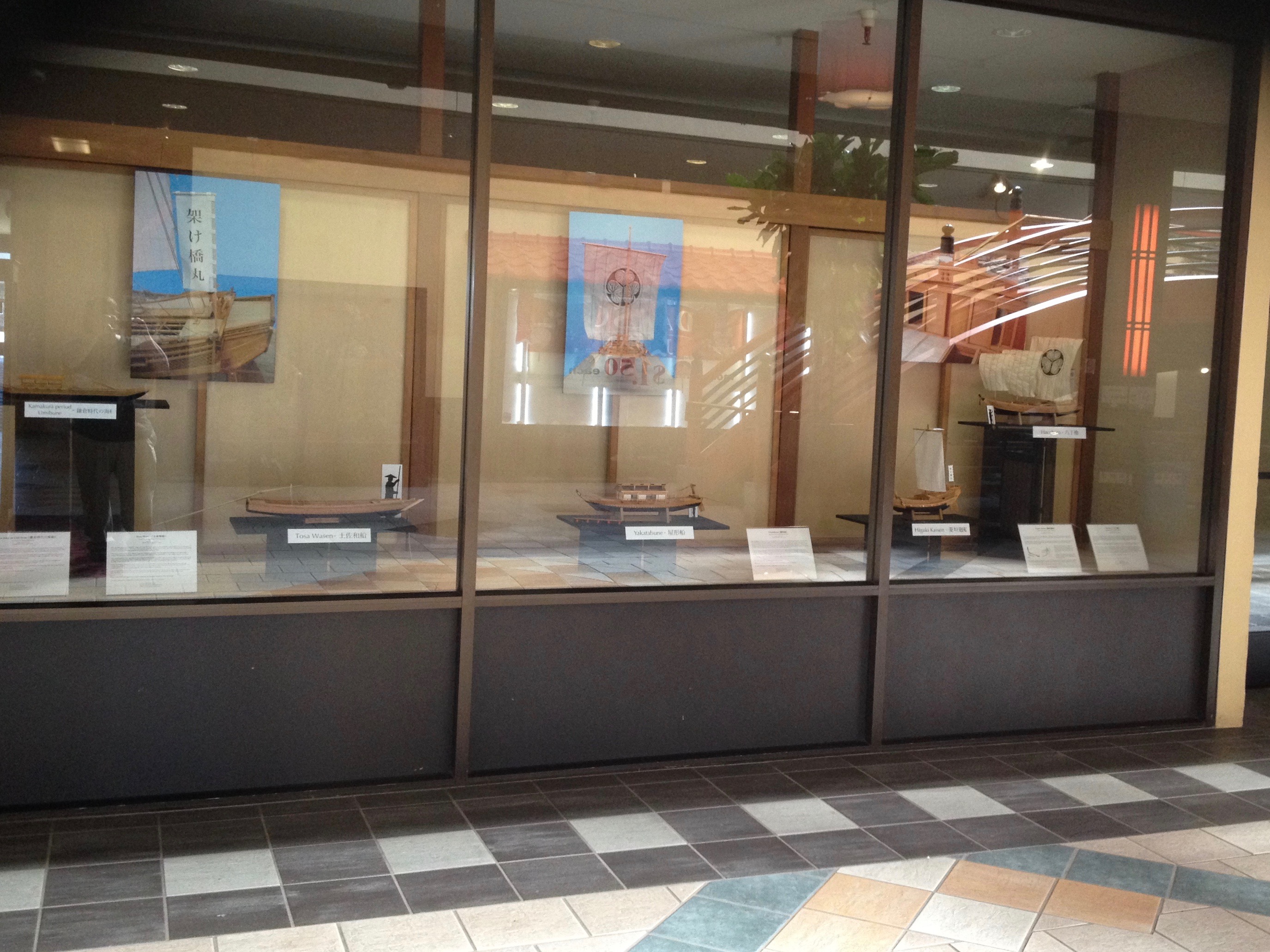
Wasen Display 6.0

The sixth display of wasen models is now set up at the Japan Center Mall in the window of the Union Bank Community Room inside the East Mall building. The display will be up through the end of March and features the same models as before, but with the addition of my Kamakura Period Sea Boat or Umi-bune. Though the Umi-bune model is not quite complete, I figured it was far enough along for public display as an “in progress” model.

The display then consists of the Hacchoro, Higaki Kaisen, Yakatabune, Tosa wasen, and the Umi-bune. The main change in the display is the use of new folding pedestals I made. This makes transportation easier, as the new pedestals take much less room in my car.

My hope for future displays is to have a model of a Kitamaebune, which is very similar in appearance to the Higaki Kaisen, and to fix up my wasen boat shop diorama with the addition of a new partially planked boat under construction and a number of miniature tools and things.

I also hope to display the completed Umi-bune and finish up my Urayasu bekabune model and perhaps display it with the bekabune model that was given to me by the Urayasu Museum. Probably, the next display won’t be until sometime in the Fall.

This slideshow requires JavaScript.

For those interested in building any of the kit models, they are all presently available. The Tosa Wasen kit is only available direct from the manufacturer. You can see their website at thermal-kobo.jp, but you will have to email them to place your order. The Hacchoro, Yakatabune and Higaki Kaisen kits are all available from the Japanese online seller Zootoyz.jp. Their prices are reasonable, service is very good, and you won’t get gouged on shipping fees. Again, instructions for all these kits are in Japanese, but all but the Higaki Kaisen are pretty straight forward.

Building the Kamakura Period Umi-Bune, Part 5

Umisen Model

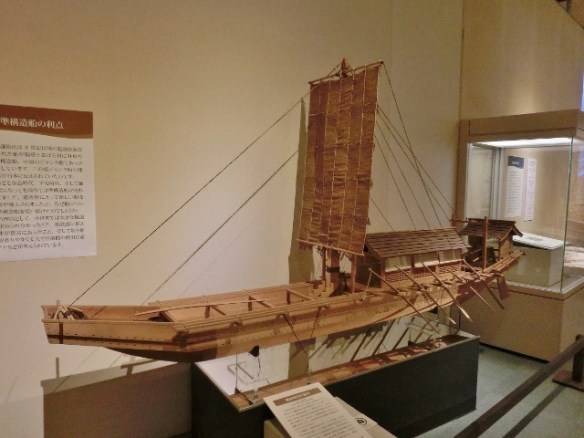
Model on exhibit at Kanagawa University. Photo by Masami Sekiguchi.

 No, that’s not my model. This 1/10-scale model of a Kamakura period umi-bune is on display at the Kanagwa University, which is home to the Institute for the Study of Japanese Folk Culture. The photo was taken by my friend Masami Sekiguchi, who is one of two Japanese ship modelers I met with in Tokyo last September. The other is Norio Uriu, Both gentlemen are members of The Rope, the Japanese ship model society in Tokyo.

I had been corresponding with Mr. Uriu for over a year, as he is a friend of fellow ship modeler Don Dressel of the Ship Modelers Association in Fullerton, California. Don was building his model of a Higaki Kaisen at about the same time I was building mine, and at some point, he put me in touch with his friend in Japan, Mr. Uriu.

When I travelled to Japan, I made arrangements to meet with Mr. Uriu for dinner in Tokyo and he brought along his daughter Hanako, who helped with our discussions, and Mr. Sekiguchi, who has been helping me understand information on Japanese ever since.

Continue reading →

Building the Kamakura Period Umi-Bune, Part 4

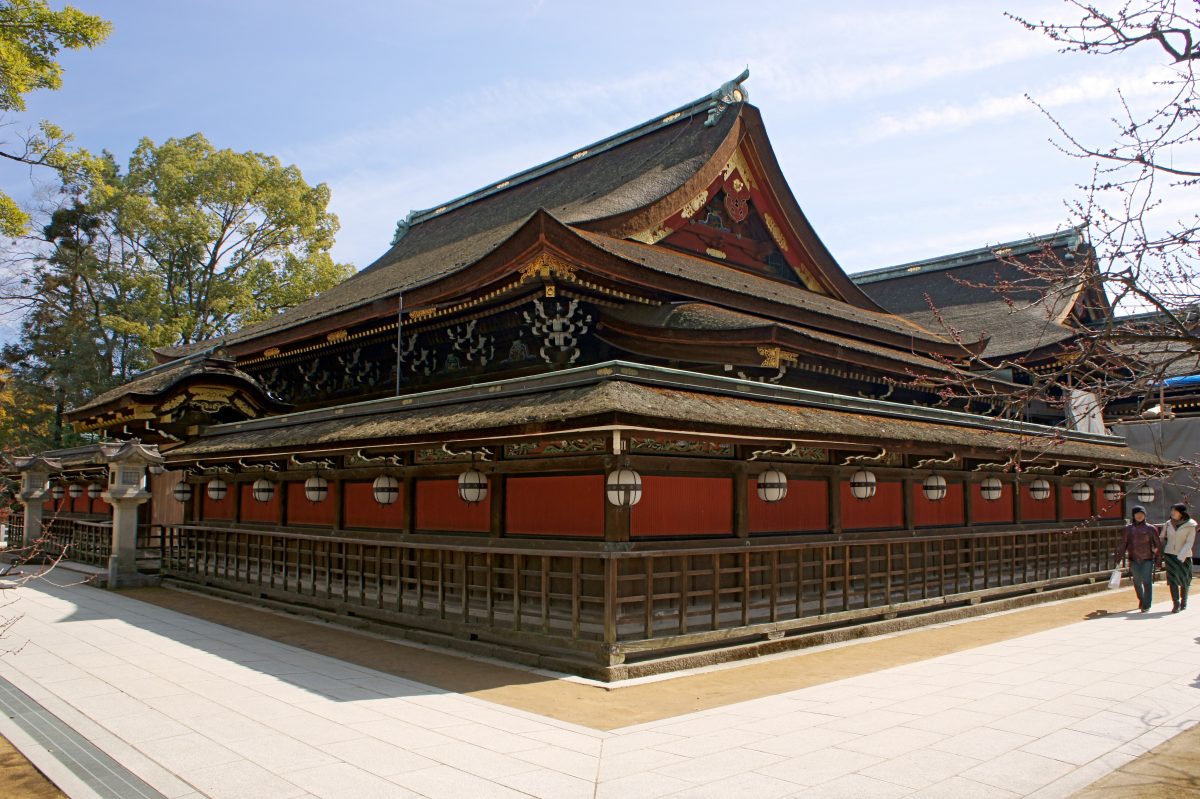
Kitano Tenmangu

Kitano Tenmangu – Shinto Shrine in Kyoto. Photo from Wikipedia.

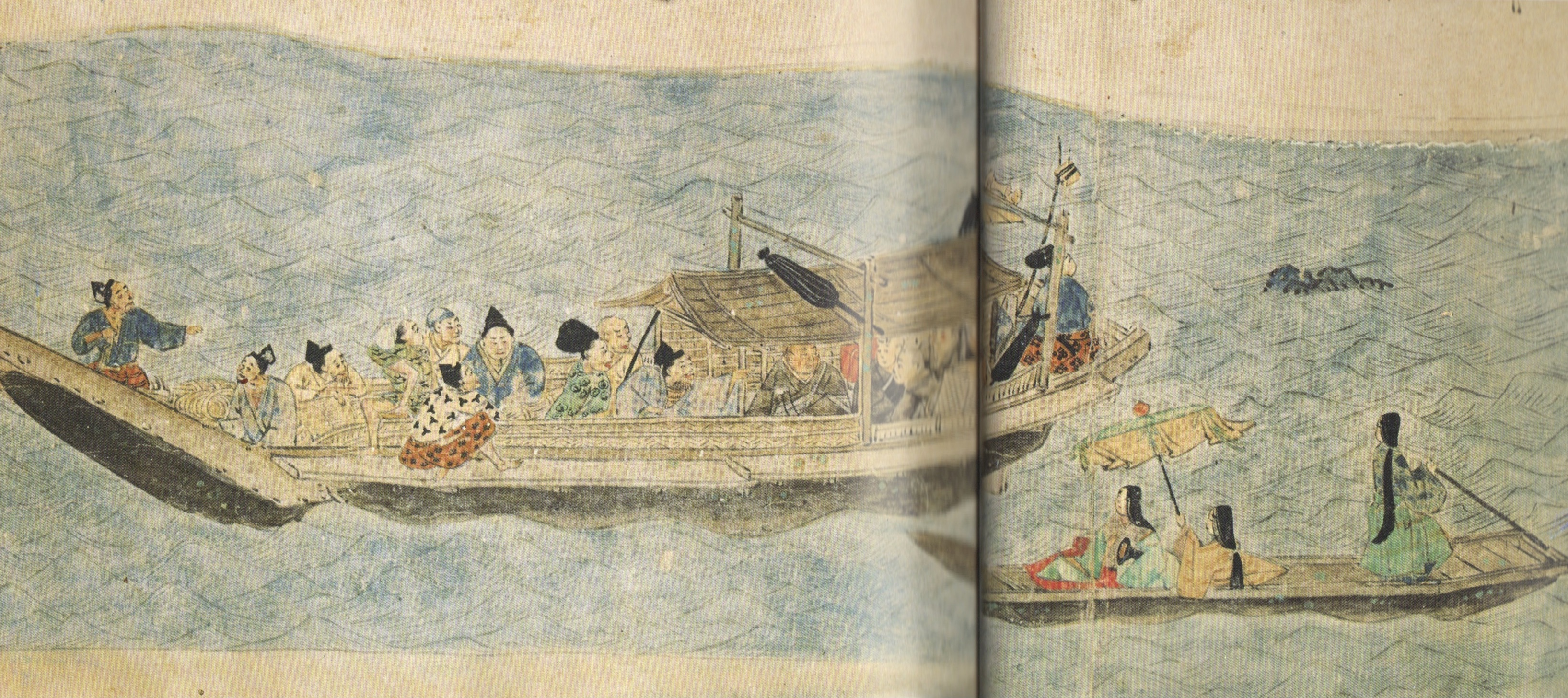
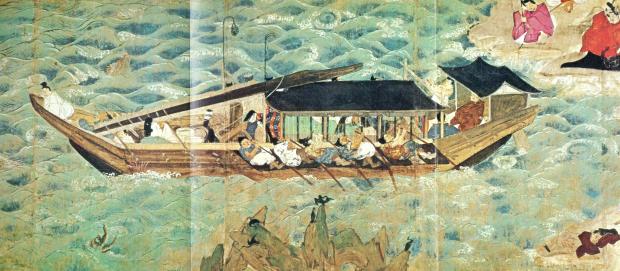
About a week ago, my ship modeler friend in Japan, Mr. Sekiguchi, explained a little about the Kitano Tenjin scrolls that depict the Kamakura period Umi-bune, and I have since re-read through online information on the subject to get a better understanding.

The scrolls represent the life of Sugawara no Michizane, a scholar and poet in the Heian period (平安時代  794-1185) who rose high in politics in Kyoto, then Japan’s capital. But, he had powerful  rivals in the Fujiwara clan that plotted against him, and he was exiled to Dazaifu on the island of Shikoku, where he died three years later in 903.

Apparently, there was much sympathy for Michizane, and shortly after his death, there were a number of calamities, including a lightning strike within the imperial palace. The emperor’s court fearing that these were caused by the wrath of Michizane’s angry spirit, decided to placate him by deifying him and erecting a shrine. He was given the Shinto name of Tenjin, and the shrine was built at Kitano, and known as Kitano Tenmangū.

Continue reading →

Building the Kamakura Period Umi-Bune, Part 3

image-2

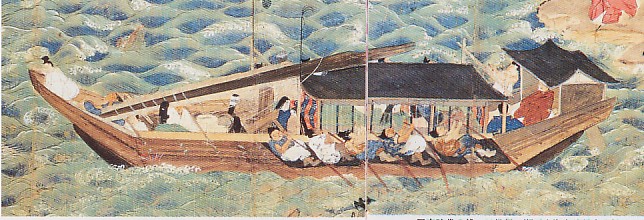
The largest source of Kamakura period boat information appears to be in 13th century picture scrolls that appear in books and on the Internet, but I really know very little about the scrolls themselves. What they depict includes a lot of boats with hull designs very similar to the ship I’m modeling. These are semi-structured ships or junkozosen (準構造船) with dugout-style hull, which have been built up with hull planks. Most of those depicted are river boats, but some appear to be sea boats.

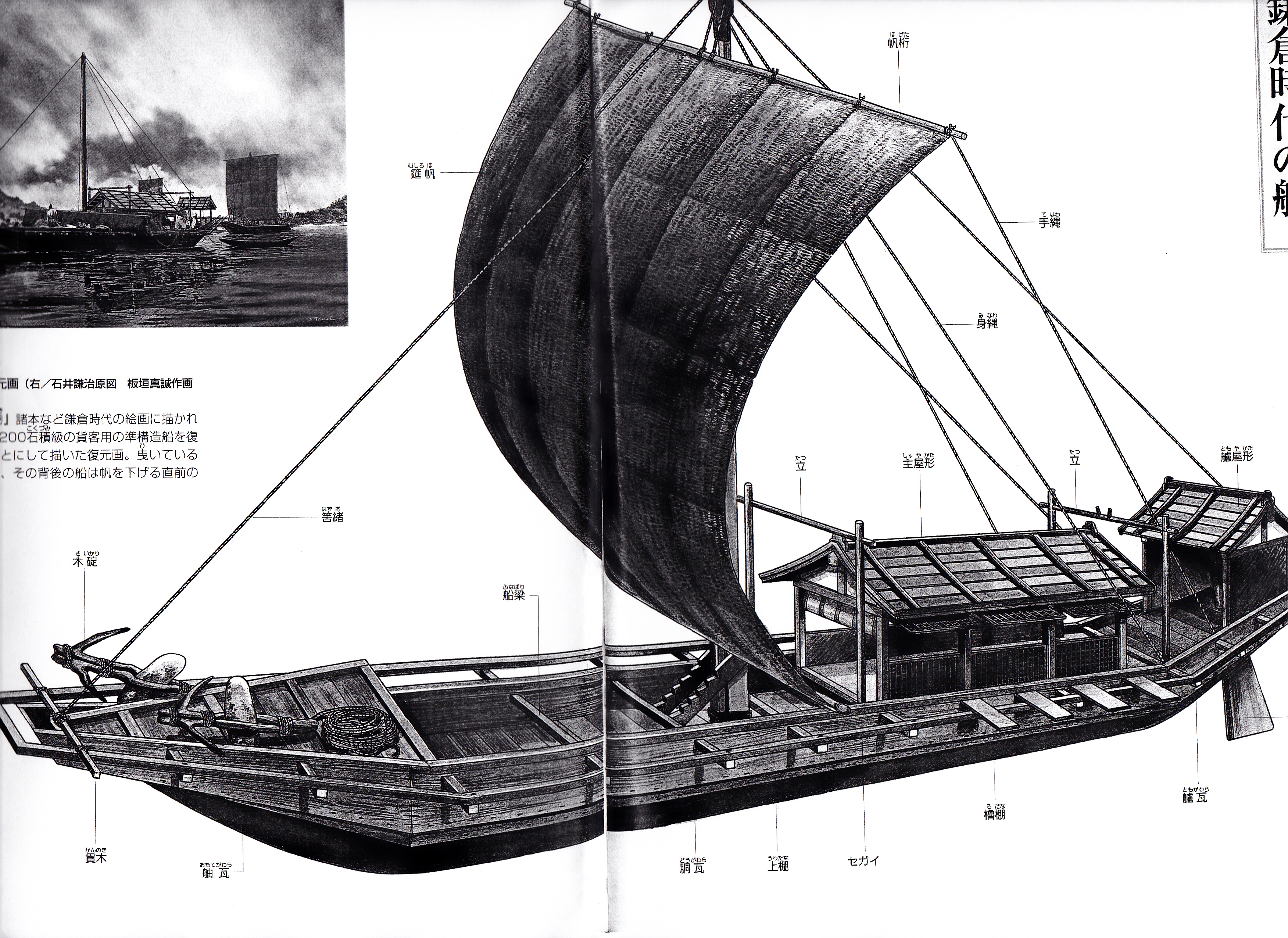
I recently found a great sketch of a large sea ship on a blog site. I believe this was scanned from one of Professor Ishii’s books, but it’s not one that I have.

25e52592258c25e8258825b9-1

This image is very similar to a less detailed drawing I have in my books. The ship depicted here varies only slightly from my model in that this image shows a peaked roof called a kappa at the bow. It also has only a single rail outboard of the hull, but it extends all the way around the bow. It also may be a somewhat smaller ship, given there are only 4 rowing platforms on either side, where my model will have 6.

A couple things I like about this image in particular is that it shows a roof design on the main deck house that is clear and makes sense to me. Note the boards that make up the roof run along the length of the roof. The drawing I’ve been working off of, shows the boards running perpendicular to these – not that it’s wrong, but that it requires an underlying structure that’s different from what I would naturally build. Also the front of the house appears to have a simple roll-up screen, no door or solid panel.

Continue reading →

Building the Kamakura Period Umi-Bune, Part 2

Illustrated History of Japanese Traditional Boats

Illustrated History of Japanese Traditional Boats

As I mentioned last time, I’m using drawings in one of the books I ordered from Japan earlier in the year. There were three I bought at the same time using a buying service called Buyee.com. This allows me to shop on Japanese online stores more easily than ordering directly from the stores since the purchases are done in English. It doesn’t help with product descriptions, but once I find something I want, buying it is fairly easy.

This service also receives the items using local shipping service in Japan, inspects the products, and ships them internationally to me.  There is a small fee in addition to the shipping charges. I’ve only needed to use the service a couple times, but has so far worked well.

Continue reading →

Building the Kamakura Period Umi-Bune, Part 1


ship2-kitanotenjin

I’m no expert on Japanese history. In fact, my interest in traditional Japanese boats is a way for me to learn more about it. Up to this point, I’ve primarily been interested in watercraft from the Edo period, which was from 1603 to 1868. This era began with the rise of the Shogun Tokugawa Ieyasu who established the capital of Japan at Edo (now called Tokyo). But, there are some interesting, large watercraft that I’ve been intrigued by as well, and many of these date back to earlier times.

Some of the ships I’ve been looking at were fairly complicated, and my information on them is clearly incomplete. But, there was one that stood as a simple design, with enough information available for me to feel that I could scratch build a model. This ship, referred to only as a large umi-bune or sea ship, dated back to the Kamakura period, which lasted from 1185 to 1333, and saw the rise of feudalism, the establishment of the Shogunate government, called the bakufu, two invasion attempts by the Mongols, and the spread of Buddhism. Continue reading →

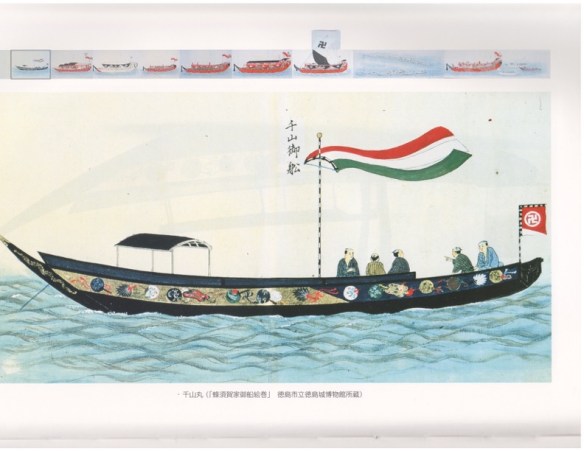
Looking at the Senzan-maru (千山丸), a Traditional Japanese Whaleboat

When I visited Japan in September, I found that I’d really hit the jackpot at the Toba Seafolk Museum. Not only are there numerous small boats on display, plus dioramas and a dozen or so models, but the gift shop is well stocked with books. I visited early in my trip, so I didn’t get as many books as I wanted to. Sadly, I didn’t see any of the books I was interested in at any other location I visited during the trip. One book I did pickup detailed a boat called the Senzan-maru, 千山丸.

img_2726

The Senzan-maru is the name given to a boat that was in the service of the Hachisuka clan. The boat was used to deliver messages and to help tow river barges, like the large decorative warship that served as the feudal lord’s yacht. The boat is a type called an Isanabune, a fast, seaworthy boat designed for whale hunting. Many whaleboats and fishing boats were decorated with painted designs on their hulls, but probably not to the same extent as Senzan-maru.

image-3

The highly ornamental hull painting on the Senzanmaru

Continue reading →

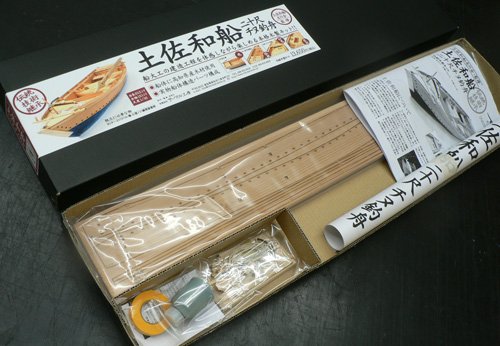
Buying the Tosa Wasen Kit

11224318_1065597873491157_360908378737328974_n

If you’re looking to buy the kit, there is good news! There is a faster, less expensive method than trying to get it through Amazon-Japan where I got mine. I found out that manufacturer will sell direct to the USA for a very good price. To buy from the manufacturer,  send an email to the company: info@thermal-kobo.jp. For buyers from other countries. I don’t know what his policy is, but you can always ask.

51PcOLPqd-L

Price for the kit is 13,000 Yen. Shipping is via EMS (A Chinese Express Mail Service that ends with a USPS delivery) for 2,400 Yen. Payment has to be via Paypal, sending to the email address above.

This is a really good price. Makes the whole thing with express shipping only about $150. I went ahead and ordered a second kit.

The only thing that I’m not so sure about is that the kit is shipped in its own box, but wrapped with a bubblewrap bag. It’s a long box, so it seems like it would be easy to bend in half. But, I received the first kit this way and it was delivered just fine. Then again, I generally have good experiences with the US Postal Service here.

It looks like I might have been their first international sale of this kit, as the owner posted a picture of the kit shipping out to the USA on their Facebook page.

When you order one, please feel free to mention where you heard about it. Ω

Speaking at the 2016 NRG Conference

Having been involved in Ship Modeling for more than 20 years, I’ve been a big admirer of the Nautical Research Guild and the work of its impressive membership. There have been so many great modelers involved in the Guild, I feel honored to be speaking together in a combined talk with boatbuilder Douglas Brooks at the opening talk of this year’s conference in San Diego. Douglas Brooks will be reprising his talk at last year’s conference on Japanese Wooden Boatbuilding, while I’ll be adding the element of modeling them.

IMG_1804

Douglas Brooks speaking at the 2015 NRG Conference in Mystic, CT.

Granted, my portion of the talk will the shorter segment. In the 15 minutes or so that I’ll have, I’ll only be able to scratch the surface of the subject, mostly talking about resources available to those who are interested in building a traditional Japanese boat. Pretty much, just enough to give folks a nudge toward attempting one.

The other part of my participation at the conference came as something of a surprise as I was told just last month that I was scheduled to do one of the round table sessions. These are 20-minute sessions that takes place simultaneously with 4 other sessions. People attend the session of their choice, and after 20 minutes, people then switch to another table. So, basically, I have a 20-minute demo, repeated a total of 4 times (with one 20-minute break).

Having no idea what I was expected to do, I’d considered a couple possibilities. The first thing that actually came to mind that I thought would work out, was to demo some of the details of paper modeling. Having completed only 1 paper model made it seem a bit odd, but I don’t think anyone else has done it, and I actually did have some interesting techniques to show.

But, talking with Kurt Van Dahm, the NRG Chairman, and others, it seemed that the idea was to give me more time to talk about modeling Japanese boats. So, I’ll be talking a mix of building Japanese kits and building from scratch. It seems a bit odd to me, as talking about kits seems a bit like a sales pitch. The only thing preventing it from being a complete conflict of interest, seeing as how I’ve done some work for Ages of Sail, is that Ages of Sail doesn’t currently carry any of the kits I’ll be talking about. And, my most highly recommended kit, the Tosa Wasen, will only be available direct from the manufacturer.

Bekabune model gifted to me from the Urayasu Museum.

Bekabune model given to me by the curator of the Urayasu Museum.

In any case, I’ll bring my in-progress Urayasu Bekabune models and a small supply of Japanese woods for people to sample themselves, giving them a chance to sand, cut and bend them. Show a couple in-progress kits, talk about how to read the Japanese language plans, etc. A 20-minute discussion should go by pretty quick, then repeat it three more times.

I really hope it won’t end up being the lamest NRG round table discussion in history, and people will find it interesting and useful. Wish me luck!