My apologies for not posting more information and updating my wasen modeling site very much lately. There are other things I’ve been trying to get done, and between this pandemic and the heaviness of having my mom in a nursing facility, I’m definitely not at my best. I did finally have a chance to play some traditional Japanese music with my music group at a couple events in Santa Rosa and San Francisco these past few weeks, but it’s not really enough.
It wasn’t until I set aside some things I’ve been trying to get done, and started paying attention to my wasen modeling, that things started feel so much better. So, I guess I’m going to have to make more time for wasen models, for mental health reasons, if nothing else!
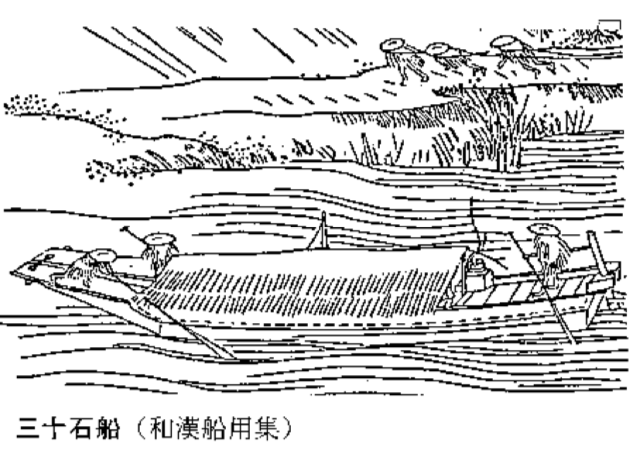
The most recent wasen topic that’s been on my mind is a type of riverboat transportation called the Sanjugokubune. These were large river boats that operated between Osaka and Kyoto during the Edo period. They are very famous for providing regular, scheduled, daily service for both cargo and passengers. I read somewhere that hundreds of these boats operated on this regular route every day.
In a recent post, I provided a link to a Youtube clip of a Sanjugokubune related story. More on that here.
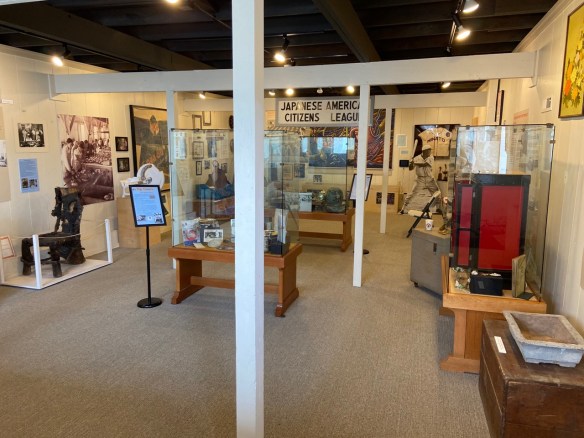
This week, I made the trip down to Monterey’s JACL Heritage Hall & Museum and met with curator Tim Thomas. He was waiting for me in front of the building when I arrived, and I was ushered into the museum room, where there were all sorts of displays of artifacts from the Japanese American community’s thriving past in Monterey.

The museum is small as it’s just the one room. But, the museum and the Heritage Hall apparently have their connections and access to a lot of knowledge about the Japanese American community, which was really thriving in Monterey before WWII. The curator has even given talks in Japan about the Japanese in Monterey.
Earlier this Summer, I was in contact with a gentleman who is a former Historian/Curator for the old Monterey Maritime Museum. Apparently, part of that collection included some Chinese junk models as well as some Japanese wasen models. He didn’t have much information on the Japanese models, but commented that all the models were built back in the 1920s.
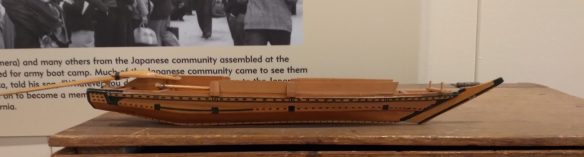
While the collection of Junk models has apparently been moved to the Pacific Grove Museum of Natural History, one Japanese boat model now resides at the Monterey JACL (Japanese American Citizens League) Heritage Center & Museum, where he now works as the Curator.

There is very little information on the model, except that it, along with the Junk models, is part of the Greatwood Collection. These were models commissioned by American oil company executive Royce Greatwood, working in the Far East in the 1920s. I’m sure there’s more to the story, but that’s all I know.
I ran across some images from a Japanese museum in Tokyo’s Koto ward in early May, and I feel like some of my work has been completely validated. This little museum is called the Nakagawa Funabansho Museum (中川船番所博物館), and I know absolutely nothing about this museum. I don’t even know if I’ve heard about it before, though I recognize the Nakagawa, or Naka river, or middle river in Japanese, which flows down from Saitama prefecture through Tōkyō.
A large display in the museum is a full-sized diorama of a small, fully loaded canal boat that looks like it’s pulling away from the dock. What surprised me was that I recognized this specific type of boat as one that I studied and created a set of drawings.
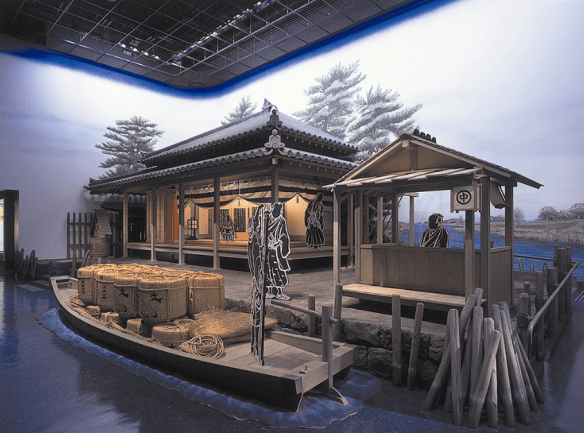
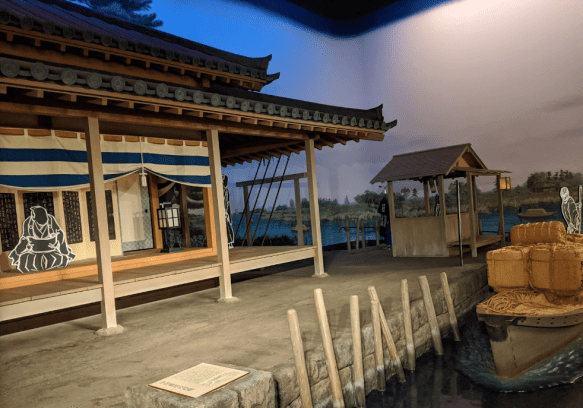
This is a tenma-zukuri chabune, a small general purpose boat from the canals of old Edo. I’ve seen very little about this boat, outside of a woodblock print in the Funakagami, an illustrated identification guide to river boats that was used to aid the government’s tax assessors.

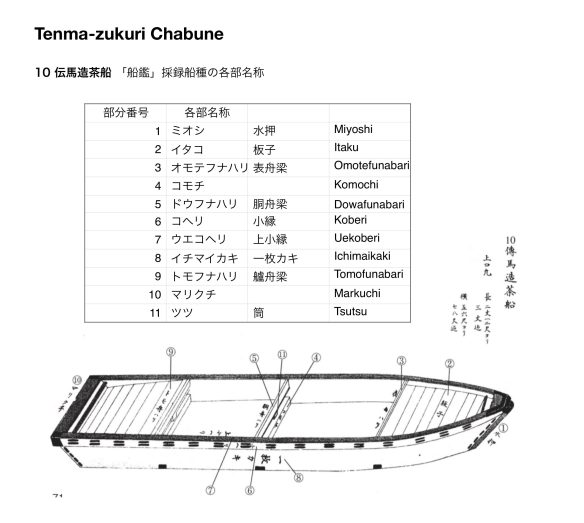
Page from the Funakagami, with my annotations on the names of parts.
Using this illustration, plus some information provided in the book, I came up with a set of drawings that I created in Adobe Illustrator.
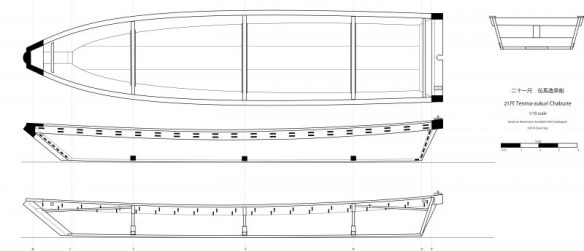
My own drawings based on the Funakagami illustration and provided dimensions.
There are some variations from the museum display, but all the details mostly seem to match. I will consider some modifications that I might make to the drawings, but I’m very confident with them, especially now that I’ve seen this museum display.
The drawings have been used to make at least two models: My 1/20-scale model and one by Japanese modeler Kouichi Ohata, who built a beautiful 1/10-scale model. Kouichi-san’s model actually came before mine, and he provided some great feedback that helped me improve the drawings from their original version.
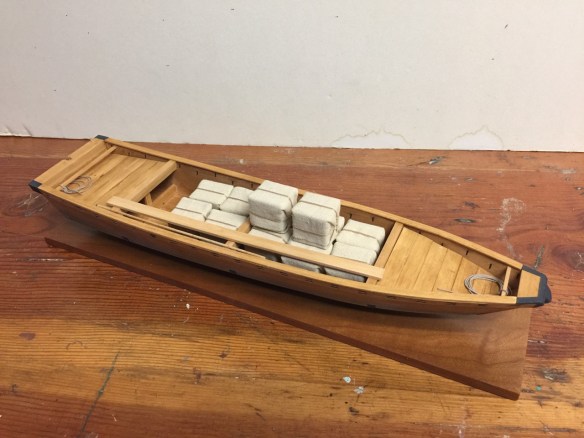
My 1/20-scale tenma-zukuri chabune
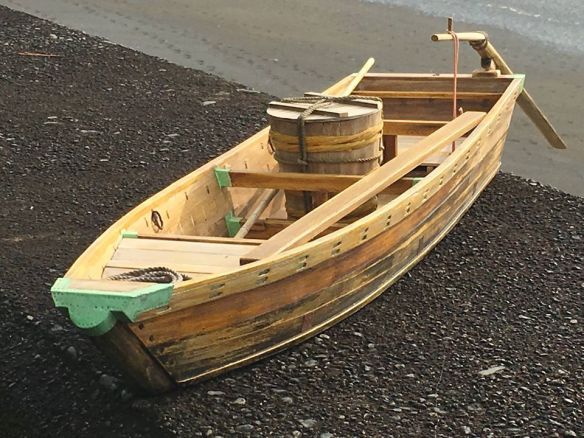
1/10-scale tenma-zukuri chabune by Kouichi Ohata
This is the first time I’ve researched a particular boat type and created a set of drawings based mostly on the interpretation of a woodblock print. While I knew I had the basic dimensions right, I never really new for sure if my interpretation of all the details was correct.
Seeing this museum display is not proof that I got everyhing correct, but at least it shows me that whoever was involved with the creation of this museum display agrees with my interpretation of this boat. That means a lot to me, given how separated and independent my study of wasen has to be.
So, I look forward to visiting this display at some point after Covid concerns have lightened up. In the meantime, perhaps I should pick another subject to try to illustrate and model. Ω
Just a few days ago, I mention in a blog post that I’d managed to acquire drawings of an Edo Nitaribune, a cargo boat used on the canals and rivers of old Edo. I also mentioned that it turns out that these drawings are a perfect match for a boat built by the late Mr. Kazuyoshi Fujiwara, a Japanese boatbuilder with whom Douglas Brooks studied under in his third apprenticeship.
Mr. Fujiwara built at least a couple boats that are now used by a group called Wasen Tomo no Kai, or Friends of the Traditional Japanese Boat. This is a group of volunteers that operate and maintain several wasen, giving rides to visitors in Tōkyō’s Kōtō ward.

Today, I spent some time working with the drawings to create an illustration to help me work out the details of my Nitaribune model. Now, I’m using the term Nitaribune and the name “Kawasemi” pretty interchangeably. But, just bear in mind that Kawasemi is just the name given to the boat used by Wasen Tomo no Kai. The name is just Japanese for Kingfisher. The group pretty much names all their boats after birds.
Anyway, using the drawings I have, plus some photos I dug up on the Japanese pages of Wasen Tomo no Kai’s website (the English language pages don’t have as much info), I was able to do a pretty fair reconstruction of Kawasemi.


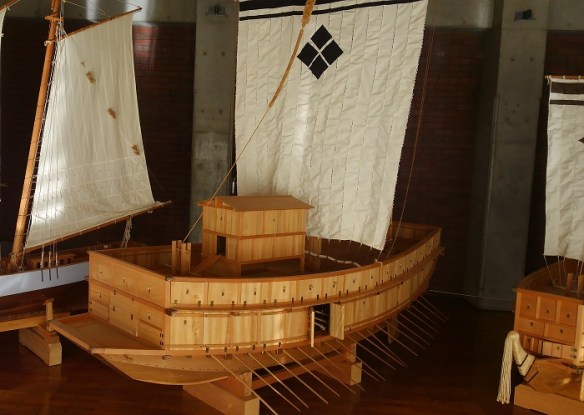
Atakebune were the largest class of purpose built warships that were used by the Japanese clans during the Sengoku period, or the Warring States period. These ships ranged from around 30 to 50 meters in length, were equipped with a large, box-like structure. Inside were the oarsmen, foot soldiers and samurai, protected by the wooden walls. The structure had two or three levels, with the top level being the roof of the structure. Firing and viewing ports were cut out and may have been closable with a hinged cover.

Atakebune model at the Verkehr Museum in Shizuoka.
In addition to a single-bank of sculling oars, the ship carried a large square sail hung from a single mast, usually mounted near the center of the ship. In bad weather, or when otherwise not in use, the mast could be un-stepped and lowered across the top of the ship. Usually, the ships were equipped with three sets of supports that the masts laid across.
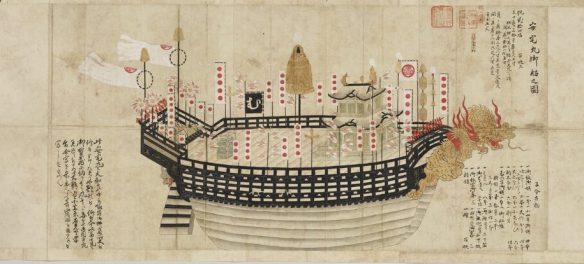
Some ships carried a heavily constructe deck cabin that sat of the roof level of the ship. Some unusually large atakebune, referred to as an o-atakebune, carried castle-like structure atop.

Image courtesy of the University of Tokyo General Library – Atakemaru ship illustration / image edited
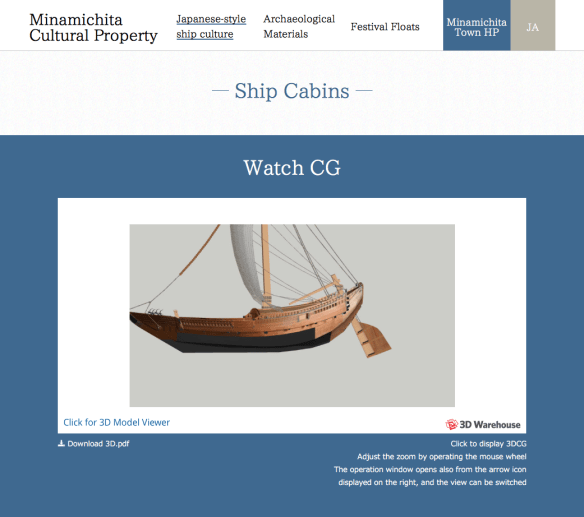
One of my Japanese contacts just posted a web page on his Facebook account. The page allows you to view a virtual 3D model that you can spin around and zoom in on. It looks pretty complete, and should be a benefit to those attempting to build a model of one of these ships, generally called Bezaisen or Sengokubune.

The website is that of the Minamichita Museum, which is located in the town of Minamichita on Ise Bay, south of Nagoya, and across the bay from Ise and Toba. The website is viewable in either Japanese or english, and not only provides this CG viewer of a bezaisen, but below it, there are some excellent photos, animations, and descriptions of important features and items carried aboard the ship.
Some of these items, I have never seen before. Check them out, and make sure to click on the animations, as they tend to reveal more information as they play. This site gave me a little more insight into the details of the interior of the ship’s cabin, and now I’m beginning to think it would be interesting to build a detailed vignette of one.
I also learned a few other things I didn’t know about shipboard details. Check it out and see what you learn: http://minamichita-museum.com/wasen/en/ship.html
Also, make sure to go to the main page and follow all the interesting information and links about Utsumi-bune, historical documents, the section on History that Survives in Minamichita, the links on festival floats, and more. Ω
Today, I just ran across a website called Explore Inside Japan. It’s an english language blog site that appears to have begun in late 2016, and has had regular postings about once a month since then. There is no explanation on the site that I’ve found as to who the blogger is, but it’s nicely written and interesting.
I specifically ran across a post about some sights in Shizuoka city, Japan, and there was a good write up about Sunpu castle, this is the castle built for the first Tokugawa Shōgun, Tokugawa Ieyasu. The article explained nicely about the different types of castle layouts, which I never knew, and had a lot of detail about this castle.
But, the next post, remembering that blogs post newest entries first, described a trip to the Verkehr Museum (verkehn is German for transportation), also in Shizuoka city. This small museum I’ve mentioned in a previous post. It happens to house a number of models of old Japanese ships, including the warships of the Sengoku period.

Photo from Explore Inside Japan’s website.
As I said, I’ve posted about the Verkehr museum before and included photos of the ship models there, but this site has many more. So if you’re interested in reading about Atakebune, Sekibune, and Kobaya, check out this blog site:
https://uexinja.blogspot.com/2018/01/
Also, if you’re interested specifically in Japanese warships, there’s an interesting post about a visit to the Wasen Research Institute’s exhibition room at Kanagawa University, and the decline of the large wooden warships.
https://uexinja.blogspot.com/2019/04/japanese-style-battle-ship.html
Again, this is an interesting website and I highly recommend checking it out. Ω