May 2021 Wasenmodeler Update

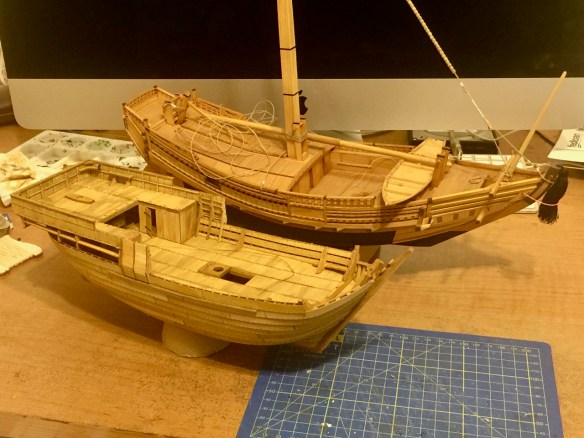
After some time off to finish a medieval European cog model and to gain some ground on a couple other ship modeling projects, I started working on wasen models again. It is interesting, though, to have the cog model and a sengokubune model (the Kitamaebune is a class of sengokubune, a common term for this type of coastal transport), sitting close together, as they are both in 1/72 scale.

My models of a medieval european cog (foreground, left) and kitamaebune (background, right), both in 1/72 scale. Different eras and regions, but still interesting to see them side-by-side.

Continue reading

Wasen Projects Status – March 25, 2021

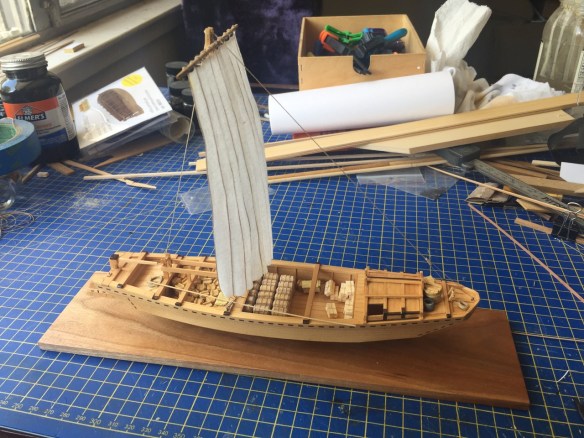
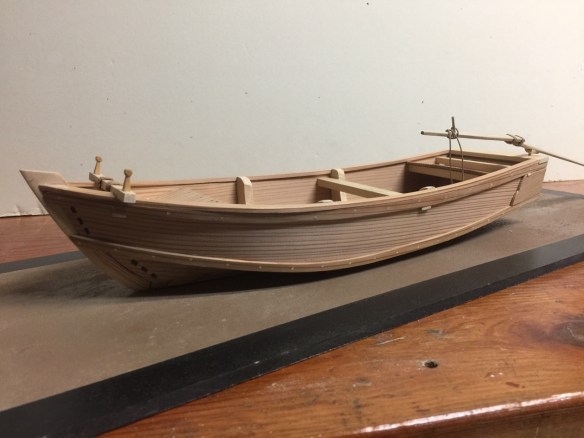
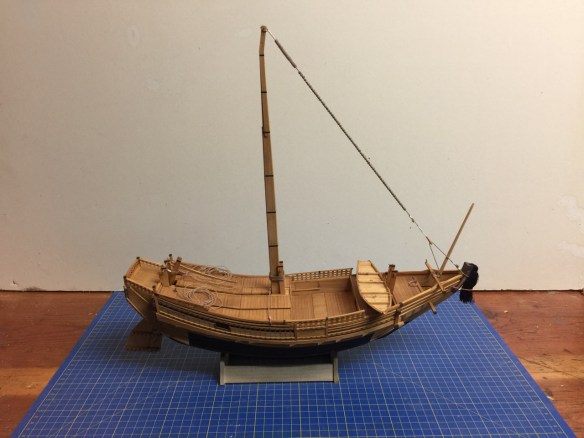
After taking a five-week break from wasen modeling, I’m back at it now, getting close to finishing up some more details on the Tonegawa takasebune, and soon the Kitamaebune, which still needs sails.
The break came about after I was asked to do a Zoom presentation as part of a series of lunchtime talks called the MESS lectures, for Maritime Education for Students of the Sea, a series organized by the San Francsico Maritime Research Center. The talk is not until the end of May – Thursday, May 27th, at 11am, to be precise. But, more on that later.

So, I kind of needed a break from my Japanese projects. Plus, for the talk, I think I need to keep some of the these models in various stages of completion, to serve as illustrations of the wasen model building process. So, I’ll probably leave the Senzanmaru and Nitaribune models where they are until after the talk.

Since it would be good to show the earliest stages of construction too, I’ll probably just get started on a couple other projects. Just not sure what the subjects will be yet. It’s all about what I think will be most interesting to illustrate or demonstrate. Again, more on that later.

For now, I ‘m going to try to focus on the takasebune. I started adding cargo into its hold, so I really need to continue with it until it seems reasonably loaded down. I had made a couple different kinds of cargo and am now finishing up the third type, which are covered buckets, or oke (oh-kay). Each one is simply a short piece of dowel, with a lid constructed of 5 small pieces, then the body of the bucket is wrapped with two threads to represent hoops of bamboo.

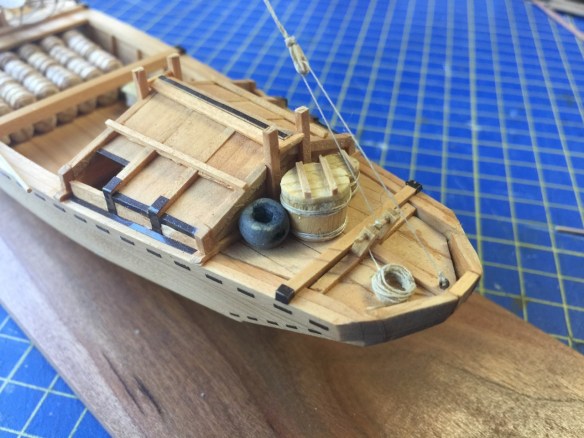
Aside from the cargo, I still have some “copper” trim to finish up, as well as the addition of parrals and brace lines to the yard. I don’t know the Japanese terms for these off-hand. My only regret is making the sale so square to the hull. I’ll probably brace the yard at a slight angle, so it’s not so straight. Thinking about it now, I would like to make a model that shows the yard holding the sail in a position that makes it act like a lug sail, a fore-and-aft sail for sailing closer to the wind.

In the near future, I’ll post more details about the steps in the construction of the Tonegawa takasebune model.

1/20-scale Senzanmaru Model – A First Update

Work is coming along on this model of the Edo period whaleboat-style craft Senzanmaru. Unfortunately, at this stage, a lot of work can be done with little apparent change in the model.

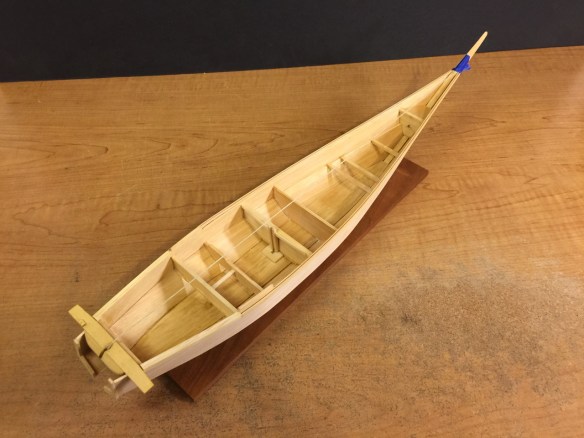
In the photos below, you can see how I taped a string at the bow and stern to service as a center reference line, so I can check to make sure everything is straight and even. I don’t know why I picked a tan line instead of a black one. I think the spool of tan line just happened to be handier.

As I mentioned, progress is being made, but it’s basically all in the details now. You may have already noticed the ōtoko, the heavy beam at the stern. This serves as the rudder mount and hinge, and has a rogui (hinge pin and resting pad) on the left or port side for mounting a sculling oar. This boat was set up for up to five sculling oars, with the rogui mounted on the ends of two beam that I have yet to add.

Continue reading

Starting a 1/20-scale Senzanmaru Model

A couple weeks ago, in a spurt of initiative, I finally began work on a 1/20-scale model fo the Edo period boat Senzanmaru.

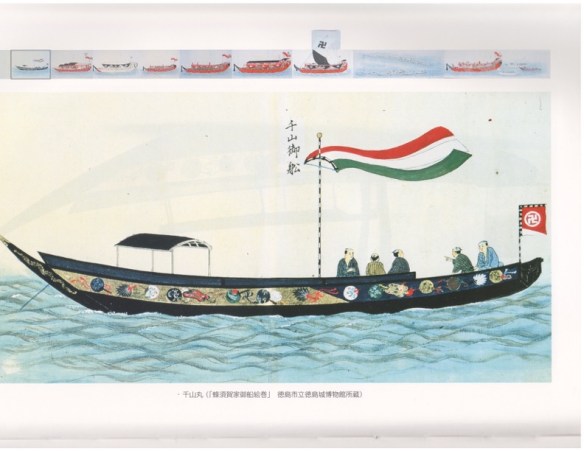
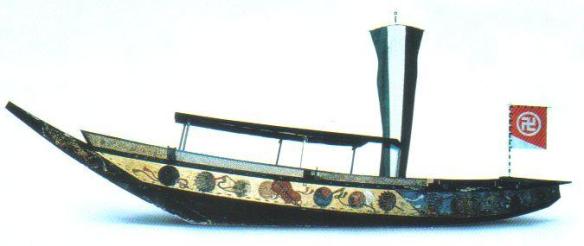
Senzanmaru is a whaleboat-style craft that was used by the Hachisuka clan of the former Awa province, now called Tokushima province. The boat measured just under 34 feet long and was propelled by up to 5 sculling oars. In addition, the boat has a mast step, though many boats have such a feature that goes unused.

I don’t know all the details of the boat and how it was used, but it is highly ornamented with elaborate designs painted on her hull and a relieve carving of a dragon on either side of her stem. While boats similar in size and type were used in large numbers to tow large gozabune, highly ornamental military-style vessels that served as yachts and transports for high-ranking samurai, the highly ornamented design of Senzanmaru suggests that this boat was also used to carry high ranking members of the clan. Perhaps it was more for transferring these individuals between ships or from ship to shore, or for carrying important dispatches, etc.

Continue reading

Wasen Projects for 2021

At the start of 2020, I wrote about an “Explosion of Wasen Model Projects” and I listed several projects, some have been long-time desired projects that were coming to life, and a few were new projects entirely. Here’s a rundown of those projects, followed be a look at what’s happening in 2021.


Himi Tenmasen – This was a project commissioned by boatbuilder Douglas Brooks. Though not a simple model, It was a quick project, as I had plenty of access to all the details of construction of the actual boat. This was something of a “full-time” build, which I started in mid-April of 2020 and finished by the end of the following month, about 5 weeks later.


Continue reading

My Second Honryou (ホンリョウ) Model

Last year, I built a model of a simple Niigata riverboat based on the one built by Douglas Brooks and Nina Noah with Japanese boatbuilder Mr. Nakaichi Nakagawa in the Fall of 2019. That model was a 1/10-scale version of the 25-foot boat.

The actual Niigata Honryousen in the workshop. Photo courtesy of Douglas Brooks.

That model was actually a commission, though I priced it really cheap to help support the project. At the same time, I figured I’d build a second one for myself. Both models were effectively at the same stage when I shipped the one off to its new owner. The other one I kept for my wasen model displays, and so that I’d have something to show at home.

The first Honryou-sen model.

Continue reading

The Tonegawa Takasebune (高瀬船) – a Model in 1/72 Scale, Part 2

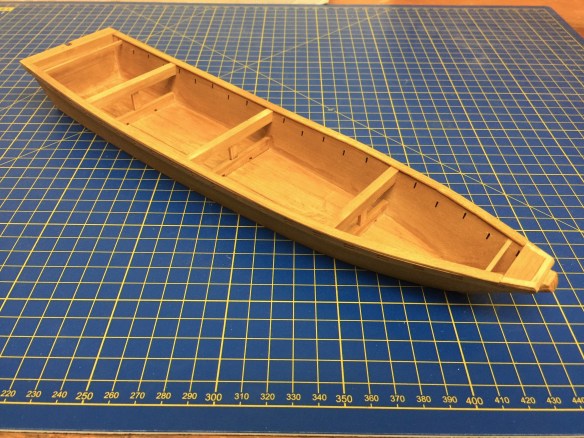
The 60-shaku Tonegawa Takasebune is a 1/72-scale scratch build, based on a drawing in the book of the same name. This, as I mentioned before, is the same scale as the Woody Joe Kitamaebune I’m building and my completed Woody Joe Higakikaisen kit. As mentioned last time, the model is based on a 2-view drawing of a 60-shaku (about 60 foot) I found in the book “利根川高瀬船” or Tonegawa Takasebune.

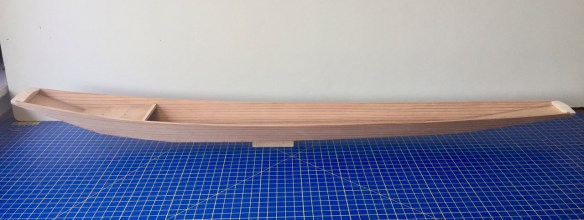
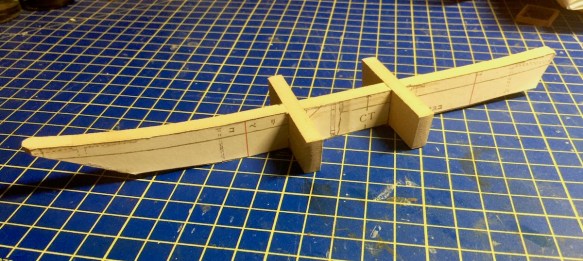
I began by scaling the actual drawing to 1/72-scale using cutting it up to create a pattern for an internal former. The use of a former is my standard method for building these essentially frameless wooden boats. The former is made from 1/4” MDF or Medium Density Fiberboard, which I buy by the 1/4-sheet at the hardware store. I start with the backbone, which is the easiest part to fashion, then add some cross section pieces, which will help me attach the hull planks at the proper angle.

Unfortunately, once I started the model, I didn’t really take a break to take photos or do any writing until I’d gotten the hull put together. But, below, you can see a template I made, which is essentially a tracing of the top view from the original drawing. This gives me the shape of the bottom of the boat. I’ve also gone back and re-created some steps so I could take a few photos to illustrate, at least. Continue reading

Building a Gozabune (Kobaya) from Paris Plans – Part 13

An update on this model is long overdue, and while I haven’t really been working much on the Kobaya model, it is a model that I’ve been very happy with. I’ve recently been researching old drawings, looking for atakebune information, but mostly finding sekibune and other small ships. As a result, I’ve found something of a renewed interest in finishing my kobaya model, and started working on it again.
The model keeps inching closer to completion, with the biggest hold-up being the making and mounting of the ship’s 28 sculling oars. Given the size of a person on the model, the deck would have been crowded with oarsmen. With such a sharp hull and relatively small size (17m) in comparison with the largest of ships at the time (30m, give or take), those 28 oars must have made her very fast.
However, Japanese sculling oars are more complicated in shape than western-style oars, so this project involves cutting and shaping 56 pieces of wood, plus the addition of bindings, handle, and mounting yoke onto each oar. So, I have my work cut-out for me.

Continue reading

Building a Tenma-Zukuri Chabune (伝間造茶船) – Part 5 – Final

First off, my apologies for taking so long to post an update on this project. The Tenma-zukuri Chabune is actually done. It sat for a long time with all the construction work done, needing only the coppering detail. I finally got the nerve to get back to it and it is now finished. But, when I last posted, there was still work to do, so let me take a step back to go over what was done.

Last we left off, the nail mortises had been cut and I was ready to add the decks at the bow and stern, or the omote and the tomo.

I don’t know if the boards that make up these decks were removable. Underneath, I left the ends open, so things could be tucked in there for storage, but only for smaller things, as the support posts of the beams cut the openings in half. If the deck beams were removable, there should be finger holes in at least some of the deck boards, so they could be easily lifted up. Sometimes, there was also a V-shaped pattern inscribed across the boards to make it easier to identify which boards go where. This is less important at the bow, where the boards lengths vary greatly, making them more easily identifiable as to which one goes where.

At 1/20 scale, I decided to keep things simple and didn’t add either finger holes or the alignment inscription. This would be more important on a larger scale model, like 1/10 or 1/15. So, adding the deck boards was just a matter of laying them down.

Continue reading

The Tonegawa Takasebune (高瀬船) – a Model in 1/72 Scale

After finishing the Himi tenmasen model, I was at somewhat of a crossroads. Though the Woody Joe kitamaebune kit is close to being completed and waiting for me to make a set of sails for it, I felt that I needed to start some kind of scratch project.

I considered some other boats from Toyama prefecture, now that I have access to drawings of many examples, but there’s always been one type of boat that has intrigued me for quite some time. The boat is a large cargo transport that operated on the larger rivers in and out of old Edo. There were various kinds of transports on the rivers around Edo, but these stood out to me.

These boats were called takasebune (tah-kah-say-boo-nay), and the term can be a little confusing, as the same term would refer to any boats on the Takase river. But, the term was more commonly applied to various types of cargo boats used on rivers through Japan. My interest here is specifically for those that plied the waters of the Tone (toh-nay) river system.

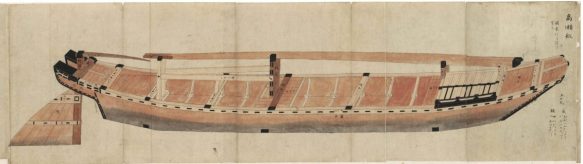
Illustration of a large Takasebune from the Funakagami

Continue reading