Building the Kamakura Period Umi-Bune, Part 6

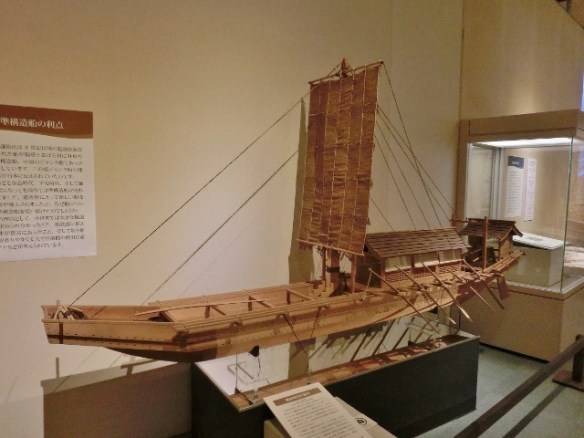
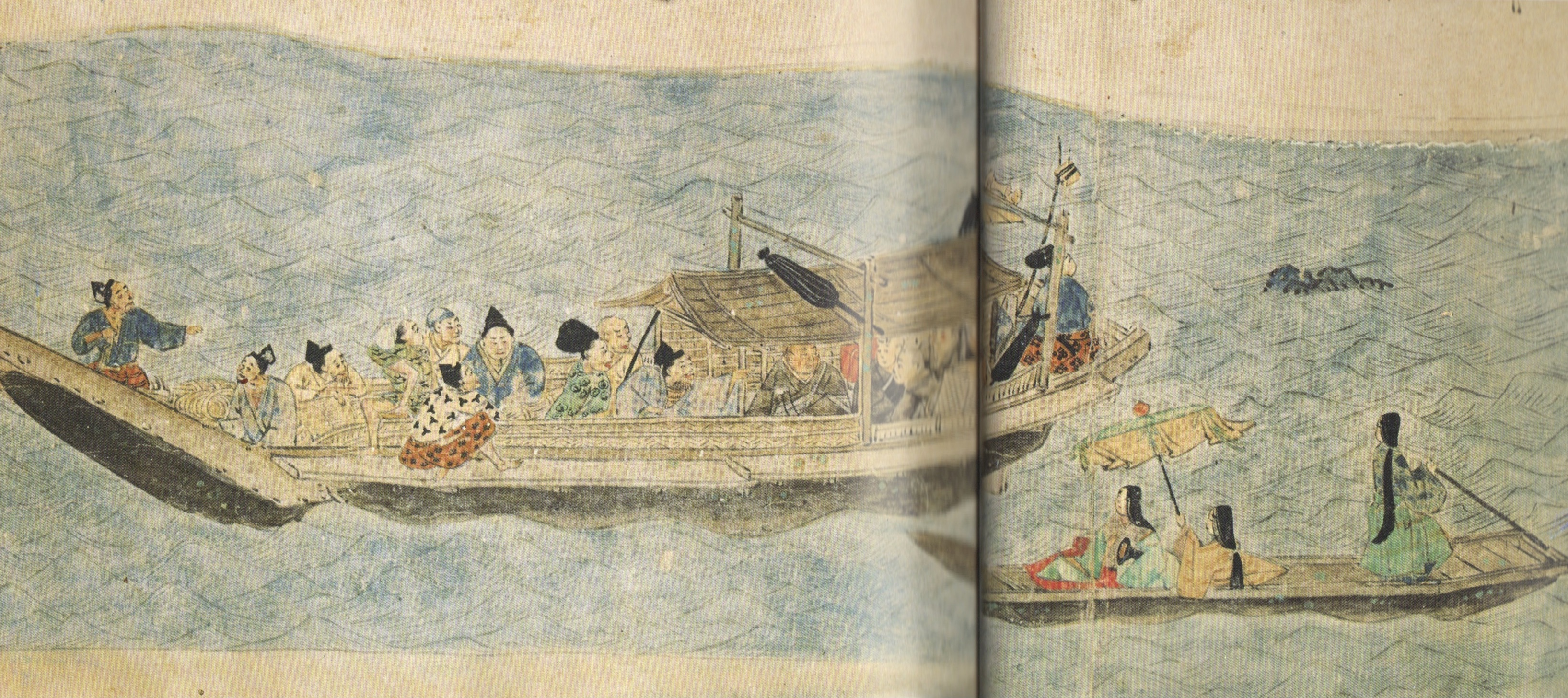
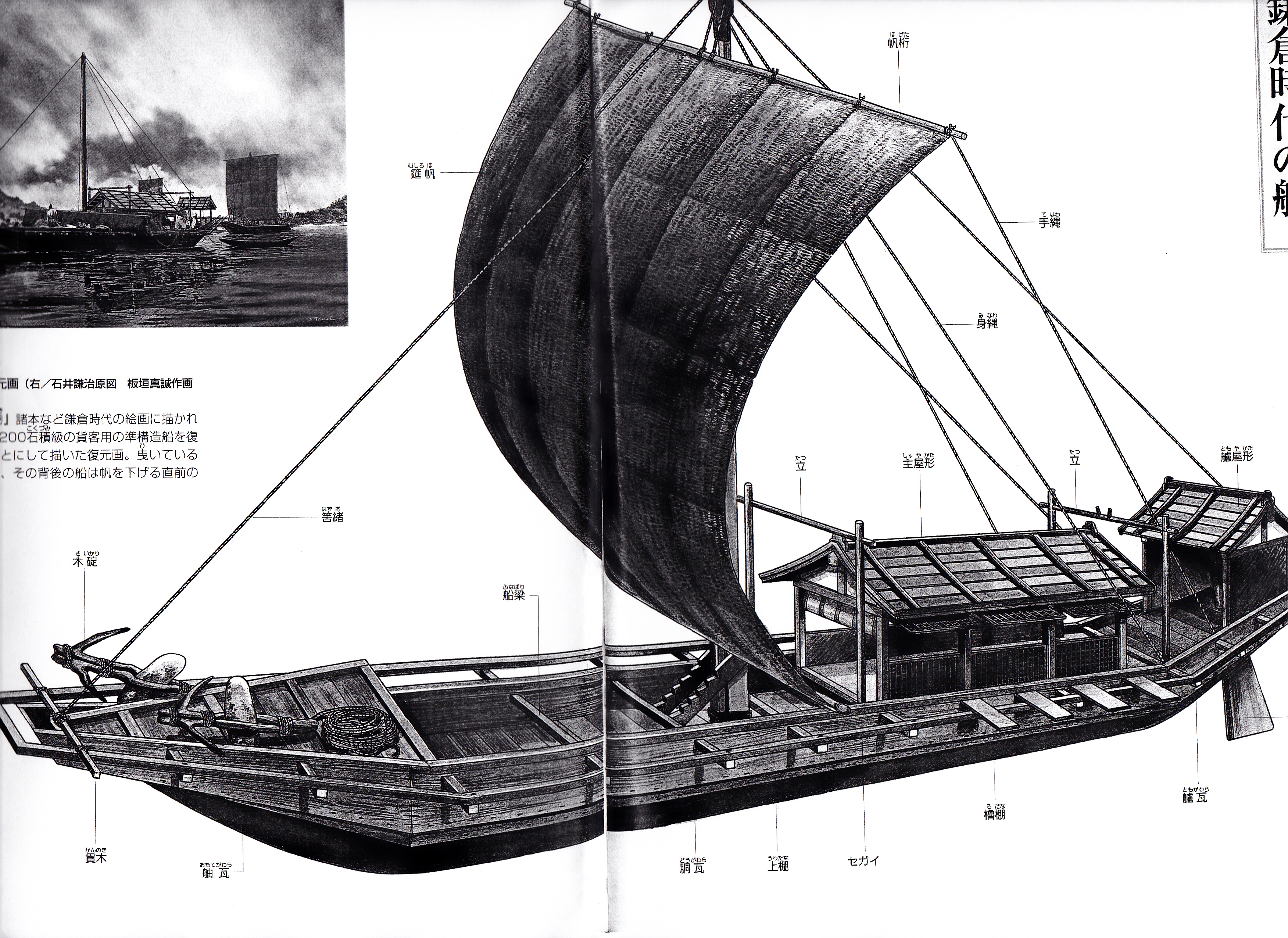
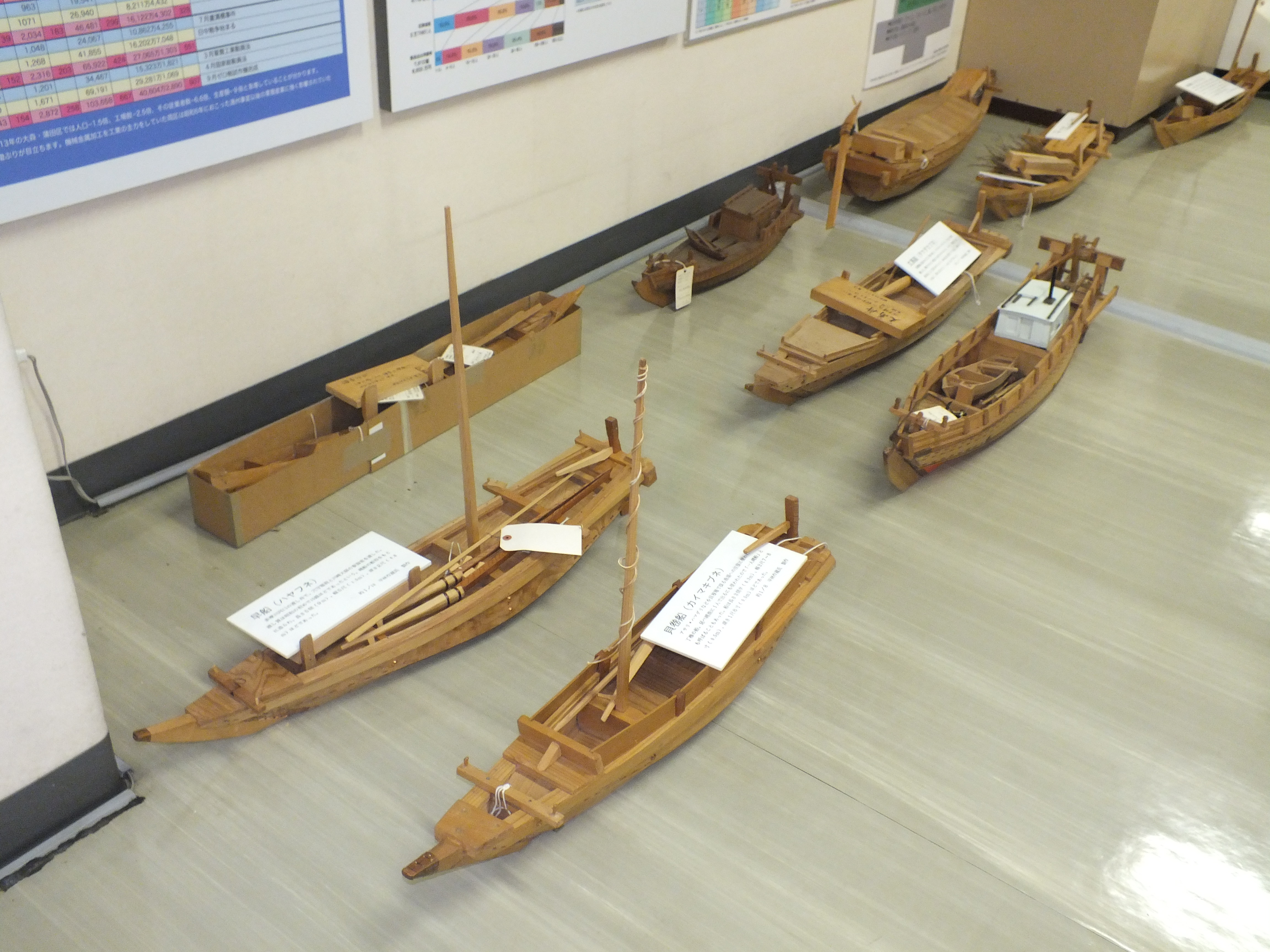
As I mentioned in my last post on this model, I’d been wrestling with the configuration of the roofs. The 1/20-scale museum model that I often see reference on the web, differs from Professor Ishii’s 3-view illustration that I’ve mostly been basing construction on. Those drawings are more of a match to the early scroll paintings. Oddly enough, none of the models I’ve seen match them exactly. Is it possible that the builders had access to more updated information? Or did they just decide that the Ishii-san was wrong? But, then what about the scroll paintings? Are they simply written off as being wrong?

As you can see in the photo below, which was taken at a ship model club meeting, I initially made flat roofs panels. If I could justify them, they would certainly be the simplest to construct.
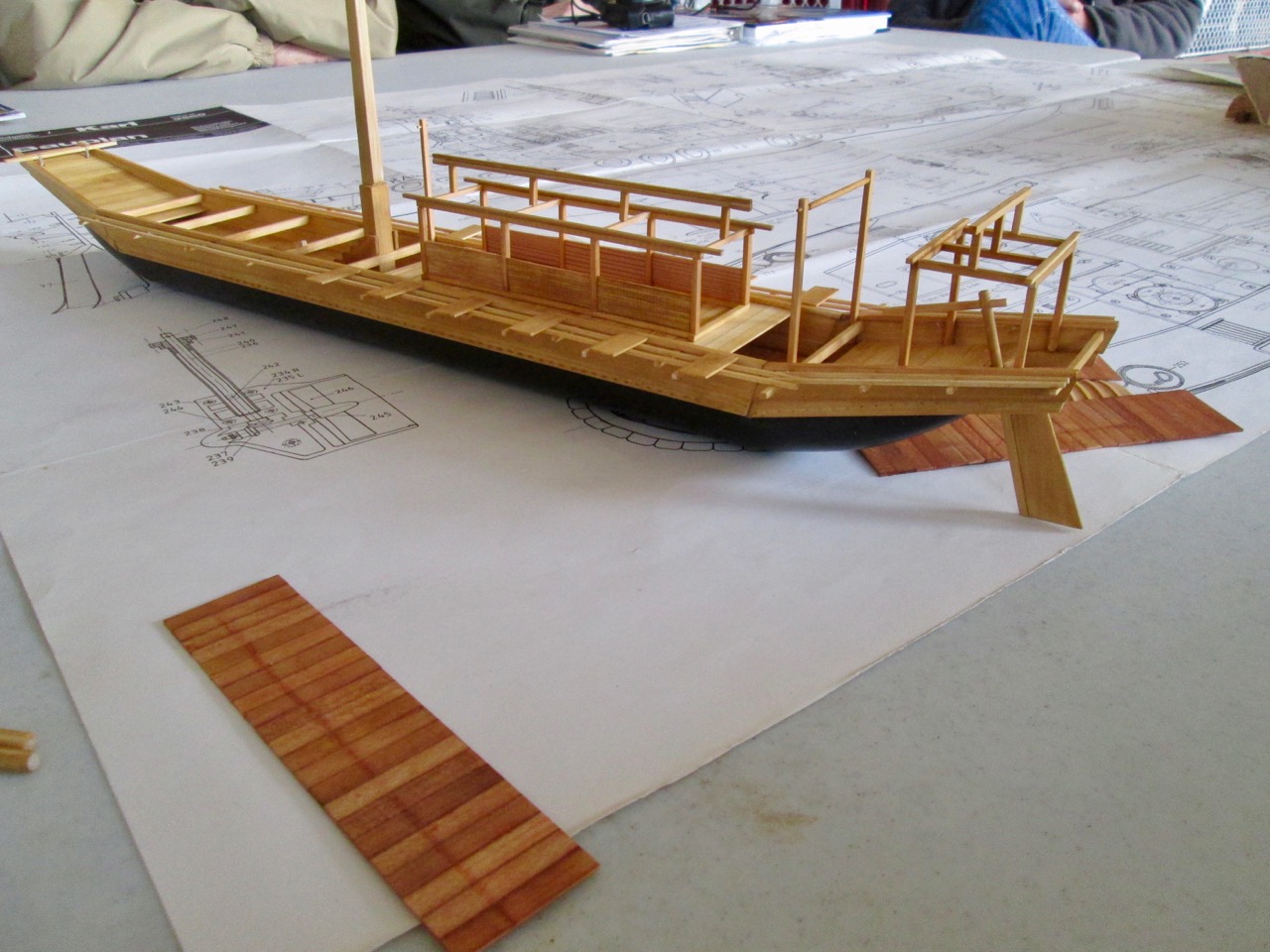
Flat roof panel initially constructed is seen in foreground.

Continue reading

On Amazon – Illustrated History of Japanese Traditional Boats by Kenji Ishii

I had to post this, because it is a very rare find. This book, written by Professor Kenji Ishii, was published in 1983 and is pretty much the bible of historical Japanese watercraft.

Illustrated History of Japanese Traditional Boats

This is the primary source for my own research on the subject of wasen, or traditional Japanese boats. I bought my copy used from Japan and it cost me around $170 with shipping. It was definitely worth the investment, as this information is extremely hard to  find anywhere else, especially outside of Japan.

Well, today, I was updating my post on my Kamakura period large sea boat project and I thought I see if I could find a link to this book on Amazon.com. I did and lo-and-behold, there’s an actual copy available in the U.S. for about $100!

https://www.amazon.com/Wasen-Shiwa-History-Japanese-Ships/dp/B00IOZFMPG/ref=sr_1_9?ie=UTF8&qid=1502065748&sr=8-9&keywords=kenji+ishii

I had to pass this along to readers here – this is a steal! I’m surprised to even see it listed here, because it’s written entirely in Japanese, so I wouldn’t expect copies to be turning up in the U.S. again, except in very rare cases. In fact, I don’t even see it listed on Amazon Japan at the moment.

Buy it before it’s gone. Seriously.

Can a Kobaya be Built from Paris Plans?

Kobaya is a term for a type of smaller military style vessel that is fast and maneuverable. Highly ornate versions of these and larger military vessels called sekibune were used by daimyo and their clans for ceremonial and other official purposes. I don’t know about the smaller ones, but the larger ones were called gozabune. In my limited experience, smaller gozabune are often referred to by their military name, kobayabune or simply kobaya, which means “small and fast.”


Photo of a 30-oar kobaya, of small fast-boat, from a display of models built by Yukio Nakayama. Photo is courtesy of The Rope.

Ship modelers building American or European subjects are accustomed to finding detailed drawingsfor the more popular of these vessels. There are even large numbers of plans made specifically for ship modelers. But, unlike with western subjects, there is a dearth of plans of Japanese watercraft. I’ve found plenty of sketches and there are basic line drawings that might be used, but these commonly don’t have the information needed to build a proper model.

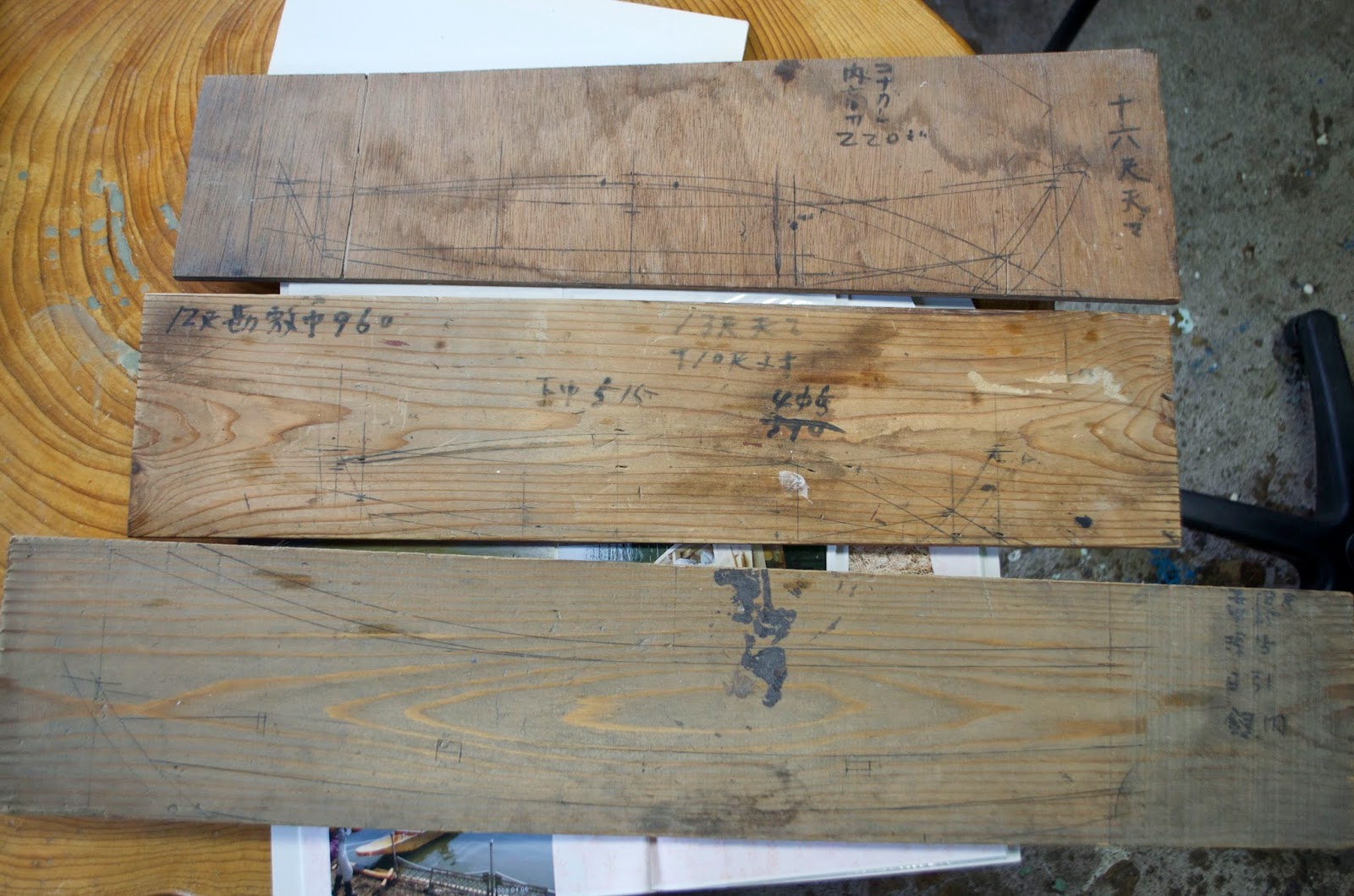
One reason for this is that Japanese boatbuilders don’t have a tradition of recording their work, and they generally only make temporary drawings on wood, sometimes destroying them when done.

Japanese boatbuilder’s plank drawings. Photo courtesy of Douglas Brooks.

Continue reading

A Thesis Writer’s Journal

Today, I was trying to find some information on the Funakagami, a book written during the Edo period used in the 19th century to help identify the river boats of the Kanto region for tax purposes.

Specifically, I was trying to find out when the book was published, which turned out to be 1803. But, in the process, I ran across a journal entry of a then graduate student of the Marine Underwater Archaeology who was writing her thesis on Japanese boats through art. Very similar in subject matter to the recent series of articles by Jean-Pierre Mélis in the French magazine Neptunia that I’ve written about here a couple times.

The journal was written in 2007 to 2009 by Michelle Damian, and provides an interesting look into the process of thesis writing and the research that goes into it. What I found the most interesting was following the experiences of someone as she was going through roughly the same discoveries and issues as myself.

Link to the Journal of Michelle Damian

I also found it interesting that one of her advisors was Dr. Hans Van Tilburg, who I was in contact with a few years back on my research on the U.S.S. Saginaw, which was the subject of one of his books. It makes me wonder why I’m not doing something more academic, given all this kind of work I’ve been doing.

In any case, I’m very curious to find out if Ms. Damian has continued her work on the subject.

Neptunia – Traditional Japanese Boats Through Prints

I have had the good fortune of having been in many email exchanges with French author Jean-Pierre Mélis and our mutual friends in Japan for about the last year or so. Mr. Mélis has been writing a three part series of articles in Neptunia, the Journal of the Friends of the French National Maritime Museum.

The series explores different types of Japanese watercraft as depicted in  Japanese woodblock prints. The journal is in French, but with modern translation tools, it’s not too difficult to read in English. This is how I was able to read the first issue, and it was a very interesting read. Plus, it was the first time I’d seen many of the prints.

It may seem odd that the subject of Japanese boats appears in a French journal, but it was Admiral Paris’s book Le Souvenirs de Marine, first published in 1888, with the most recent reprint that I know of being in 1962, that gives westerners the earliest detailed look at Japanese watercraft. A model based on this work also appears in the French National Maritime Museum, and is featured on the cover of the first issue above.

From Le Souvenirs de Marine

Mr. Mélis informed me the other day of the publication of his final article, which looks at the boats used to navigate the rivers and canals of Japan during the final years of the Shogun period.

If you are interested in reading the articles, you can purchase copies from the publisher’s website: http://www.aamm.fr/neptunia/derniers_numeros 

Specifically, the issues are numbers 281, 283 and 285.

The articles should be interesting and informative, and I am looking forward to seeing the artwork as well.


Book: The Tub Boats of Sado Island

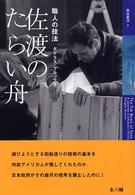
I just found out that Douglas Brooks has a number of copies of his book, The Tub Boats of Sado Island: A Japanese Craftsman’s Methods, available for sale.

This book is in Japanese, but includes a full english translation in the back with translated photo captions as well. It was published in 2003 by the Kodo Cultural Foundation and lists for $38.99 plus shipping from the Kinokuniya book store. However, they list it as out of stock.

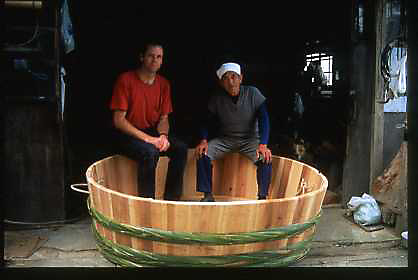
The author with Mr. Koichi Fujii. Photo courtesy of Douglas Brooks.

You can get a copy now, inscribed by the author, for only $30 including shipping. Take advantage of this opportunity by emailing the author directly. Here’s a link to his contact page: http://www.douglasbrooksboatbuilding.com/contact.html.

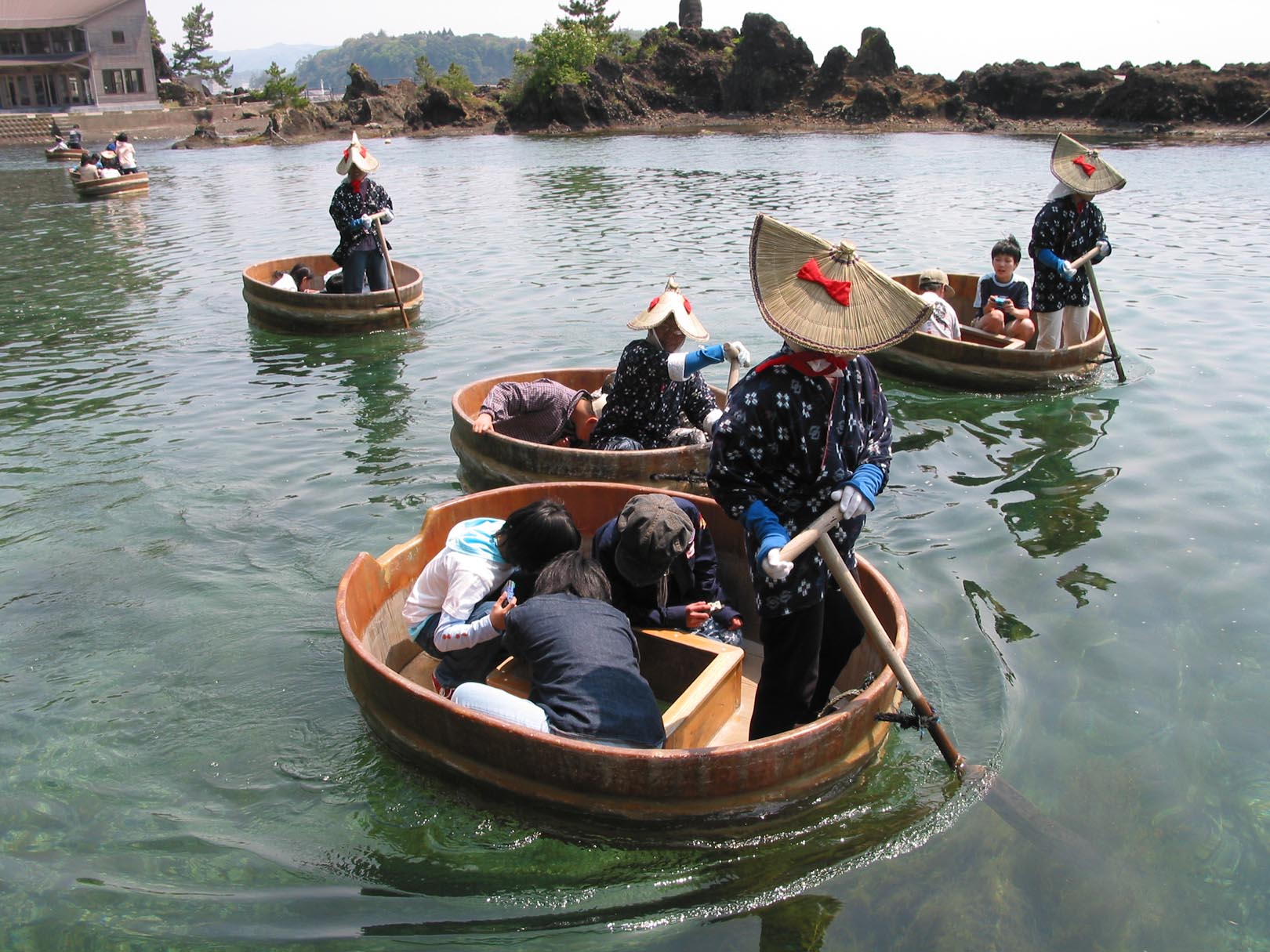
If you didn’t know, these boats are called Taraibune (たらい舟), and were used on the Echigo coast of the Sea of Japan and on Sado Island. If you ever visit Sado Island, there are a couple places where you can take a ride in one and even try out using the front mounted oar. Douglas Brooks did his first traditional apprenticeship in Japan with Mr. Koichi Fujii, who was the last professional tub boat builder on Sado Island until his death in 1999.

Taraibune for tourists at Shukunegi village, Sado Island. Photo courtesy of Douglas Brooks

Learn more about Taraibune on Mr. Brooks’s website: http://www.douglasbrooksboatbuilding.com/taraibune.html


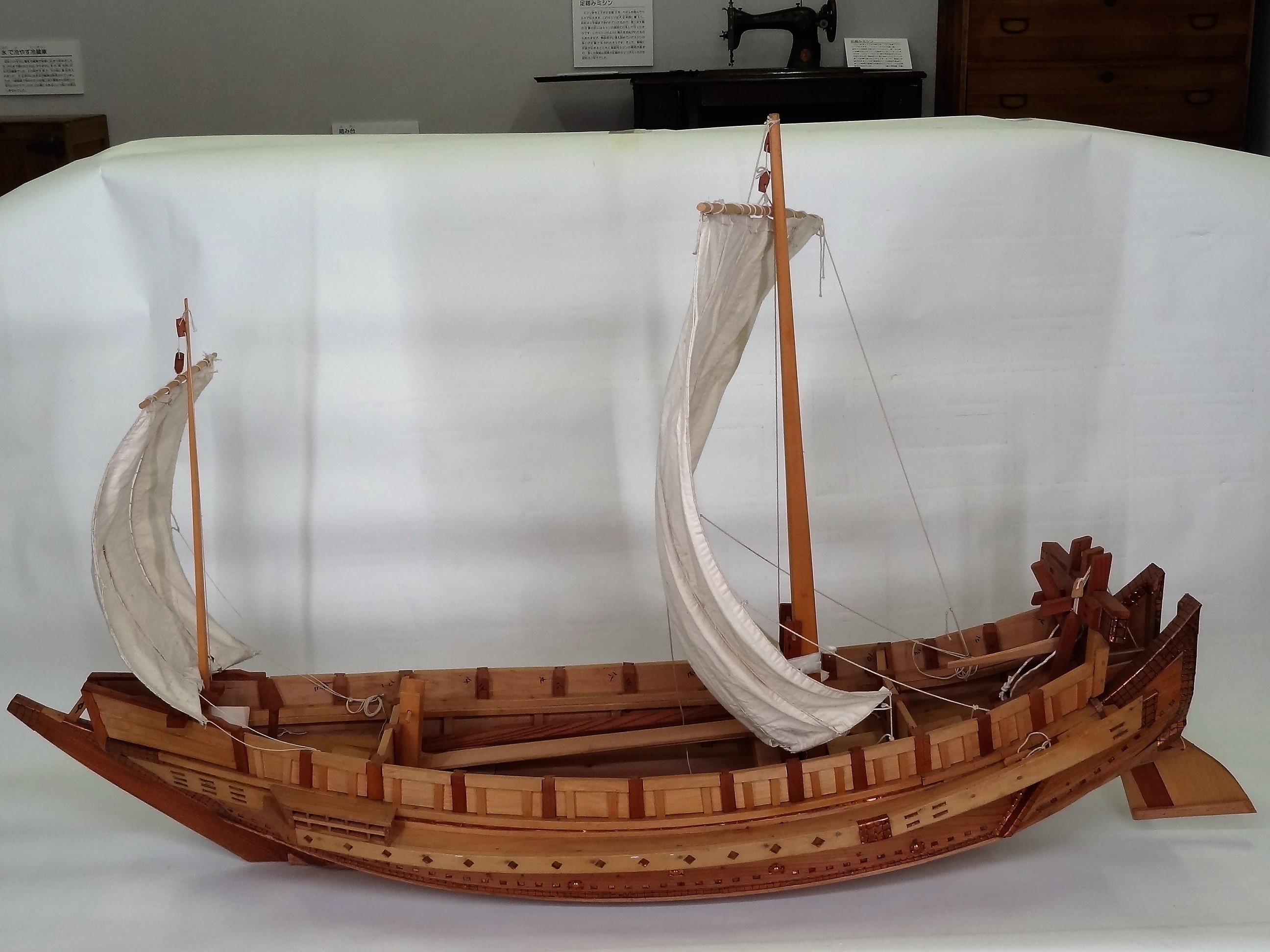
Wasen Models of the Ōta Ward Museum (大田区の博物館)

%e4%ba%94%e5%a4%a7%e5%8a%9b%e8%88%b9%e6%9c%a8%e6%9b%b4%e6%b4%a5%e8%88%b9_3

五大力船 – Godairiki-sen. 1/10 scale. One of the models in storage at the Ota Ward Regional Museum. Photo courtesy of Ota Ward Folk Museum, and taken by The Rope Tokyo.

The Ota ward’s regional museum is a place I’d never heard of, and nobody told me about. I discovered it one day as I was digging through an old database file I stumbled across on the Nippon Foundation Library website. Not being able to read much Japanese, I downloaded an Excel spreadsheet and began translating piece of it to figure out what I had. What I found was a list of about 900 wasen models and their dispositions. Included in the list was their city location and address.

I recognized the kanji for Tokyo, 東京, so I focussed on those. I copied and pasted the address into Google Translate, and I got that the address was in the Ōta ward. Now, I’ve been to Tokyo a few times, but I’m not too familiar with the system of wards, which are subdivisions of cities. But, I had the address and popped it into Google Maps, which allowed me to locate it precisely, and even do a virtual walk around the area.

screen-shot-2017-02-12-at-9-40-25-am

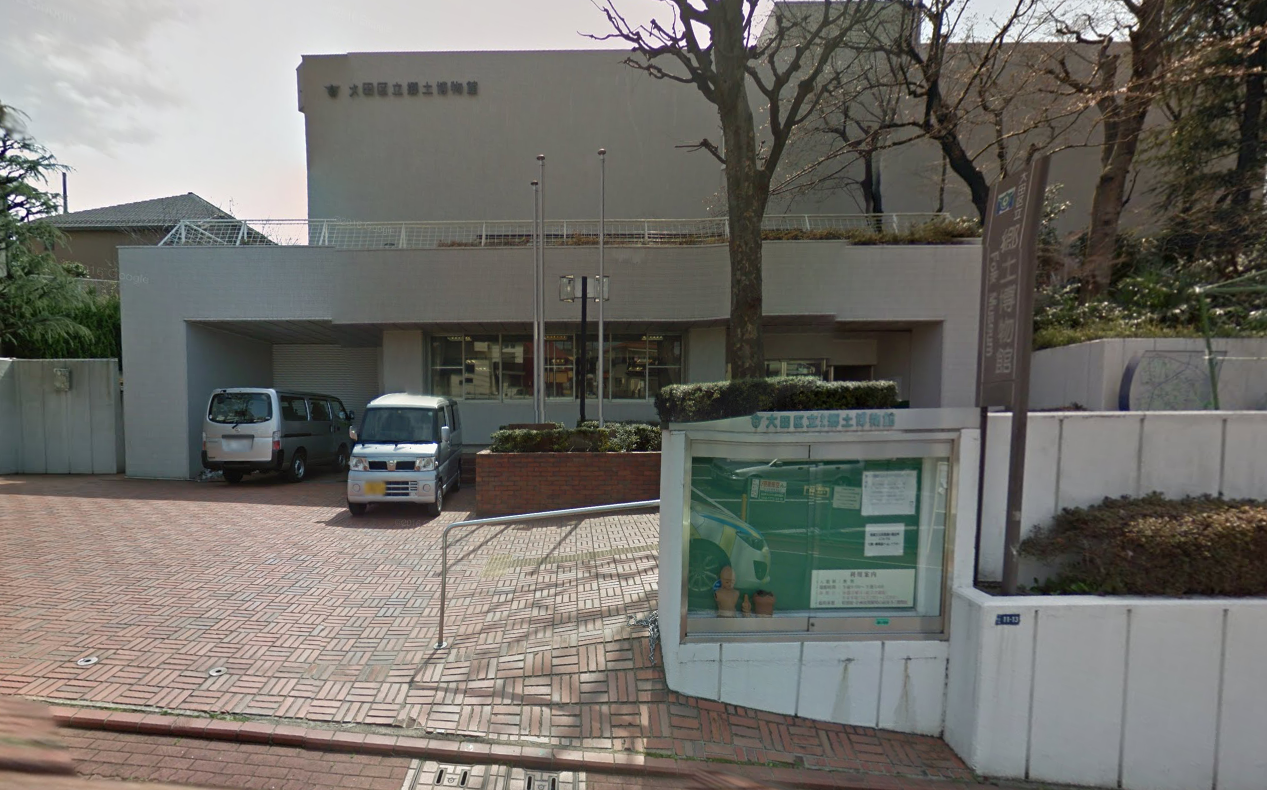
Front of the Ota Ward Regional Museum as seen from Google Maps’ street view.

Continue reading

Building the Kamakura Period Umi-Bune, Part 5

Umisen Model

Model on exhibit at Kanagawa University. Photo by Masami Sekiguchi.

 No, that’s not my model. This 1/10-scale model of a Kamakura period umi-bune is on display at the Kanagwa University, which is home to the Institute for the Study of Japanese Folk Culture. The photo was taken by my friend Masami Sekiguchi, who is one of two Japanese ship modelers I met with in Tokyo last September. The other is Norio Uriu, Both gentlemen are members of The Rope, the Japanese ship model society in Tokyo.

I had been corresponding with Mr. Uriu for over a year, as he is a friend of fellow ship modeler Don Dressel of the Ship Modelers Association in Fullerton, California. Don was building his model of a Higaki Kaisen at about the same time I was building mine, and at some point, he put me in touch with his friend in Japan, Mr. Uriu.

When I travelled to Japan, I made arrangements to meet with Mr. Uriu for dinner in Tokyo and he brought along his daughter Hanako, who helped with our discussions, and Mr. Sekiguchi, who has been helping me understand information on Japanese ever since.

Continue reading

Building the Kamakura Period Umi-Bune, Part 4

Kitano Tenmangu

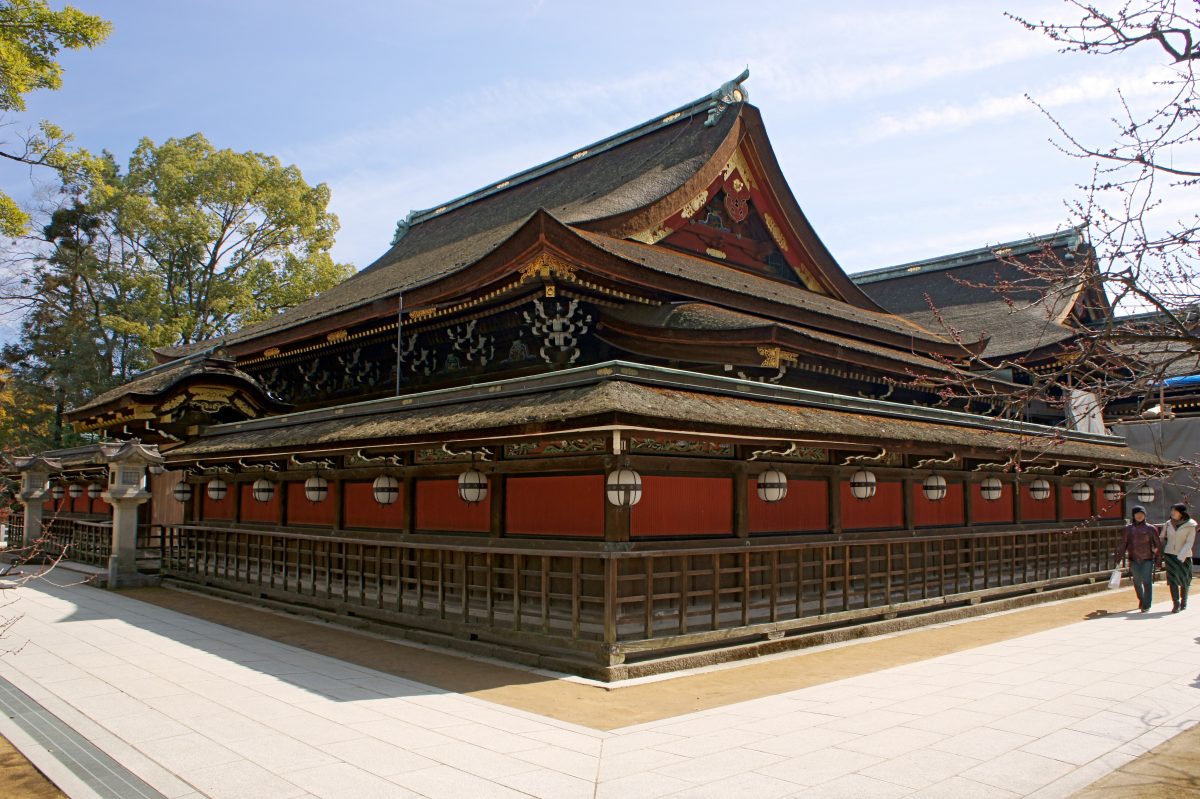
Kitano Tenmangu – Shinto Shrine in Kyoto. Photo from Wikipedia.

About a week ago, my ship modeler friend in Japan, Mr. Sekiguchi, explained a little about the Kitano Tenjin scrolls that depict the Kamakura period Umi-bune, and I have since re-read through online information on the subject to get a better understanding.

The scrolls represent the life of Sugawara no Michizane, a scholar and poet in the Heian period (平安時代  794-1185) who rose high in politics in Kyoto, then Japan’s capital. But, he had powerful  rivals in the Fujiwara clan that plotted against him, and he was exiled to Dazaifu on the island of Shikoku, where he died three years later in 903.

Apparently, there was much sympathy for Michizane, and shortly after his death, there were a number of calamities, including a lightning strike within the imperial palace. The emperor’s court fearing that these were caused by the wrath of Michizane’s angry spirit, decided to placate him by deifying him and erecting a shrine. He was given the Shinto name of Tenjin, and the shrine was built at Kitano, and known as Kitano Tenmangū.

Continue reading

Building the Kamakura Period Umi-Bune, Part 3

image-2

The largest source of Kamakura period boat information appears to be in 13th century picture scrolls that appear in books and on the Internet, but I really know very little about the scrolls themselves. What they depict includes a lot of boats with hull designs very similar to the ship I’m modeling. These are semi-structured ships or junkozosen (準構造船) with dugout-style hull, which have been built up with hull planks. Most of those depicted are river boats, but some appear to be sea boats.

I recently found a great sketch of a large sea ship on a blog site. I believe this was scanned from one of Professor Ishii’s books, but it’s not one that I have.

25e52592258c25e8258825b9-1

This image is very similar to a less detailed drawing I have in my books. The ship depicted here varies only slightly from my model in that this image shows a peaked roof called a kappa at the bow. It also has only a single rail outboard of the hull, but it extends all the way around the bow. It also may be a somewhat smaller ship, given there are only 4 rowing platforms on either side, where my model will have 6.

A couple things I like about this image in particular is that it shows a roof design on the main deck house that is clear and makes sense to me. Note the boards that make up the roof run along the length of the roof. The drawing I’ve been working off of, shows the boards running perpendicular to these – not that it’s wrong, but that it requires an underlying structure that’s different from what I would naturally build. Also the front of the house appears to have a simple roll-up screen, no door or solid panel.

Continue reading