Building Woody Joe’s 1/72-scale Kitamaebune Kit – Part 13

When I look at how long this project has sat, while I’m off working on other things, it just seems crazy. Fortunately, I’ve found an impetus for finishing up. Before COVID, I used to have displays of Japanese traditional watercraft at a display window in Sand Francisco’s Japan Center Mall. Well, I finally reached out to the bank which has that display window, and I’ve got the display area reserved for late October. So, it’s time to wrap this up, one way or another.

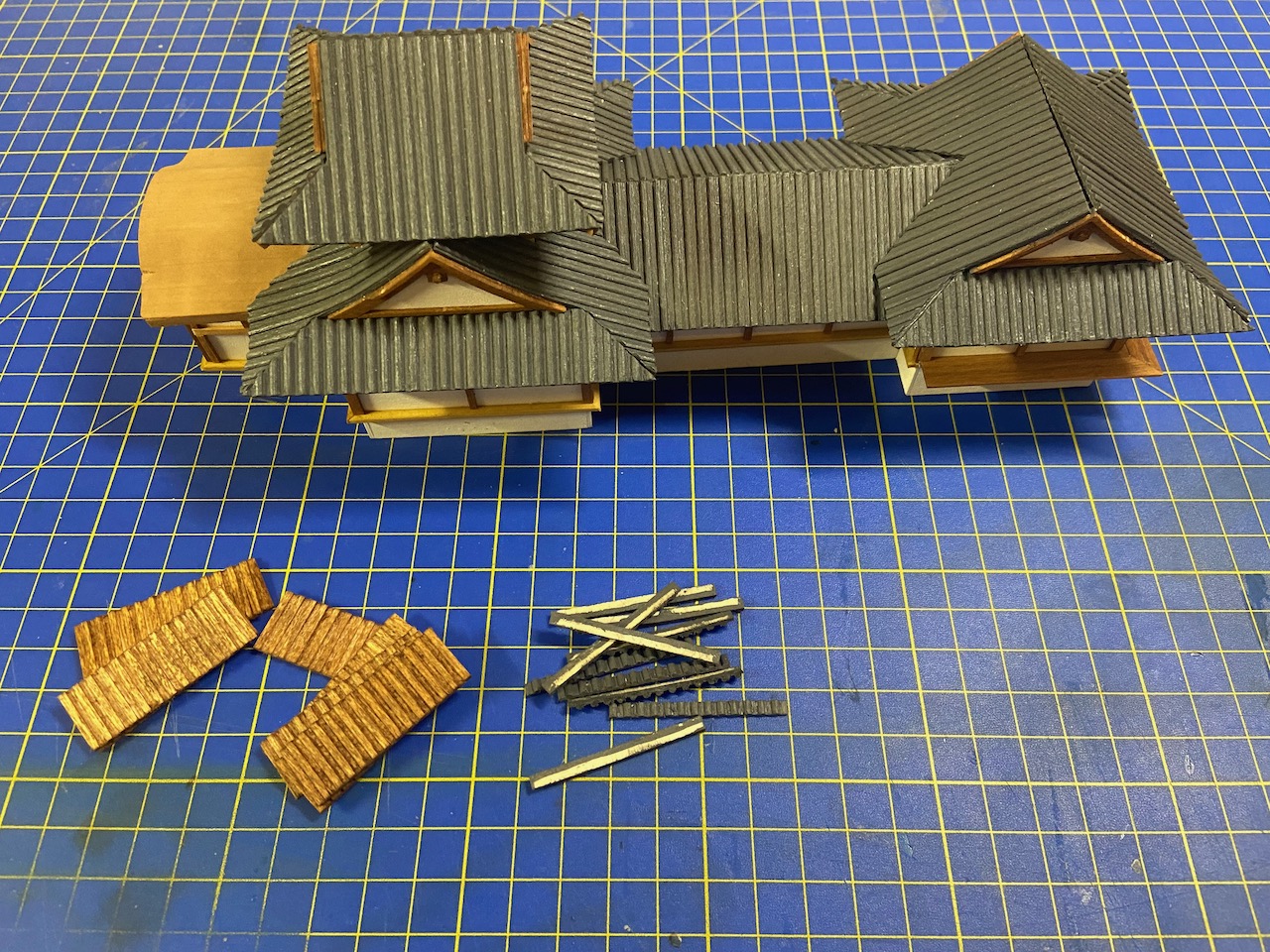
The model itself looks the same as it ever did, but I’m now back to working on the sail. I’ve gone around in circles on this feature and I’ve written enough about ideas and steps I’ve tried taking, considered taking, and so on. So, now, I’m just going to show where I’m at with it.

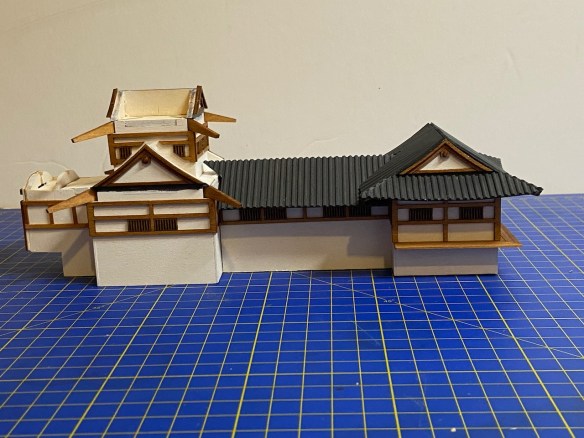
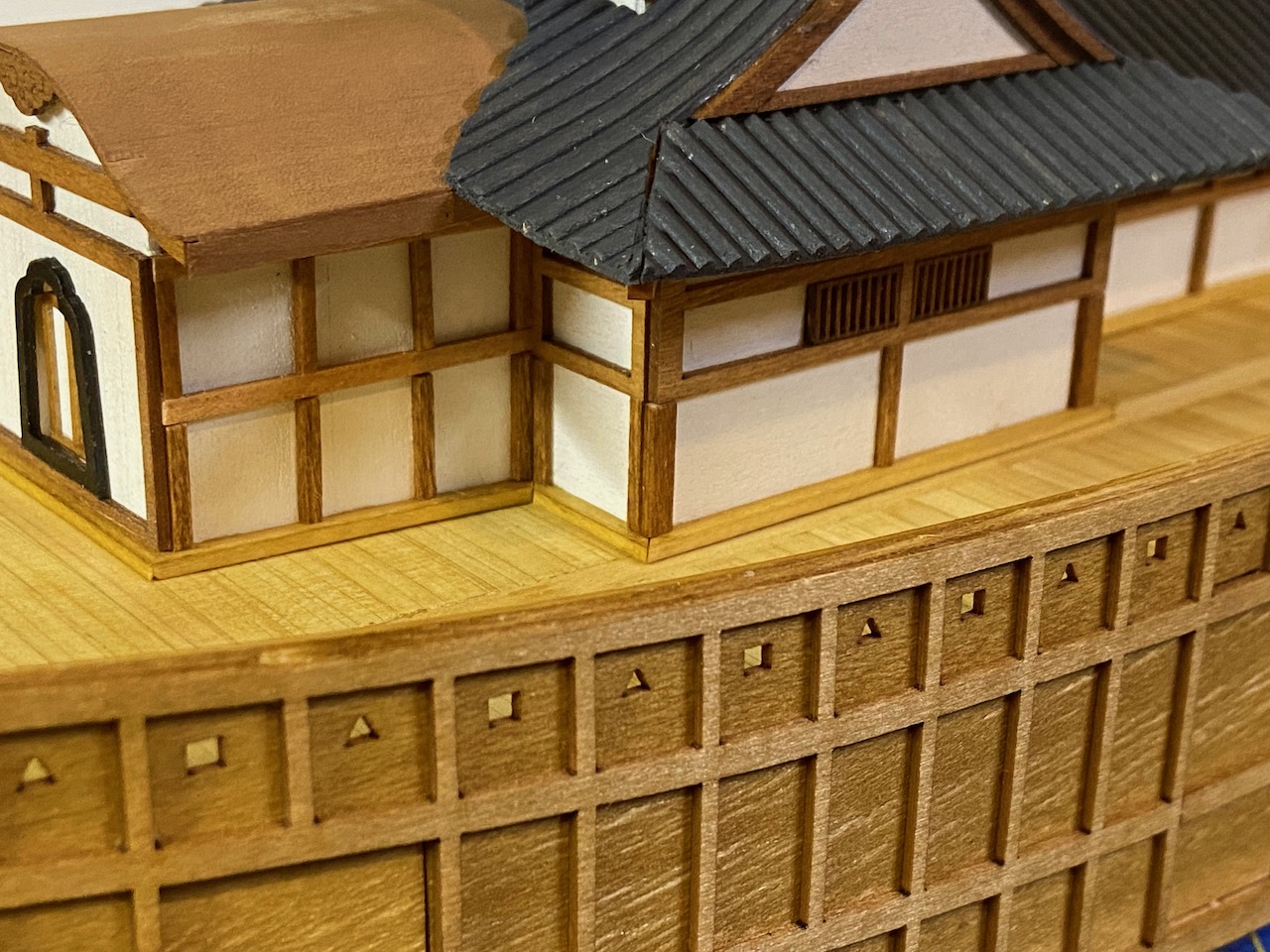
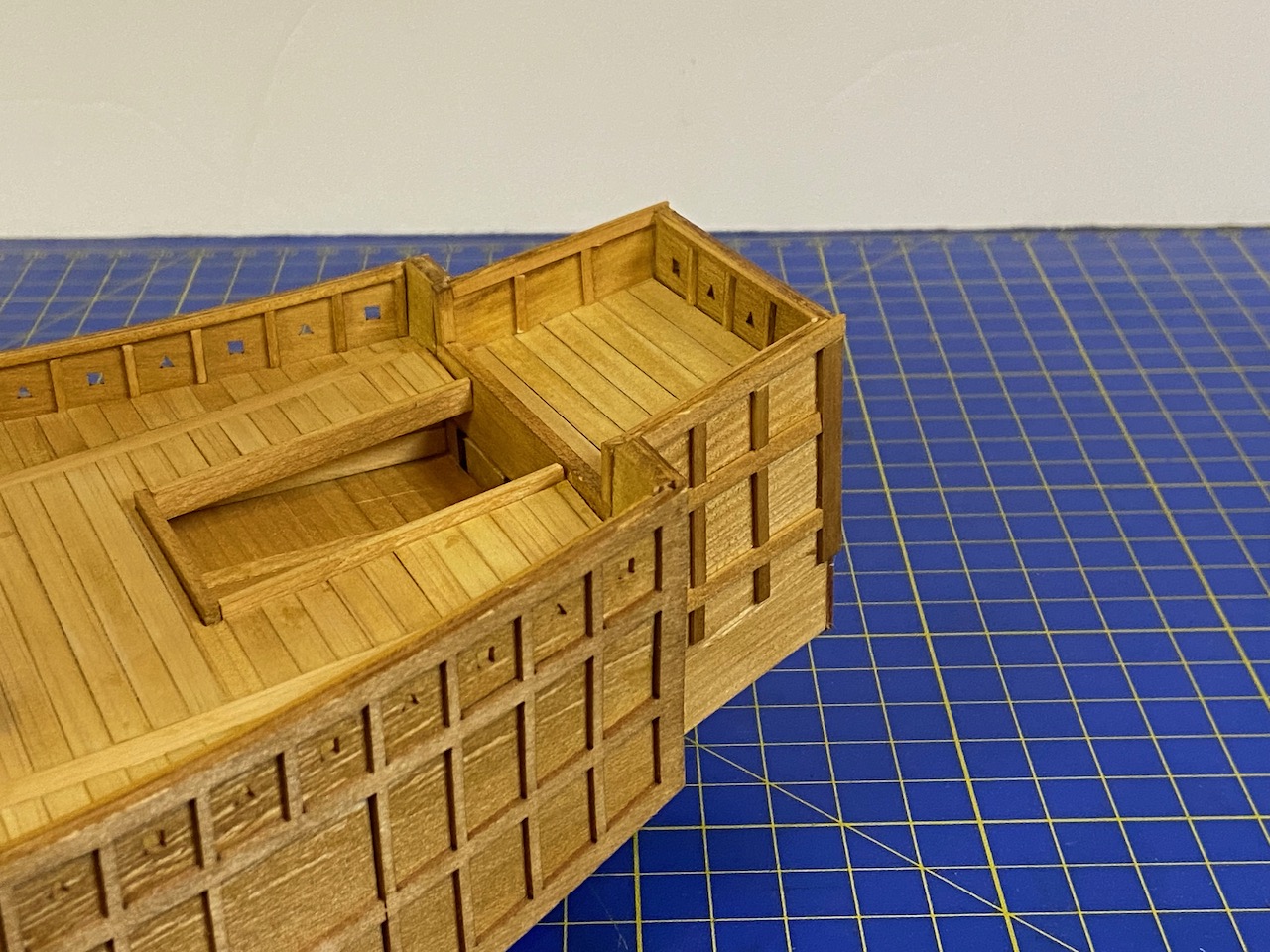
The model, as we last left it.

Continue reading

Wasen Modeler Update for Summer 2025

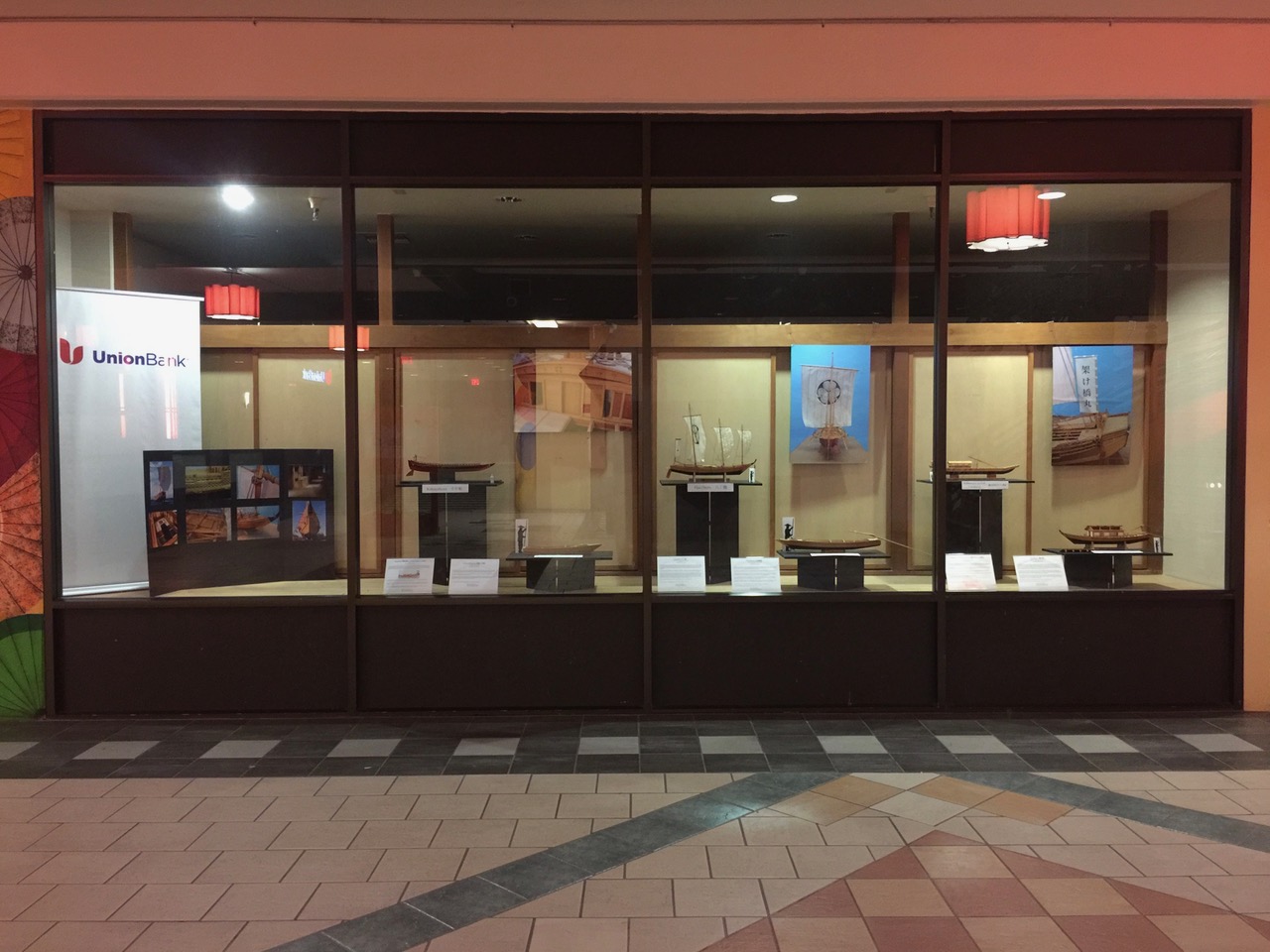
I’ve been pretty idle in terms of modeling Japanese watercraft or updating this site, some might even say I’ve been remiss. But, I was recently contacted by my old mentor Douglas Brooks to build a model of the Shinanogawa boat that has been the subject of his full-size Japanese boatbuilding workshops. So, I’ve been revisiting my wasen modeling supplies, notes, tools and all. I even started thinking again about the wasen model displays I used to set up at the bank in the Japan Center Mall in San Francisco. Last time I displayed there was nearly 7 years ago. I used to display two or three times a year there until Covid put an end to that.

My wasen model display at Union Bank in the Japan Center Mall, San Francisco, in November of 2019

Continue reading

Building a Gozabune (Kobaya) from Paris Plans – Part 14

An update on this model is long overdue. While I hadn’t really been working much on the Kobaya model, it is a model that I’ve been very happy with. With the release of the new Shōgun TV series (more on that in another post), I’ve found something of a renewed interest in working on my wasen models, particularly in my kobaya model, as I knew the next steps I wanted to deal with. So, I brought the model down from the shelf, cleaned it up, and immediately started working on it again.
The model is inching closer to completion now, with the biggest hold-up being the making and mounting of the ship’s 28 sculling oars. Given the size of a person on the model, the deck would have been crowded with oarsmen. With such a sharp hull and relatively small size (17m) in comparison with the largest of ships at the time (30m, give or take), those 28 oars must have made her very fast.
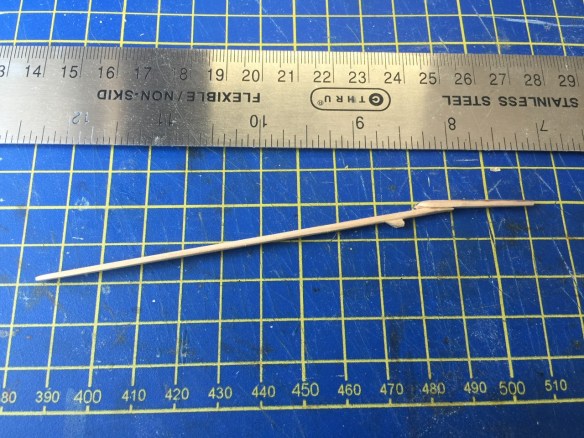
Below is an one of the sculling oars, which in Japanese is called a “ro”. It’s not complete as it need a rope wrapping where the head and the body overlap. It also needs a small handle that should stick up near the end of the oar’s head.

Continue reading

This Week in Wasen Model Making – October 15, 2022

Last weekend, I had a number of models on display at the Good Sam Showcase of Miniatures, which consisted mostly of my wasen models. This was the first time I’d had any of my Japanese watercraft models on display since January, and it seems to have spurred me to get back to work on some wasen model projects. While I have the two Woody Joe kits to finish up, those being the Kitamaebune and Atakebune kits, I also have two scratch models I stated long ago, the whaleboat-style Senzanmaru, and the small Nitaribune based on the late Fujiwara-san’s boat Kawasemi.

Small Nitaribune, or cargo boat, based on the boat built by the late Fujiwara-san for Wasen Tomo no Kai.

The Senzanmaru, a whaleboat-type boat use by the Awa clan.

Continue reading

Ogura Pond Boat (巨椋池舟) in 1/10 Scale – Part 3

I’m playing a little “catch up” on my blog regarding the Oguraike boat. As a reminder, this is a boat used for fishing and sightseeing in Kyōto, which was the former capital of Japan, prior to the Edo period. The boats were used until the pond was drained in the 1930s as part of a reclaimation project. My model is a 1/10-scale reproduction, based on the research of Mr. Tomohiko Ogawa, an artist and boatbuilder living in Kyōto.

Again, I don’t know the term for the bottom connecting plank, but with it now in place, I went ahead and added these mortises. On the actual boat, nails are driven into the side, to fasten the plank to the shiki, or bottom board. Nails are also driven up through the bottom edge, to fasten the plank to the hull plank. On the real boat, it would make more sense for this to be nailed first to the hull plank, then that whole plank assembly nailed to the bottom board.

Continue reading

Ogura Pond Boat (巨椋池舟) in 1/10 Scale – Part 2

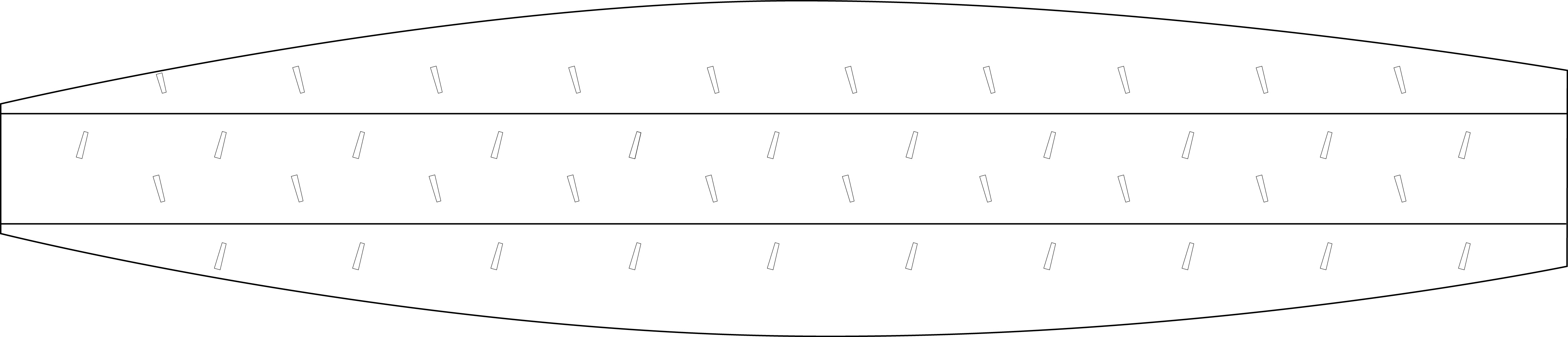
I’d been making progress on the Ogura Pond Boat up through the month of March, but I hadn’t posted very much information about it here. Last I posted was back in January. At that time, I had glued up the three boards that make up the shiki, or bottom plate of the boat. Next is to shape the shiki, which is really quite easy the way I’m building these models. It simply requires printing out a portion of the drawings I’m using.

In this drawing, you’ll notice that I’ve marked out the mortises as well. This was something that was not on the original drawings, but I could see some of them in Ogawa-san’s photos. As I mentioned in my last post, what’s special here is that the mortises clearly aren’t perpendicular with the edges of the planks. This is something I’ve never seen this before, except where an occasional mortise has to angled to avoid a knot in the wood or similar reason. Here, however, they seem to be regularly placed so that the nails are driven at a slight angle towards the bow.

Continue reading

Building Woody Joe’s Atakebune Kit – Part 12

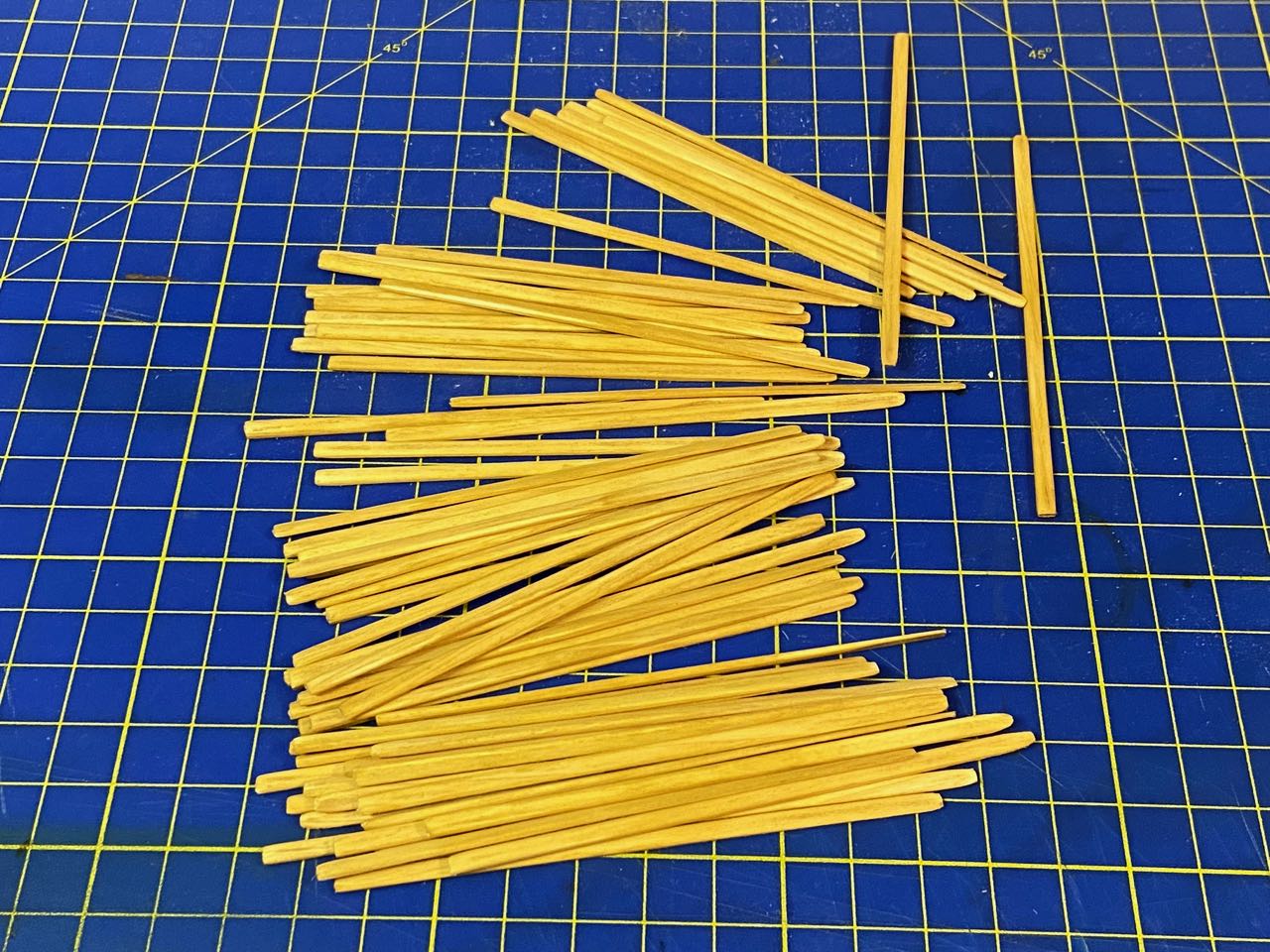
After some time away to work on the Oguraike boat and to get some traditional western ship modeling done for the newly restarting ship model meetings here in the San Francisco Bay Area, finally got back to finishing the sanding the sculling oars on my Atakebune model. I guess the model only needs 66 of them, but I’m sure I counted 72 in the kit. Maybe there are spares.

There’s more to do on these, as I’m thinking I’ll probably add the “heads” to them, or at least some of them that might end up visible if I leave any of the doors open in the box structure, or yagura.

Continue reading

Building Woody Joe’s Atakebune Kit – Part 11

It’s time to finish the Atakebune’s castle structure. Basically, what’s left is to add the pieces that fit under the eaves of the roofs and also to install some edging pieces and then some final decorative details to the rooftops.

Continue reading

Building Woody Joe’s Atakebune Kit – Part 10

Continuing with the Atakebune’s castle structure, I began looking at the little walkway and decorative railing at the back end of the structure. Considering that I’ve lowered the main deck of the ship, I needed to know how high above the deck this railing would be. So, I assembled the pieces to allow me to test fit the parts in place. While I was at it, I made one small modification here, which was to make the walkway from separate strips of wood, using the kit provided pieces as patterns for the walkways.

The completed walkway was actually all that I needed. It also needed to fit perfectly in place, which took a few minor adjustments.

While I went ahead and glued the walkway into place, I didn’t want to permanently add the railing, as it’s pretty delicate, and I was worried that it would get damaged during the remaining construction on the castle structure.
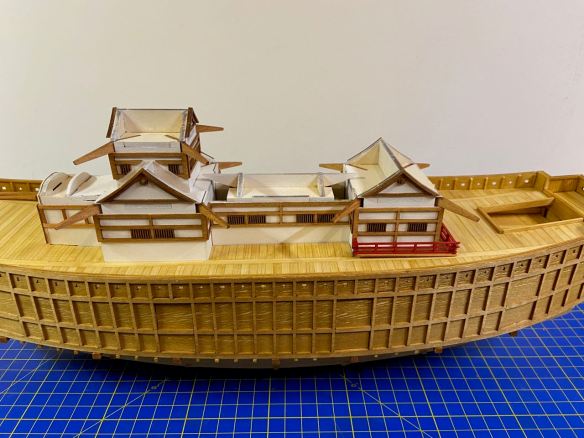
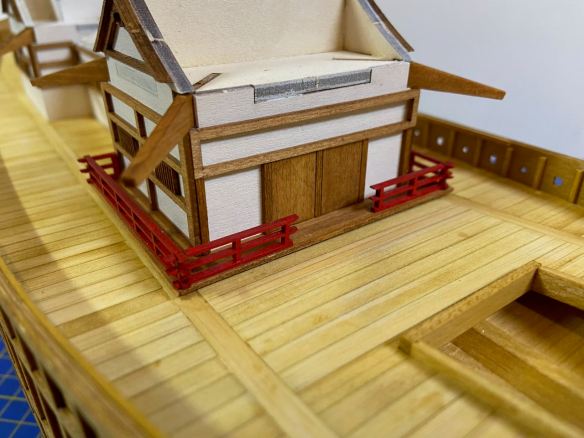
It was nice to see how this railing will add a splash of color to the final model, pretty much the only parts that aren’t going to be natural wood color, or painted gray or white.

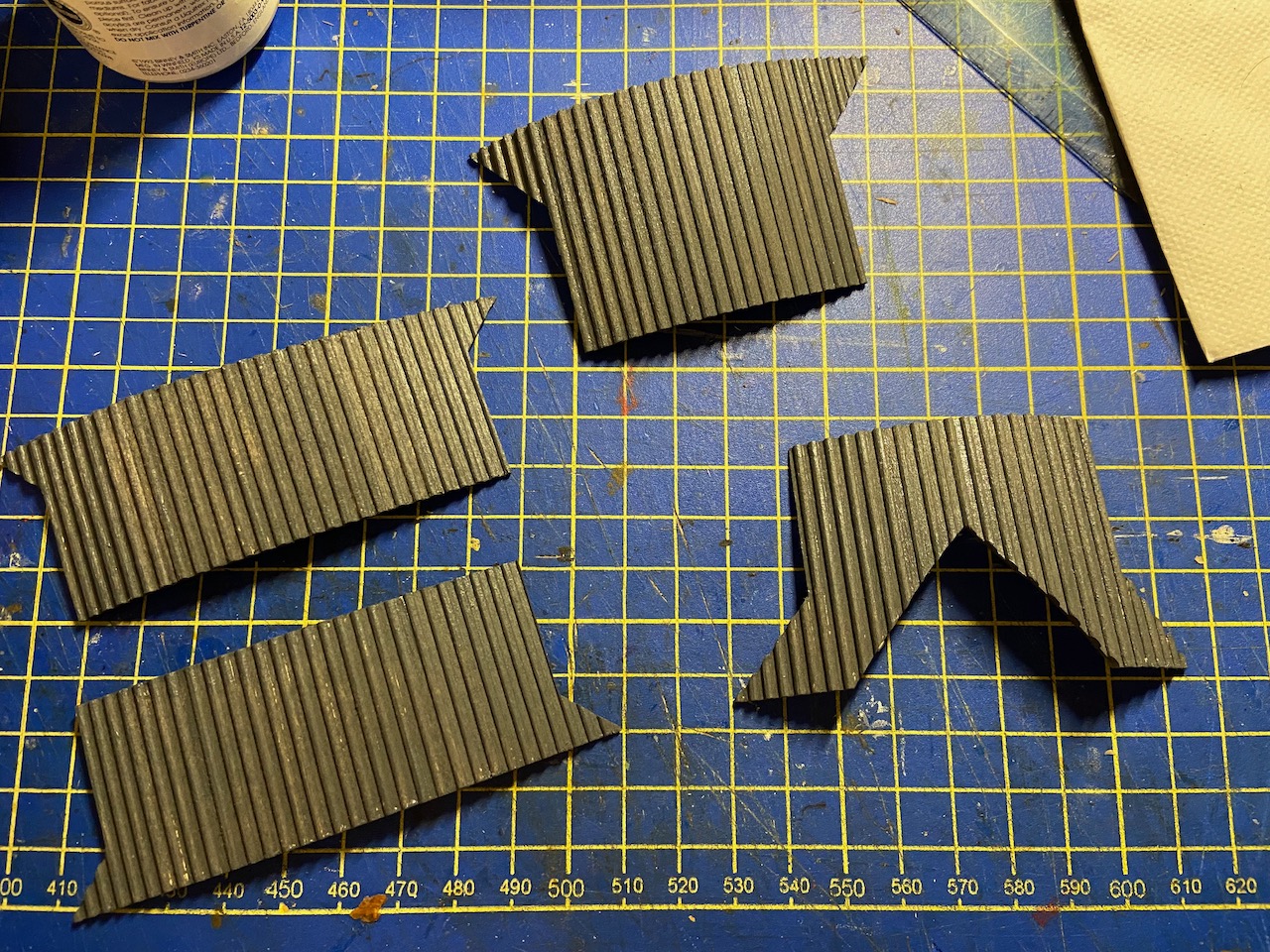
Next up was to begin working on the castle structure roof. most of which is made from milled material that resembles a tiled roof. However, the roof of the forward part of the castle structure, specifically the one I extended, was designed to be made up of individual arch-shaped pieces. Since that section has been lengthened, the provided roof pieces would no longer work. What I did then, was to use the provided pieces as beams, and for the roof itself, I cut a piece of thin pear wood veneer.
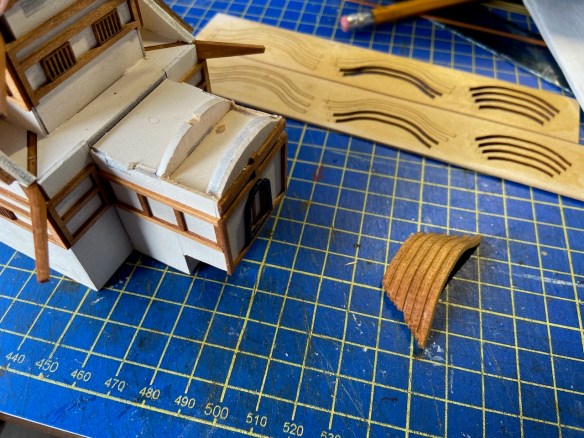
I don’t have photos of all the work I did on this roof section, but it took a little work to attach the “beams” together, so that I could mount the thin roof material. I used a couple wood strips under the beams to create a rigid framework, but this required me to cut away some of the wood that would be under the roof to make room for these added wood strips.
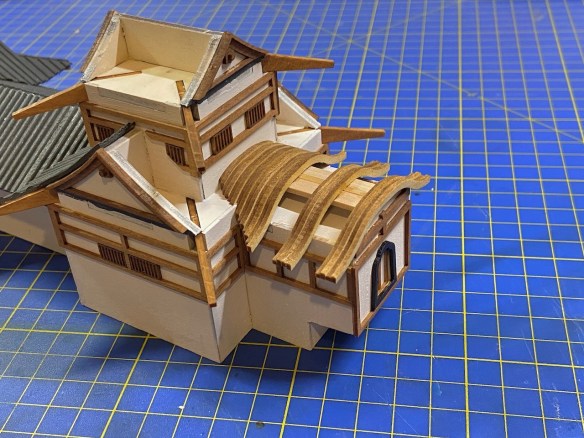
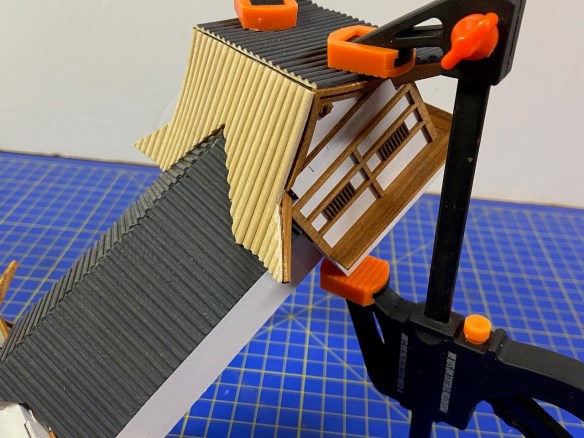
Once the beam assembly was ready, I could simply cut the wood veneer and glue it to the beams. Plastic clamps held the roof in place, causing the veneer to take on the curvature of the beams while the glue set.

With this particular roof section done, I could complete the rest of the castle structure roofing. This type of construction is quite fun, and it’s very different from any ship modeling work I’ve done before. I’m already familiar with building these castle roofs as I built Woody Joe’s Iwakuni-Jo castle several years ago, one of their smaller castle kits. I won’t go into a lot of detail here and just offer some progress photos.

While working on the castle structure and waiting for glue to dry, I decided it was time to tackle the modification of the stern structure. I was a bit hesitant to do this, but I saw how nicely Kazunori Morikawa’s model looked with the modified section, and I thought it really made the overall shape of the ship nicer. So, I began dismantling the stern section.

Turns out that because I used original formula Titebond wood glue, I could simply use water to soften the glue joints. As a fellow ship modeler pointed out, rubbing alcohol works well, and won’t raise the wood grain or cause the wood to swell or warp.

I was basically able to extend the internal structure of the stern by 15mm. This didn’t change the shape of the rear wall, just the side walls of the extension. So, I was able to use some of the parts I removed. However, I did have to make a new deck section, as the shape had changed due to the new dimensions.
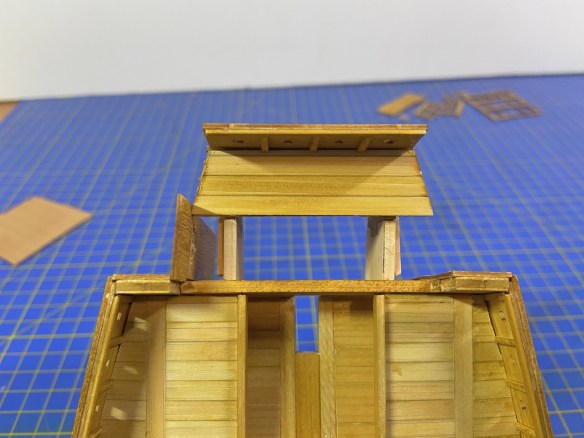
Once the extensions were added to the internal structure, it was all pretty easy to build it all back up again.
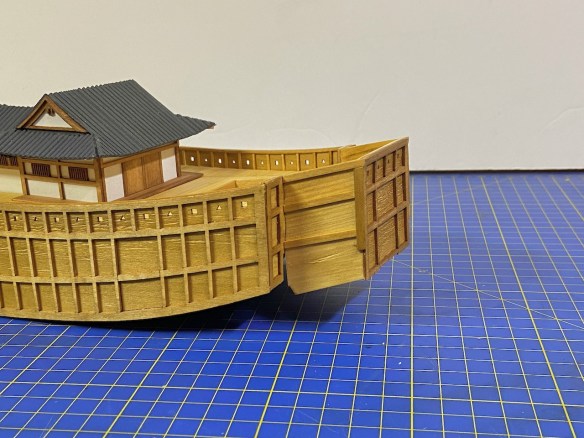
Finally, I was able to finish the initial roof placement and add the remaining coaming and lower trim of the castle structure, as well as to add the stanchions and complete the external trim of the stern section today.
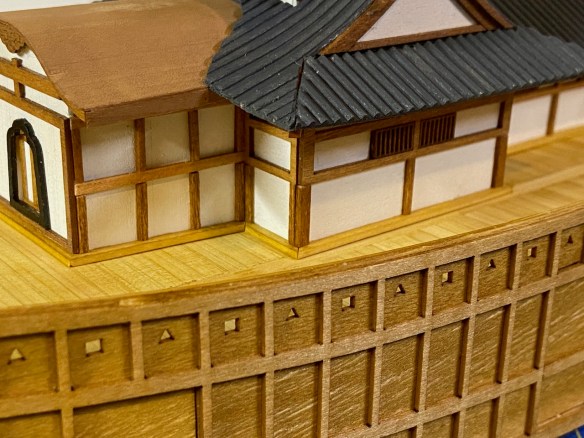
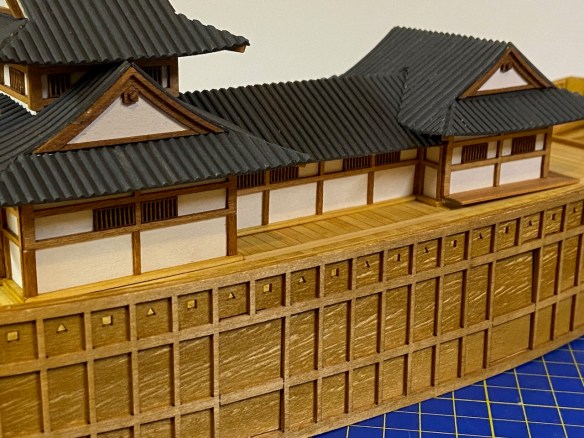
Next time, I’ll be adding the simulated beams under the eaves of the tile roofing, and adding the details that remain for the rooftops. After that, I’ll be giving some thought to finishing the lower hull modifications I had been planning.

Building Woody Joe’s Atakebune Kit – Part 9

One of the features of this particular Atakebune that make it so interesting is the castle structure. Most Atakebune were simpler and just had nothing more than a single roofed house for the commander to oversee the battle. But, on this ship, the castle is very prominent. On the model, it makes for a nice project in itself.

Promotional image from Woody Joe.

Construction starts with the basic foundation structure, which is made to fit inside the opening in the deck. It was somewhat of a tight fit, so the opening had to be adjusted. You’ll notice a little piece of the base sticking out at what is the front of the structure. This is because there is a small structure at the front, which I’ve been considering modifying to more closely match the model at the Saga Prefectural Nagoya Castle Museum of which this model is based. The design of this section is nice in that you can mostly work on this structure separate from the rest of the model. Continue reading