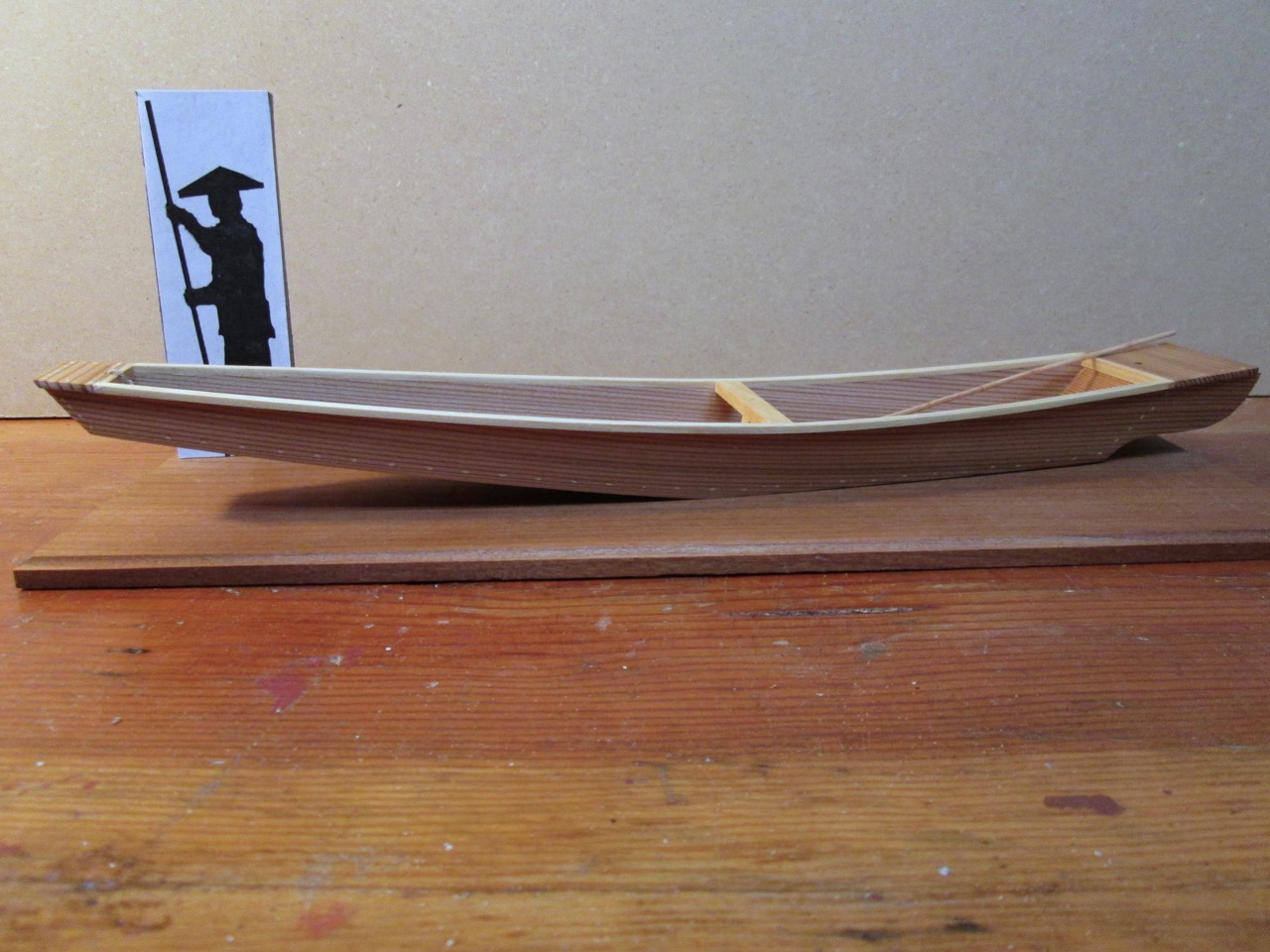
Building a Hozugawa Ayubune Model in 1/10 Scale – Part 3

My illustration of the ayubune, based on plan drawing by Douglas Brooks (with his permission). Position and size of details shown here are only approximate.

Counting up all the major planks, transom, and beams, this Ayubune model will be made up of only 17 pieces:

  • Shiki (bottom) – 3 pieces
  • Omote no tate ita (bow plank)
  • Todate (transom)
  • Tana (hull planks) – 4 pieces, 2 on each side
  • Omoteamaose (bow platform)
  • Tsunatsuke (lit. rope attachment) – Bow beam
  • Omote no funabari (forward beam) – 3 pieces
  • Tomo no funabari (aft beam)
  • Tomoamaose (stern platform)
  • Transom Strake

In addition to these, I made patterns in paper for obtaining the proper angle for the lay of the hull planking. I have yet to decide at this point just how I’m going to fix the hull planks to that angle. But, there’s time before that needs to be deal with.

My second illustration of the ayubune. I’ve labeled most of the parts here, but haven’t been able to get the names of all of them yet.

Continue reading

Building a Hozugawa Ayubune Model in 1/10 Scale – Part 2

The ayubune is not my first Japanese boat scratch build attempt. The first was the Urayasu bekabune, a boat designed for working among the seaweed nets of Tokyo Bay. But, being unaccustomed to scratch building Japanese traditional boats, I was wresting with a few construction problems and a couple errors, so I set it aside. Then, I found the ayubune on Douglas Brooks’s blog.

The ayubune is a very simple design. There is no cutwater, the side are flush, making for a very simple shape, and there few details beyond the hull and beams. This seemed to be an ideal subject to start with.

Mr. Brooks recorded 3 sizes of ayubune in Japan, a 24-shaku, 18-shaku and a 15-shaku boat. I noted that he built at least 3 of the 15-shaku boats and posted photos and notes on their construction. At a traditional 1/10 scale, the 15-shaku boat would be just about 15″ long, which seemed like a good size.

Large, 24-shaku fiberglass ayubune usee to give river tours to tourists on the Hozu river.

15-shaku ayubune on which my drawings are patterned. Photo courtesy of Douglas Brooks.

Continue reading

Urayasu no Bekabune (浦安のべか舟)

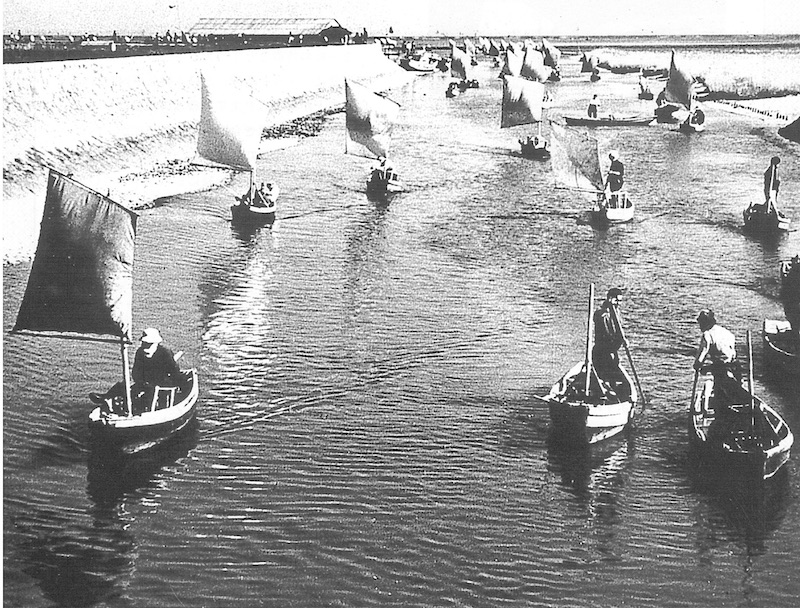
The bekabune, sometimes referred to simply as a beka, is a small, one person, flat-bottomed boat used for gathering seaweed. In the city of Urayasu, which was once on Tokyo Bay until landfill projects left it far from shore, there were two types of bekabune used. A smaller one, sometimes called a noribeka, that was used strictly for gathering seaweed, and a slightly large oner which was also used for catching shellfish. Large numbers of these boats operated out of Urayasu, while similar boats operated out of the rival port to the west at Ōta.

Many of these boats were designed to allow the use of a mast with a single spritsail. Others, which I believe were expected to be towed or carried aboard the large net fishing Utasebune, were only designed to be paddled.

At one time, large numbers of bekabune operated out of Urayasu on Tokyo Bay. Photo courtesy of the Urayasu City Regional Museum.

Continue reading

Building the Kamakura Period Umi-Bune, Part 6

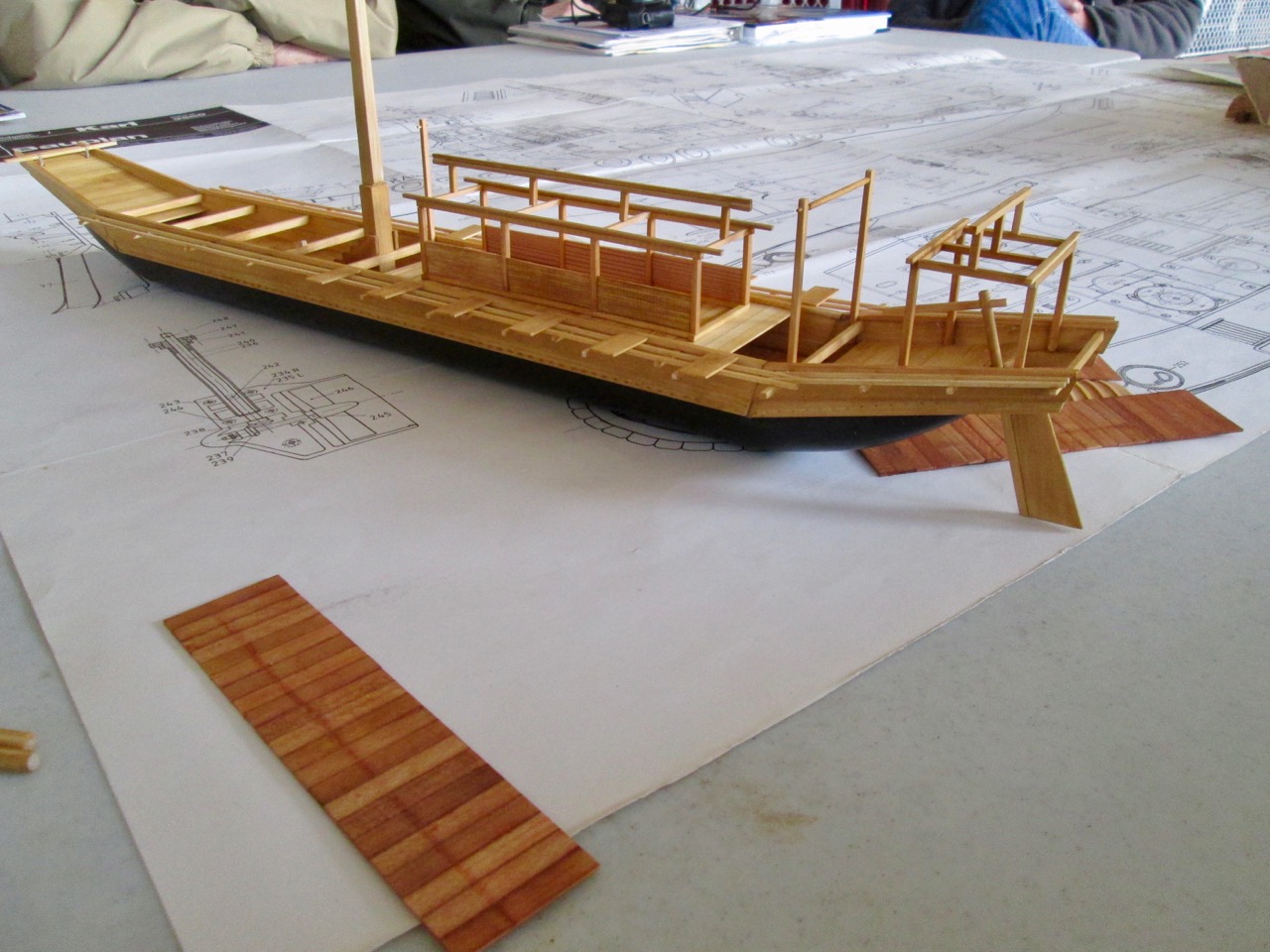
As I mentioned in my last post on this model, I’d been wrestling with the configuration of the roofs. The 1/20-scale museum model that I often see reference on the web, differs from Professor Ishii’s 3-view illustration that I’ve mostly been basing construction on. Those drawings are more of a match to the early scroll paintings. Oddly enough, none of the models I’ve seen match them exactly. Is it possible that the builders had access to more updated information? Or did they just decide that the Ishii-san was wrong? But, then what about the scroll paintings? Are they simply written off as being wrong?

As you can see in the photo below, which was taken at a ship model club meeting, I initially made flat roofs panels. If I could justify them, they would certainly be the simplest to construct.

Flat roof panel initially constructed is seen in foreground.

Continue reading

Tosa Wasen Youtube Video

This is my second youtube video, which is again actually a slide show. The first one was of the Shinmei-zukuri shrine model from Woody Joe that I built a few months ago. This time, I went back to my Tosa Wasen model from Thermal Studio.

I’m still learning how to use the Youtube editor, but I just found out that it’s going away on September 20th of this year. That’s actually okay, because it works very similarly to Apple’s iMovie software, which I’ve used before, and will just have to go back and use again. Also, iMovie has more control over audio tracks. With the Youtube editor, I’m mostly trying to fit the video to exact length of the audio, which is kind of a drag.

In any case, you can view the Tosa Wasen video below.

Again, I’m happy to hear from anyone with suggestions. Please check it out.

Can a Kobaya be Built from Paris Plans?

Kobaya is a term for a type of smaller military style vessel that is fast and maneuverable. Highly ornate versions of these and larger military vessels called sekibune were used by daimyo and their clans for ceremonial and other official purposes. I don’t know about the smaller ones, but the larger ones were called gozabune. In my limited experience, smaller gozabune are often referred to by their military name, kobayabune or simply kobaya, which means “small and fast.”


Photo of a 30-oar kobaya, of small fast-boat, from a display of models built by Yukio Nakayama. Photo is courtesy of The Rope.

Ship modelers building American or European subjects are accustomed to finding detailed drawingsfor the more popular of these vessels. There are even large numbers of plans made specifically for ship modelers. But, unlike with western subjects, there is a dearth of plans of Japanese watercraft. I’ve found plenty of sketches and there are basic line drawings that might be used, but these commonly don’t have the information needed to build a proper model.

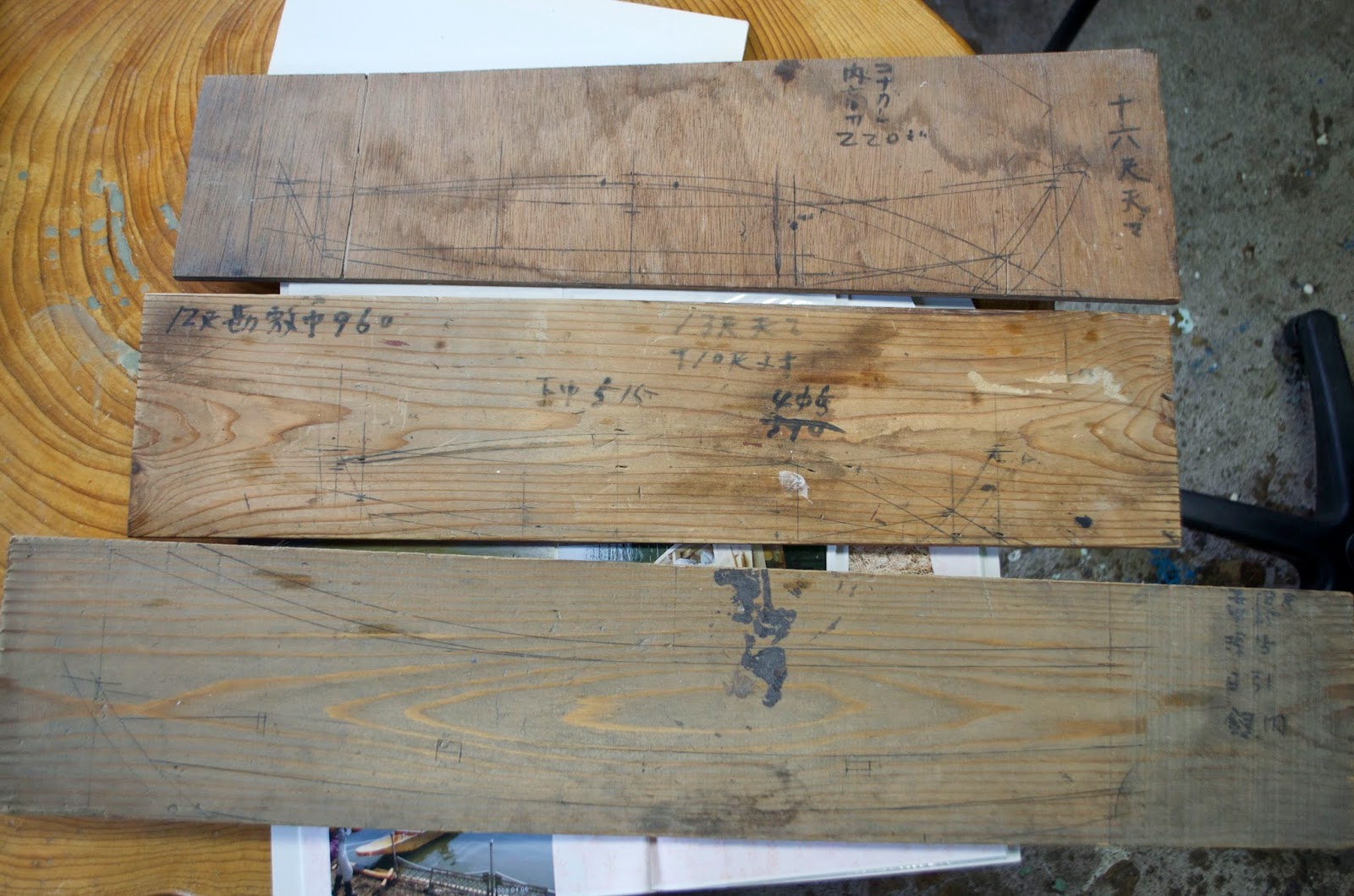
One reason for this is that Japanese boatbuilders don’t have a tradition of recording their work, and they generally only make temporary drawings on wood, sometimes destroying them when done.

Japanese boatbuilder’s plank drawings. Photo courtesy of Douglas Brooks.

Continue reading

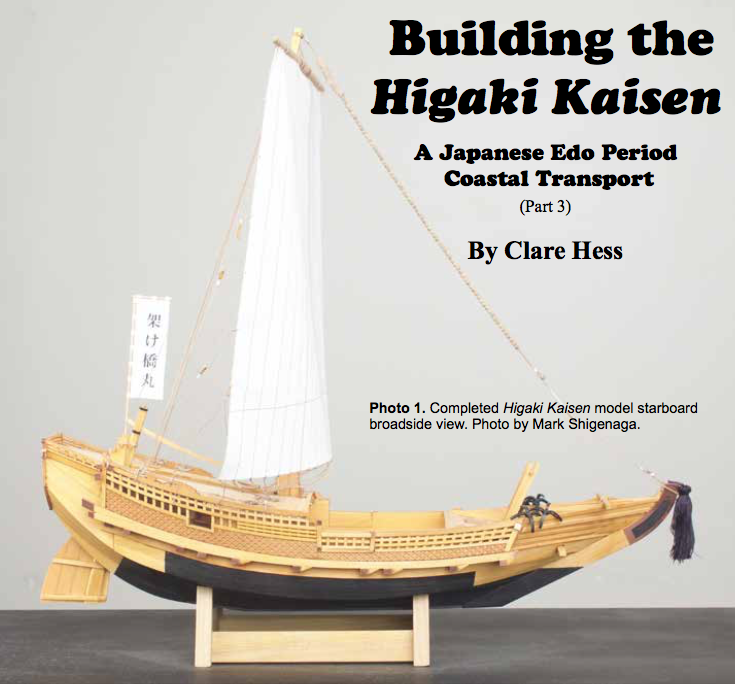
Higaki Kaisen Article Part 3

The third and final part of my Higaki Kaisen build article is out with the latest issue of Seaways’ Ships in Scale. While I was actually relieved to see the previous article, so those building the kit would have the information I’m trying to pass along, it’s kind of sad this time around. Though I’ve had other multi-part articles published in the magazine, I’d really like to keep writing about this kit to generate more interest in this and other Woody Joe kits.

Of course, there are other Woody Joe kits to write about. It’s been my plan to write about building the Hacchoro with modifications based on my visit to the replica boats in Yaizu harbor. But, it takes time and I have other projects I need to be working on. So, finding time for that one will be a bit rough.

But, at least all the information on the kit is in print, and hopefully, interested model builders will take advantage of the information, go out and buy the kit, and have a fun and successful build.


Of course, I’ll keep posting info about this and other traditional Japanese watercraft here. So, stay tuned!

Building a Hozugawa Ayubune Model in 1/10 Scale

There are a lot of potential wasen subjects to model, but good plans are difficult to come by. Also, when decent drawings are found, it’s often difficult to find or to understand the details of the subject. I’ve been toying with a lot of different possible model building subjects, but would usually run into some issue that kept me from pursuing it further.

Recently, I sort of re-discovered a subject that I seem to have overlooked before. It is a boat that Douglas Brooks wrote about in past blogs from about 3 years ago, when he was building a boat in Kameoka, Japan, which is about 16 miles west of Kyoto. There, he built a Hozugawa Ayubune, a type of simple fishing boat that was used on the Hozu river.

15 shaku Ayubune built by Douglas Brooks in Kameoka, Japan, in 2014. Photo courtesy of Douglas Brooks.

Continue reading

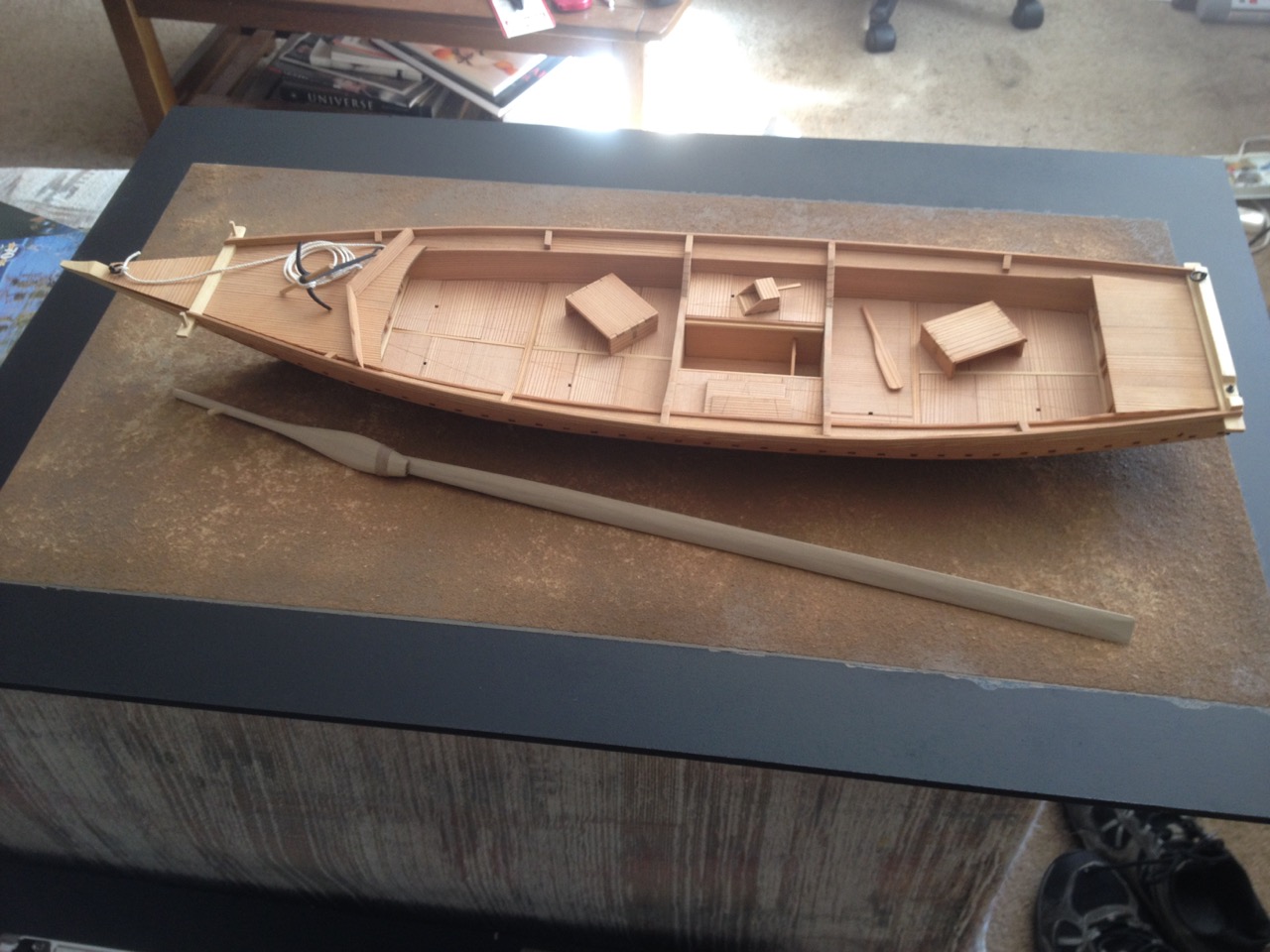
Modeling a Gifu Tabune – Adding Details

I added some details to my 1/20-scale rice field boat since my last post, so I took some new photos.

Continue reading

Modeling a Gifu Tabune

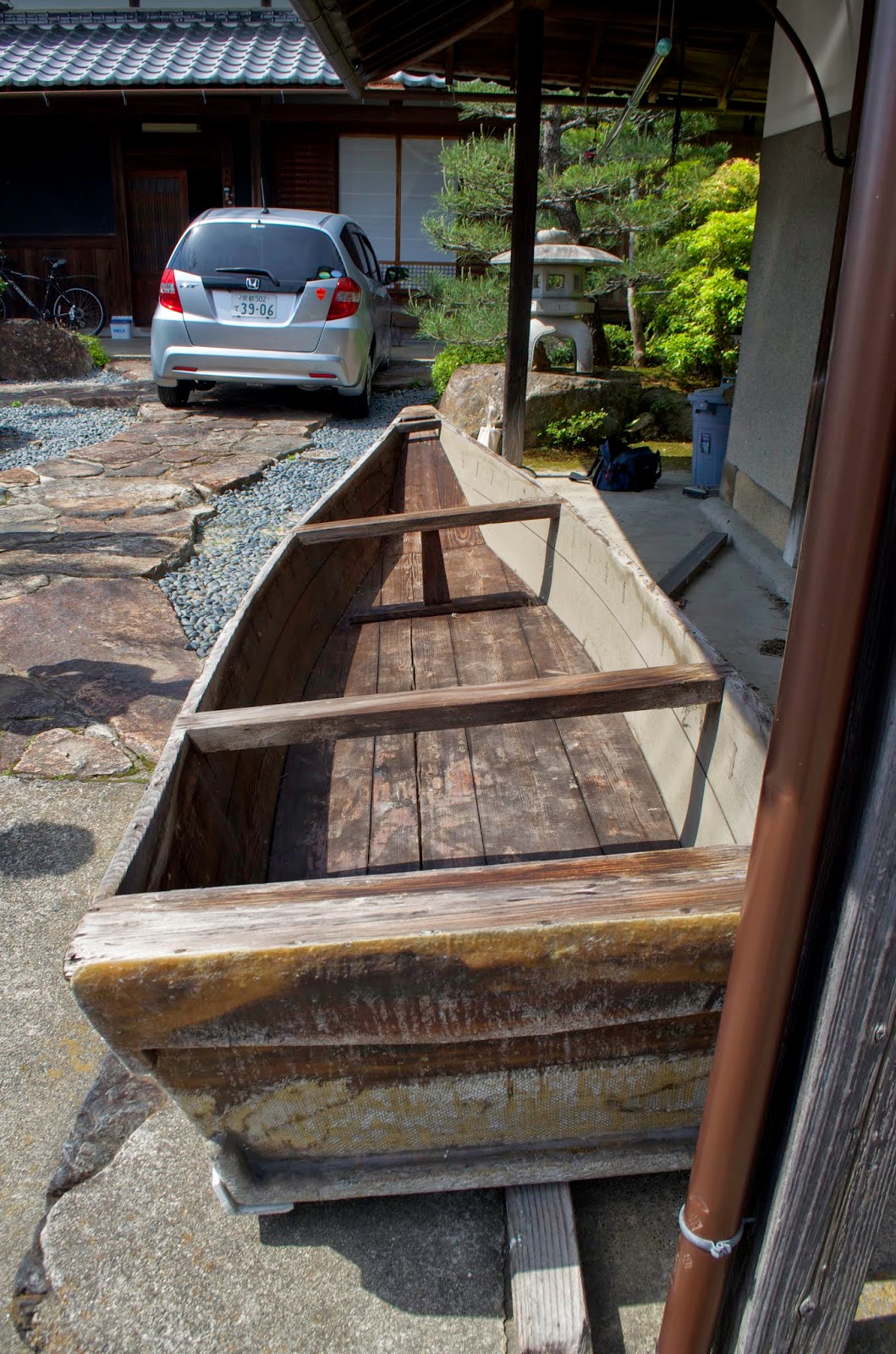
When I was writing my recent post about Douglas Brook’s upcoming work in Gifu, Japan, building an Ukaibune, or cormorant fishing boat, I noticed another boat and some drawings on his blog site. The boat was one of three tabune (田舟), or rice field boats, that boatbuilder Seichi Nasu had just completed.

One of Nasu-san’s tabune built in 2014. Photo courtesy of Douglas Brooks.

Continue reading