Building the Tosa Wasen – part 5

Continuing with the detailing now starting with the bow and stern decks.

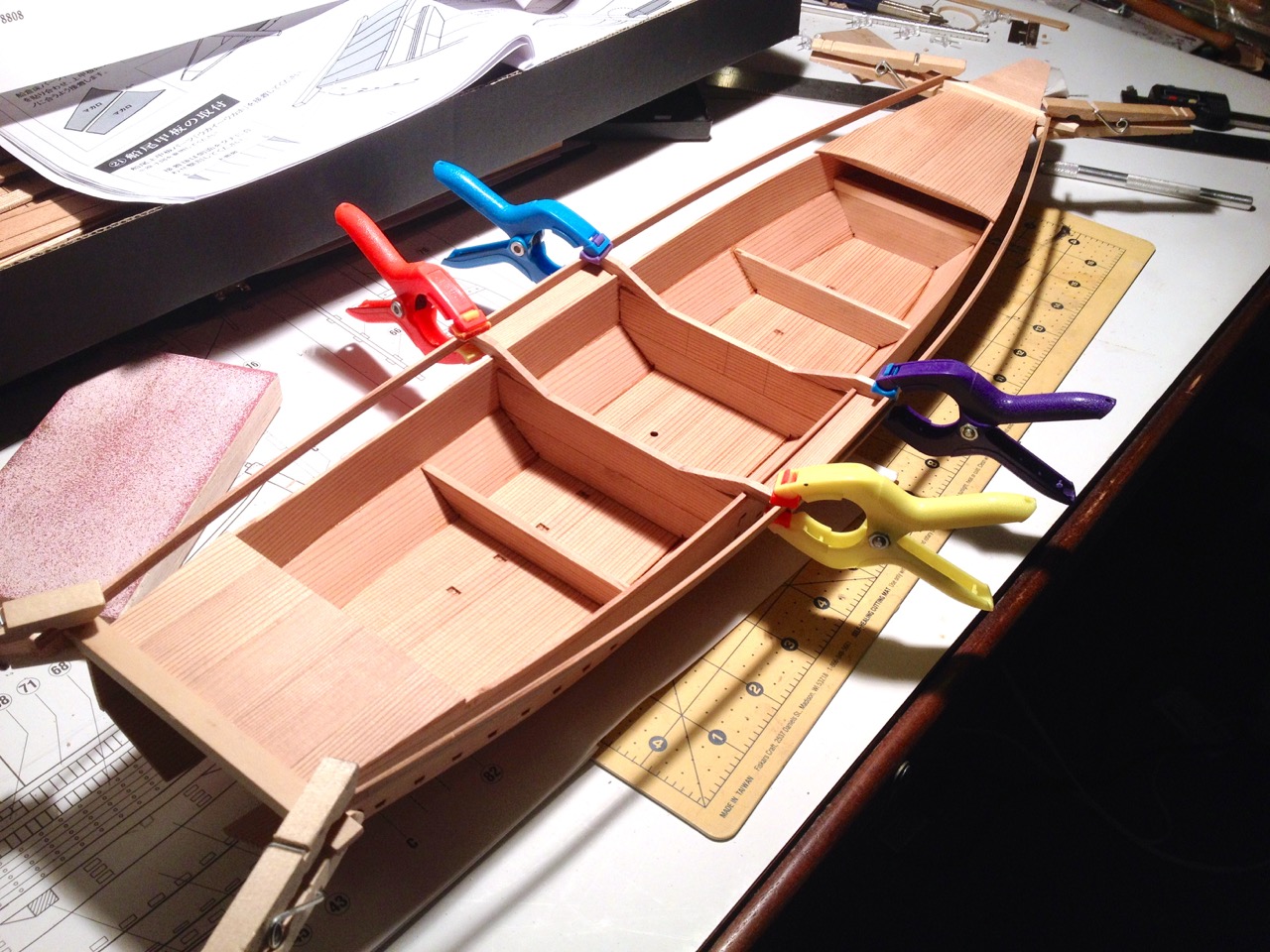
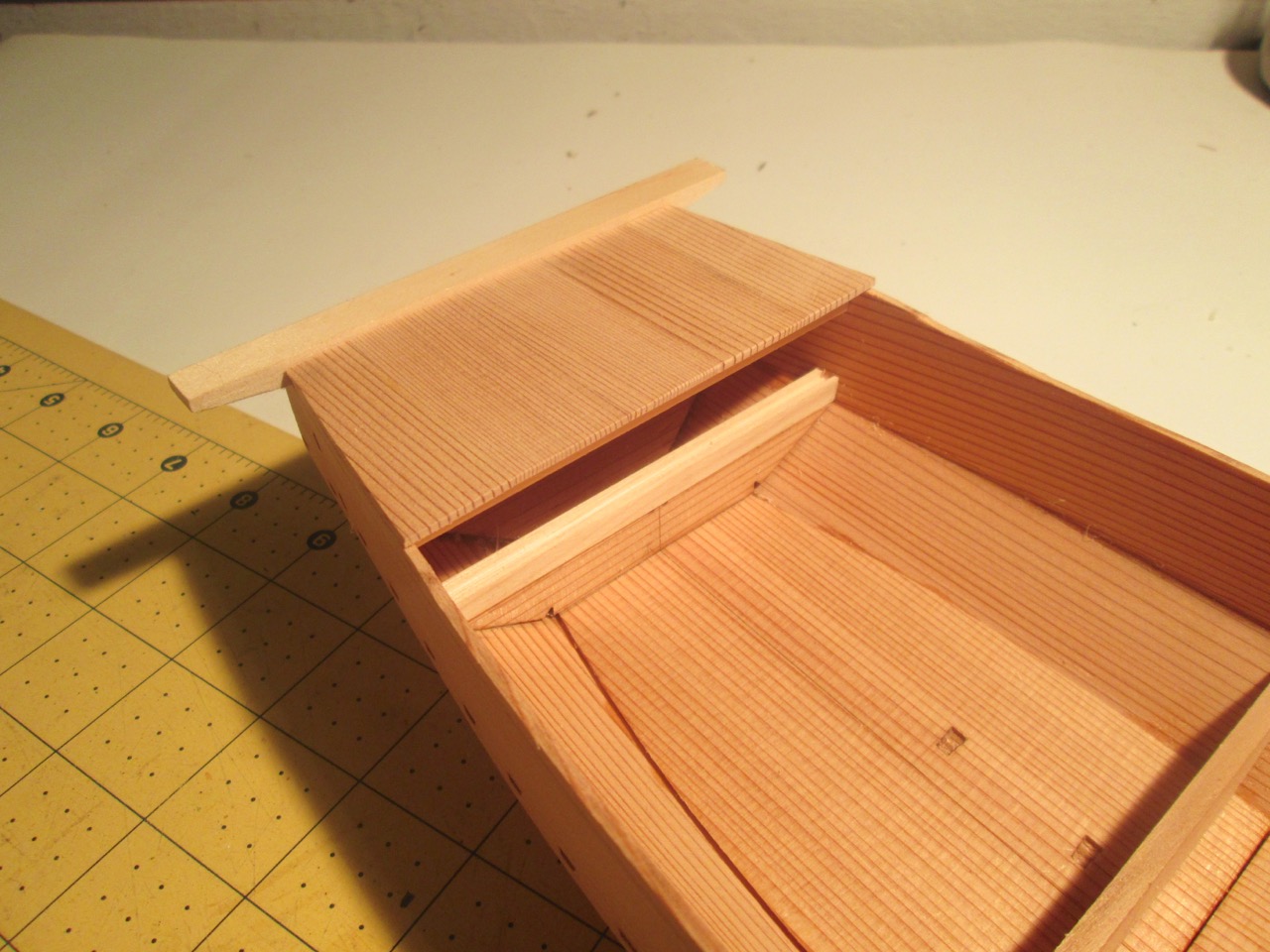
The bow deck required installation of support beams. The beams are provided pre-cut, but the ends needed to be tapered to fit snugly against the hull planking.
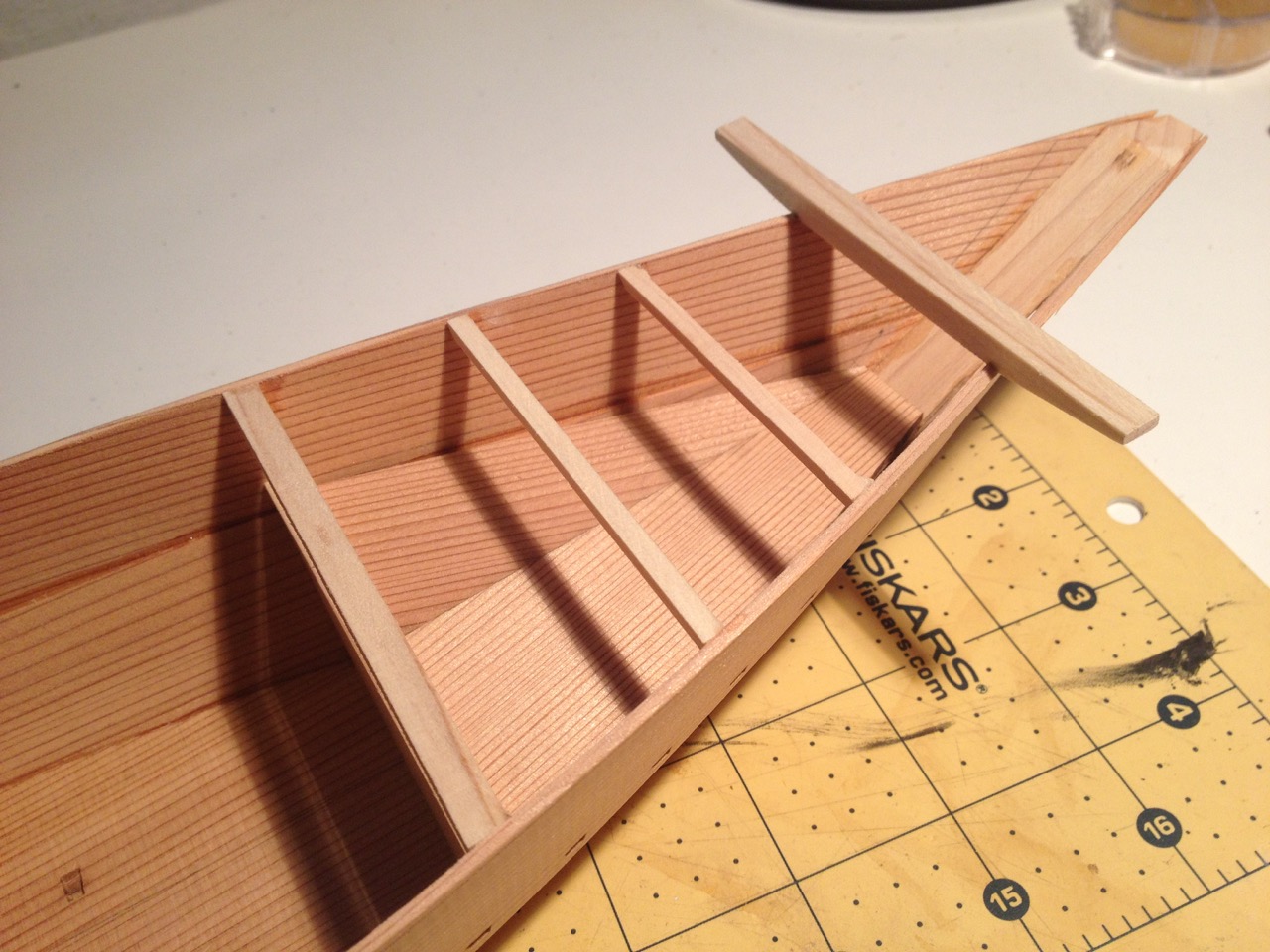
IMG_1905


The deck itself is made up of two pre-cut pieces of cedar.
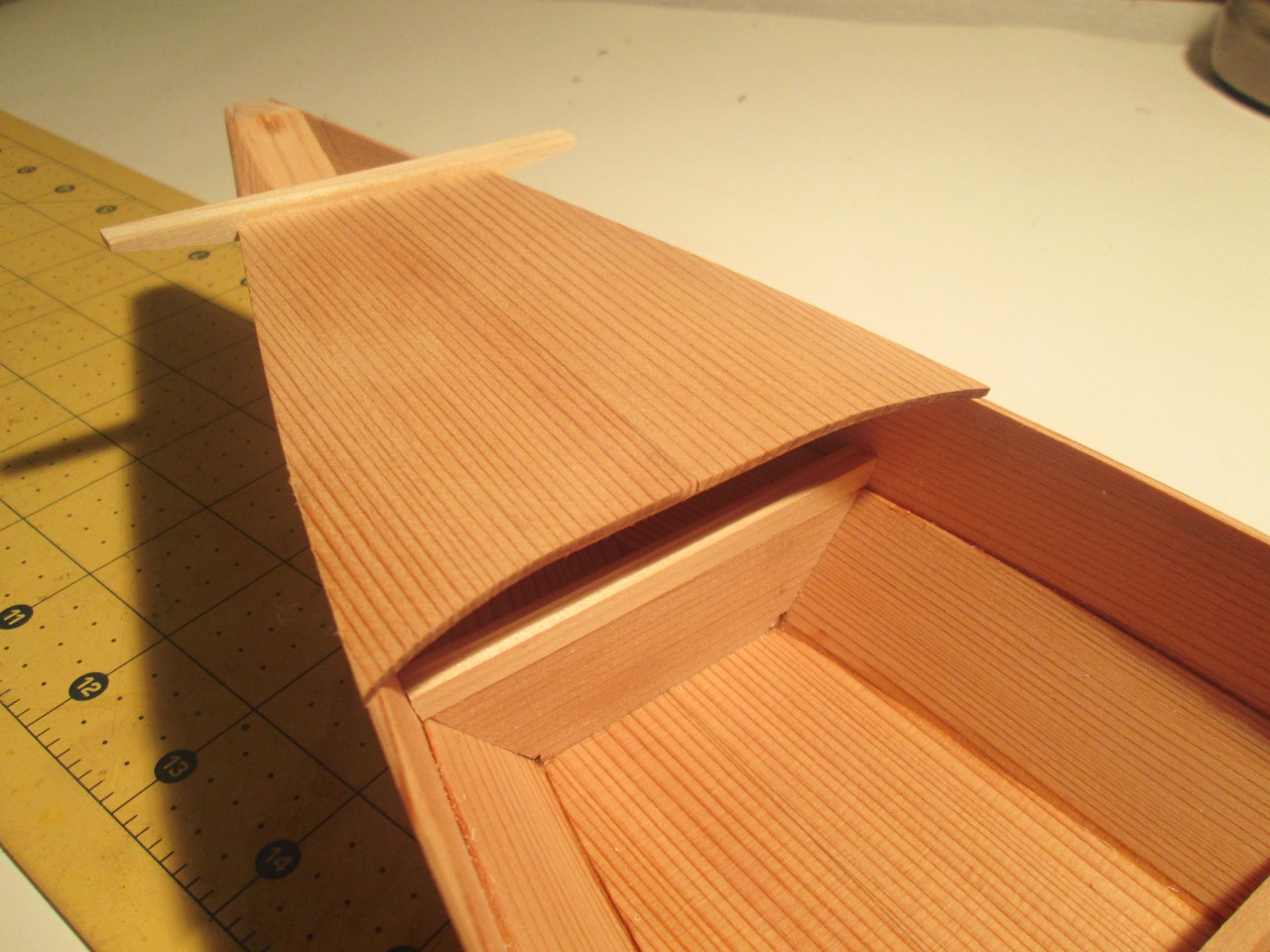
IMG_0286


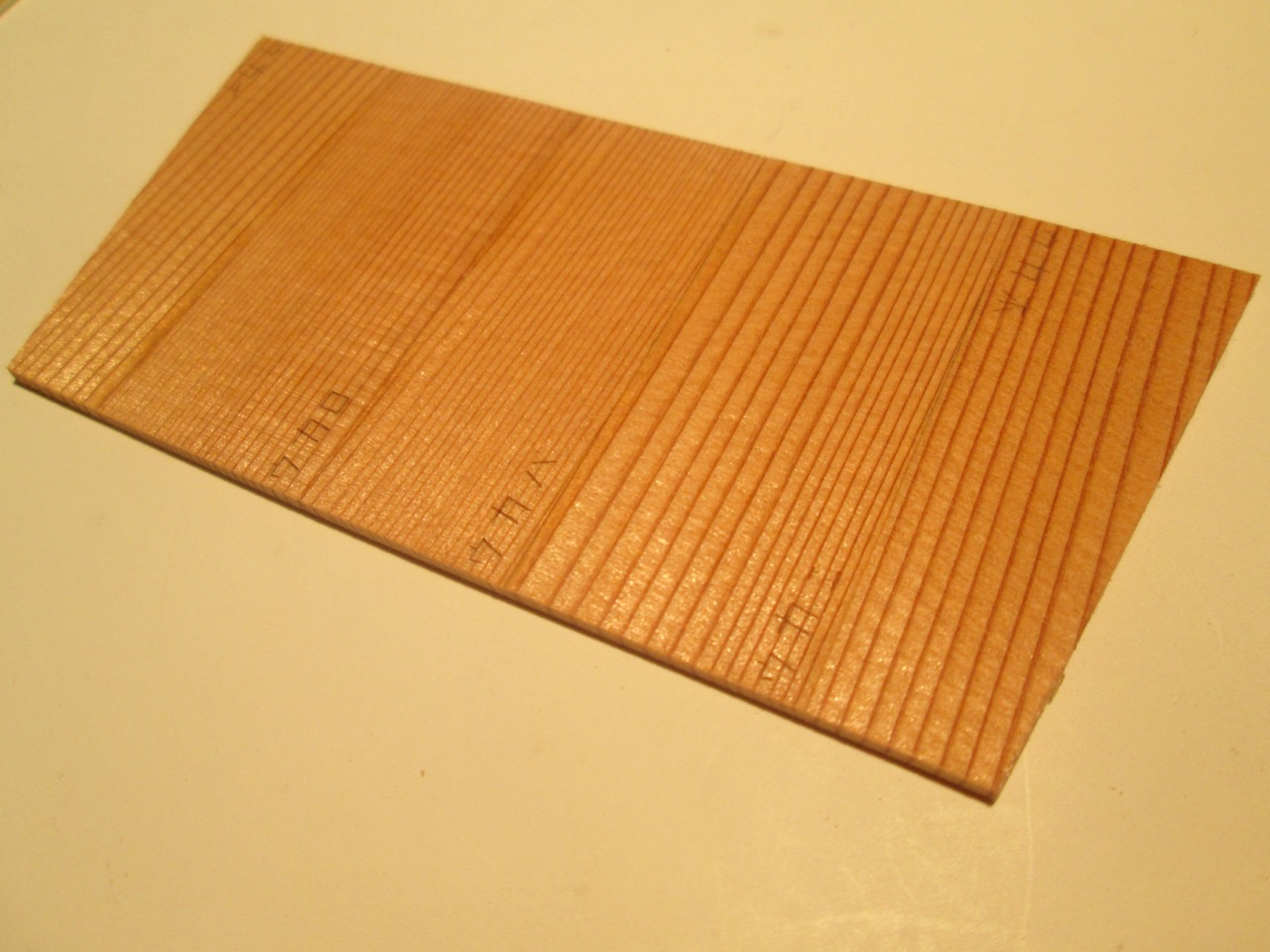
The stern deck is made up of 5 pre-cut boards, but the pieces are of different widths. The instructions don’t show you, but the plans provide the labels, so you can locate the needed pieces. You don’t have to read Japanese, but you do have to match the characters on the plans with those on the parts.

To those familiar with Japanese, the labels are all in the phonetic alphabet known as Katakana. In this case, the parts are:

ウカイ

ウカロ

ウカハ

ウカニ

ウカホ

These characters don’t actually mean anything here – They’re basically no different than labeling parts as A1, C2, etc. Most of the parts in the kit are identified this way.

Something else to note is that the pieces aren’t necessarily placed on the sheets in any order. Efficiency of material was very obviously given precedence here, so related parts may be separated  quite a bit. You can see this by how these deck pieces are located on the laser-cut sheet.
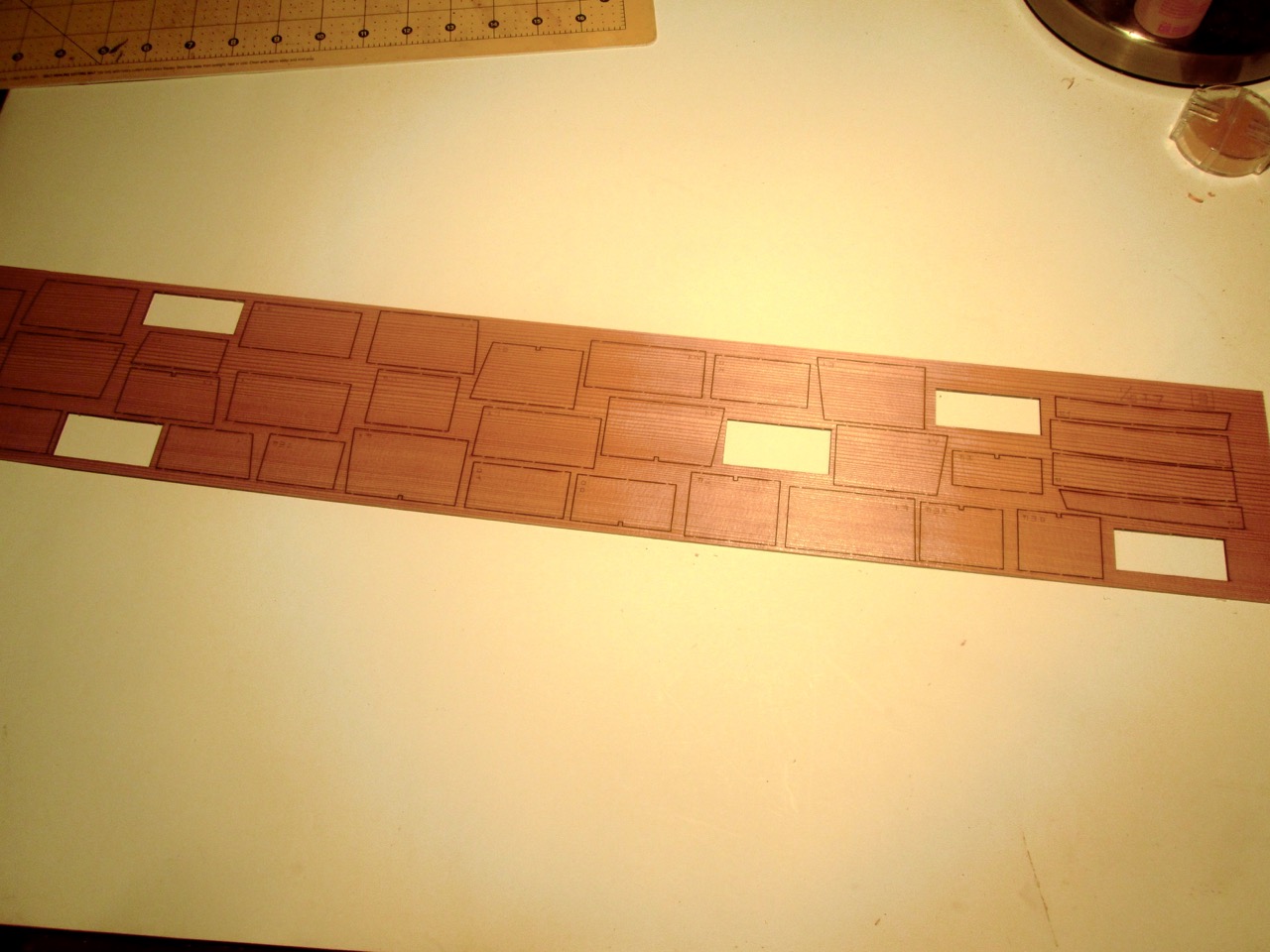
IMG_0287


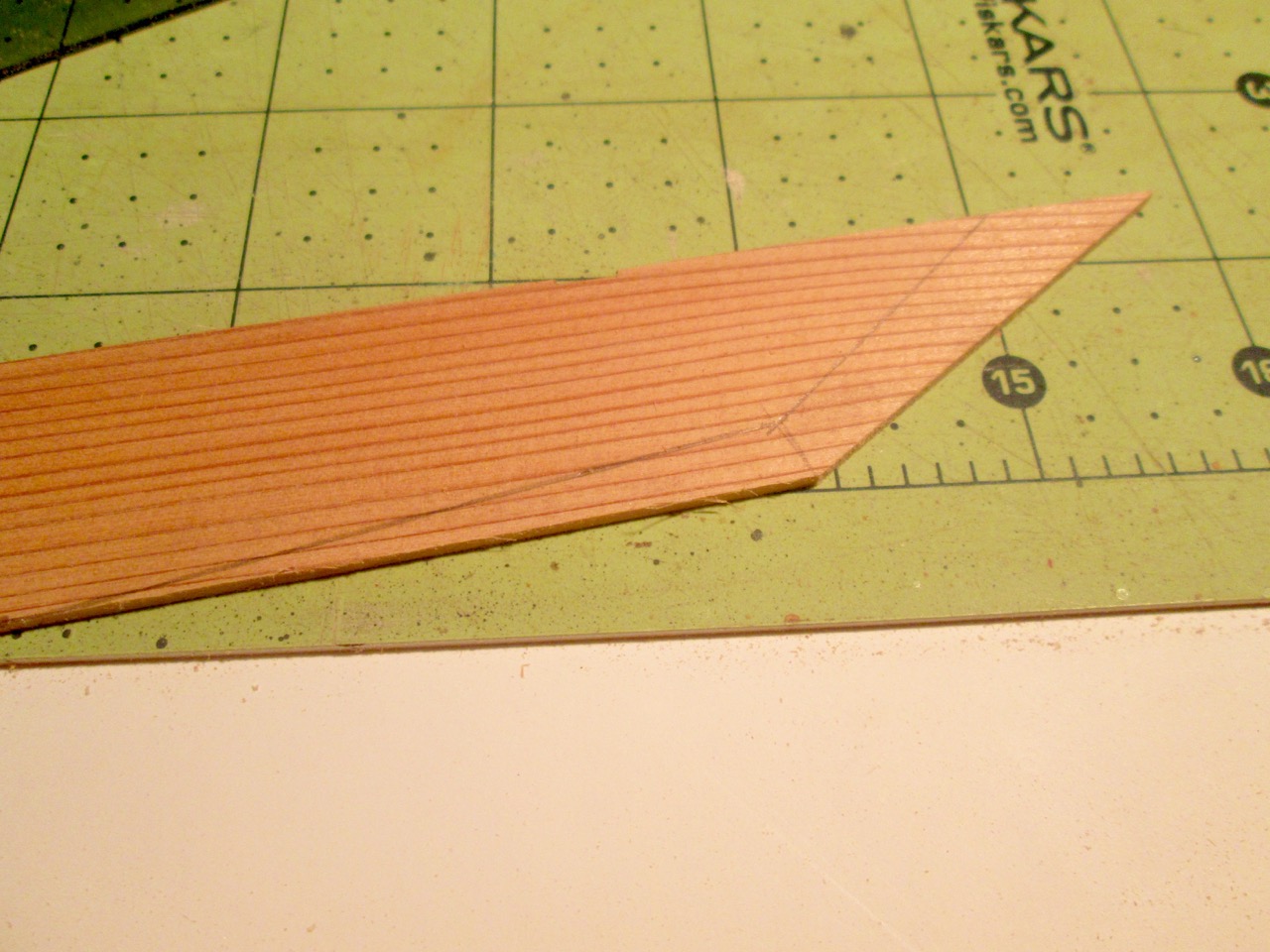
The deck parts were glued up and I then placed them on the hull and traced the edge onto them using a pencil. This was then trimmed by knife and sanded to fit the hull. As I mentioned before, trimming Japanese cedar with a knife can be quite tricky as the wood is soft and the grain is hard, so the knife catches the grain and wants to follow it, so extra care is required.
IMG_0283


One thing you’ll notice is that the part labels are etched onto each part, so you have to either hide the labels or sand them off. Or, you could always just ignore them. They’re not that easy to see unless you’re looking closely. In this case, I just glued the boards so that the labels will all be on the underside of the deck.
IMG_0285


Adding the Rail

We’ve now come to the stage on the Tosa Wasen model where I became a bit confused about the next step of construction. It involves installing a rail, and I suppose that it may simply be a matter of getting accustomed to traditional Japanese building methods which, as far as I can tell, this kit seems to follow quite closely.

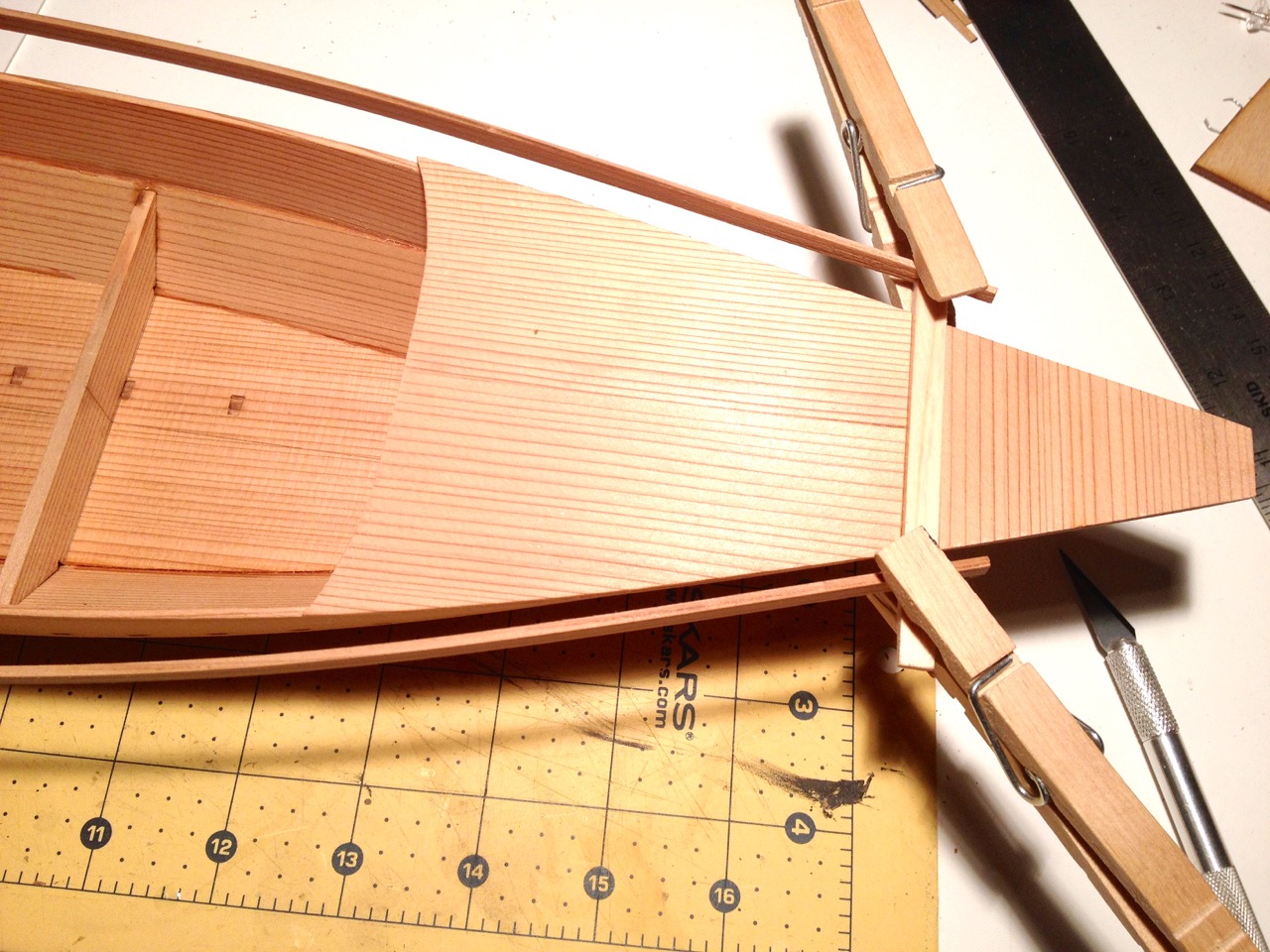
The first problem I ran into was that the ends of the long rail pieces that have to be added first. These are notched to fit to the beams at the bow and stern, but the pieces are too long to fit. So, the notch at one end can be used, but the other end has to be cut to deepen the notch.

More than this, where on a western style ship, we’re accustomed to installing framing and then attaching the rail onto that, with Japanese boats, the process is reversed. The rail is installed to only a few attachment points first, then the supports are added afterwards. This is something that I’ve seen in hull construction of Japanese boats too. The hull planks are edge fastened and bent/clamped into place in the process, and the framing is installed afterwards – Lessons in traditional Japanese boatbuilding!

Page 12


Of course, this isn’t limited to the Japanese or Asian ship/boat building. Thinking back, I recall local ship modeler and marine archaeologist Ed Von der Porten (he’s written a number of articles that have appeared in Ships in Scale) talk about modeling a Basque whaler and about how frames were added after the planking process had begun.

Anyway, I finally worked it out in my head, and the rail construction progressed.
IMG_1907

IMG_1911


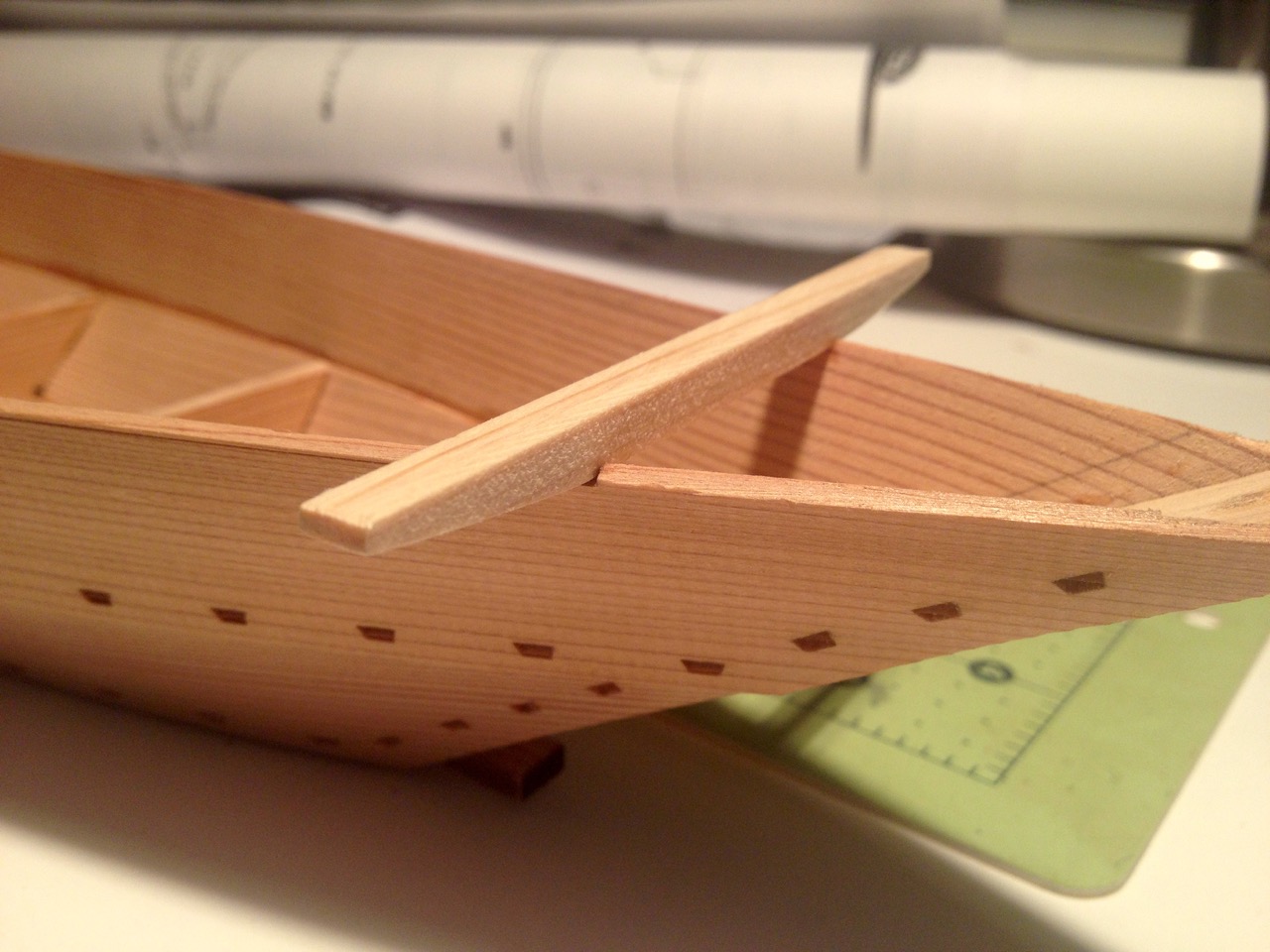
I completed construction of the rail, adding the pieces that make up the underside. With these in place, it’s a much stronger structure.

To fit the pieces into place, I had to soak the cedar pieces a little bit to impart a slight bend or twist here and there. I took the shortcut of wrapping the pieces with a wet paper towel and putting them in the microwave for about 30 seconds. This was just enough to do the trick.
IMG_1914


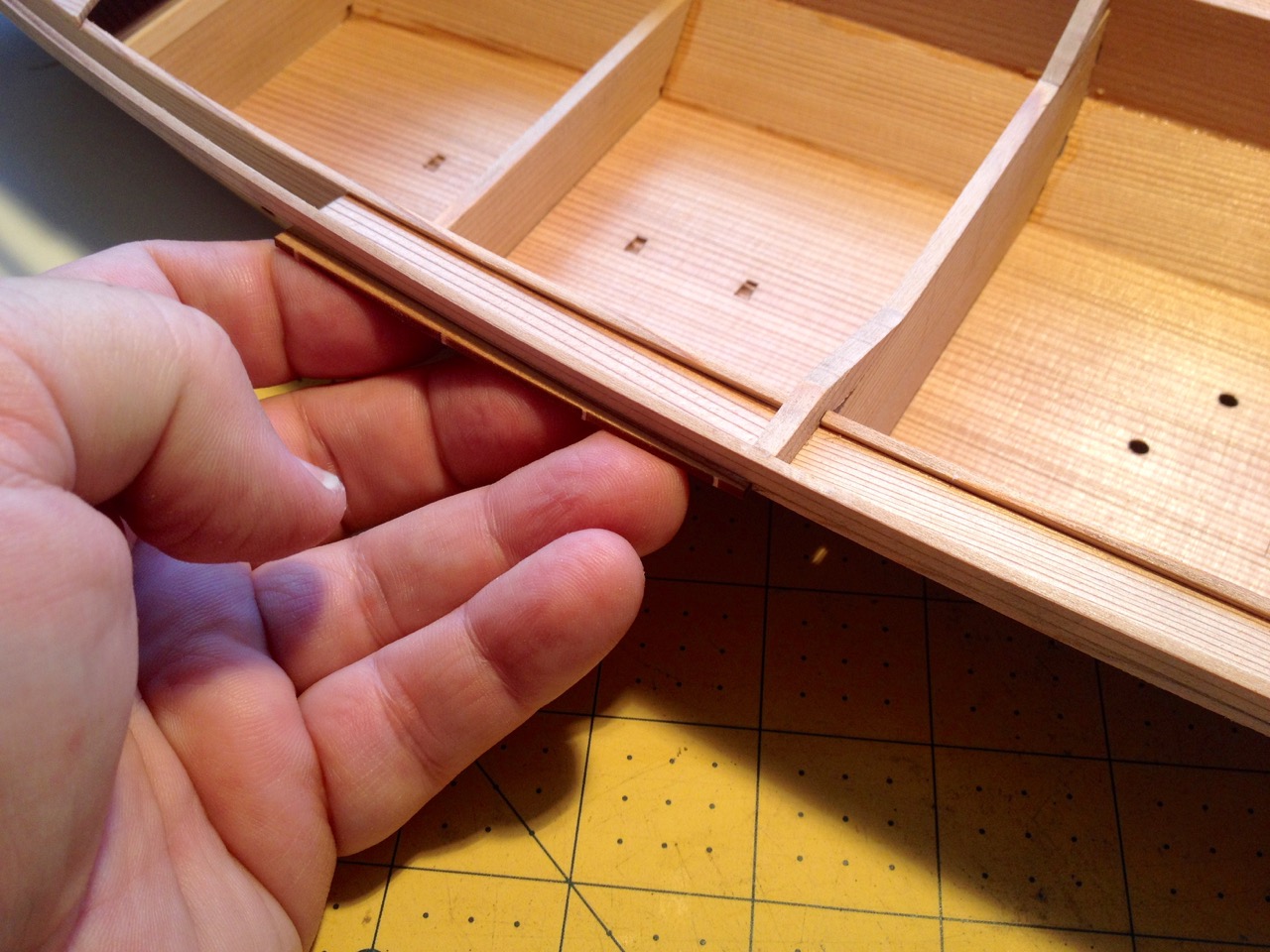
Along the underside of the rail on the upper hull planks there is a laser-scribed line to help position the underside pieces of the rail.
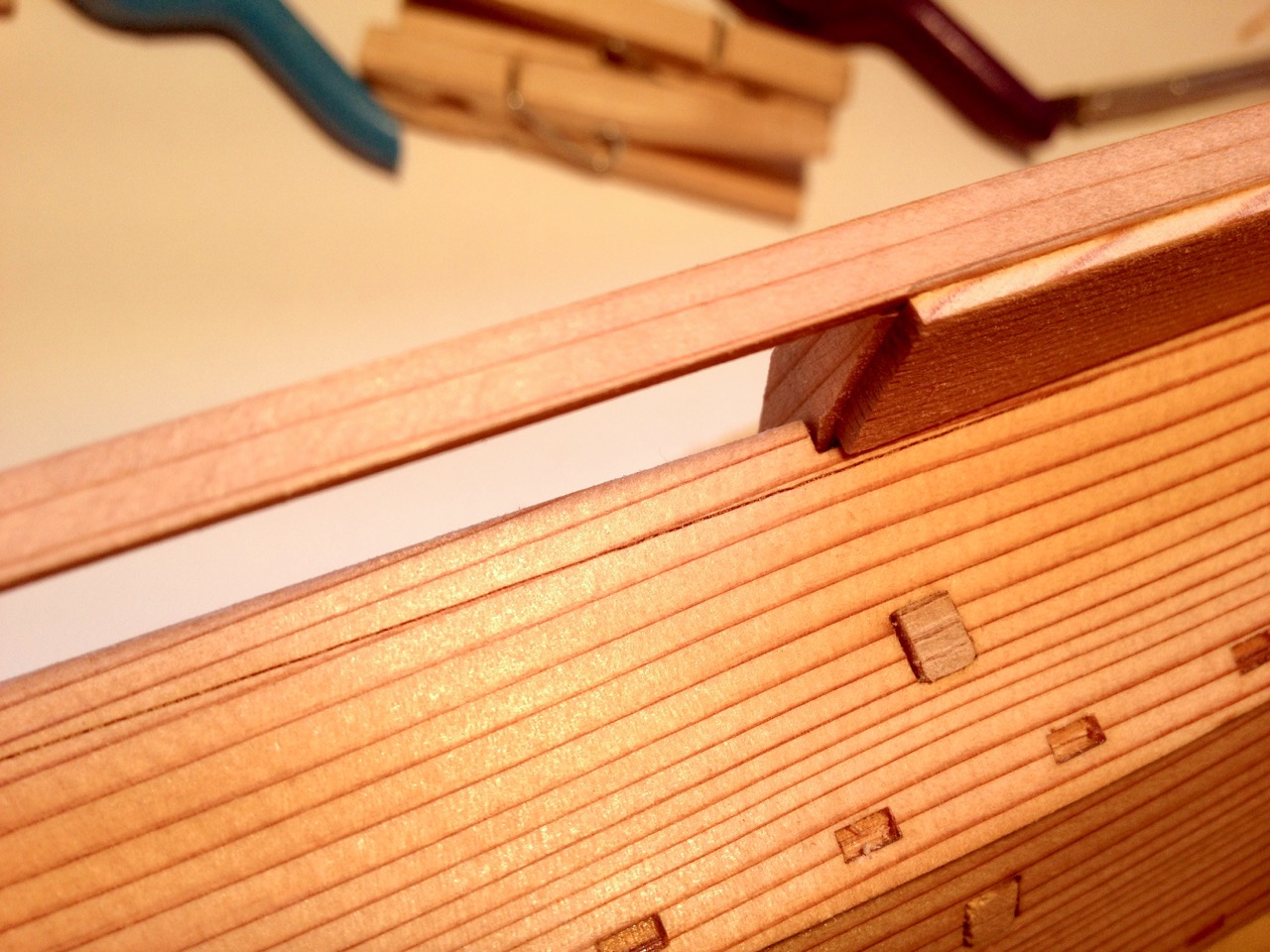
IMG_1915


The pieces glued and clamped into place
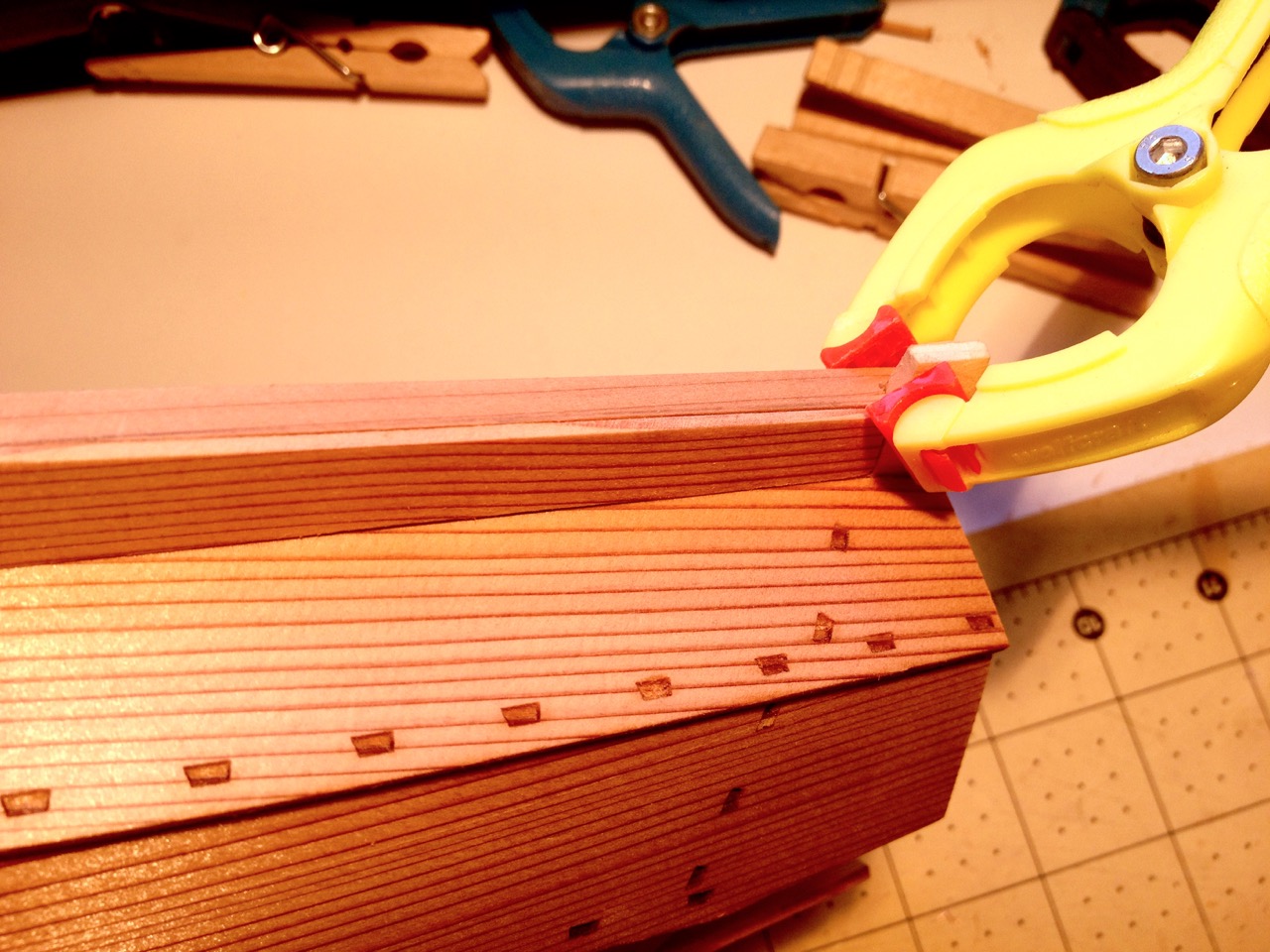
IMG_1917

IMG_1912

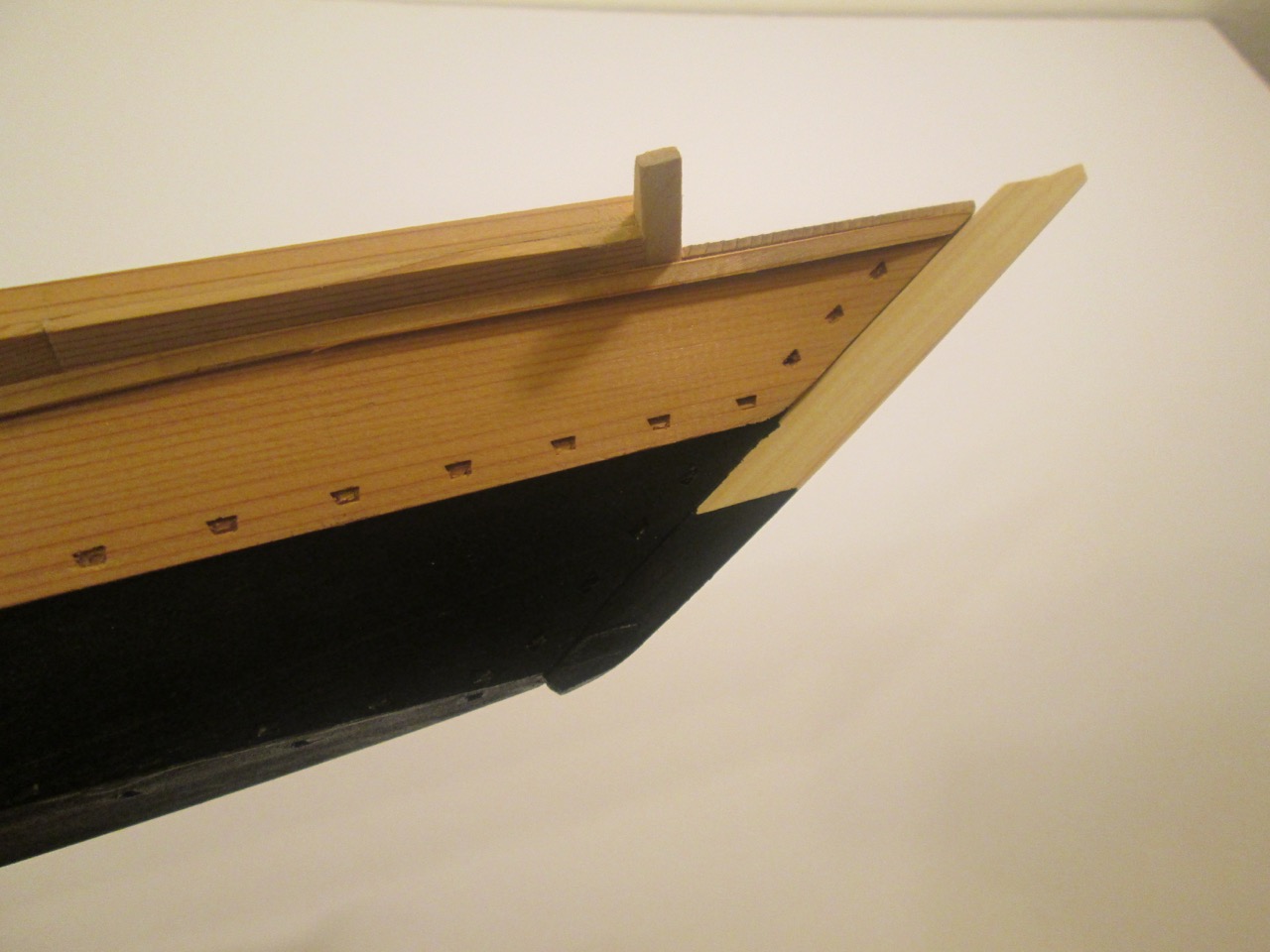
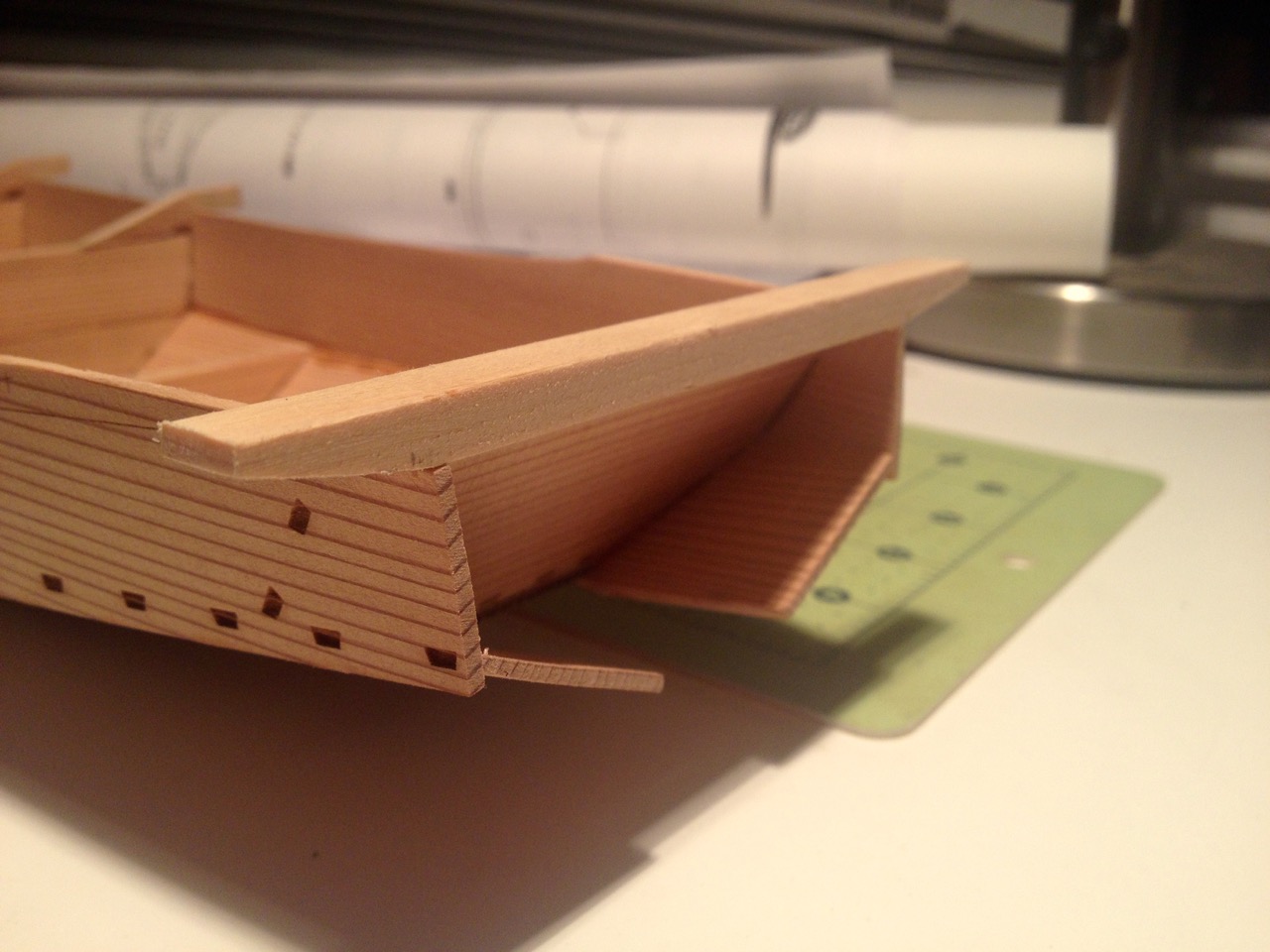
After the rail was completed, I went ahead and added the stem and other hull details, including a thick strake located on the upper hull planking, just underneath the recently completed rail.
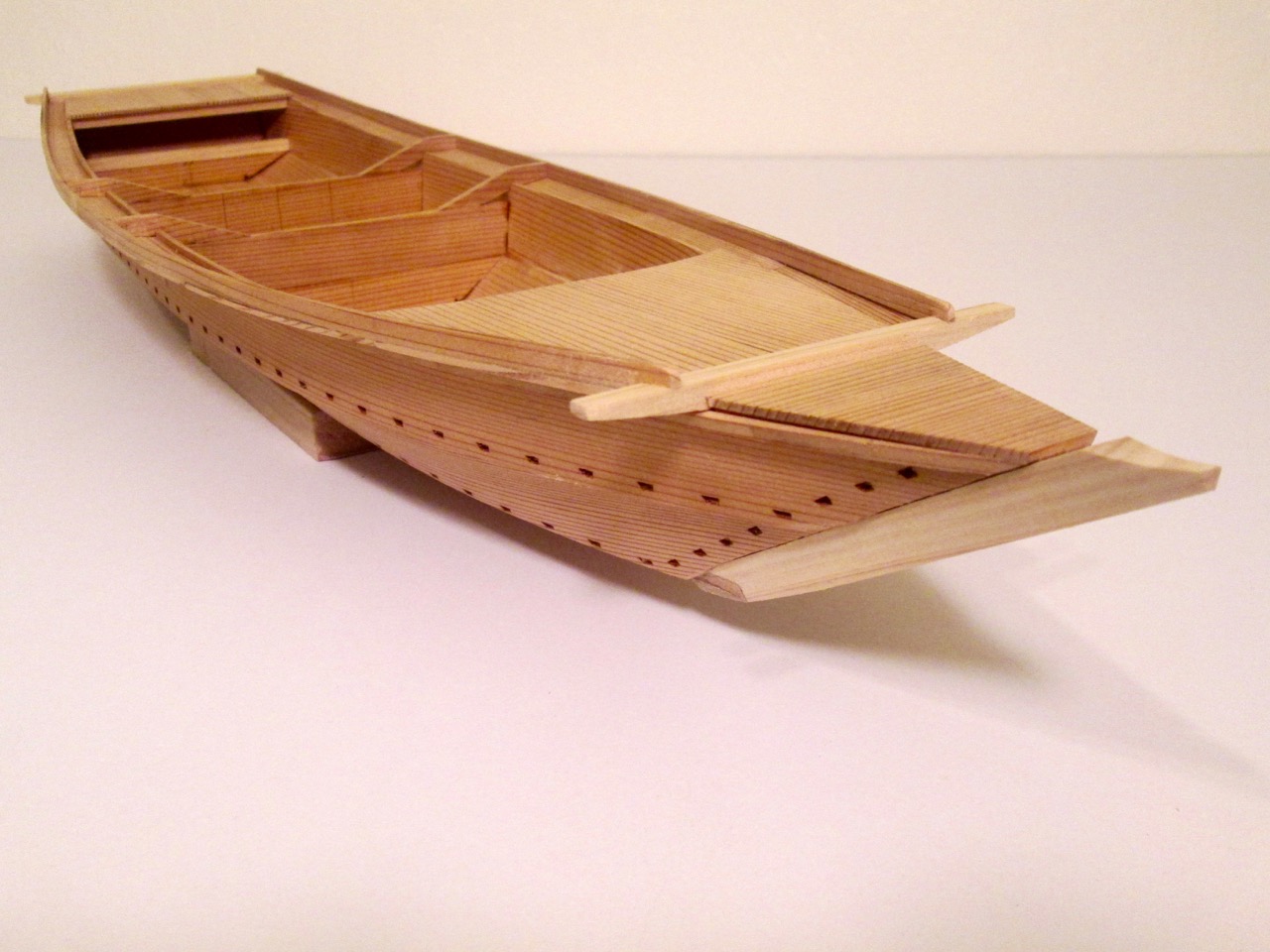
IMG_0364


You may notice that the stem is lighter than the rest of the hull. Like the stern beam, the stem is make of Hinoki or Japanese Cypress instead of Sugi, Japanese Cedar.

Painting the Hull Bottom

Next, it was time to paint the bottom of the hull. The finish of the hull bottoms changed a bit over time. But, what we see as common for the Edo period would be black paint. The kit actually included a roll of narrow yellow masking tape from 3M which worked very well. For paint, I used a model paint sold by Caldercraft as part of their Admiraly Colors line.

There was no particular reason I used this other than to test the paint out. For all other wasen models I’ve built, I used artist’s acrylics Mars Black from Liquitex. In fact, the result using the Caldercraft paint was just a bit shinier than I would have preferred, but it came out fine. I keep trying other hobby paint brands and often end up just coming back to the artist’s acrylics.
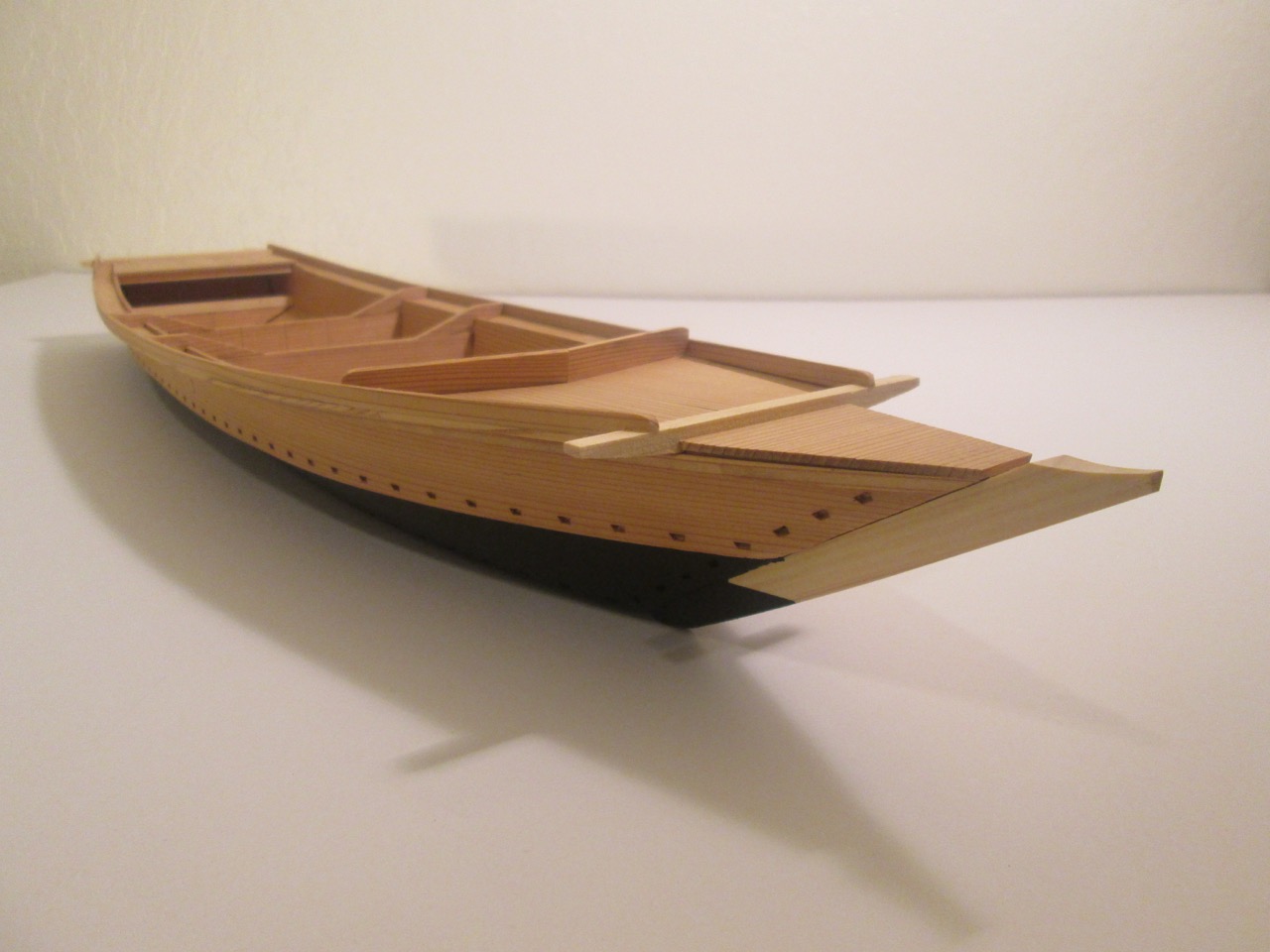
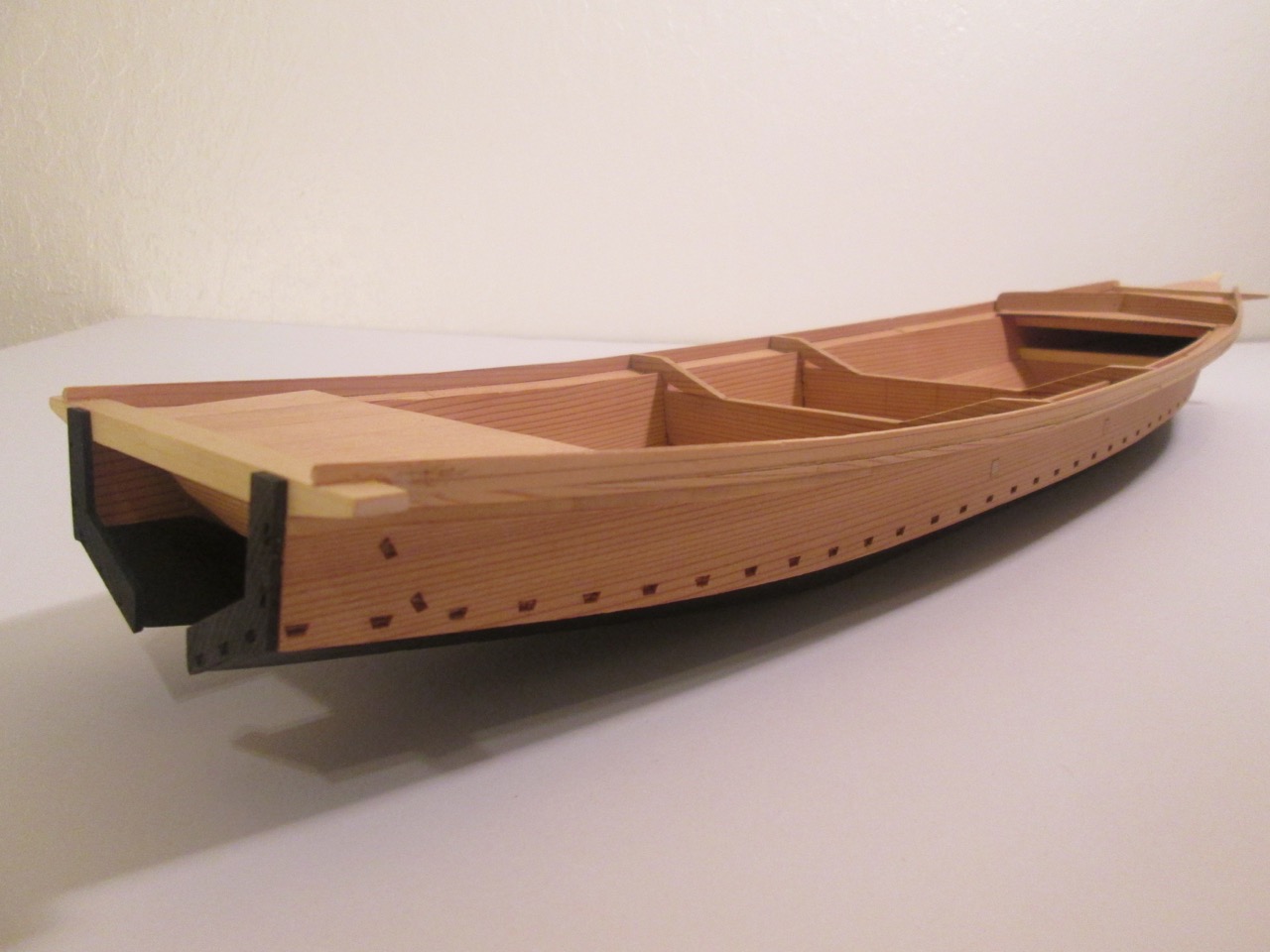
IMG_0367

IMG_0369

IMG_0370


While I was at it, I went ahead and added the splash rail, which sits on the bow deck. The joint where the two piece meet and also the bottoms of the pieces had to be beveled to fit properly.

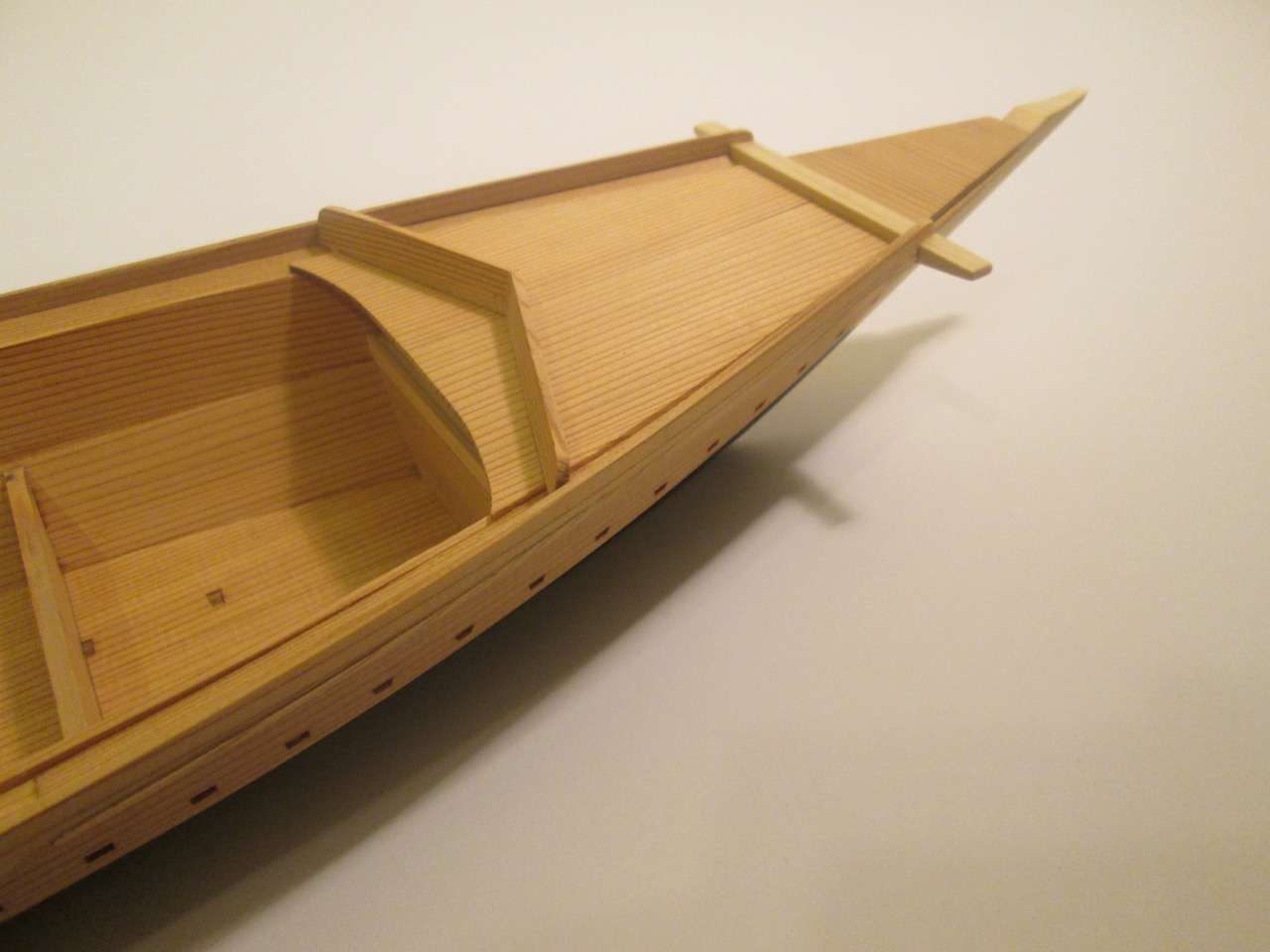
IMG_0368


IMG_0371


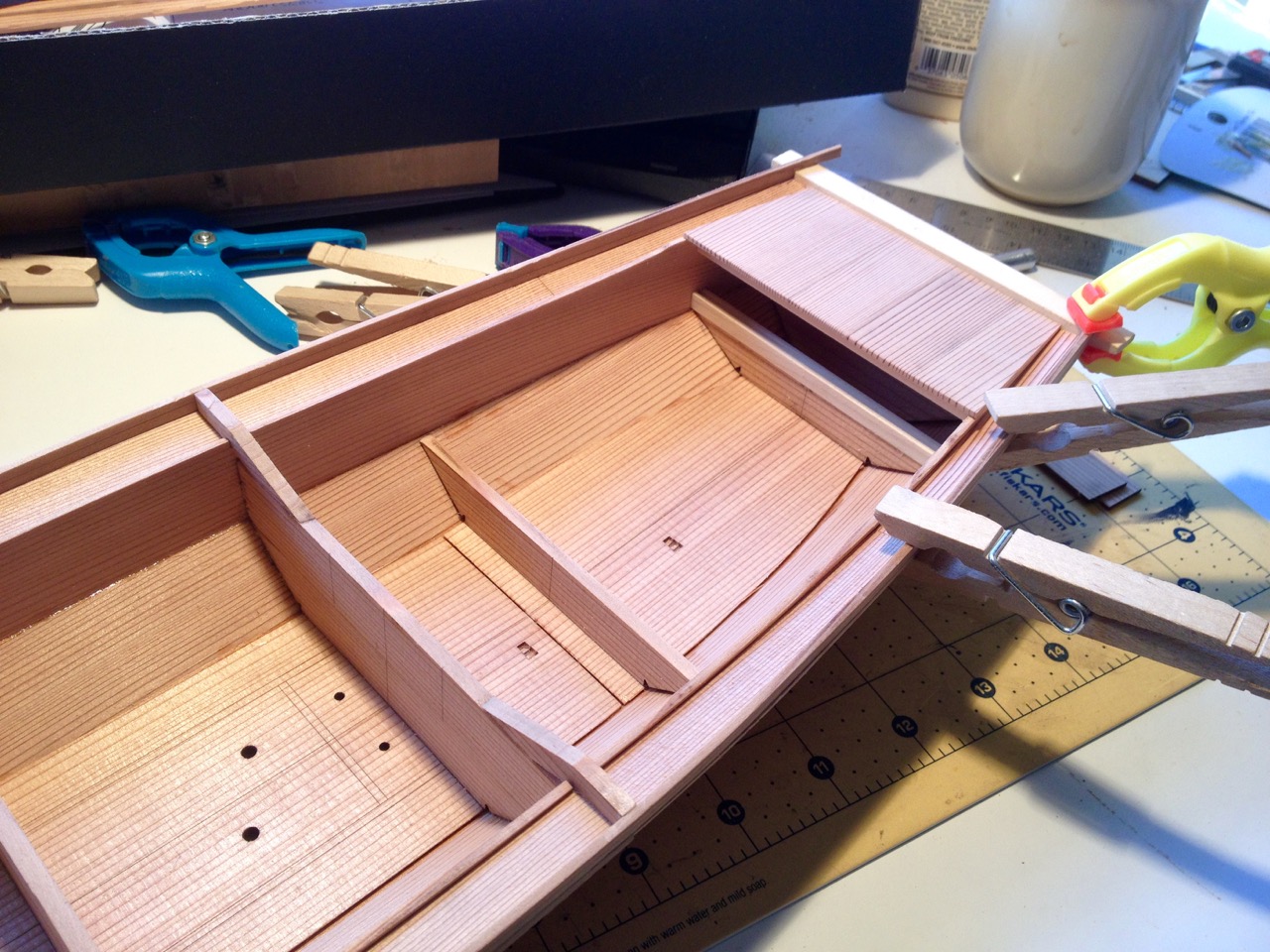
Finally, I built the well area. This was pretty straightforward, though I did start to run into little discrepancies in parts alignment, which is going to happen on kits with pre-cut parts. Also, a reminder that it’s REALLY easy to over sand the kit’s Japanese cedar.

The bottom of the boat will be comprised of covered compartments. So, beams and ledges will be added to seat the deck boards / compartment covers. The well section is the tallest compartment.

Here, I’m adjusting the position of the ledge that I’m gluing into place on one of the well partitions. I used wood from the sheet of deck covers as a guide for exact positioning of the ledge. This assures that the deck covers will be flush with the tops of the partitions.
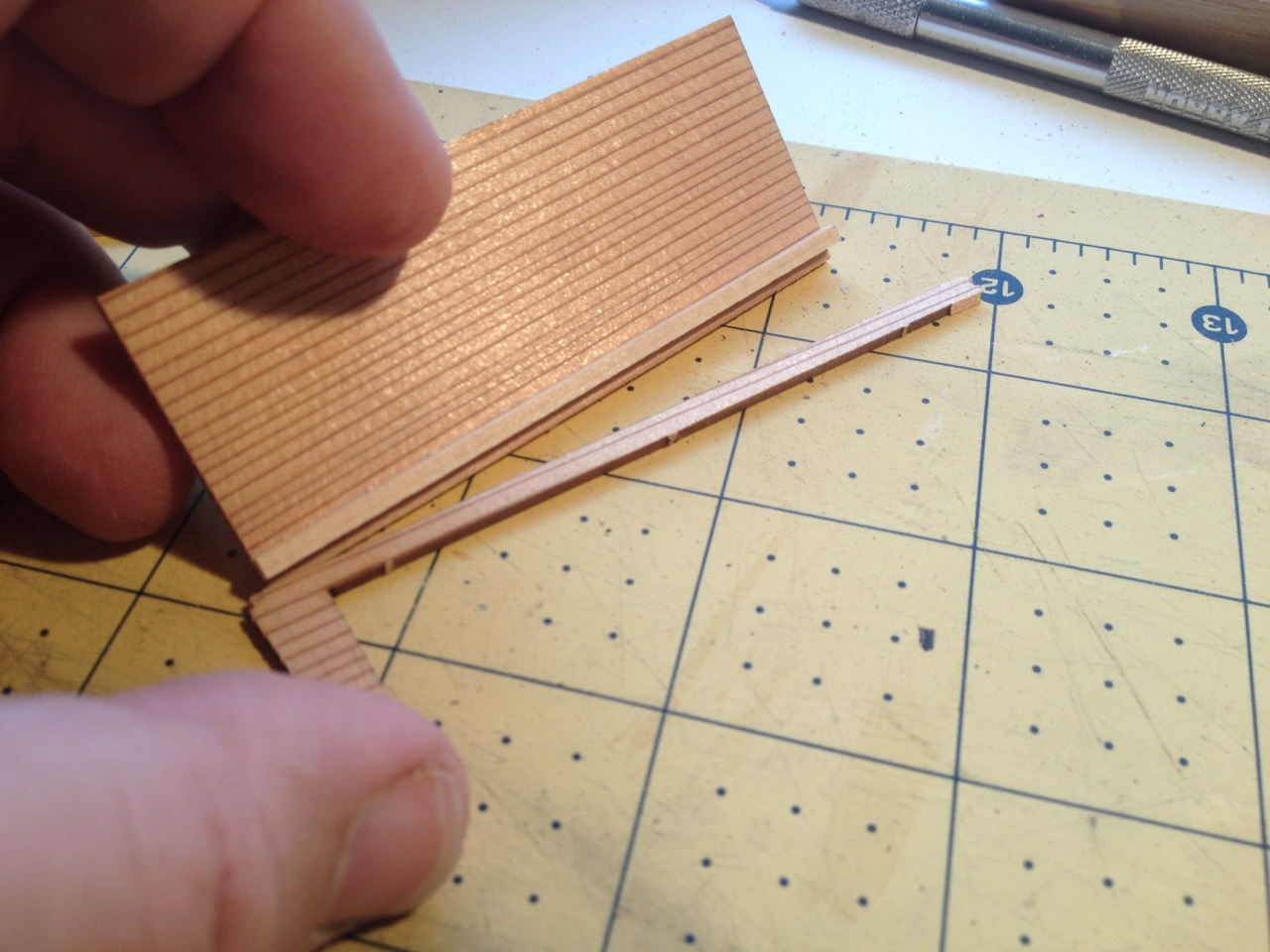
IMG_1931


Here’s the completed well area. Note the ledges glued to the hull.
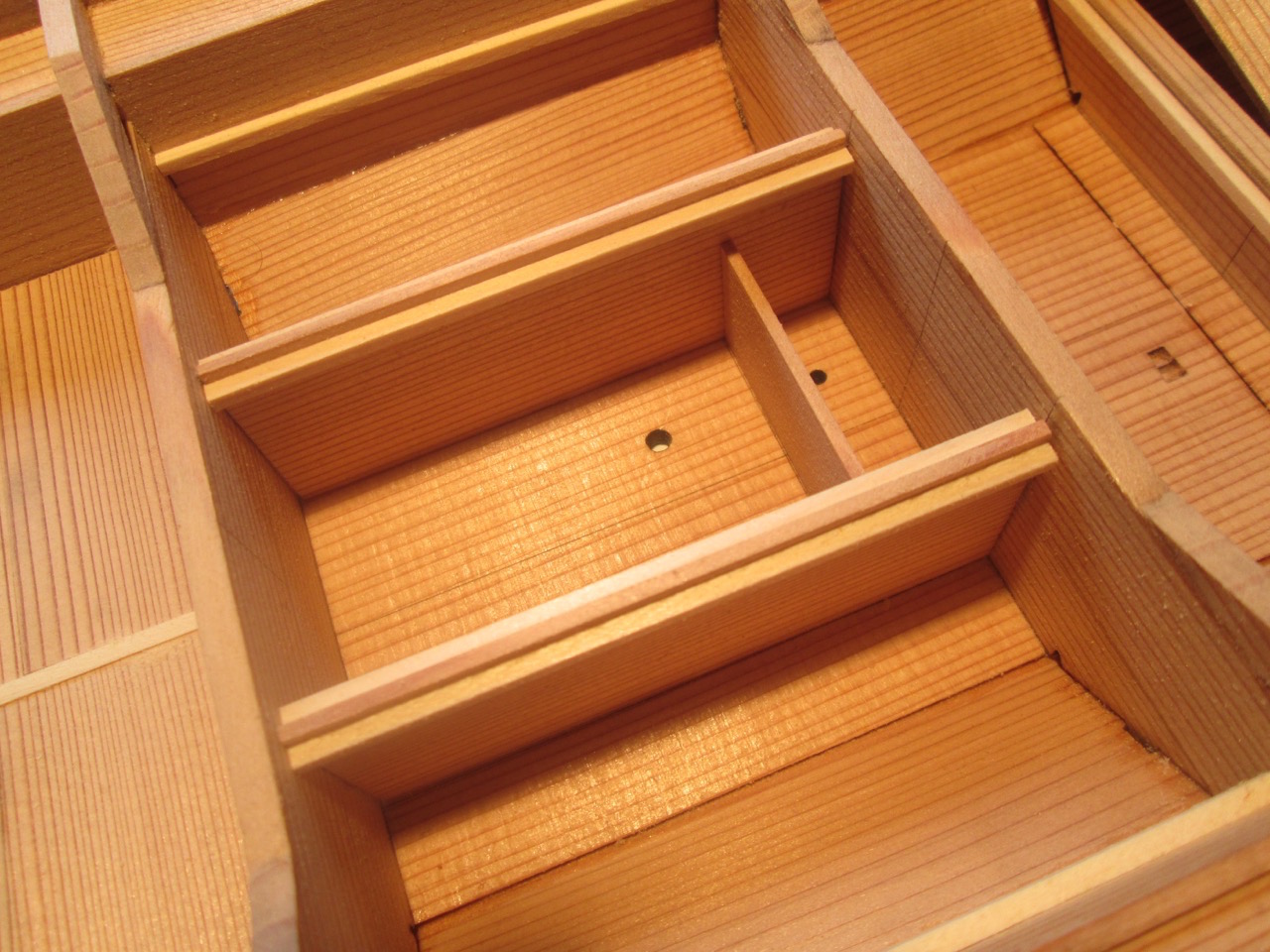
IMG_0381


Before the deck covers can be added, beams and more ledges have to be added. I’ll cover this next time, along with the covers for the bow and stern holds, making the “Ro”, which is the Japanese name for the long sculling oar, and the final accessories such as the anchor and the bailer, etc. The next installment should see the completion of our Tosa Wasen.
Building the Tosa Wasen – part 4

Last time, I left off with the basic hull completed. Now comes the detailing.

A pair of beams are provide which are attached directly on top of the upper hull planks. These are first tapered from underneath so that at the ends they are reduced to half thickness. The fore beam referred to here as the ツノ or Tsuno (tsue-no), and the stern beam is the オオトコ or Otoko (oh-toe-koh). The heavy stern beam in particular is a common feature of traditional Japanese boats as it is used to mount the rudder on some boats, and usually bears the seat for the sculling oar.

IMG_1887

IMG_1888

One thing you might note about these beams is that the parts are made from a lighter colored wood. True to the original boat, instead of the Japanese Cedar used for the hull planks, these parts were usually made out of Hinoki (Japanese Cypress) because its greater density and strength.

IMG_1894

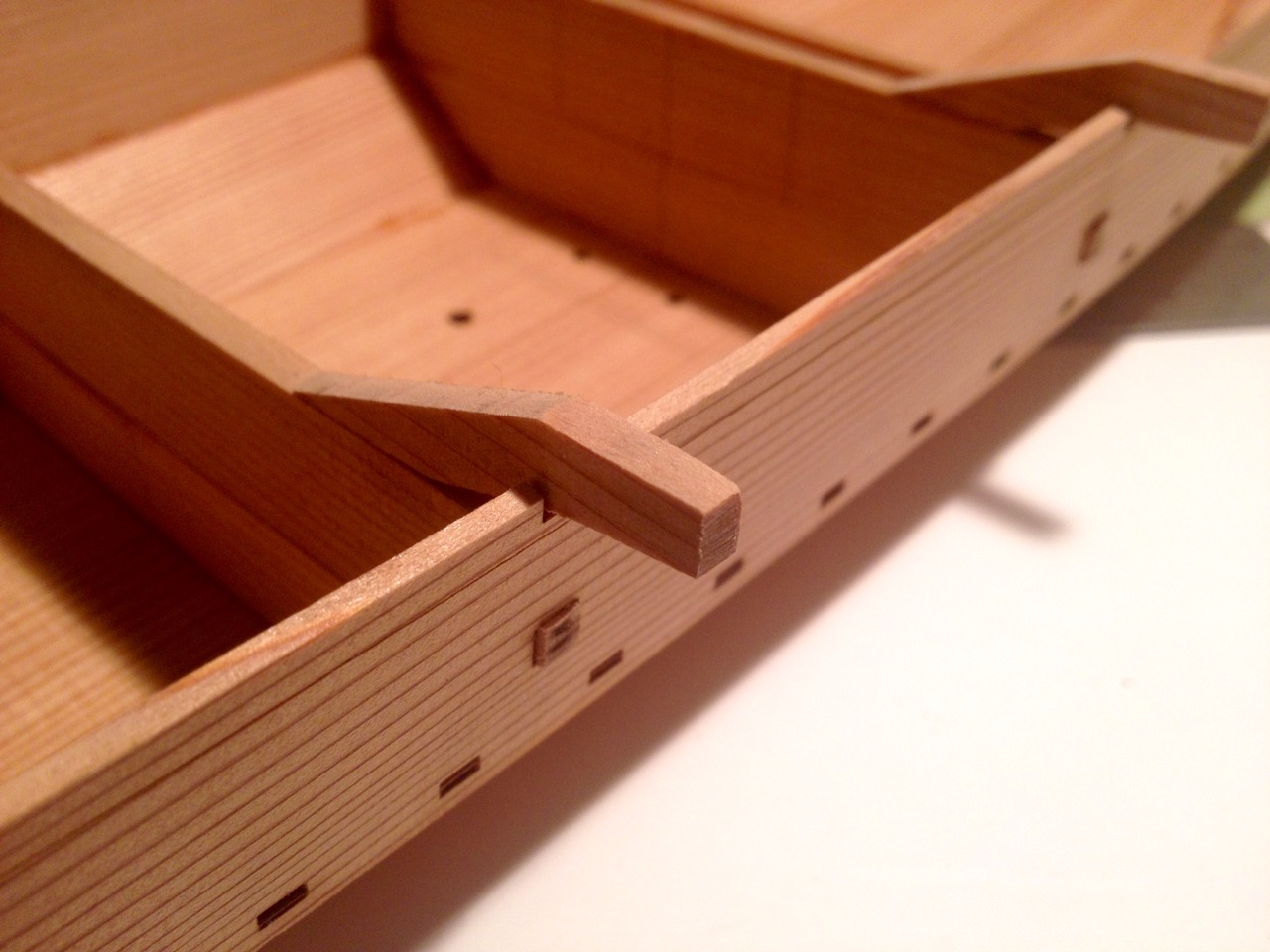
At this time, there are some extension pieces located at the midships frames (I was calling them beam initially, but now they’re built-up high enough to call them frames or bulkheads). I don’t know what it’s called yet, but this boat has an extended rail outside of the hull and these pieces are the central supports for it.

These small pieces initially had a lot of char from the laser cutting on top and bottom. I was as careful as I could be to not take off too much material. But, the cedar is relatively soft and it sands a little too easily here. But, I seemed to manage okay and essentially got the char off.

By the way, something interesting about that space between the frames that you see in the photo. In the center portion of the hull bottom, there are a few holes. I believe that this might have served as some kind of “live well” that must fill with water through those holes. There are in fact, two sets of holes. Near the forward bulkhead, there are two smaller holes in the bottom, and I believe these open into a smaller, separate section that might have been for storing bait. I’ll report on this at another time after i’ve collected some facts.

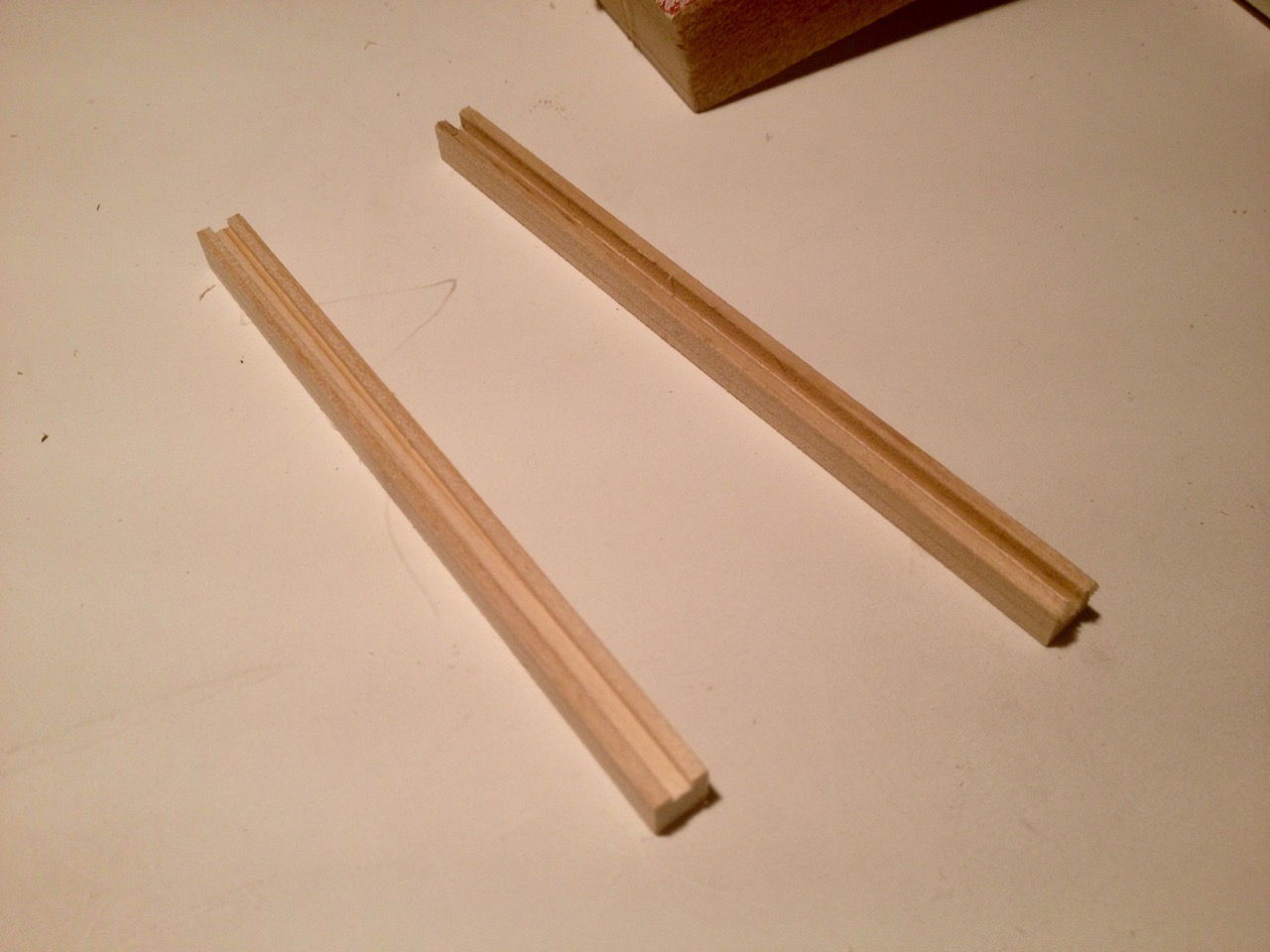
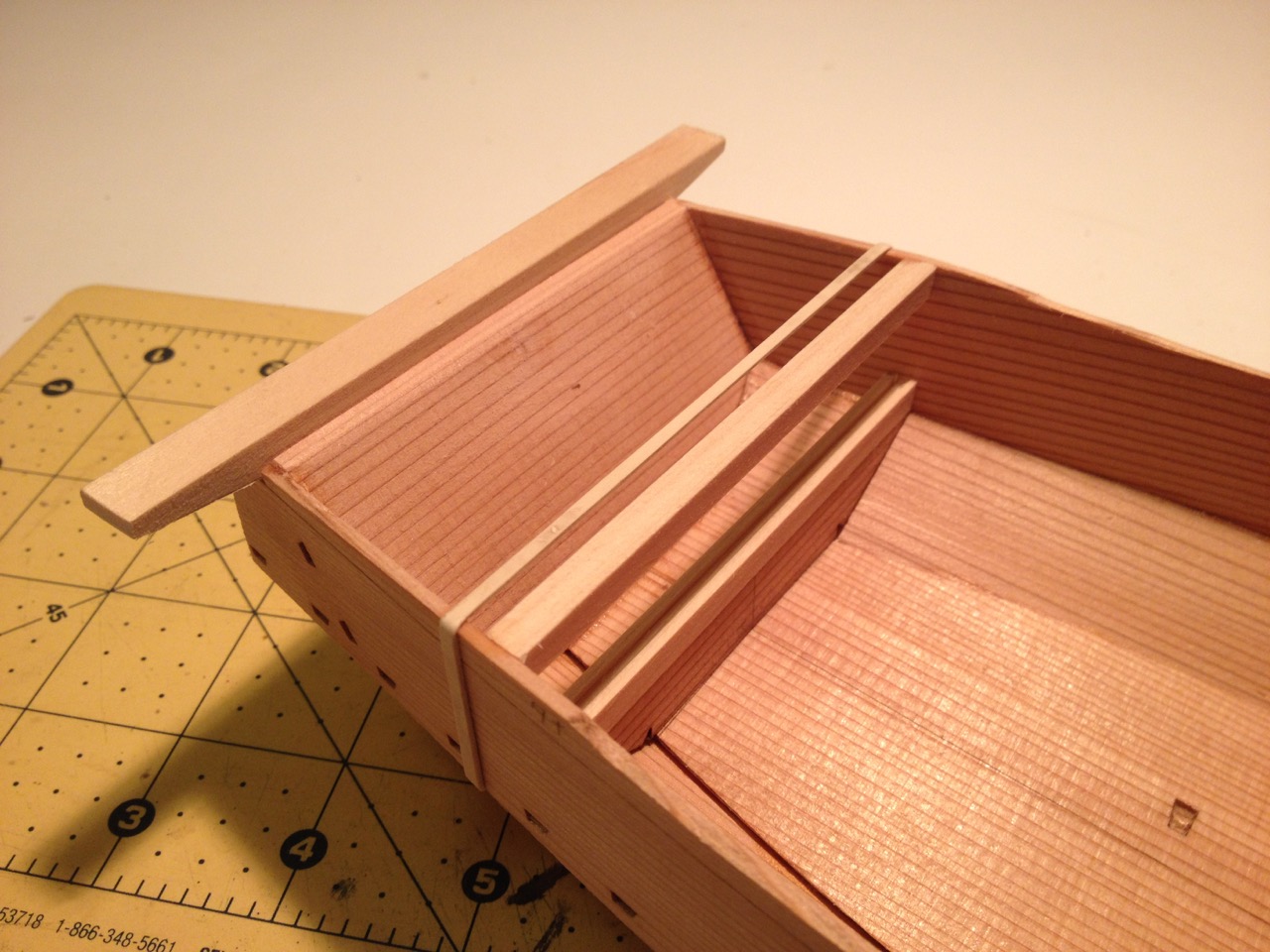
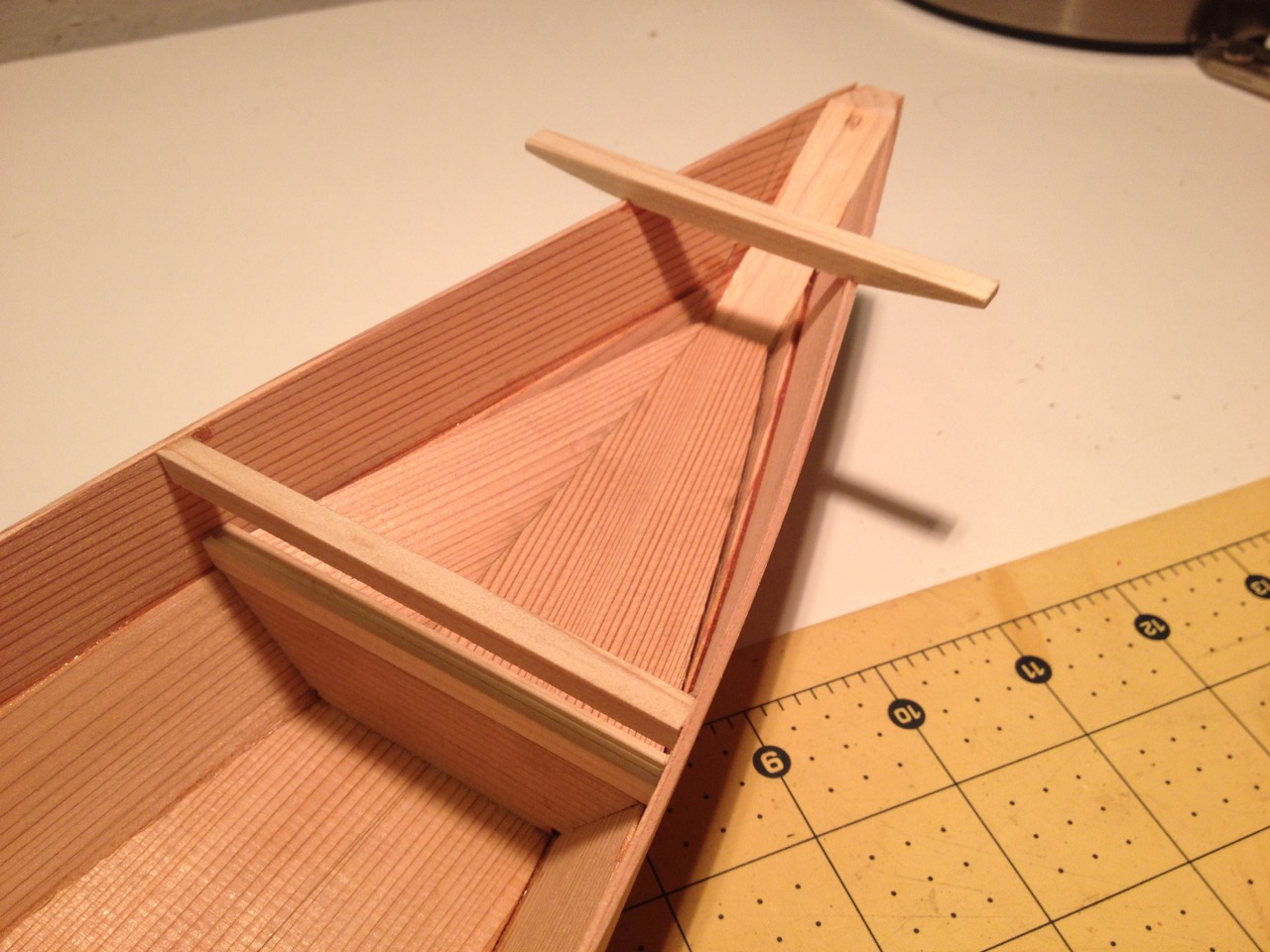
So, next step was to add the upper and lower slotted beams, which will hold removable doors to allow access into the bow and stern storage compartments. The ends of the beams had to be sanded down to fit nicely in place.


IMG_1892

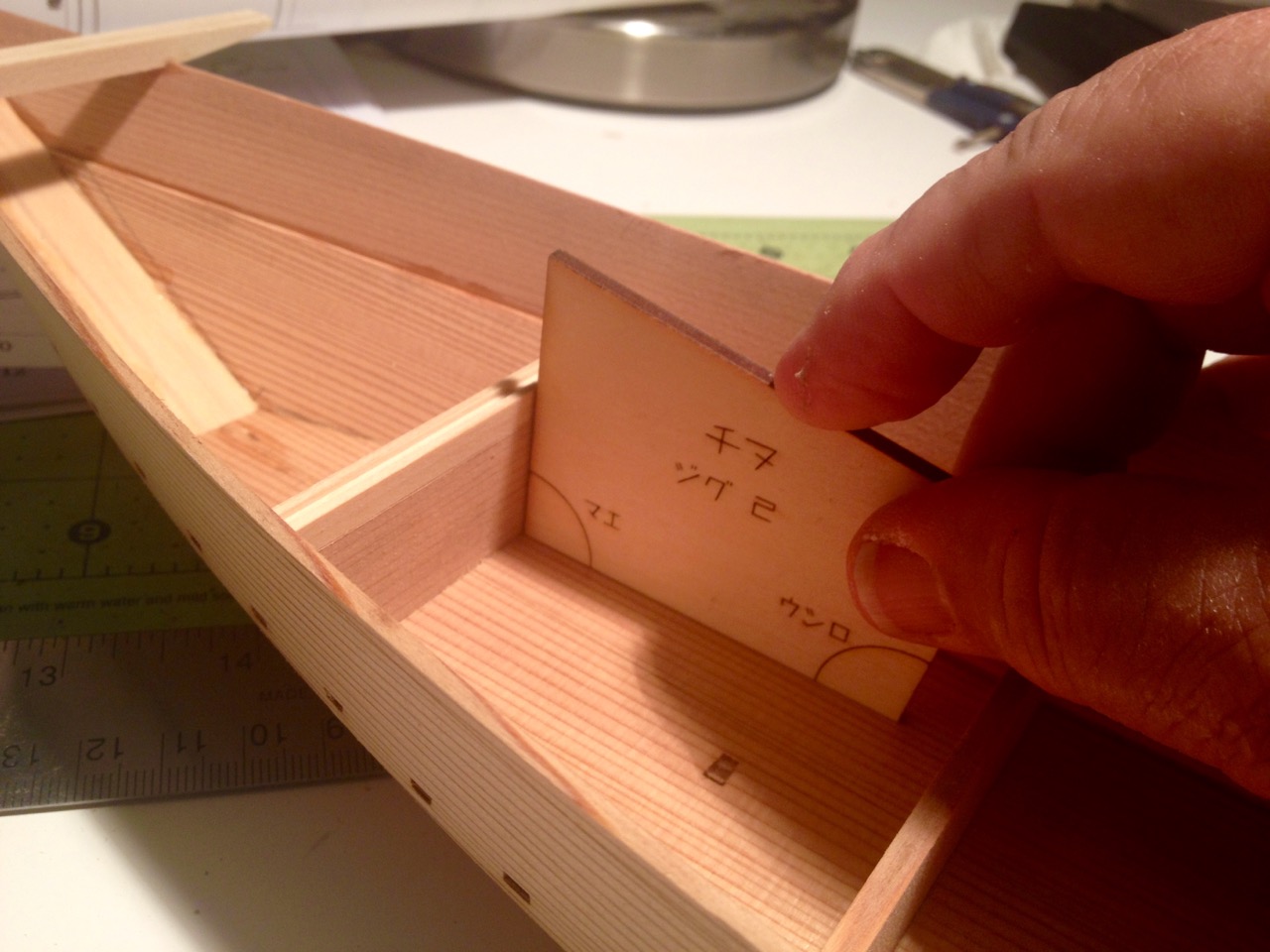
A special template is provided to make sure that the beams are properly aligned. One side of the template is used for the bow and the other side is used for the stern. The angles are different enough so that it’s pretty obvious which side is used for which end of the boat. You don’t need to read Japanese to figure that much out.

IMG_1897

IMG_1901

One of the issues I ran into was that the tops of the upper hull planks weren’t perfectly aligned. So, I made an extra effort to make sure the gap between the upper and lower beams was consistent.

After the stern pieces were done, I assembled the floor of the bow storage compartment. Interestingly enough, the two pieces that make up the floor aren’t two symmetrical halves. In fact the joint between the two doesn’t even run parallel to the centerline of the ship. You can see what I mean when you look at the photo.

IMG_1900

I’ll cover the completion of the holds next time. The next step is to add the deck beams to the bow compartment and then the add the bow and stern decks.


Building the Tosa Wasen – part 3

With the lower planks in place, there are next two support beams that were glued in place. Like the pair of lower support beams that the lower planks lock into, these upper support beams are notched so that they fit into holes in the upper planks. When the glue on those beams was drying, the upper planks were cleaned up the leading edges were tapered the same way as the lower planks. The lower planks were then glued to the support beams described above.

IMG_0260

As with the lower planks, the upper planks were then initially glued only at the transom and at the stem. Fitting the planks was fairly easy at the stern, but was a bit harder at the bow. There, the planks are hard to seat tightly against the stem since there is some overlap between the upper and lower planks.

IMG_0266

This definitely took a lot of hand pressure and the use of medium CA glue since I couldn’t get a clamp onto the bow. I just had to hold the planks tight as long as possible until the glue set. At the stern, the planks were much easier to glue. But, I did run into one self-created problem that was actually less of a problem than I’d realized.

IMG_0265

The stern edge of the transom should have been lined up with the edge of the notch where you see the rubber bands in the above photo. I cheated a little in order to fix the problem by trimming the leading edge of the notch, effectively moving the notch forward. A beam is supposed to fit precisely into this notch, so I had to sand the stern edge of the planks just enough so the size of that notch was retained.

But, as it turns out, the top of the transom gets sanded flush with the top of the planks and later the whole section gets covered with planks right up agains that beam anyway, so you wouldn’t have been able to tell that the transom didn’t touch the edge of the beam, unless you looked up at it from underneath the boat.

With the planks secured in place, I then ran a thin bead of CA glue all along the inside of the joint between the upper and lower planks. Lots of clamps made sure that the planks were held properly together until the glue set.IMG_0263

After a while, it was safe to then remove the temporary strong-back, which was a nice and satisfying milestone in the build.

IMG_0267With that, the basic hull is complete and we have something that now looks like a boat. There is still the outer stem to add as well as some stern trim that protects the ends of the planks, but aside from that, it’s pretty much time to start detailing.


Building the Tosa Wasen – Part 2

The next stage of the build is the hull planking.

On a traditional Japanese boat, there are basically only 4 planks, 2 on each side, with the upper planks making a nearly vertical surface. The kit refers to the lower planks as カジキ or Kajiki and the upper planks as タナ or Tana. The term Kajiki is the same term used for the lower planking on the Bekabune as described in Brooks’ book and blog. And in fact, the Tosa term for the upper plank, Tana, is related to that of the Bekabune, which is the compound word Uwa-Tana, but run together the “T” becomes a “D” sound and becomes Uwadana.

Diagrams in the kit show that the leading edge of the lower planks need to be tapered. There are measurements shown in the instructions, but the exactly shape of the tapered area is not precisely defined. It ended up being a matter of getting something to look like the shape shown in the diagram – a shape that reminds me of the tip of a samurai sword.

IMG_0259

After tapering the leading edge of the planks, it’s then a matter of fitting the planks on. The laser-cut planks have square openings that line up with square tabs that protrude from the central beams on the model. These are actually located slightly aft of center, but they are at the widest point of the boat.

I found that mating the planks to those notches was a pretty tight fit, but it was good that the fit was snug, as this helps hold things together while gluing. I glued the planks to these notched frames first and let that dry, which seems to be how the instructions want you to do it. Next, the planks were fit to the transom and glued only at the transom.

IMG_0254

From what I could tell, it seemed that the top of the planks should be kept low against the frames, so that the planks ended up sticking up above the frames by only a small amount at the stern. On the forward half of the boat, the planks seemed to mostly line up with the top of the frames.

The planks were then glued to the stem, which is called the Miyoshi (mee-yoh-shee). The planks had to be positioned so that the very forward edges were flush with or just barely past the stem. After the glue dried, the rest of the planking was glued to the bottom and the frames using medium CA and the applicator tips supplied in the kit. Those, by the way, were a perfect fit for ZAP brand glue bottles.

IMG_0253

I found it a bit of a struggle to hold the boat while trying to glue the lower planks into place. The strong-back in the center is only glued in at the top and bottom of the transom and the stem, so it’s very flexy. It took a while to learn to hold the whole thing while bending the planks and gluing them into place.

IMG_0256

I should also mention that the kit never has you soak any of the planking. It’s long and thin enough that it flexes pretty easily. I suppose it might have made sense, as a ship modeler, to try to pre-bend the planks. But, it certainly wasn’t necessary and I managed without soaking or pre-bending the planks.

IMG_0252

I left the whole thing to dry and then came back and sanded the upper edges of the lower planks. When dealing with the upper planks, the will overlap the edges of the lower planks, and to make a good bonding surface, or watertight surface in the case of the real boat, the outer edge at the top of the lower plank has to be sanded roughly vertical.

IMG_0257

On the real boat, iron nails would be drive into the bottom edge of the upper plank and into this flat edge of the lower plank. Of course, there’s more to it than that, but that’s the basic idea.


The model is just about ready to receive the upper planks or the Uwadana.

Building the Tosa Wasen – Part 1

The build begins with the floor piece. There are apparently different regional names for this and I don’t know what the name is in the Tosa region. The term カワラ, or Kawara, is shown a lot for it in the instructions, so I assume that’s the regional term in Tosa. I’ll have to send an inquiry about these things at some point.

The first step in the kit is to bevel the bottom edge of the kawara. To aid in this, there are laser scribed lines. Interestingly enough, the sheet with this part is actually scribed on both sides. I’ve never seen that in a model kit. This means that the manufacturer had to register the wood and the laser in some way so that the cuts on one side line up with those on the other side.

IMG_0235

Something interesting about working with the Japanese cedar. Where those dark lines in the grain show, that’s where the wood is more dense. When carving, you have to be aware of that because those lines are harder to cut through than the lighter colored wood in between. These dark lines are also harder for the laser to cut through. So, if you look in those etched trapezoidal holes, you can see lines of wood that line up perfectly with the grain. I started to trim out those ridges in the cut-outs. There aren’t that many really, so I’ll probably continue with that as I go.
The other issue with those lines is that they can make the laser scribed lines very hard to follow. Woody Joe uses laser scribing to mark the beveling lines on their kits too, but they use light color Hinoki, so I ‘ve never had to deal with hard to see scribed lines before.

The next thing is to partially cut through the Kawara at the dashed line.

IMG_0236

This is where the bottom of the boat angles upwards. In his book Japanese Wooden Boatbuilding, Douglas Brooks describes this as Kirimage (kee-ree-mah-gay), or “cut bending”. I don’t know about the Tosa boats, but the Aomori boat he worked on used a technique like this, though there’s more to it.

In my case, I thought this was a good opportunity to bring out my Japanese hobby saw, which is a very thin pull-type saw. The problem was that it was too thin. It cut nicely, but didn’t leave room for the piece to bend upward. So, I pulled out my old razor saw and I cut the line several times, holding the blade at different angles, so that it would cut more of a V-groove.

IMG_0238

With that done, I could add the floor frames. These are permanent frames, thought a long strong-back piece serves as a temporary alignment guide. This was interesting because so many Japanese boats are frameless, or close to it. At some point I’ll look into this further. On the real boat, these may have been added after the planks were in place.

There was a fair amount of char on the edges of these and all the other wood pieces. The kit includes a large flat sanding block that made clean-up of these parts pretty easy. I did notice that there was a fair amount of smudging on the wood faces though. I cleaned these up as best I could. I used the sanding block, but tried to keep working very lightly.

IMG_0243

I test fit the stem to how it was all going to work. The stem is made up of an inner piece and an outer one. The outer stem gets added later, but the inner one goes on next. I wanted to make sure I understood the design before continuing.

IMG_0241

First, I had to made sure the strong-back was properly aligned. The main issue was to keep it centered and perpendicular to the Kawara. The piece is also to be spot glued at the very ends to keep it in place until it is removed in a later step.

IMG_0246

Here’s where I’m at now. Steps 1 through 6 have been completed. I have only to bevel the stern most frame and the transom to complete step 7, then comes the lower planking. Japanese boats use very wide planks that are often very thick. On the Tosa wasen, the planks appear to be as much at 18″ wide.

IMG_0249

I went ahead and started prepping the lower planks. Where I am cutting in the photo, the laser does not completely cut the dark lines of the wood, so I have to go over this with the X-Acto a few times on each side to cut the pieces free.


Tosa Wasen – Japanese Fishing Boat Kit – A First Look

With the Thanksgiving holiday last week, I’d been home a lot except for one day, Friday. Naturally, that’s the day the postal carrier showed up with the package from Japan. With nobody home to sign for it, I had to wait the extra day to pick up the kit. Fortunately, the Post Offices are still open on Saturdays, so in short order, I had the package.

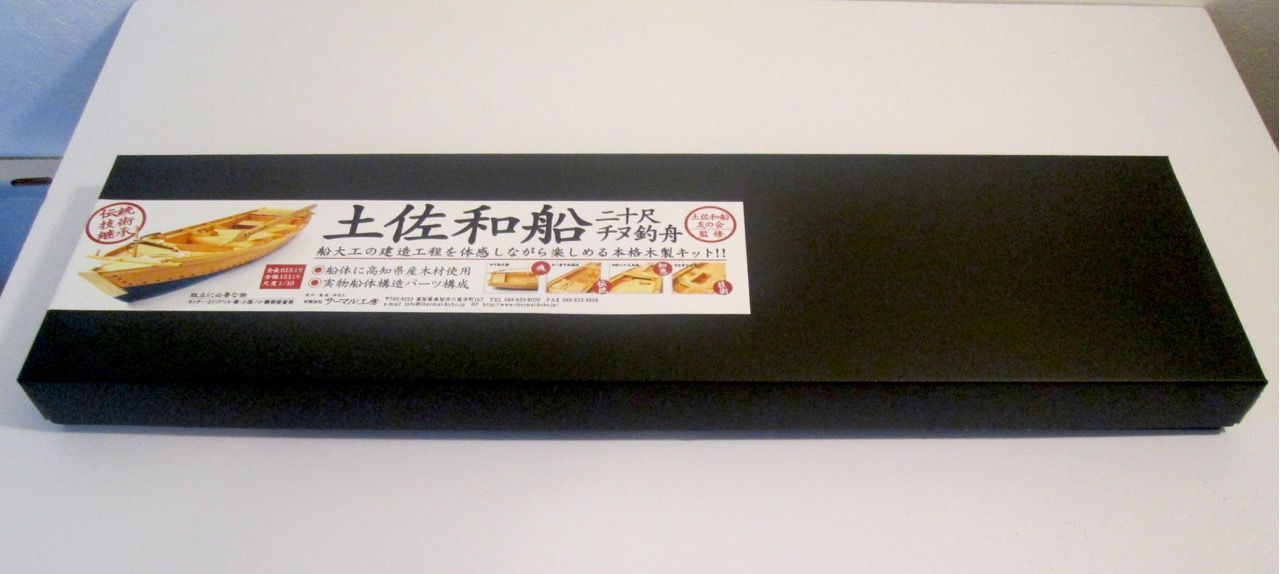
The kit is not all that heavy, about 1-1/2 pounds, but it’s in a long box. I think this kicked the shipping cost up a bit, which was just about $30. Still, a ship model kit, particularly one this rare, for around $170 total, is not bad. That’s just about what I paid for the Woody Joe Hacchoro and the Yakatabune kits I bought from Zootoyz.

IMG_0157

Having ordered through Amazon Japan, the only seller of the kit did not ship internationally, so I had it sent to someone that then re-shipped it for me from Japan and they didn’t charge me any service fees. He’s done this twice for me and I don’t want to impose on him any further. There are companies specifically set up to forward packages from Japan. I just finished setting up an account with one called Tenso.com. Next time, I’ll try them out.

By the way, it looks like I may have been wrong about this kit being out of production. I thought it was no longer manufactured because the company that makes it, Thermal Studios, primarily makes large model glider kits and doesn’t list the Tosa Wasen kit at all. However, I emailed them about it and if we understood each other correctly, they produce the kit. Perhaps it’s more of a local item since they are apparently close to Tosa, Japan, and seem to have some kind of connection with the Tosa Traditional Boat Society. Continue reading

Tosa Wasen – Japanese Fishing Boat Kit

A couple weeks ago, I was checking Facebook posts and I saw one from my friend Morikawa-san  who runs the Japanese online hobby shop Zootoyz. He’d posted a Japanese build log that I’d seen quite some time ago regarding the building of a large-scale model of a work boat from the area of Tosa, Japan. When I first ran across the blog, I searched for the kit’s manufacturer, but noted that they no longer produce the kit. It was 6 months to a year ago when I first learned about the kit, so when I saw Morikawa-san post a link to the same blog, I was hopeful that I had gotten mixed up before and that the kit was still in production.

Looking around the Internet again, I found no indication that it was in production. But, thinking about it some more, I remembered that I’d found an out of production wooden Japanese ship model kit on Amazon-Japan before. So, I went to Amazon.co.jp, and used my familiarity with the American site to stumble my way around the Japanese site.

Going back to the posts about the kit, I found the text for the name ”土佐和船” and did a little copy/paste into the search field… And there it was! Available, yet! Well, at least there was one available. Turns out it really is still out of production, but here was an old stock kit for not a whole lot more than the original pricing.

11224318_1065597873491157_360908378737328974_n

Instead of the 13,650円 as originally marked, it cost me about 17,000円, which is about $140. I think if it had been listed by someone on the US Amazon.com site, they would have asked twice that amount, so I was happy to pay the $140. There was one hitch. The kit only ships within Japan. But, I’d dealt with that before by enlisting the help of a friend in Japan to serve as a kind of a shipping agent. I had the kit sent to him and he shipped it to me.

Shipping has been all happening very quickly, but I won’t receive the kit until Friday or Saturday this week. I’m really excited about this find. Morikawa-san has looked into the possibility of carrying this kit, but the manufacturer, a glider manufacturer called “Thermal Studio” lists it as “out of stock”. Now, why a maker of glider kits would make a traditional Japanese boat kit, I have no idea. I suspect it has something to do with the company’s close proximity to Tosa and the existence of a Tosa Traditional Japanese Boat Society.

I’m hoping he’ll be able to convince the manufacturer to produce the kit again. I’d love to be able to write up a magazine article on this one as it looks nicely detailed, very authentic, and at 1/10-scale, it’s just about 2 feet long – a nice size.


51PcOLPqd-L


51dQ9jex4UL


In any case, I’m planning on starting a build log on Model Ship World, and with the NRG conference in San Diego next Fall and the possibility of Douglas Brooks doing another talk on Japanese traditional boats, this should fit in quite well there. Not to mention the fact that it will greatly enhance my Wasen Display in Japantown, San Francisco.

But, one of the things I’m really looking forward to is how it may help me further my understand of traditional Japanese boats given that this kit appears to be extremely authentic – more so than most of the Woody Joe kits in detail.


41X0bKNS3wL 41jY6MzEt4L

Also, I’m interested because I’m doing the preliminary work for scratch building an Urayasu Bekabune, one of the boat documented by Douglas Brooks during his Japanese boatbuilding apprenticeships. While this is a much different boat, I see some design elements that may help me figure things out on the scratch project.

Finally, given the rarity of this kit, I’m probably not going to build it directly. Rather, I’m probably going to use it as a pattern to try scratch building a model from. Just from looking at the build logs and photos of the contents, I can see that this kit has some interesting design elements that I’m interested in.

For one thing, I believe this kit may be of a style that actual traditional Japanese boatbuilders would use to build models of their own work. For one thing, the scale, 1/10, is the same scale that the boatbuilders used when creating their plan drawings (traditionally drawn on a wooden plank). For another, from the photos, it appears that this kit might actually use the same kinds of woods used to build the actual boats. Specifically, it looks the the hull planks may actually be made from Sugi, or Japanese Cedar, while some parts like the stem and beams appear to be a lighter, creamier color, suggesting to me that they are made from Hinoki, or Japanese Cypress.

Of course, this is all just speculation based on photos. I’ll get a better idea when I see the kit, which should be very soon… I hope! Ω

Japanese Wasen Model Display in San Francisco

This week has been a kind of crazy week of dealing with the display of ship models. I now have 4 models out on display. Two of them are part of a display at the San Mateo County Fair headed up by the South Bay Model Shipwrights club. The other two are part of my own display that I’ve put together in the big window of Union Bank’s community room in Japantown, San Francisco.

The models are my Higaki Kaisen and Hacchoro models that I built from Woody Joe kits. The display is my second now, and I’ve learned a lot from my first display that I put up earlier in the year. That display was small for the window area and the models were hard to see and the display was not very attention grabbing.

This time around, I’ve had posters printed up using some new photos I’ve taken. I mounted these on foam core poster boards and also set up a large display board with 8″x10″ photos showing details of the models. To make the models easier to see, I removed them from their cases and raised them up closer to eye level by placing them on some pedestals I made from MDF board.

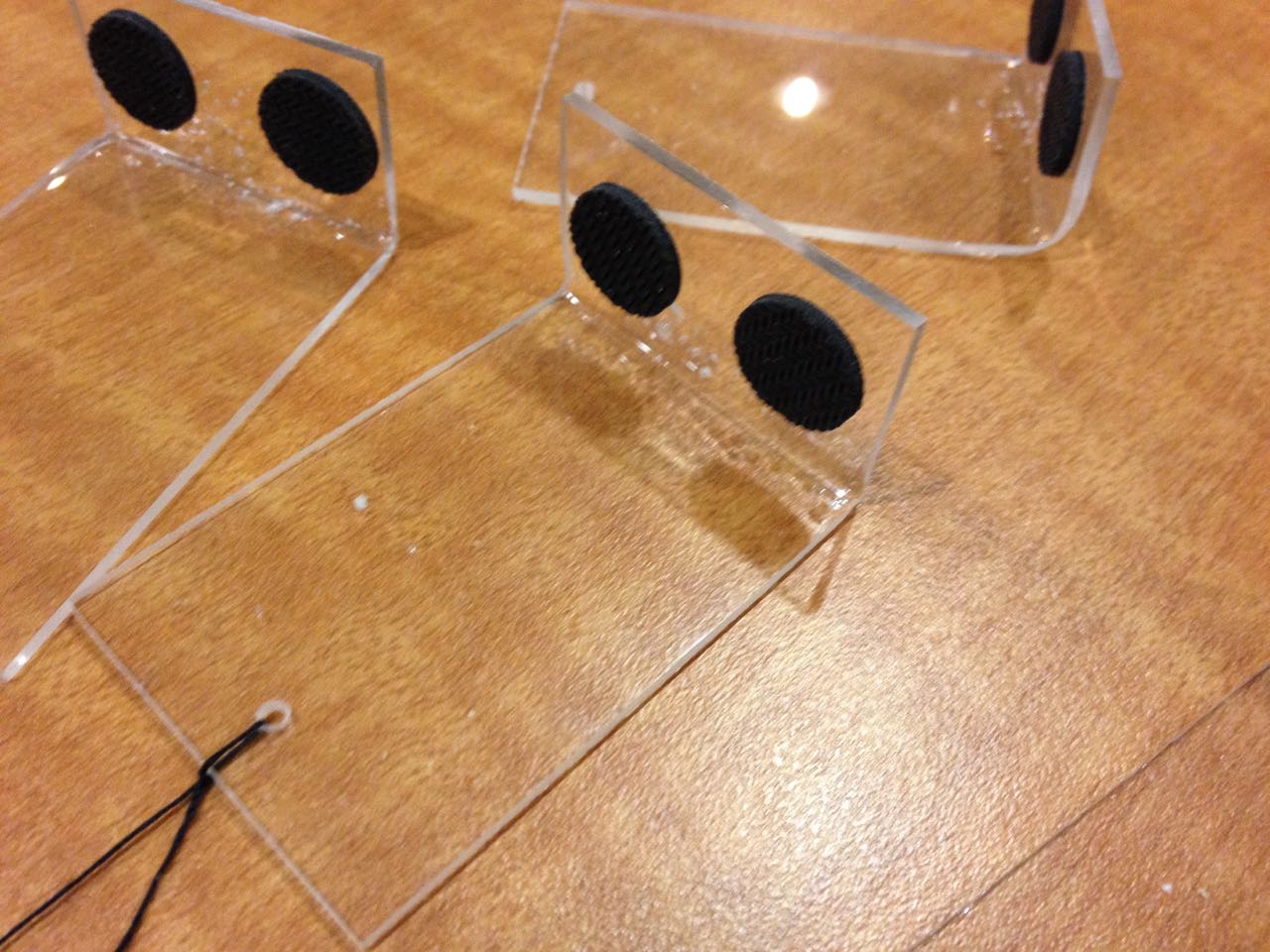
At the last minute this morning, I cut some acrylic sheet into strips and made some plastic clips to hang the posters from. The strips were cut to size and drilled and then heat bent to shape using a small torch. They aren’t perfect, but they work.

Late this morning, I crammed everything into my car and drove to San Francisco to set it all up.

IMG_1091

Models set up and ready to put on display.

IMG_1088

Homemade clips for hanging the posters.

This time, with all the display elements, it took me a lot longer to set up than I’d expected. I could imagine what it’s like to work setting up displays in department store windows. Overall, it was a good 45 minutes to bring everything up from the parking garage and to set it all up. The posters and the hangar clips took the most time to set up so that the posters hung at the right heights.

I felt I was kind of rushing the layout. It would definitely be helpful to get a second person to help with this so that one person can look at it and recommend adjustments while the other put the display elements into place.

In the end, I think it all worked pretty well and I’ve definitely got thoughts of Wasen Display 3.0 starting to develop. Having the third model will be good, which will most likely be Woody Joe’s Yakatabune as that’s a nice looking model and a quick build.

IMG_1093

Higaki Kaisen model.

IMG_1092

Photo Board and Hacchoro model. Note the hanging posters.

One thing I realized was that every time I’m in the mall where I have time to take photos, it’s roughly noonish and the sun comes streaming straight down through the skylights in the mall. So, I mostly get a lot of glare in these photos. I think at other times of the display, it is much easier to see the models and photos. I’m going to have to check out that theory and take some photos maybe late in the day or evening early evening. Maybe I can get some decent photos of the display then.

IMG_1096

A much improved display over the last one.

Wasen Display 2.0 will run from Friday, June 5th through Friday, July 10th. I hope you will stop by to see it and let me know what you think!

Higaki Kaisen Display at San Francisco’s Japan Center

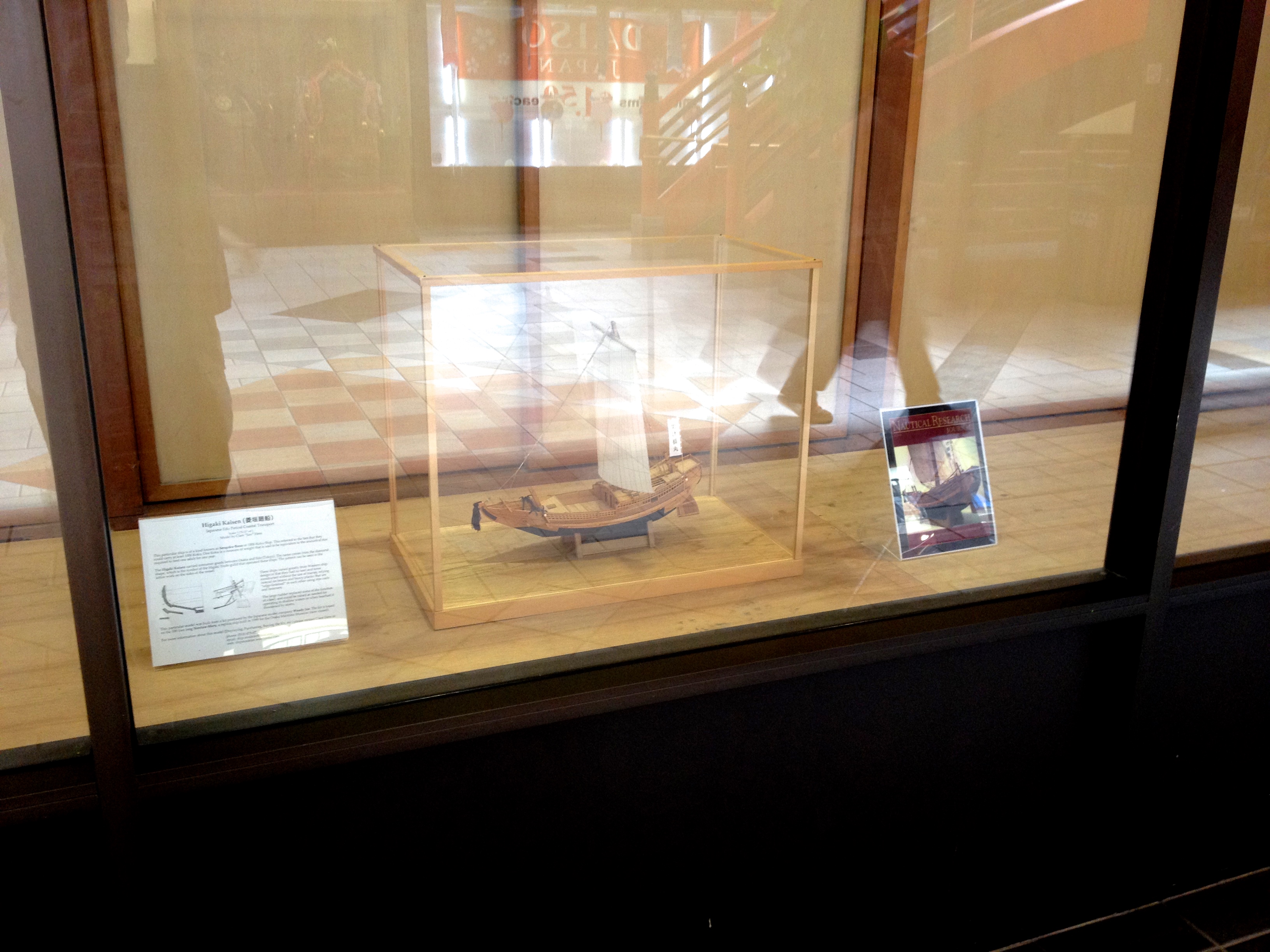
It’s official, my Higaki Kaisen model is now on display in the East Building of the Japan Center Mall in San Francisco’s Japantown. The model is in the window display of Union Bank’s Community Room.

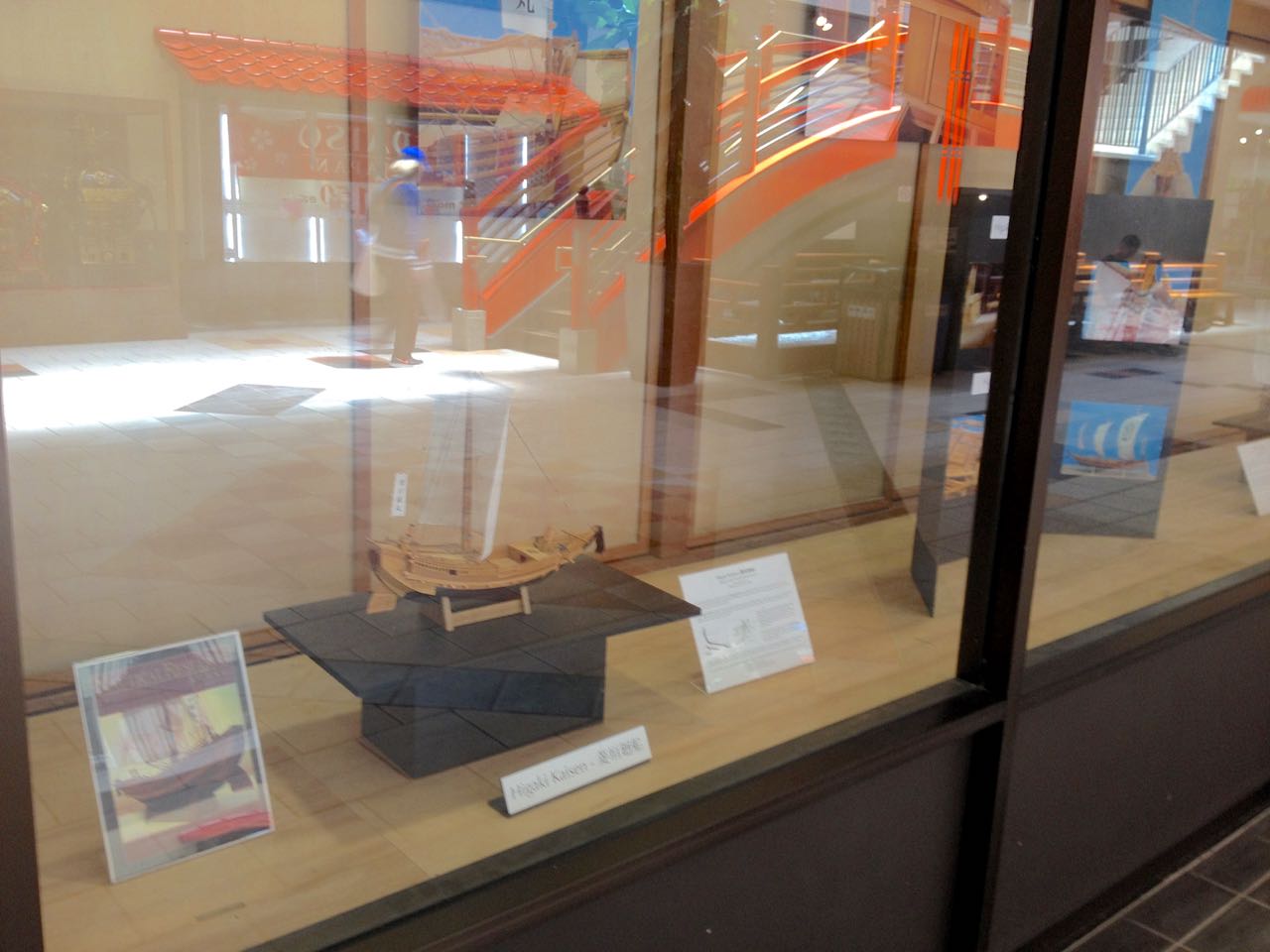
The model is in a case made using a Woody Joe case kit. I made a couple informational displays to go with it. Sorry about the quality of the photo. Shooting through glass in brightly lit open area doesn’t work out so well. Maybe with a polaroid filter – do they make those for iPhone cameras?

IMG_0764

My Higaki Kaisen model in the window display at Union Bank’s Community Room in San Francisco’s Japantown.

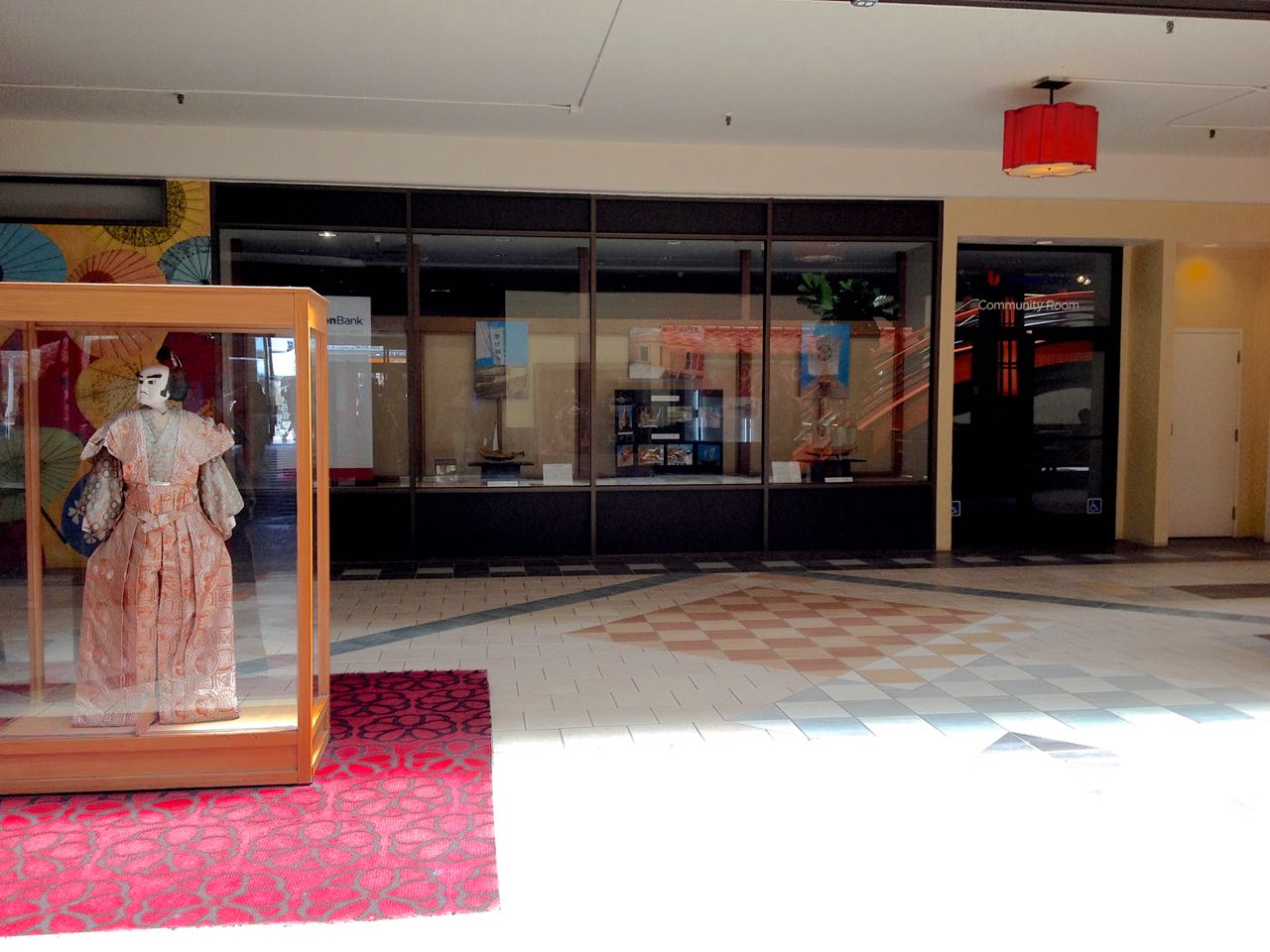
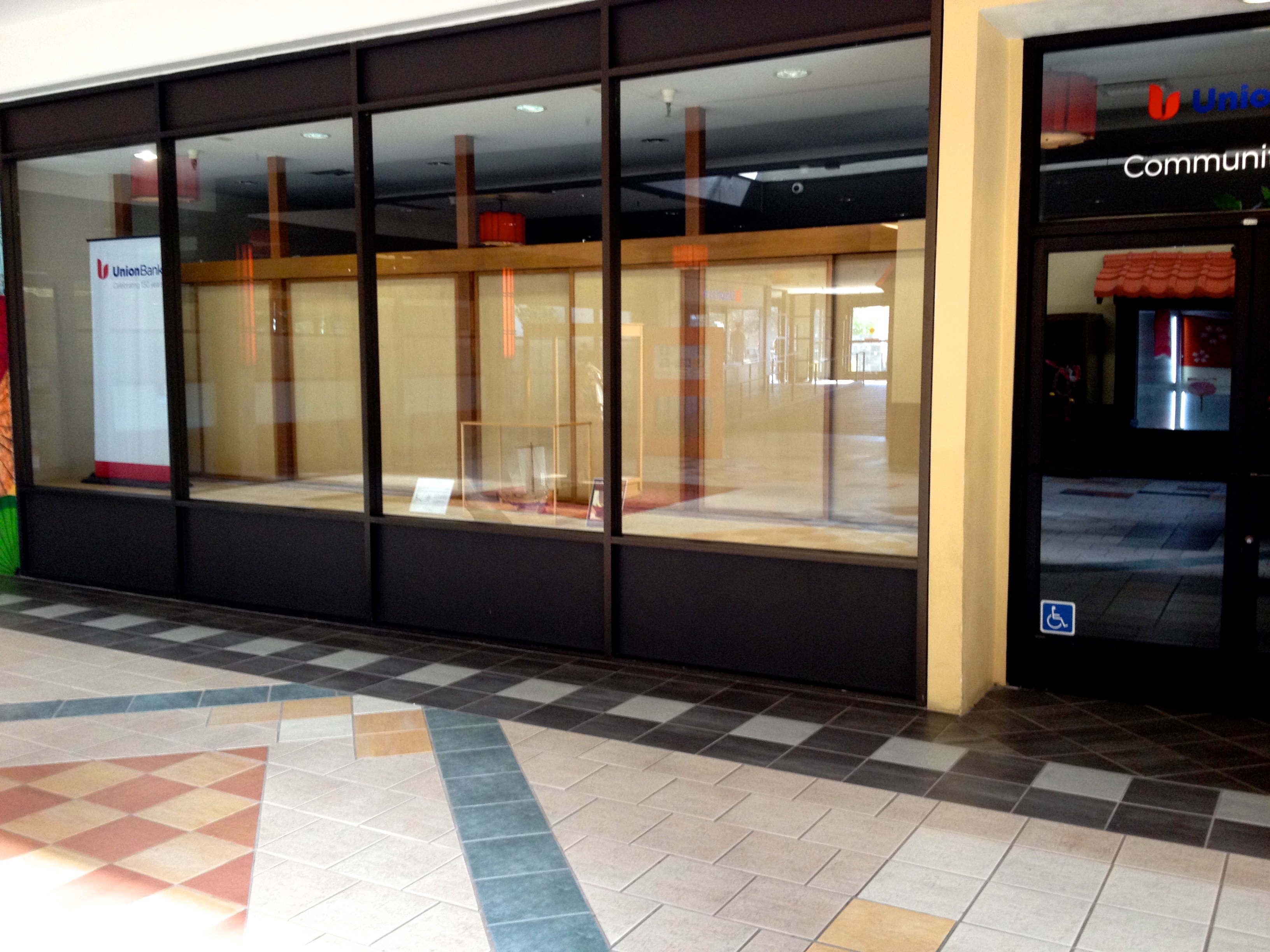
The bank administrator was very happy with the display and cleared out all the general promotional bank stuff that’s normally in there. The model will be on display from now until about April 3rd, when SF Cherry Blossom set up takes place and a Japanese doll display goes in. We’ve already discussed the possibility of bringing the model back after some time in May when the display case may become available again.

IMG_0762

The display is right off this open courtyard. What looks like a bridge is actually a stairway.

The only thing is that the model looks awfully lonely in the big display window. We both agreed that there should be two other models to accompany it – the display window is just laid out perfectly for that.

IMG_0767

My model seems sad to be all alone in the big window.

Now, I do have a partially completed Hacchoro model, which will actually be larger than the Higaki Kaisen model since it is at 1/24 scale. I just need to finish it and get another display case. Not sure what to do about the empty third spot. I have the large Sengokubune kit, but it’s unstarted, and there’s no way I can justify taking the time to build it with all these other projects waiting for me.

Woody Joe’s 1/24-scale Yakatabune kit is a possibility as it’s almost identical to the Hacchoro in construction except that instead of all the oars and sails and accompanying details, it just has a deckhouse. That would be a pretty quick build and it would fit the theme very well.

Lastly, because of the low position of the floor of the window display, a friend of mine was suggesting maybe putting in some kind of box stand. I suppose anything would work. Lot of possibilities here. Almost screams for some kind of diorama.

Thinkin’, thinkin’…


Higaki Kaisen in NRG Journal

I got a nice surprise a couple months ago when the editor of the Nautical Research Journal, Paul Fontenoy, asked me to submit a short article on my Higaki Kaisen model. So, a while back, I sent him some photos to use and a very short write-up with some captions to accompany the photos. Then, I got an even nicer surprise when I was told the model would appear on the cover.

Cover NRJ 59-3 for Web-1

Having been an NRG member/supporter and having long admired the models that have graced the pages of the Journal, this was a really tremendous honor. Now, I’ll have to admit, it really the model subject and the uniqueness of the kit that got the model on the cover and not my artistry or craftsmanship. But, still it’s pretty nice to see it there.

Of course, being that I’ve been advocating Woody Joe kits here, it’s great to get people’s attention this way. I got an extra copy of the issue and sent it Woody Joe and they should be receiving it any time now. I’m sure they’ll be very happy to see their kit receive such attention.

The timing of this article probably couldn’t be any better, as I just submitted the proofs for my Higaki Kaisen kit review article, which will appear in Seaways’ Ships in Scale in the next few weeks. As for my history/build article for Ships in Scale, I’ve been getting pretty distracted with all the projects I’m trying to get done. But, with these articles both out in August/September, I’ll need to get back on it very soon.

But, while I’m mentioning the NRG here, I would like to say that this is a really fine organization, dedicated to ship modeling, and it deserves and needs your support. It’s not all academic and it’s not about being “purists” or anything of the like. The tagline “Advancing Ship Modeling Through Research” is just to say it’s about making better models, it’s about helping the modeler make better models, it’s about getting help to build better models.

Seeing my own model on the cover, I can’t help but wonder when the last time was that a kit build was featured on the cover? Times really do change. So, join the NRG. It’s a great organization, you’ll be supporting a great cause (ship modeling) and you’ll get your quarterly issue of the Journal!