Building Woody Joe’s 1/72-scale Kitamaebune Kit – Part 8

More and More Copper Details…

This project stalled a bit while I was adding the copper coverings detail, which I’ve actually been making using brown permanent adhesive vinyl that I laid out and cut using my Silhouette Cameo 3 machine. The slow down is simply due to the amount of small details I’ve been feeling I need to make.

As I’ve written earlier, I reproduced the kit-provided shiny copper pieces with vinyl ones using the Cameo’s feature called PixScan, which allows me to use a specially marked mat on which the parts are placed and to take a photo of the them. This gets imported into the Silhouette Studio software and I am able to recreate the parts from the photo.

Part of the process is automated, but it works much better for larger objects. The small parts in this kit require that I do a lot of editing to sharpen up and straighten up the cut lines.

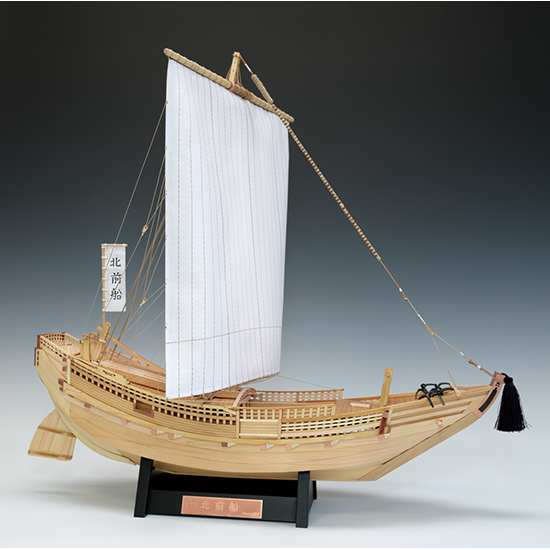
Woody Joe product image of the completed Kitamaebune kit.

In addition to those parts, I’ve been studying my photos of the Hakusan Maru, the kitamaebune on Sado Island, to figure out what other copper plates I need to make. There are a LOT of copper coverings on these ships, so the project seemed a bit overwhelming. Each part had to be measured on the model, which does not correspond exactly to this particular ship, and drawn in the Silhouette Studio software. Then, the Cameo cutter was set up with a piece of the same brown colored vinyl on a light adhesive cutting mat, loaded up, cut, unloaded, vinyl removed from the mat, mat put away to keep it clean (more like keeping it from getting too dirty). Finally, the pieces are carefully applied to the model.

Stern of the Hakusan Maru on Sado Island showing all the copper plates and the iron work on the rudder.

Bow of the Hakusan Maru on Sado Island showing lots of small copper plates on the real ship.

Continue reading

Building Woody Joe’s 1/72-scale Kitamaebune Kit – Part 7

The Tenmasen

This Woody Joe kit does not include a tenmasen, which is the small ship’s boat used for transferring crew and cargo to and from the ship, but neither did their Higaki-kaisen kit. The tenmasen is normally carried across the deck, atop the kappa, which is the small forward cabin where ropes and sails are stored. They are used by the Higaki-kaisen as well as the Kitamaebune.

Image from a Tokyo Maritime Science Museum book on bezaisen such as the Higaki Kaisen and Kitamaebune. Note the tenmasen forward of the open main deck.

Up to now, all the tenmasen I’ve seen illustrated have been pretty heavily constructed boats, propelled using one or two ro, or sculling oars. In contrast, the tenmasen recorded in the Paris illustrations is very wide and flat, appears somewhat lightweight, with a shallow draft, and is equipped with a pair of sculling oars, as well as 10 paddles, which are used much like western-style oars.

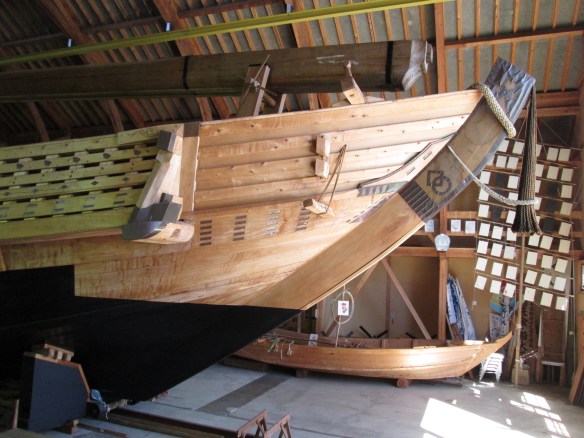
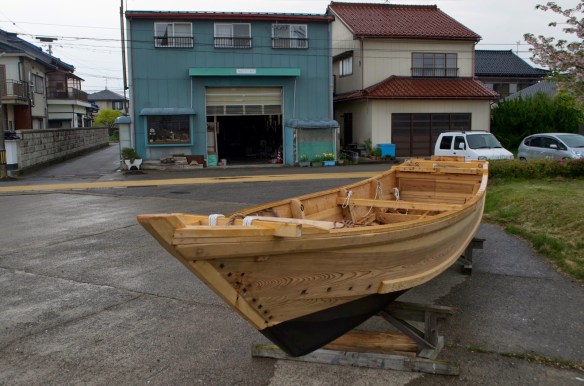
Tenmasen reconstruction at the Hakusan-maru Museum on Sado Island.

Continue reading

Building the DNB Maru – A Niigata Honryousen – Part 4

I’m going to keep this posting short, as it’s kind of a major milestone, with the finishing of the boat’s basic hull shape.

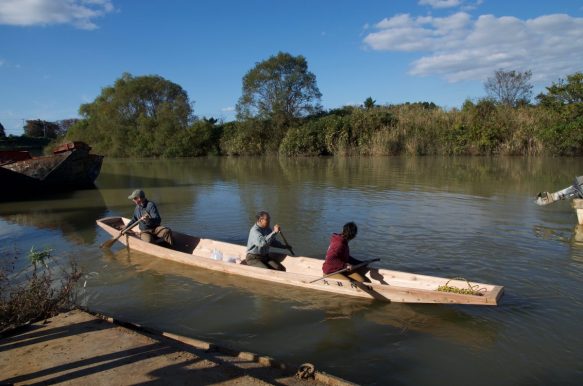
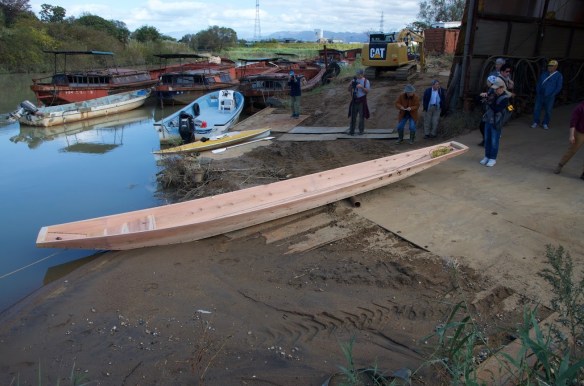
The full-sized honryousen completed and on the water. Photo by Benjamin Meader.

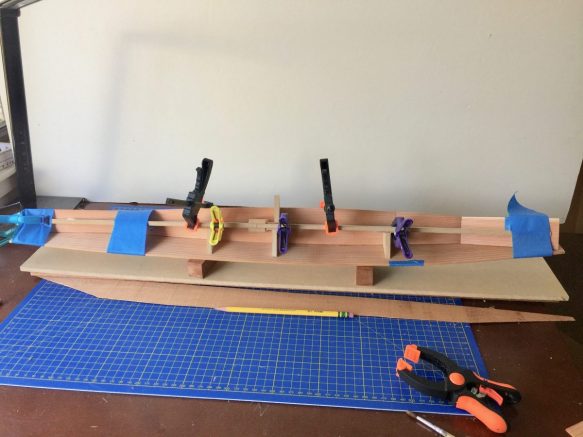
With the hull planks, locally called hoteita (ho-tey-ee-tah), glued into place, the bottom edges of the hull planks were easy to trim, as they just had to be flush with the bottom. For the top edge, I had some measurements to go by, and I used thin strips of wood to use as battens, clamping them into place along the inside of the hull. The top edges of the battens marked the top edges of the hull planks.

With the battens clamped in place, I made adjustments to the height at various locations along the hull. But, the most important thing was to make sure it was a fair curve, Once satisfied with the curves, I marked the hull planks with a pencil line drawn along the top edge of the battens, then started the process of whittling the wood down to that line.

I used a large hobby knife to trim away the bulk of the excess, paying close attention to the wood grain, which wood would split along. When most of the wood was trimmed away, I then used the mini-block plane to do the fine shaping. A little final go with a sanding block cleans up any little variation.

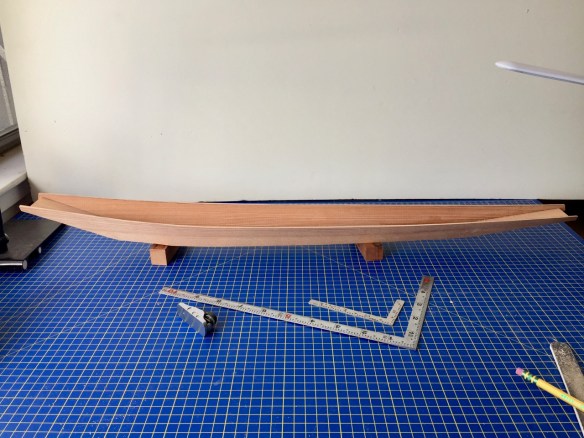
The mostly final curve of the hull. In front of the model, you can see my Japanese squares marked in shaku/sun instead of feet/inches. Also, there’s the miniature block plane I used for the fine trimming.

The next steps of the major construction issues are the addition of the single beam of the boat, and the blocks that fit at each end of the boat. The beams are called funabari, but I don’t know the term for the blocks at the ends of the boat yet. Looking into that now.

These parts are made from a lighter-colored wood on the real boat, though I’m not sure of the exact species. For my model, I’ll use hinoki, which I now have a small supply of.

Building the DNB Maru – A Niigata Honryousen – Part 3

Planking the hull is a somewhat tricky process. There are no frames to glue to, so clamps are next to useless, except to hold the former in place. Also, this is an open boat that, like the full-sized boats, will have no finish on it. It’s too small to nail together, so the hull will be held together with wood glue.

CA, or instant glue, will stain the bare wood. If I were to apply a finish on the completed model, I might be able to get away with using CA. But, with unfinished wood, it will mar the model’s appearance. To keep it looking as clean as possible, I’m using yellow carpenter’s glue, which cleans up with water. The only issue is that the parts will need to be held together while the glue sets.

Since I can’t use clamps, tape is being used to hold the planks in place while the glue dries. For this, I’m using low-tack painter’s tape.

Continue reading

Building the DNB Maru – A Niigata Honryousen – Part 2

Construction of the Honryousen model began with gluing patterns to the wood for the shiki, or hull bottom, and the ottate, which I am told is an informal local term for the bow and transom planks. From an earlier build of a kawabune (riverboat), I learned that the common formal term for the bow plank is omote no tateita and the term for the transom plank is the tomo no tateita.

Honyousen side profile I created in Adobe Illustrator

Patterns were simply printed on large format paper and glued to the wood using rubber cement. This stuff sticks well enough and rubs off pretty cleanly after it has dried.

When I started this project, I wasn’t sure if I needed to build a former for it, like I have for all the other scratch built wasen models I’ve made. The former serves as a temporary backbone and framework that wood hull parts can be clamped to while gluing into place. Instead, I thought I might be able to hold the parts together and band them into position using clamps and such, much like the real boats are constructed.

Continue reading

Building the DNB Maru – A Niigata Honryousen

In 2019, boat builder Douglas Brooks had developed a project together with Nina Noah of an organization called The Apprenticeshop, to go to Japan and build two traditional Japanese boats with two different Japanese boat builders.

The two boats were a Niigata kawabune called a honryousen built with Mr. Nakaichi Nakagawa, and a Himi Tenmasen, built with Mr. Mitsuaki Bansho.

Photo courtesy of Douglas Brooks

The Honryousen, or simply Honryou, is a riverboat built in a style called itaawase, which simply means “plank joined”. That the term refers to a boat built entirely of planks, including the bow and stern – basically one with no cutwater. While not exclusive to Niigata prefecture, this was very common on the rivers there.

The Honryousen that Douglas Brooks built was dubbed “DNB Maru”, named for Douglas, and the two people from the Apprenticeshop that came with him to Japan, Nina Noah and Ben Meader.

If you would like to read about the two projects and view a couple videos, I recommend visiting the Apprenticeshop blog here: https://www.apprenticeshop.org. Continue reading

2020 New Year’s Explosion of Wasen Model Projects

I’m constantly studying and reviewing information about various types of wasen, or traditional Japanese boats, that I could possibly model. Sometimes it takes a long time, searching for information in books and on the Internet, until I have enough knowledge, drawings, and photos to get started on something.

I spend time researching and studying subjects based on what information I can find. Often, following a lead that takes me to some other website, or maybe suggests the availability of a book that might be useful. In all cases, I travel up an information stream that eventually just dries up. Then, hunting around, I find some information on a different subject, often repetitive, but sometimes providing some information on an altogether different subject.

So, I end up with all these incomplete branches of study. When interest and clues lead to a discovery, or when it just feels like I have enough information and probably won’t find a whole lot more, a project is born. I gather together the information, create drawings or scale existing ones, and start making templates for hull construction.

But, more often, I sit on a potential project, waiting for more information – waiting to decide if I really do have enough information and to decide if I have enough understanding to successfully build a model from what I have. Sometimes, a project is simple enough that I decide I can get started. Sometimes, the potential model size or the details leave me hesitant about how I want to proceed. So, several potential projects sit on my desk and on my computer, waiting for the inspiration to start it.

Well, it seems that the new year has created a lot of inspiration and there are several potential projects to take up. The inspiration has fired off on several of these all at once. Plus, I’ve been tasked with a couple in addition. So, in addition to finishing up the Woody Joe Kitamaebune kit, and adding some more details to my Kobaya from Paris drawings. The following have sprung to life:

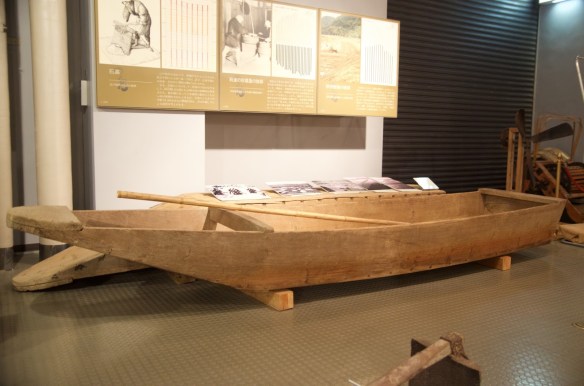
Himi Tenmasen – I’ve been tasked with building a model of the small boat that Douglas Brooks and students built with Mr. Mitsuaki Bansho in Toyama prefecture. Originally, the plan was to build two of these for him, but for budgetary reasons, that’s been scaled back to one, plus a Honryousen model (see below).
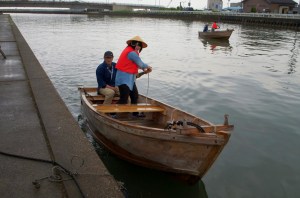
Honryousen – This project to model a Niigata kawabune is a fallback from plans to build a second Himi Tenmasen for Douglas Brooks. But, in actuality, it would have happened anyway. It’s a pretty simple subject and should be quick to build. The original was built with Mr. Nakaichi Nakagawa.
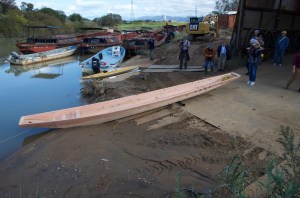
Senzan maru – This is one of the more ambitious of the projects which I now feel has to see the light of day. This Edo period whaleboat-type craft was owned by the Hachisuka clan of Tokushima prefecture. It is a particularly important project, as it was made possibly by my Japan research trip back in 2016, for which I received a lot of support from friends and family. For this project, I have a book and drawings published by the Tokyo Museum of Maritime Science.
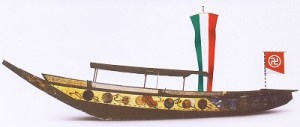
Tonegawa Takasebune – One of the great mysteries to me has been the details of this important river cargo transport of old Edo. There’s much mentioned about these boats which carried food and bulk goods down river to the bustling metropolis of the Japanese capital, but it’s been difficult to find enough technical details to feel comfortable taking on a build of this type. But, the design is actually pretty simple, so I feel there’s no reason to wait on this one any longer.
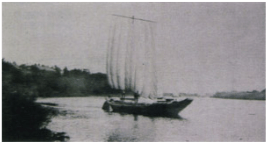
1/20-scale Hozugawa Kudaribune – I’ve modeled this boat in smaller scale and it’s a beautiful boat. I was planning on sending the 1/40-scale version off as a gift. And, while that gifting is on hold at the moment, I still don’t want to be without a model of this boat, so I’m just scaling up what it did before, but with maybe some adjusted details.
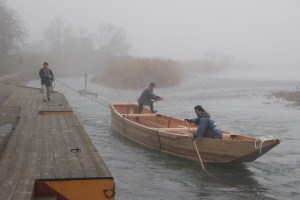
Sekobune – A chaser-type whaleboat is particularly significant right now, as a number of my fellow NRG (Nautical Research Guild) members attended a conference held at the New Bedford Whaling Museum in Massachusetts. As it turns out there is a beautiful model of a Japanese whaleboat on display there that was brought there by one of my Japanese contacts. I was sent many photos of this model by friends in the NRG and offers of assistance from my Japanese contact, who happens to be the curator of the whaling museum in Japan. With a set of plans in hand, this project is calling for me, but at what scale?
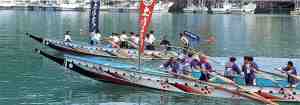
 

So, it does all seem to be happening at once. But, that’s not a terrible thing. At least I don’t feel stuck. The Honryou will likely be the first started and finished, since it is such a simple design – It basically only has 5 planks, a beam and some boards that make up a seat. Now, I just have to get some measures for it. Ω

Zutta Tenma in 1/10 scale – Himi Rice Field Boat – Final

The Zutta Tenma is a small Tabune, or rice field boat, from Toyama prefecture. My model is based on a drawing that I got from Douglas Brooks, which is very similar to one he used when he built one in 2016.

Todate/Transom

The todate or transom on my drawing is in two parts. I could have, made it from a single piece, but I chose to make it in two pieces. Unfortunately, the drawing doesn’t show how these are fastened together. To keep the model simple, I’m assuming that nails of some type were driven down from the top through the short piece of the todate. This is then covered by a board, the name of which I don’t know.


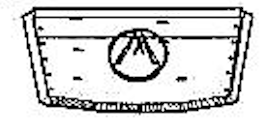
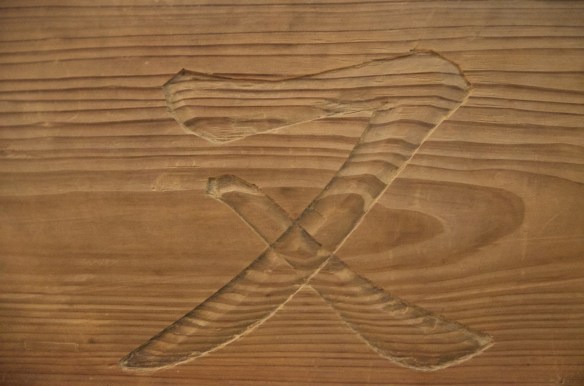
On the face of the todate is a carved symbol of the owner. I don’t know a whole lot about these, but was told it was a yago. That doesn’t make a lot of sense to me, as I thought a yago was a house name. The above is a from the plans I’m using. It shows what appears to be twin mountain peaks inscribed in a circle – clearly not a name. The other plan shows what looks like a Chinese character. It looks similar to this one, 又, but it doesn’t make much sense as it is the word mata, which means “also”.

Continue reading

Zutta Tenma in 1/10 scale – Himi Rice Field Boat – Part 2

The Zutta Tenma is a small Tabune, or rice field boat, from Toyama prefecture. My model is based on a drawing that I got from Douglas Brooks, which is very similar to one he used when he built one in 2016.

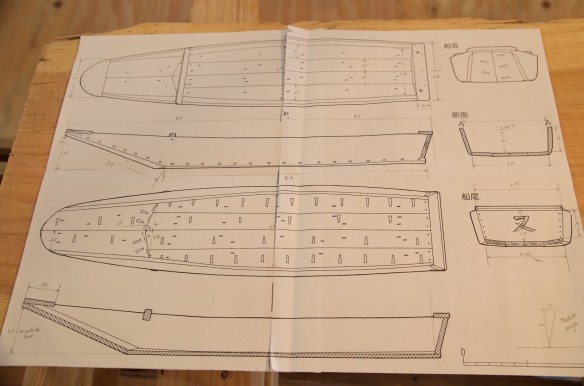
Photo of the drawings used by Douglas Brooks to build a Zutta Tenma in Himi in 2016. Photo courtesy of Douglas Brooks.

This drawings varies only slightly from one I used, which I believe was published in a museum book on boats of Toyama prefecture. I managed to find a couple of these books on Yahoo! JAPAN Auctions and used my Buyee.com account to purchase it. This, by the way, is a very useful buying service, which allows you to view products in english and ship them to a Japanese address, where they handle the international shipping for you. It’s very easy to use and gives you access to lots of great stuff for sale in Japan.

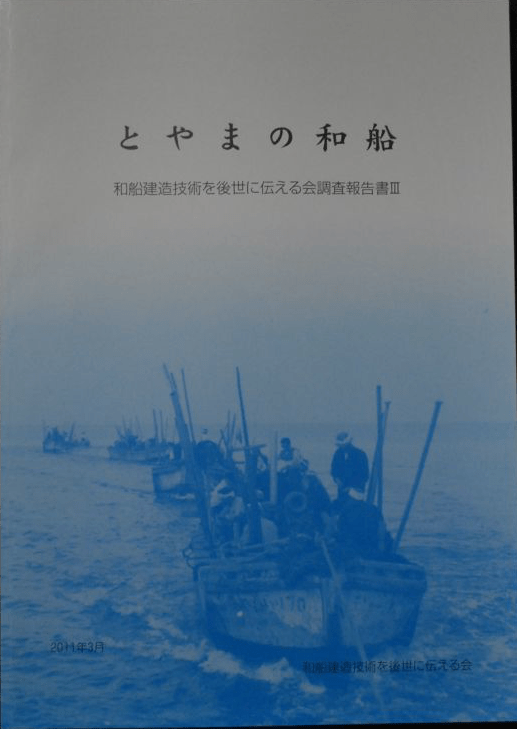
One of two books on traditional Japanese boats of Toyama prefecture that I just purchased.

Continue reading

Zutta Tenma in 1/10 scale – Himi Rice Field Boat

In early 2016, Douglas Brooks was in Himi, Japan, to build a small Tabune, or rice field boat, known locally as a Zutta Tenma. He is back in Japan now, on his way back to Himi, this time to build a general purpose boat that I’m told is simply called a Tenmasen.

As part of a fund raising plan, I’d agreed to build a couple models for fund raising purposes for him for a nominal fee. This will happen some time in the next 6 months, probably, as I wait for more details on the boat’s construction.

Himi Tenmasen

In the meantime, Douglas was also in Niigata prefecture, where he worked on a very simple river boat which has been called a Nouninawase or Itaawase, or as I just learned today, a Honryousen.

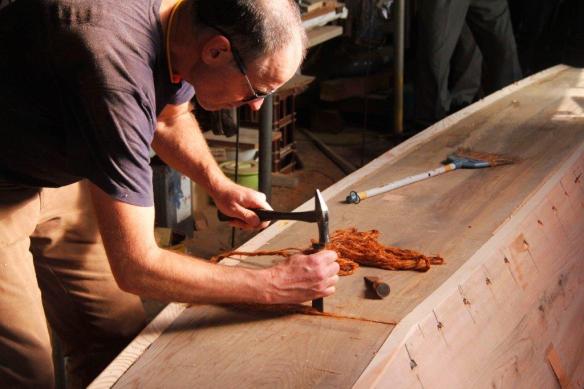
Douglas Brooks caulking a seam on a Honryousen

I’m not sure if it’s going to happen, but Douglas was interested in getting a model of the Honryousen he just built, so I’m waiting on some dimensions on that too.

But, while I’m waiting for information on those, I decided that I really haven’t done all that much in the way of a model of a boat that he’s built, and I’m about to build two. So, I figured I’d better get a head start and get in some practice by building a Zutta Tenma model.

Zutta Tenma were boats used in and around the rice fields of the region. This one is a smaller type and has a very simple design. My understanding is that these were not built by boat builders, per se, but by builders who specifically built these tabune, or rice field boats.

Zutta Tenma in a museum in Himi, Japan

The boat is only about 12 feet long, so I’m going with a 1/10-scale model. At this scale, the model will be about 14 inches long. This also allows me to put in the mortise detail, which is hard for me to do at smaller scales. It also keeps the model from seeming too simple. Unfortunately, most of the interesting detail is on the underside of the boat, so you won’t be able to see it unless the model is displayed upside down.

For the most part, I think the boats look best on a simple wooden base. But, a mirrored base, would allow a viewer to see the bottom of the boat as it sits upright. I’ll have to think about this.

You can read more about Douglas Brooks’s 2016 Zutta Tenma project on his blog here: http://blog.douglasbrooksboatbuilding.com/2016/02/the-rice-field-boat.html