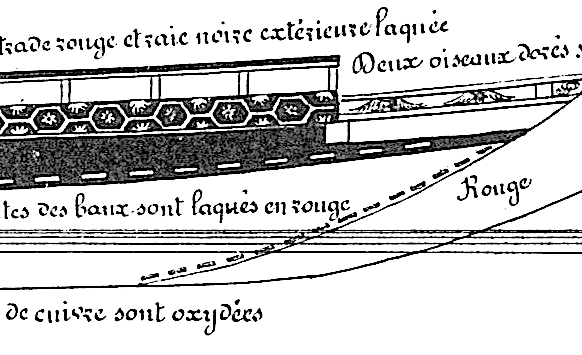
Note the pattern of the chain of hexagons and what look like little sunbursts in the Paris drawings.

Note the pattern of the chain of hexagons and what look like little sunbursts in the Paris drawings.
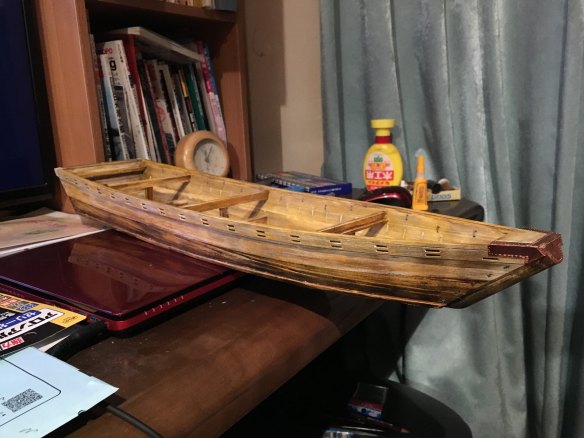
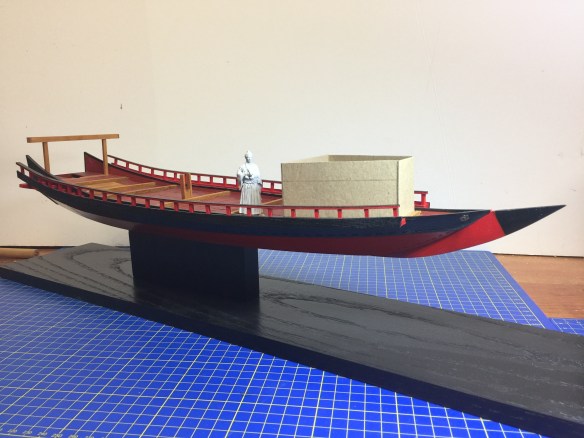
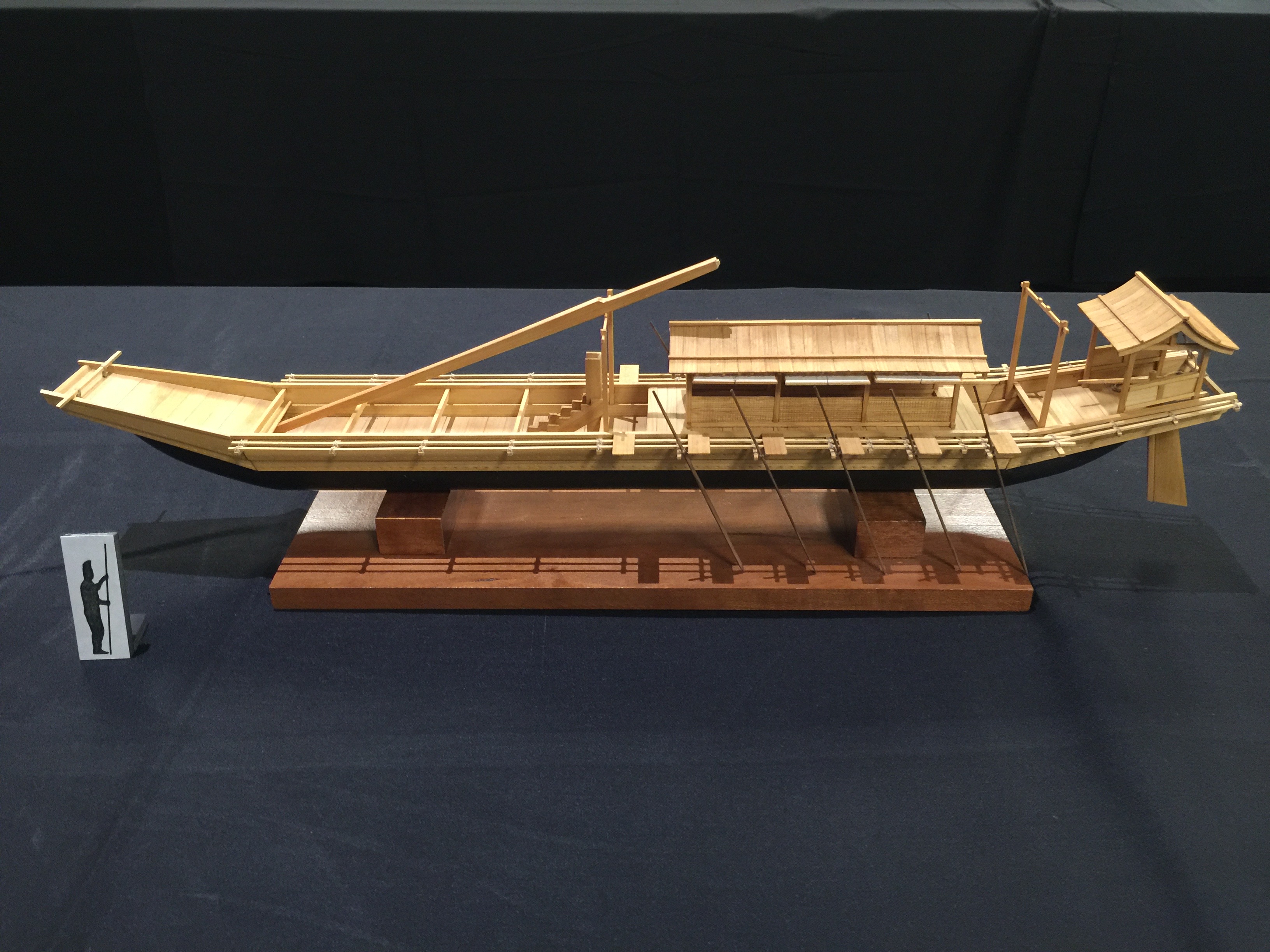
I completed what I believe is a good final draft of the Tenma-zukuri Chabune from the Funakagami, and I’m now working on my model. However, it appears that I am already late to my own game. Model builder Kouichi Ohata has already completed his model in 1/10 scale, and he’s done a beautiful job with the boat as well as with all the added details!

Kouichi Ohata’s model
With the help of fellow modeler Kouichi Ohata and my mentor Douglas Brooks, I’ve gone through several revisions of the plans – seven major ones, so far.
The biggest difficult has been in analyzing the single wood-block print of this type. Compared to other boats in the Funakagami, this one has a very flat bottom, showing no real rise at the stern, which may be possible, but it’s really throwing people, as it seems very unusual for a Japanese style boat. Continue reading

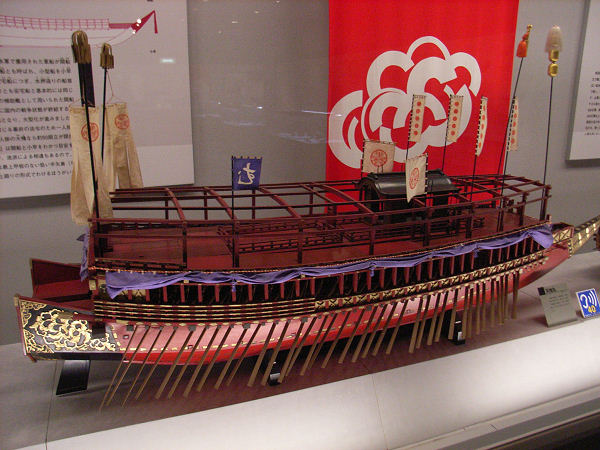
The restored yakata from the Naminashi-maru at the museum of Kumamoto Castle.

Work on the drawings of the Tenma-zukuri chabune continues. Over the past months, I’ve been making changes to my drawings of this wasen that I found in the the Funakagami. With the help of fellow modeler Kouichi Ohata and my mentor Douglas Brooks, I’ve gone through several revisions of the plans – seven major ones, so far.
The biggest difficult has been in analyzing the single wood-block print of this type. Compared to other boats in the Funakagami, this one has a very flat bottom, showing no real rise at the stern, which may be possible, but it’s really throwing people, as it seems very unusual for a Japanese style boat.
Also, if you look at the near side of the boat, particularly the bottom, it doesn’t appear to show any inward curvature. This threw me initially, as this is, again, pretty unusual. It’s not impossible, as the hozugawa boat I built doesn’t have any inward curvature at the stern either. But, looking more closely, at the far side, you can clearly detect inward curvature at the stern. The lack of curvature had bothered some people, so I’m glad I could spot some in the image to justify it on my drawings.
In early November, boatbuilder Douglas Brooks wrote a post on his blog about an unusual type of boat found in the area of Lake Biwa, Japan’s largest freshwater lake, which is located northeast of Kyōto. The boats feature a slightly rounded, sharply angled bow, built of narrow staves, called Heita.
The heita-built bow is a type of construction common to many boats of Lake Biwa, including fishing boats, cargo boats, and even rice field boats. Mr. Brooks specifically mentions Marukobune (Mah-roo-koh-boo-nay). Though the boats he shows on his blog are not Marukobune, they share the same style of bow construction, and his mention of Marukobune in particular intrigued me, as I’d seen something about this type before, but didn’t know anything about it.
I recently ran across a website on the Internet for a class on Japanese maps and travel literature taught at the University of British Columbia. The site is a repository of student work and appears to be quite current.
I took particular interest in one piece of work on the Nihon Sankai Zudō Taizen, or the Complete Map of the Mountains and Seas of Japan. The map is a hand-colored woodblock print originally published in 1697. The student researched work discusses the map, its background, and some specific features shown on the map, namely, the boats depicted in the artwork.
The article is interesting, and in fact the whole site is interesting. I don’t agree with the authors statement about the boats. I don’t think you can reliably discern anything about the types shown in the artwork. But, I did find it interesting to see my own Higaki Kaisen model shown in the section about bezaisen, and to see my personal ship model work website referenced regarding Tosa wasen, even if the author did misread the information I posted there.
There does appear to be a lot of good information on maps, history, and culture on the site. You can find this specific article here: https://asia453.wordpress.com/tokugawa-maps/tokugawa2016/nihon-sankai-zudo-taizen/
Ω
Back in March of this year, I was digging through the images of the wasen recorded in the Funakagami. This, as you might recall, is a book put together in 1802 to identify the different boat types in use on the waterways of Edo for tax collection purposes.
There was an excellent short article that appeared in issue number 82 of The Rope News about a talk given in 2014 by Mr. Iinuma, who was the curatorial director of the Museum of Maritime Science in Tokyo. The talk focussed on the Funakagami and the boats described in it. Here’s a link to it if you haven’t seen it: The Rope News, No. 82
I’ve been looking over the 33 boats shown in the book, trying to find a subject that I felt I could model. Unfortunately, I’ve found no technical drawings for any of these boats. But, there was one that piqued my interest, as it’s name became more meaningful as my Japanese language skills improved. That boat was the Tenma-zukuri Chabune. Continue reading
I brought my Kamakura period sea boat to the Nautical Research Guild Conference, which was held this past weekend in Las Vegas, Nevada. I had some last minute work to complete, but finished in time for the model display.
Preparing it for the display took a bit of last minute work. I hadn’t put the remaining oars on until I was actually in the hotel the night before. The reason for the delay was mostly due to my taking the model to the October meeting of the Hyde Street Pier Model Shipwrights. Carrying around of model of this nature, or any nature I suppose, has certain hazzards associated with it. I had taken the model to the meeting of the South Bay Model Shipwrights the night before with no problems whatsoever.