Unknown's avatar

About catopower

Ship modeling since 1993.

New Model Gallery

Over the past couple days, I’ve finally been setting up the Model Gallery page on my site here. I’ve had the menu showing for quite some time, but up to now, it’s just been an empty page. So, I finally got my act together, collected a few photos, and got them up.

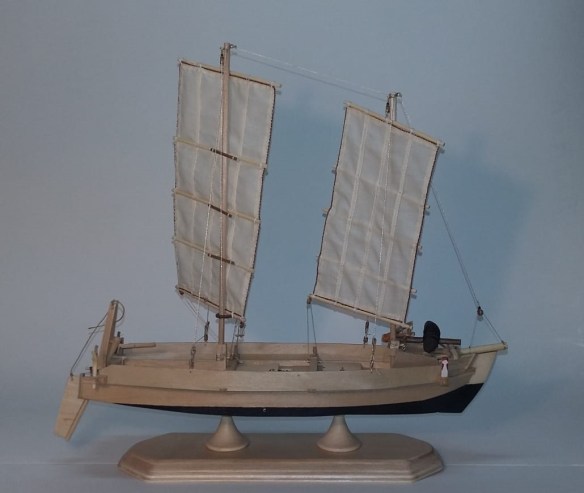
Kushikino no kogata wasen model Alexey Shaporov of the Russian Federation. One of the wasen models now on display in the Model Gallery.

To access the galley, just click the link above, or choose Model Gallery in the main menu.

I may change the format in the future, but the displaying of other modelers wasen models is long overdue. I’m looking to add others. If you’ve built a wasen model, whether it’s scratch built or kit built, please contact me here. Ω

Attending a Japanese Wasen Meeting on Zoom

Last night, I had a very rare opportunity to attend a meeting of the wasen study group that normally meets periodically at Kanagawa University. I’ve been wanting to attend a meeting for more than a year, but getting to Japan is difficult these days. Even if I could make the trip, the odds that I’d be able to make the trip coincide with a meeting are very slim.

Having resigned myself to the fact that I’d probably never be able to attend, a strange thing then happened. The world COVID-19 pandemic hit, and nobody was meeting in person anywhere anymore. But, after a while, people started adjusting to the new reality and the Zoom meeting became common. And, when I saw a notice on Facebook about the next Zoom meeting of the wasen study group, Wasen Kenkyuu Kai, I realized that a new opportunity had opened up.

I contacted the person who handles the posts on Facebook, and made arrangements to attend the meeting. I had an initial pre-meeting with the new contact Mr. Shinya Tominaga, and we had a really great conversation in english, with some Japanese exchange. Tominaga-san is, by the way, a member of the group Wasen Tomo no Kai, which operates several small boats to teach the public the experience of the traditional use of the ro, or sculling oar.

When the actual study group meeting took place, I was a bit nervous. For one thing, I’d never attended any Zoom meetings with more than one other person. Including myself, there were 16 people present. Of course, it was all in Japanese.
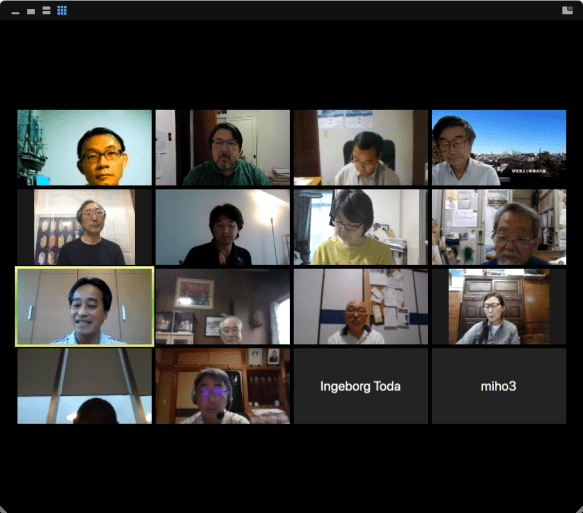
My Japanese speaking skill is maybe worse than my reading comprehension, if that’s possible. Who was speaking to who? And when someone said my name, I felt like a deer in the headlights, as everyone got quiet, waiting for me to reply. Since everyone looks at the screen, there’s no other indication that people are waiting for you, except when you’re sure you heard your name. Well, I managed, more or less.

I did hold back a bit, as I was embarrassed that I didn’t understand more, and I may have disappointed the organizer, who I think may have believed I was going to speak more Japanese and participate more. But, my one contribution was to share a drawing that was given to me by Douglas Brooks, and my desire to find out if the boat in the drawing was recognizable.
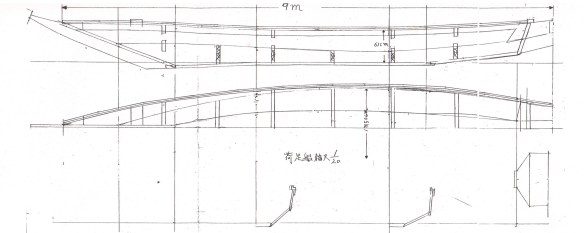
The drawing of the mystery wasen

It did prompt a little discussion of the reverse sheer of the bow, which curves downward. This is called a nomeri-type. Professor Kon referenced some material about this type of bow, which was a feature found in the Kanto area, which is the area around Tokyo.

Also, another gentleman, who’s name I couldn’t get as most were shown only in kanji, seemed to know a lot about the nomeri type. I asked as best I could if this was a feature for sea boats. And, if I said it correctly and understood his reply, this is apparently the case.

Tominaga-san also showed a page that cataloged the boats used by the Wasen Tomo no Kai, which included the boat that I thought the drawing might represent. But, that boat was too short at less than 8 meters in length. The above boat is clearly more than 9 meters long. So, I’m not really any closer to knowing this specific answer. But, I did have something to contribute.

Actually, I did have a set of slides put together that showed most of my wasen models, but I felt too self conscious to take over the meeting to show them. Also, when people start talking about you and your work, and you don’t know what they’re saying, it’s a bit strange. So, I figured I’d hold off. I can alway show it at a future meeting, if I follow up on this one.

The meeting moved on from wasen models to the topic of chikiri, which are wooden dovetail fasteners used in Japanese woodworking, including Japanese boatbuilding. 
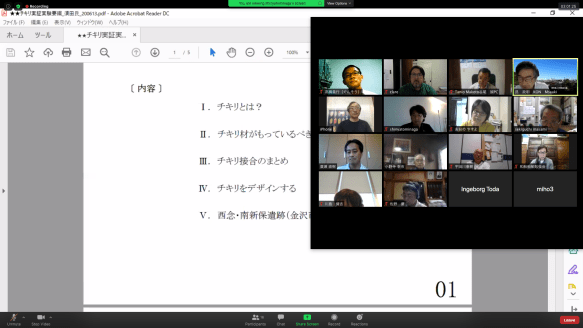
The meeting lasted about 4 hours, beginning at 1:30pm, Tokyo time, which means that it started for me at 9:30pm and didn’t get done until 1:30am. But, perhaps because of my nervousness and my desire to learn, I didn’t feel very tired, even after many hours had passed.

I’m glad I was able to attend. I learned some and it was a great experience to sit in with these knowledgeable wasen enthusiasts.

Ω

Building a Himi Tenma in 1/10 Scale – Part 6 – Final

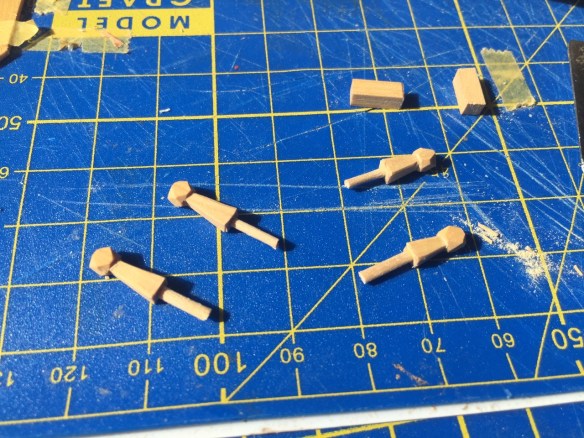
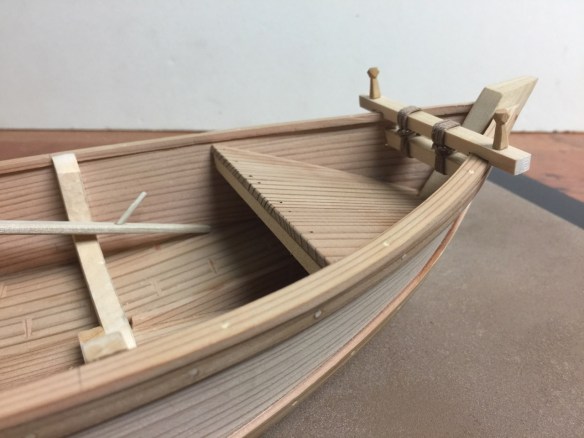
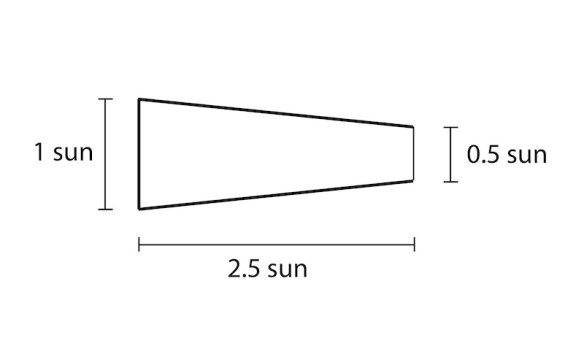
One of the features of this model is something that appears on many Japanese wooden boats, and dealing with it has been on my mind since this project began. I’m talking about the mooring bits, called the kanzashi. On this boat, they are tapered square posts with a faceted knob at the end.

On the real boat, these were made of honiki, but for a 1/10 scale model, I decided to use a harder wood that I have on hand, some Castello boxwood, which I use in ship modeling all the time, as there is no grain, has a nice tan color, and carves beautifully.

As it turned out, these were pretty easy to make. So much so that I made a pair and decided they were too short and quickly made another pair.

These were large enough that, rather than trying to carve a post to fix them into the mooring beam, I drilled them out and inserted very small birch dowels. These then fit easily and securely into holes drilled into the mooring beam.

The final stage was to lash the mooring beam down to the bow beam directly underneath it. This I did using some excess rigging line from a completed Woody Joe kit. I took about 6 turns around the beams and then wrapped around the waist of the lashing and tied off. I then secured the knot with a little glue and trimmed off the excess line. This holds the mooring beam very securely.

Continue reading

Building a Himi Tenma in 1/10 Scale – Part 5

Since we’re still under the stay-at-home order and I have time, I’m plowing ahead with the Himi Tenma. I did manage to get some measurements from Douglas Brooks, but mostly, to verify that my beams are fairly close. Not all exactly like the boat built last Fall, but close enough for this project.

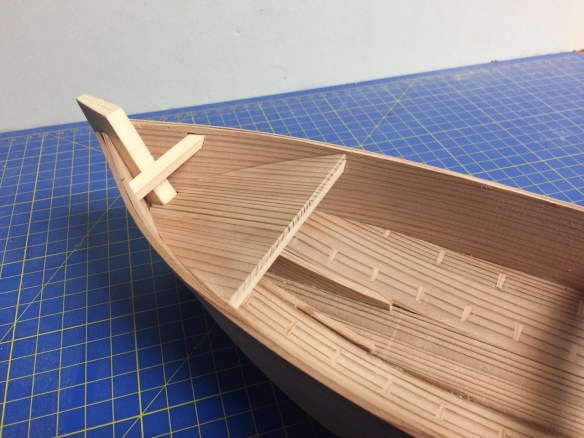
With the beams, or funabari, in place, I went ahead and added the decks at the bow and stern. I don’t recall off hand what the term is for the stern deck, but the bow deck is called the kappa. I fit both decks by first making a templates that I cut to fit as best I could in place of the planks.

I cut three planks to make up each of the decks. For the stern deck, I installed a simple strip of wood onto the transom, or todate, to serve as a shelf for the lower plank ends. That wasn’t necessary at the bow, due to the shape of that deck, which held the planks in place better.

The aft deck turned out well, but I realized later that the bow deck angles downward too much, and is probably smaller on the actual boat. But, it looks fine and I don’t really think there’s any need to redo it.

Continue reading

Building a Himi Tenma in 1/10 Scale – Part 4

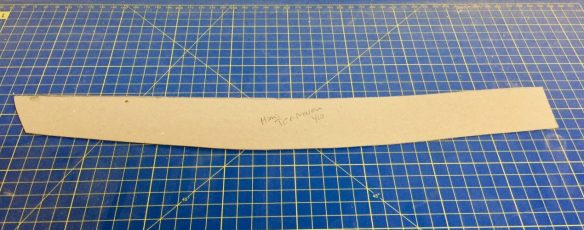
I started working on planking the hull of the Himi Tenma shortly after my last post. The first thing to do was to cut a cardboard template to the approximate shape of the hull plank.

This was done by taping a piece of cardboard into place on the model. The bottom edge was traced with a pencil onto the cardboard. The shape at the bow was approximated, and the stern end was cut off a little bit long. The top edge was derived by marking the top edge at the ends of the model. I then used a thin wood batten to create a fair curve and traced that shape onto the cardboard template. The template really does not need to be very accurate. It just has to be big enough to work, and a bit oversized is best.

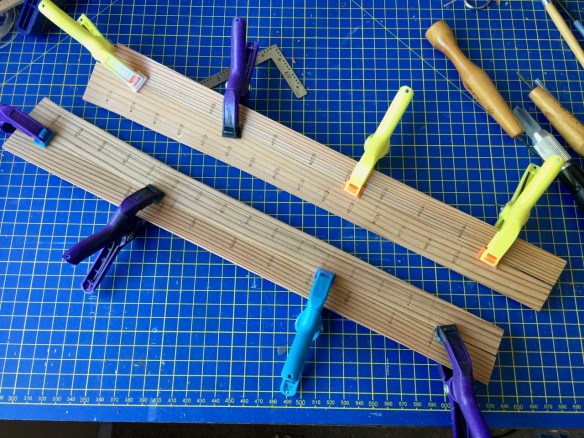
The template can now be used to help select the wood. I try to be efficient as possible and  find a way to get two planks out of the smallest sheet of wood that will work, since the wood I’m using is hard to come by.

Continue reading

Building a Himi Tenma in 1/10 Scale – Part 3

I’m making decent progress on the Himi Tenmasen model and am now working on the kanjiki planks. These are the bottom planks located either side of the heavy, central bottom plank, called the chyou. As I mentioned before, my model will have two kanjiki planks on each side, much like in the tenma drawings, though the boat built last fall actually only used one plank per side. But, this way allows me more efficient use of my wood supply, and if I screw up a plank, I lose less wood. And, while it means more mortises to cut, it also means there is more detail on the model.

Measurements of mortises given are at full size.

Continue reading

Building Woody Joe’s 1/72-scale Kitamaebune Kit – Part 11

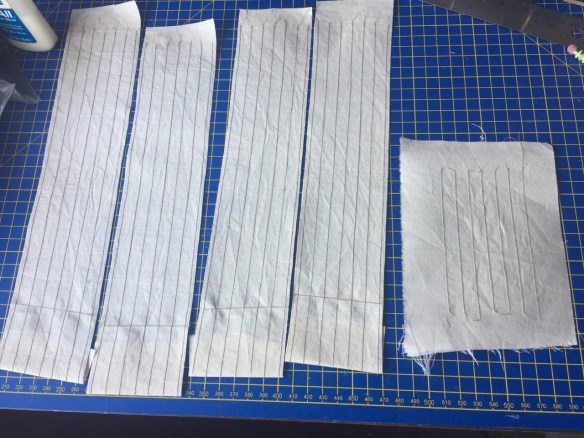
Sailmaking is at somewhat of a standstill, as I’m experimenting with different techniques for representing the large sails of the kitamaebune in 1/72 scale. There are number of possible things I can try,, including simply stitching the seams as one might do for a western ship’s sails, but I’m still hoping I can show some of the characteristics of the Japanese sails.This is something of a long term process, so in the meantime, I decided to move ahead with some of the other model details.

One of my sail making attempts still being tested and considered.

It had occurred to me that might make the most sense to go ahead and build the various components of the main stay. It took me a while to figure out this is called the Hazuo in Japanese.

Dealing with the stay, or hazuo, requires making/rigging four different parts. Here’s the section of the instructions that deal with this.

Continue reading

Building a Himi Tenma in 1/10 Scale – Part 2

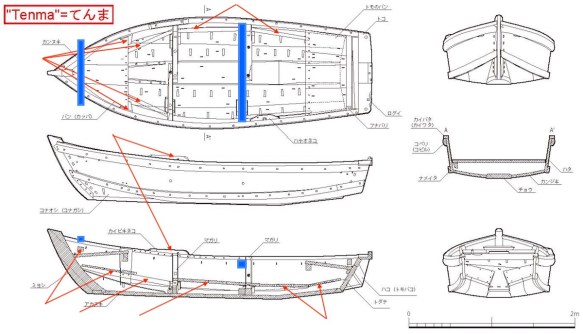
Reviewing photos of the Himi Tenma that Douglas Brooks worked on last Fall, I’ve been comparing them with the drawings from the Himi City Museum. There are a number of differences which I’ve marked on a copy of the drawings.

Modified copy of the Tenma drawings provided by the Himi City Museum, shown here with permission of the Himi City Museum.

To match the Himi Tenma built last Fall, the features that I’ve marked with red arrows will need to be omitted from my model. The blue rectangles represent the approximate size and location of beams which will need to be added to the model.

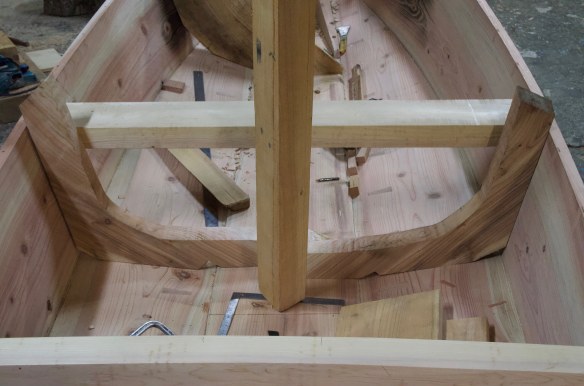
Photo showing the positioning of the overlapping frames. Photo courtesy of Douglas Brooks.

In addition, the other main difference is that if you look at the frames in the drawing, they are offset so that the starboard frames aren’t directly across from the port side frames. However, in the boat built last Fall, the tops of the frames actually sit directly across from each other, but since the frames still overlap one another, they are canted slightly. For now, I’m just making a mental note of these things, and will deal with them when the time comes.

Continue reading

“Fune” Build by Alexandru Gurau

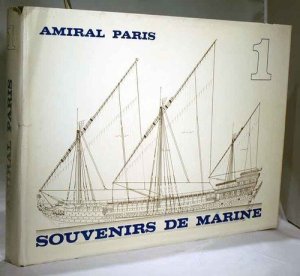
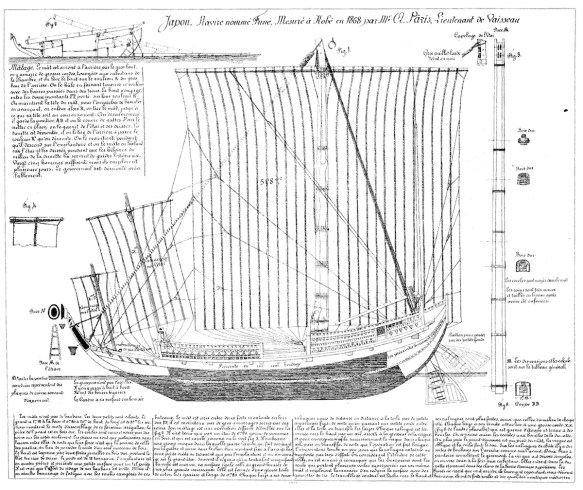
Years ago, ship modeler Alexandru Gurau of Canada had been building a model of a bezaisen, an Edo period coastal transport, based on drawings recorded by French lieutenant Armand Paris, and recorded in the book Souvenirs de Marine.

I was particularly impressed by Mr. Gurau’s work, as the information contained in the Paris drawings are a bit difficult to follow on their own. My own experience with the building a model from Paris drawings resulted in my own Kobaya project. In that particular case, I had discovered that the drawings may have been somewhat incomplete as they were based on vessels that were no longer in use and seemed to be missing features. I believe that problem was unique to that particular vessel, and the other Japanese boats recorded in the book appear complete. Still, not always easy to decipher all the information needed. Not to mention that the note contained in the drawings are handwritten in French.

Still, for the larger subjects in particular, like Mr. Gurau’s Fune model, It just seems difficult to wrap one’s head around the details due to the unusual nature of the hulls of these coastal transports – unusual to the western eye, anyway.

Scan of what Paris describes simply as “Fune”, recorded at Kobe, Japan, in 1868.

The Mr. Gurau’s model was mostly completed in 2013-2014, but he recently updated some things, which brought the model back to my attention. His dealing with the sails of the vessel have given me new inspiration to complete the sails of my own kitamaebune model, which is based on a kit from Woody Joe.

His build photos are available to view on his personal ship modeling website here:  http://www.alexshipmodels.com/2016/10/28/fune-build/

He also documented the build on The Nautical Research Guild’s Model Ship World (MSW) online forum here: https://modelshipworld.com/topic/3230-fune-by-alexandru-finished-japanese-ship-of-1868-scale-150/#comments

The one thing to note on the MSW forum’s topic title and first entries say that the model is built at 1/50 scale, but it appears that his model was actually built in 1/100 scale.

In any case, it’s nicely done and worth checking out. Ω

Building a Himi Tenma in 1/10 Scale – Part 1

You might recall that In the Fall of 2019, boat builder Douglas Brooks had developed a project together with Nina Noah of an organization called The Apprenticeshop, to go to Japan and build two traditional Japanese boats with two different Japanese boat builders.

I wrote about modeling the first of the two boats, the Niigata Honryousen, which he had built with Mr. Nakaichi Nakagawa and Nina Noah. But, it’s the second of the two boats that was the main subject of the project. The second boat was the Himi Tenmasen.

Photo by Ben Meader

The Himi Tenmasen, or Himi Tenma, was built by Douglas Brooks and Nina Noah, under the guidance of Mr. Mitsuaki Bansho, a Japanese boatbuilder who was the only one of five brothers to follow in his father’s trade, who was also a boatbuilder. After his father’s passing, Bansho-san primarily built fiberglass boats, but in the past 20 years, he began building boats in traditional Japanese fashion for museums.

The Himi Tenmasen is a typical small boat that was used in fishing and as a general workboat. Similar types were used to ferry cargo and passengers between larger ships and the shore.

Continue reading